
Growth Marketers: Run Reliable A/B Tests with 1,000 Visitors/Variant
A/B test marketing is the practice of showing two versions of a page, email, or ad to separate, randomly assigned groups and measuring which one moves a chosen metric more. It works when you have enough live traffic to reach statistical significance in a reasonable window; it's the wrong tool when traffic is thin or the metric you care about is vague. Get those two conditions right, and A/B testing replaces guesswork with a defensible answer.
TL;DR:
- Running tests for a full business cycle of one to two weeks ensures representative data, and stopping early can lead to false positives.
- Use simple, no-code tools with essential features like consistent bucketing, power calculations, and traffic split checks to improve test reliability.
- Formulate hypotheses that specify expected effects and rationales, focusing primary metrics on business-critical outcomes like revenue or conversions.
- Avoid common errors such as peeking early, overlapping tests, or chasing tiny statistically significant gains that lack practical value.
Table of Contents
- How to Run an A/B Test Step by Step
- How Much Traffic Do You Need for a Reliable Test?
- Choosing the Right A/B Testing Setup for Your Team
- Writing Hypotheses and Metrics That Actually Tie to Revenue
- Common Mistakes That Quietly Invalidate Your Results
- Real-World Test Examples Across Marketing Channels
- What Makes a Test Result Trustworthy in Practice
- What Winning A/B Tests Actually Look Like
- Reading Results and Turning Them Into the Next Test
- Ethical Considerations and User Experience Impact
- How to Prioritize What You Test Next
- Get Your Next Test Live Without the Setup Delay
- Sources
How to Run an A/B Test Step by Step
Every credible test follows the same skeleton, whether you're tweaking a subject line or rebuilding a checkout flow. Skip a step and you'll get a number, just not one you can trust.
- Write a hypothesis before you touch the design. A workable template: "Changing [element] will [expected effect] because [evidence]." Grounding the hypothesis in actual user research, not a hunch from a meeting, measurably raises your odds of a meaningful result, according to the Nielsen Norman Group.
- Pick one primary metric. Signups, checkout completion, revenue per visitor, whatever ties directly to the business outcome you're chasing. Set two or three guardrail metrics alongside it, things like page load time or return-visit rate, so you catch a win on paper that's secretly a loss in practice.
- Build the control and exactly one challenger. Resist the urge to change five things at once. If you can't isolate which change drove the result, you've learned nothing.
- Run a power calculation before launch. This tells you how many visitors and how many days you need to detect the lift you're hoping for, and you commit to that number, not to "let's check it Thursday and see."
- Lock in consistent assignment. Use a stable user ID or cookie so the same visitor always sees the same variant. Instrument the events cleanly on both sides, or your data will lie to you politely.
Pro Tip: Write your stopping rule and required sample size on a shared doc before the test goes live. It's much harder to talk yourself into peeking early when the rule was set in writing, by you, before you had a stake in the outcome.
Marketers who skip step one and start with "let's just test a button color" almost always end up with a test that's technically running but has nothing at stake. A hypothesis forces you to say, out loud, what you expect and why. That's what makes the result worth acting on later.
How Much Traffic Do You Need for a Reliable Test?
Here's the number growth teams underestimate constantly: a workable baseline is roughly a thousand visitors per variation, and even that assumes you're chasing a fairly large lift, per Shopify's testing guidance.
That figure moves a lot depending on what you're trying to detect. Small effect sizes are expensive to detect. Big, bold changes are cheap to detect. That tradeoff should shape which tests you run first.
Two things to keep in mind when planning duration:
- Run for at least one full business cycle, typically 1 to 2 weeks, so weekday and weekend behavior both get represented.
- Never stop a test early just because the numbers look good on day 3. Early wins regularly regress once the full cycle plays out.
If your homepage gets 500 visitors a week, testing a subtle headline tweak is a month-long project. Testing a completely redesigned hero section might show a clear signal in three weeks. Match your ambition to your traffic.
Choosing the Right A/B Testing Setup for Your Team
Not every team needs the same toolkit, and the biggest mistake here is over-buying complexity you'll never use.
At minimum, whatever you use needs a few non-negotiable capabilities:
- Consistent bucketing so the same visitor always lands in the same variant.
- A sample-ratio-mismatch (SRM) check that flags when your traffic split drifted from 50/50 without you noticing.
- A built-in power calculator, so you're not guessing at required sample size.
- Support for sequential testing if your team wants early peeks without inflating false positives, a capability Abtesting recommends specifically for teams tempted to check results daily.
- Clean event instrumentation that ties back to your analytics stack.
For a marketer running landing page or email tests without engineering support, a no-code visual editor with a lightweight script is usually the faster path; you can launch a test in an afternoon instead of filing a dev ticket. Full feature-flagging systems and custom dev workflows make more sense once you're running multivariate tests across a product with dozens of engineers touching the same codebase. Before committing to either, confirm the tool connects cleanly to your analytics platform, your tag manager, and ideally supports server-side events and data export for reporting outside its own dashboard.
Writing Hypotheses and Metrics That Actually Tie to Revenue
A hypothesis that doesn't name an expected effect and a reason isn't a hypothesis, it's a guess with extra words. The format that works: proposed change → expected effect → rationale. "Adding a shipping-cost estimator to the product page will increase add-to-cart rate because heat-map data shows visitors leaving right after checking the price."
Your primary metric should map to something the business actually cares about; conversion rate, revenue per visitor, or completed signups, not a vanity number like time on page.
- Guardrail metrics catch the damage a good-looking primary metric can hide, things like page speed, retention, or bounce rate.
- Practical significance matters as much as statistical significance: a 0.3% lift that requires three engineers and two weeks to ship might not be worth the effort, even if the p-value checks out.
Common Mistakes That Quietly Invalidate Your Results
Most bad test results don't come from bad ideas, they come from bad hygiene.
- Peeking early. Checking results daily and stopping the moment you see a "win" inflates your false positive rate, since early data is noisier than data from a completed sample.
- Sample ratio mismatch. If your test is supposed to split traffic 50/50 and you're actually seeing 55/45, something's broken in your assignment logic, and the results downstream are suspect.
- Overlapping tests. Running two experiments on the same funnel at once means you can't tell which one caused the effect you're seeing.
- Chasing tiny "significant" wins. A statistically significant 0.4% lift might be real and still not worth the engineering time to ship.
| Mistake | Why It Hurts | Quick Fix |
|---|---|---|
| Peeking / stopping early | Inflates false positives | Pre-register sample size and stopping rule |
| Sample ratio mismatch | Signals broken assignment logic | Check traffic split weekly against expected ratio |
| Overlapping tests | Confounds which change drove the result | Stagger tests or use mutually exclusive audiences |
| Tiny but "significant" lifts | Statistically real, practically pointless | Weigh lift against implementation cost before shipping |
Real-World Test Examples Across Marketing Channels
A/B testing works across nearly every marketing channel, and the setup differs depending on where the test lives, per Adobe's overview of A/B testing use cases.
- Email subject lines. Test two subject lines on a sample split, measure open rate first, but track click-to-conversion as the metric that actually matters.
- Landing page CTAs and headlines. Test button copy, headline framing, or form length, and lean on effective CTA strategies for higher conversions when your traffic is too low for a full conversion signal.
- Checkout and onboarding flows. Multi-page funnels need multi-page testing since a change on step one can shift behavior on step three.
- Multivariate testing. Reserve this for mature programs with heavy traffic; testing five elements at once needs exponentially more visitors than a simple two-variant test.
What Makes a Test Result Trustworthy in Practice
Author Juan has reviewed how lightweight, no-code setups affect experiment quality, and the pattern holds: implementation friction is often the real reason tests don't get run at all, not statistical complexity.
- A script under 6KB, like Stellar's, adds negligible load time, which matters because a slow test script can itself skew the metric you're measuring.
- A no-code visual editor cuts the time between "we have a hypothesis" and "the test is live" from days to hours.
- Dynamic keyword insertion and built-in goal tracking mean a marketer can personalize a landing page variant and track its conversion goal without a developer.
- A free tier for under 25,000 monthly tracked users lets small teams test this workflow before committing budget.
Faster setup means more tests get run, and more tests run means more real learning instead of theoretical planning.
What Winning A/B Tests Actually Look Like
The tests that produce clean, useful wins share a pattern: they target a specific point of friction, not a general "let's improve the page" impulse.
A subscription business testing a shorter checkout form against a longer one with more fields typically finds the shorter form wins on completion rate, but the longer form sometimes wins on lead quality when the extra fields qualify the buyer. Neither result is universally "right," which is exactly why you test instead of assuming.
Email marketers often see the clearest wins from subject line personalization, adding a first name or a location cue tends to lift open rates, but the effect on actual revenue is smaller than the open-rate bump suggests. That gap between open rate and revenue is exactly why guardrail metrics matter: a test that wins on the primary metric but does nothing for revenue isn't really a win.
Landing page tests focused on a single, specific claim, "ships in 2 days" instead of "fast shipping," tend to outperform vague reassurance copy, because specificity reduces the cognitive load of deciding whether to trust the claim. The pattern across most successful tests isn't a clever design trick. It's removing one specific piece of friction or ambiguity that was quietly costing conversions the whole time.
Reading Results and Turning Them Into the Next Test
A result isn't a finish line, it's a data point that should point directly at your next move. Start by checking whether the lift is statistically significant using confidence intervals, not just whether the variant "looks better" on the dashboard.
Once significance is confirmed, ask the practical-significance question: does the lift justify the cost of shipping it permanently?
If the result is a loss or a flat result, don't file it away as a failure. A null result tells you the hypothesis was wrong, which is valuable information that should shape your next hypothesis. Segmenting the data by device, traffic source, or new-versus-returning visitor often reveals a test that looked flat overall actually won decisively with one segment and lost with another. That's usually more useful than the headline number.
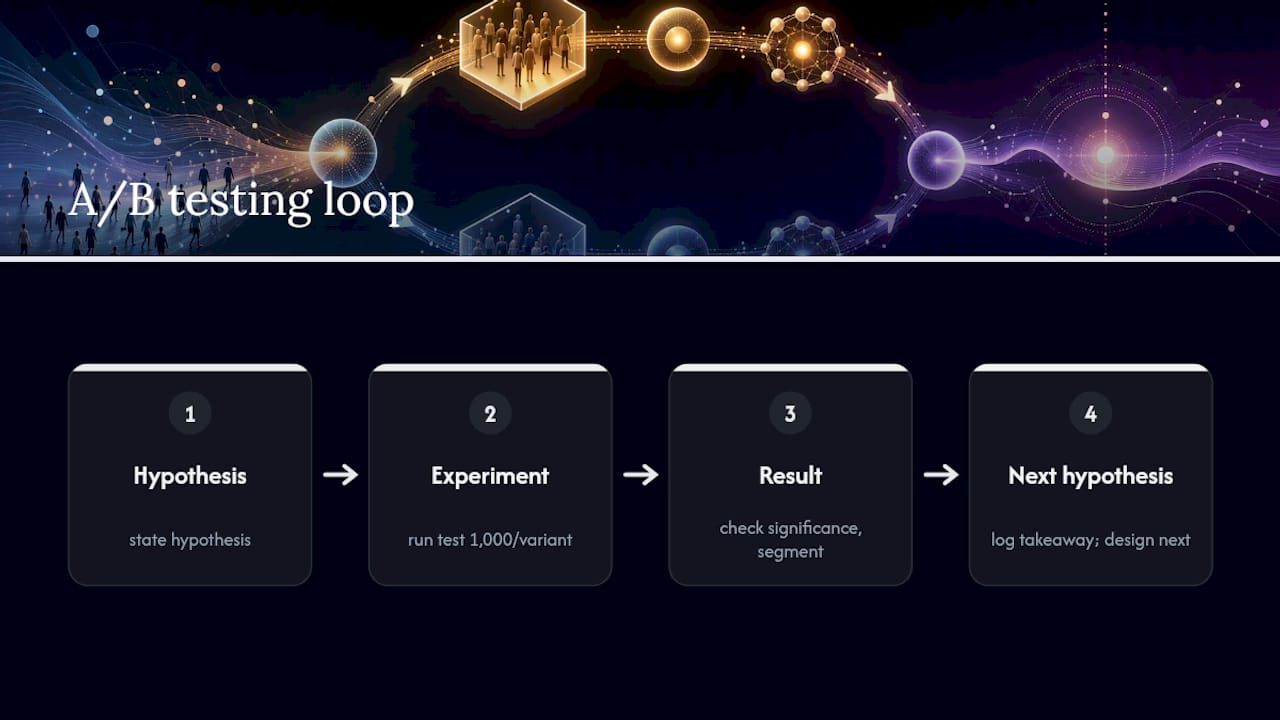
Build a simple habit: every test, win or lose, gets logged with its hypothesis, result, and a one-line takeaway for the next test idea. Programs that treat testing as a continuous loop instead of a one-off project compound their learning fast; teams that treat each test as an isolated event tend to keep relearning the same lessons.
Ethical Considerations and User Experience Impact
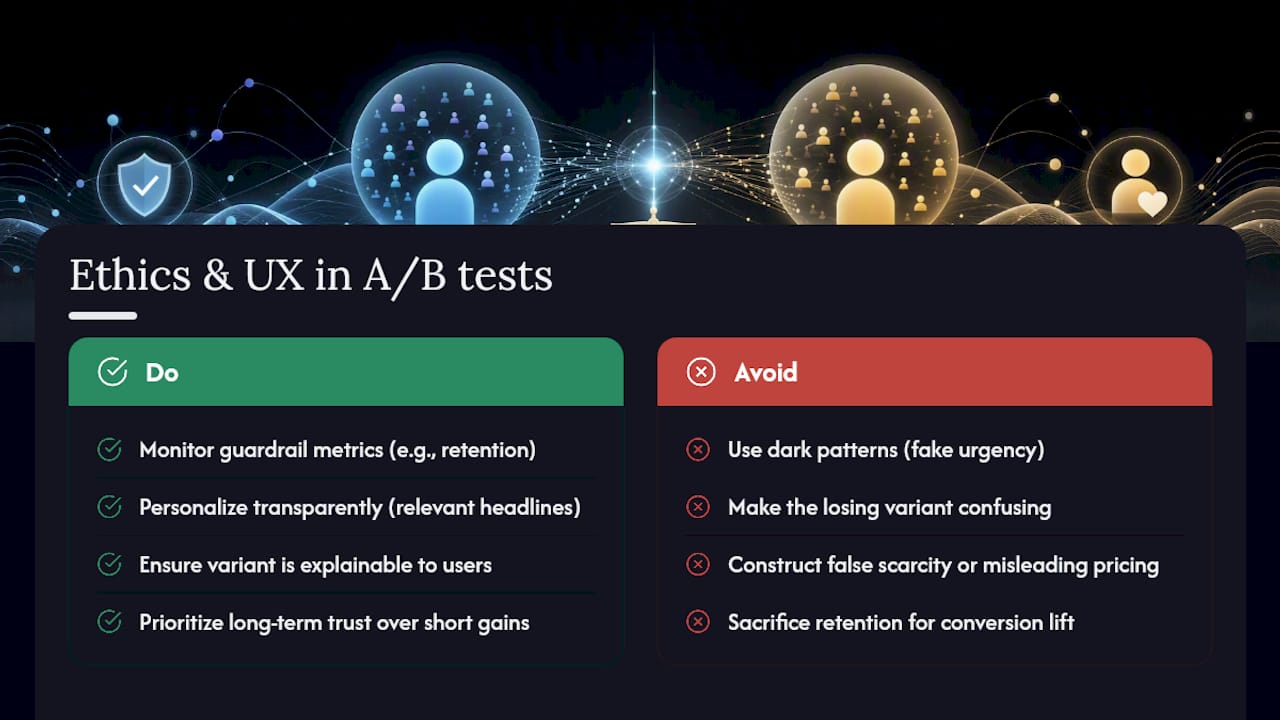
Running an experiment on live visitors means every variant you show is affecting a real person's experience in that moment, and that carries some responsibility. A test that intentionally makes the "losing" variant confusing, misleading, or manipulative to prove a point isn't good practice, even if it produces a clean statistical result.
Dark patterns, like a fake urgency countdown or a pre-checked box that adds a hidden fee, might lift a short-term conversion metric while quietly damaging trust and long-term retention. That's exactly why guardrail metrics matter: a primary-metric win paired with a retention drop is a sign the "winning" variant crossed a line worth reconsidering.
Transparency also matters for personalization tests, like dynamic keyword insertion on landing pages. Personalizing a headline to match a visitor's search term is a reasonable use of data; using that same data to construct false scarcity or misleading pricing is a different thing entirely. The line isn't always obvious, but a useful check is asking whether you'd be comfortable explaining the variant, in plain language, to the person who saw it.
How to Prioritize What You Test Next
Test the funnel step that's bleeding the most revenue first, not the one that's easiest to redesign. Small, cheap tests validate a hypothesis before you invest in a bigger build, and a documented null result saved for the team is worth more than an undocumented "win" nobody can repeat.
— Juan
Get Your Next Test Live Without the Setup Delay
Everything covered above, hypothesis writing, sample size math, guardrail metrics, testing hygiene, only pays off if the test actually gets built and launched. That's usually where momentum dies: a great hypothesis sits in a backlog waiting on a developer.
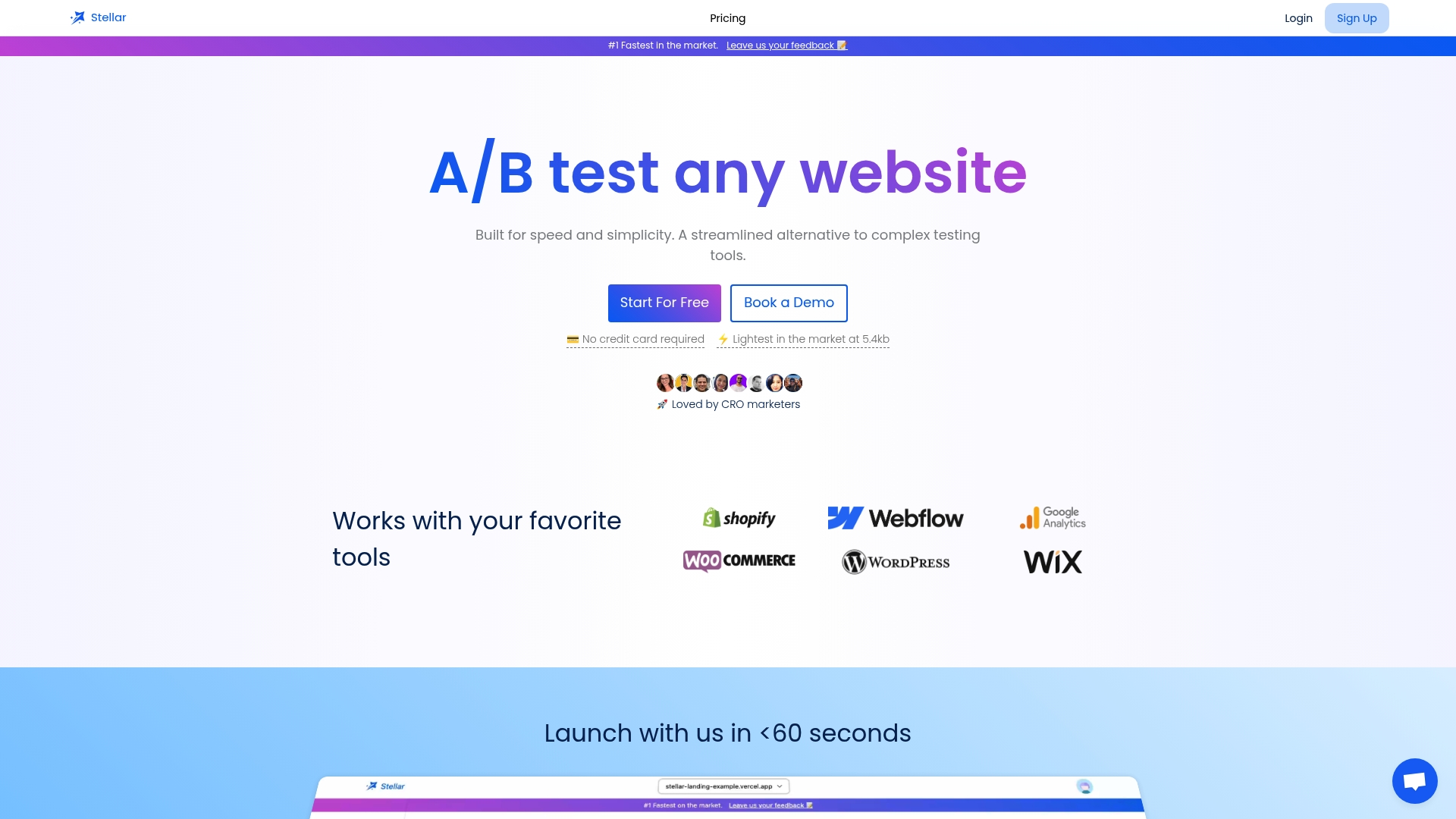
A platform is built to close that gap for small and mid-sized marketing teams. The no-code visual editor lets you build a control and challenger without a dev ticket, the script itself is light enough that it won't distort your page speed metrics, and goal tracking plus real-time dashboards mean you're reading results the moment they're statistically meaningful, not digging through a spreadsheet. Some providers offer free tiers for teams tracking under 25,000 monthly users. If the sample-size math and hygiene checklist above made sense but the tooling has always been the bottleneck, start a free trial on the Stellar landing page and get your next hypothesis live this week instead of next quarter.
Sources
- How to run A/B tests (Shopify blog)
- A/B Testing (Nielsen Norman Group)
- How to Run an A/B Test in 2026 - A Step-by-Step Practical Guide | ABTesting
- What is A/B Testing? | Salesforce US
Recommended
Published: 9/9/2026