Best 5 A/B Test Tools for Online Stores – Expert Comparison 2025
Choosing the right tool to test website ideas and create better experiences can make all the difference for online businesses. Some platforms offer lightning-fast updates and simple editing while others pack in advanced features and analytics for teams ready to dig deeper. Speed, simplicity, insights, and cost all shape what will work best. The options are packed with unique strengths and thoughtful tradeoffs. Which will fit your needs and help you move from good guesses to clear results? Read on to discover how these solutions stack up.
Table of Contents
Stellar
At a Glance
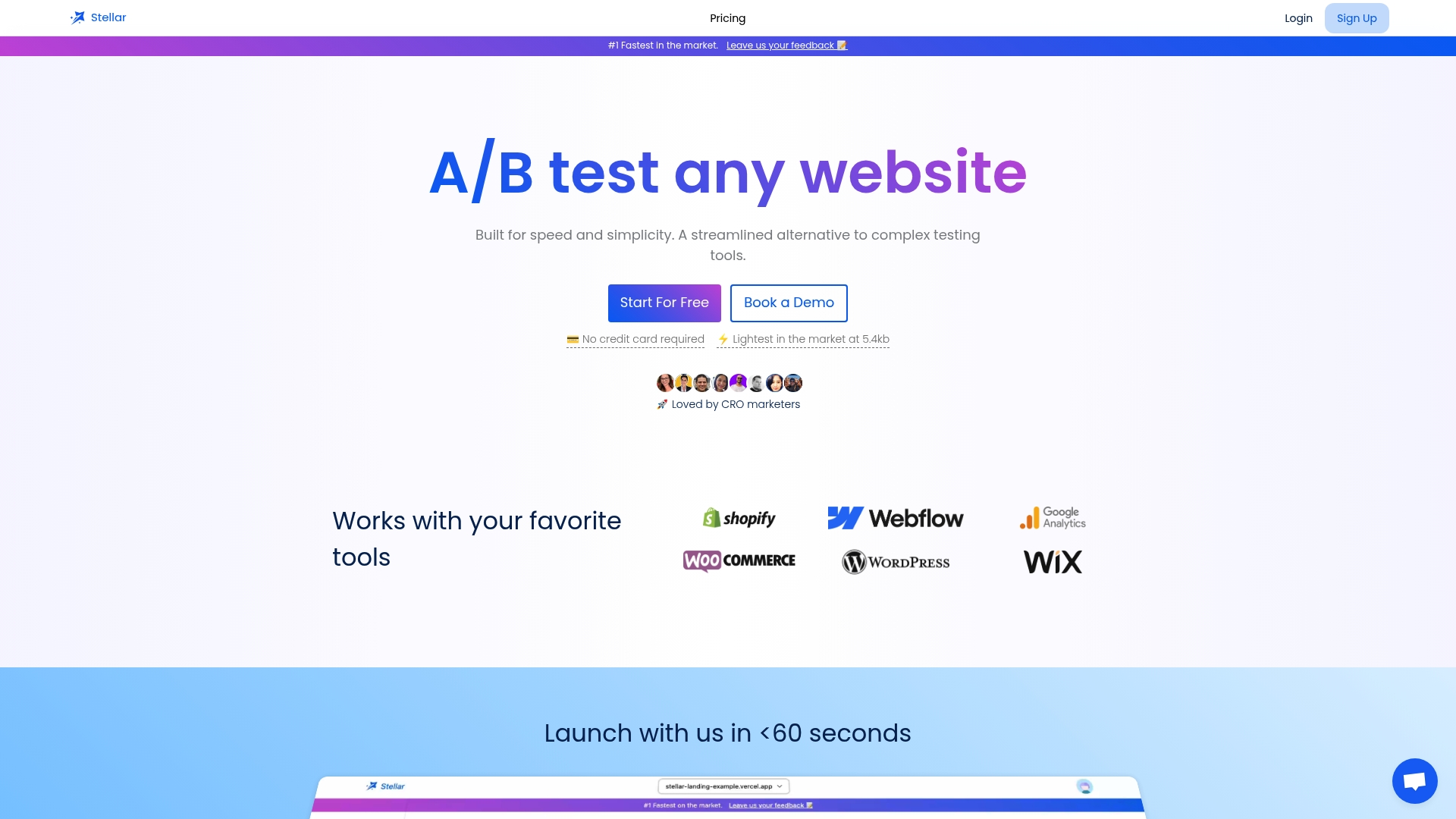
Stellar is a fast, focused A/B testing platform built for marketers and growth teams who refuse to trade speed for experimentation. Its standout promise—near-zero load impact—combined with a no-code visual editor makes it easy to run high-velocity tests without dragging down page performance. Real-time analytics and AI-driven insights help you interpret results quickly, so you can move from hypothesis to rollout in hours, not weeks.
Core Features
Stellar packs practical features aimed squarely at conversion-focused teams: the market-leading performance claim of 0ms load time to preserve site speed and SEO, a no-code visual editor for building variants, dynamic keyword insertion to personalize landing pages, and the ability to add custom JavaScript and CSS for granular control. It also offers real-time performance charts, AI-powered conversion recommendations, easy integration with analytics platforms like GA4, and straight-forward goal setup with multiple conversion tracking options.
Pros
- Incredibly fast and lightweight, preserving website speed and SEO, which reduces experiment-induced friction and keeps user experience intact.
- User-friendly, no-code interface suitable for beginners and non-developers, enabling marketing teams to run tests without constant developer support.
- Affordable and flexible pricing with a pay-as-you-go model that helps smaller teams scale tests without oversized commitments.
- Robust analytics and real-time data for insightful decision-making, allowing you to react to trends and stop underperforming variants quickly.
- Excellent customer support and positive user reviews, which means help is available when you need it and real teams report success.
Who It's For
Stellar is tailored to marketers, CRO specialists, web developers, and small to medium-sized business owners who need fast, simple, and effective testing without sacrificing page performance. If you run landing pages, product pages, or campaign funnels and value quick iterations, Stellar fits naturally into your stack—especially if you already rely on GA4, Segment, or Mixpanel for analytics.
Unique Value Proposition
Stellar’s unique value is its relentless focus on speed plus usable intelligence. Where many platforms introduce bulky scripts that slow pages, Stellar promises a near-zero load impact, making it the practical choice for commerce sites where milliseconds matter. The no-code editor lowers the barrier to testing, while custom JS/CSS keeps power users satisfied. Real-time charts and AI recommendations shorten the feedback loop, so optimization decisions are faster and more evidence-driven. The pricing approach—free tier plus a pay-as-you-go model—aligns with the needs of growth teams that want to experiment without large upfront costs. Any limitations noted in source materials—such as fewer advanced enterprise features—are deliberate trade-offs to prioritize simplicity, speed, and accessibility for small and medium teams rather than bloated, complex setups.
Real World Use Case
An e-commerce retailer used Stellar to run rapid A/B tests on product page layouts and CTA language, maintaining page load speed while testing multiple variants. Real-time analytics flagged a winning layout within days, and AI suggestions helped refine copy and placement to boost conversion rate without engineering cycles.
Pricing
Free plan available with limitations, Pro plan at $99/month with more features, and custom enterprise solutions available with tailored pricing.
Website: https://gostellar.app
Optimizely
At a Glance
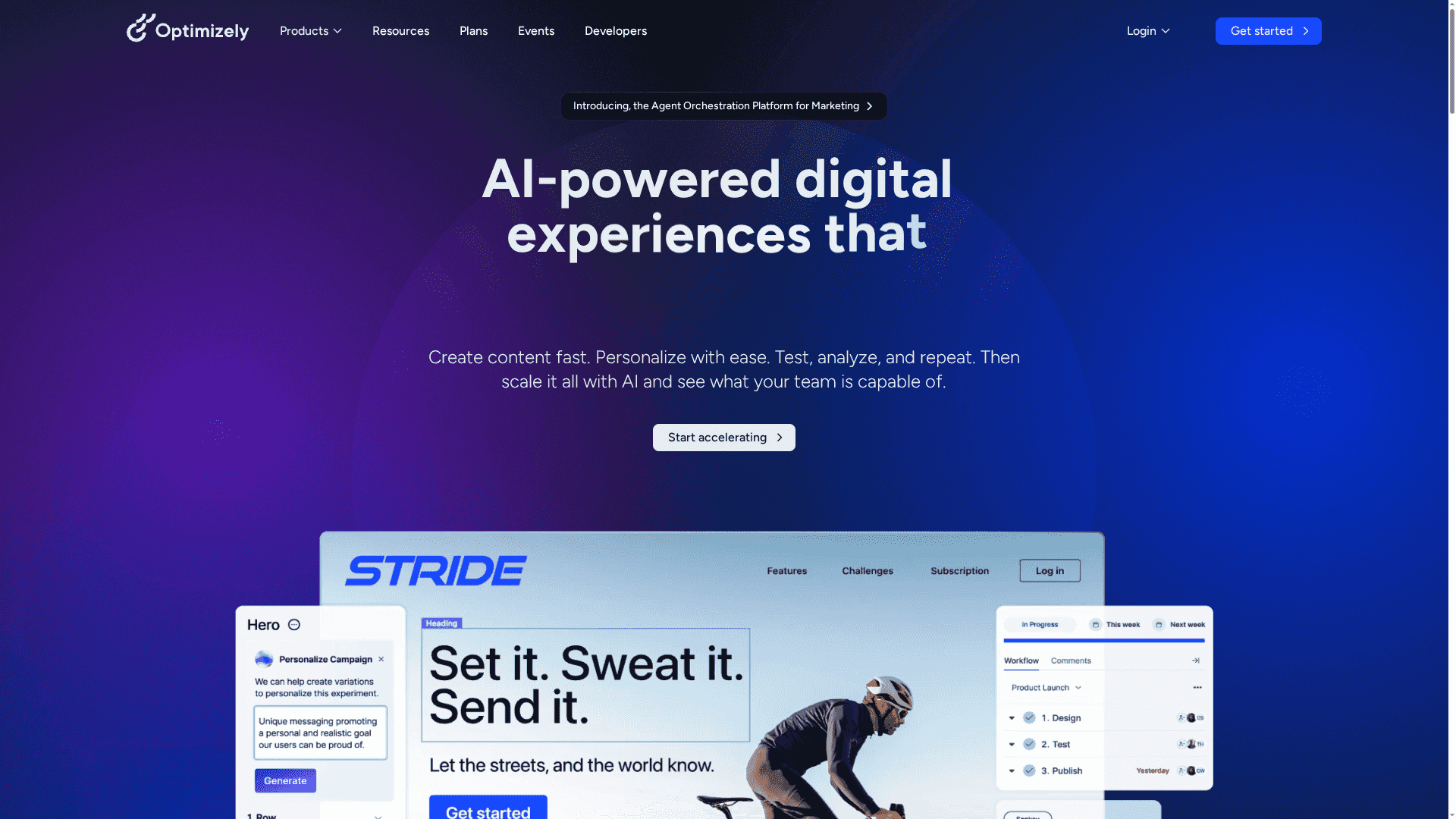
Optimizely is a comprehensive digital experience platform that combines AI-powered experimentation, personalization, content management, and commerce capabilities. Its strength is in delivering scalable, data-driven experiences for marketing and development teams that need advanced targeting and testing. The platform can feel dense at first, and pricing is typically customized, which may be a barrier for smaller stores. Overall, Optimizely is a powerful choice for teams that need an all-in-one solution and have the resources to manage and integrate it effectively.
Core Features
Optimizely bundles AI-powered experimentation and personalization with a content management system that supports headless architectures, enabling flexible content delivery across channels. It includes digital asset management, feature experimentation and deployment tools, real-time personalization and audience targeting, commerce features for multichannel selling, a data platform for customer segmentation and activation, and integrations with a variety of apps and tools. The platform also highlights automation via the Agent Orchestration Platform and AI agents to streamline campaign and content workflows.
Pros
- Comprehensive suite of digital experience tools: Optimizely brings experimentation, personalization, content, and commerce capabilities together so teams can manage multiple parts of the customer journey from one platform.
- Strong AI-driven personalization capabilities: The platform leverages AI to tailor experiences and automate aspects of campaign and content creation, which can speed up iteration and relevance.
- Integration-friendly architecture: Optimizely supports integration with various apps and tools, making it easier to connect existing analytics, CRM, or ecommerce systems.
- Scalable for growth: The solution is built to support mid to large-sized organizations and development teams that need robust deployment and feature-flagging workflows.
- Robust experimentation and testing features: The platform offers feature experimentation and targeted A/B testing alongside content and commerce experimentation to optimize conversions.
Cons
- Complex setup and configuration might require technical expertise: Implementing and configuring Optimizely often needs developer involvement and training to unlock advanced capabilities.
- Pricing details are customized and may be costly for smaller businesses: Because pricing is tailored to each customer, smaller stores may find the platform less budget-friendly compared with simpler tools.
- Platform breadth can be overwhelming for some users: The extensive feature set creates a steeper learning curve, and teams may need to prioritize which modules to adopt first.
Who It's For
Optimizely is best suited for mid to large-sized organizations that require a unified platform for experimentation, personalization, content management, and commerce. Marketing teams that want AI-driven targeting and developers who need robust feature deployment and headless CMS options will get the most value from this solution.
Unique Value Proposition
Optimizely stands out by combining AI-powered experimentation and orchestration with a CMS and commerce capabilities, enabling teams to personalize and test experiences at scale while automating parts of campaign and content production through AI agents.
Real World Use Case
An ecommerce company uses Optimizely to personalize product recommendations, run A/B tests on landing pages to improve conversion rates, and automate marketing workflows with AI agents to increase customer engagement and sales.
Pricing
Pricing is available upon request and is typically tailored to the specific needs of the business, which means costs vary based on modules, usage, and scale.
Website: https://optimizely.com
VWO (Visual Website Optimizer)

At a Glance
VWO is a comprehensive digital experience optimization platform built to analyze, test, and personalize across websites, mobile apps, and server-side environments. It bundles A/B and multivariate testing with behavioral analytics—heatmaps, session recordings, and conversion funnels—so you can move from hypothesis to insight without stitching tools together. For mid-sized companies and enterprises that need a scalable, security-minded solution, VWO delivers a powerful all-in-one offering; smaller teams should weigh cost and complexity first.
Core Features
VWO’s core capabilities include A/B testing and multivariate testing alongside personalization and segmentation tools that let you tailor experiences to audience slices. Behavioral analytics are strong: heatmaps and session recordings reveal how users interact with pages, while funnel and conversion analysis surfaces drop-off points. VWO also offers qualitative tools such as surveys and form analytics to capture user intent. The platform supports web, mobile app, and server-side testing and integrates via robust APIs for data syncing and automation.
Pros
- All-in-one experimentation and personalization: VWO combines testing, personalization, and behavioral analytics in a single platform so you don’t need to assemble multiple point tools.
- Cross-channel testing support: It supports websites, mobile apps, and server-side experiments, enabling consistent experimentation across digital touchpoints.
- AI-assisted insights: VWO includes AI-powered capabilities like VWO Copilot to help automate analysis and surface test ideas or patterns.
- Strong integrations and APIs: The platform provides robust integrations and APIs, which simplifies syncing data with analytics, CDPs, and other systems.
- Enterprise-grade security and compliance: Built with security and scalability in mind, VWO is positioned to meet enterprise requirements for governance and data protection.
Cons
- Higher cost for smaller teams: Pricing can be expensive for small businesses or startups, which may limit access to the full feature set.
- Some features require add-ons or higher tiers: Advanced capabilities are sometimes locked behind add-ons or higher-tier plans, increasing total cost for complete functionality.
- Steep learning curve for new users: The extensive feature set can be overwhelming, and new users may need time or training to use the platform effectively.
Who It's For
VWO is best suited for mid-sized companies and large enterprises that need a scalable, secure experimentation platform and want to centralize testing, personalization, and qualitative analytics. Growth and CRO teams that run frequent, sophisticated experiments and rely on integrated data pipelines will gain the most value.
Unique Value Proposition
VWO’s unique appeal is its breadth: it unifies experimentation, personalization, and behavioral analytics in one platform while supporting web, app, and server-side use cases. That combination reduces tool fragmentation and accelerates insight-to-action loops for teams focused on conversion optimization.
Real World Use Case
A retail website runs multiple A/B tests on product pages, uses personalization to surface targeted promotions, and analyzes heatmaps and session recordings to identify UX friction. The combined insights help the retailer prioritize changes that increase conversions and improve customer satisfaction.
Pricing
VWO offers tiered plans—Starter, Growth, Pro, and Enterprise—with custom pricing for large organizations. Specific costs are typically provided after consultation or demo and are based on MTU (Monthly Tracked Users) and feature needs.
Website: https://vwo.com
Optimizely
At a Glance
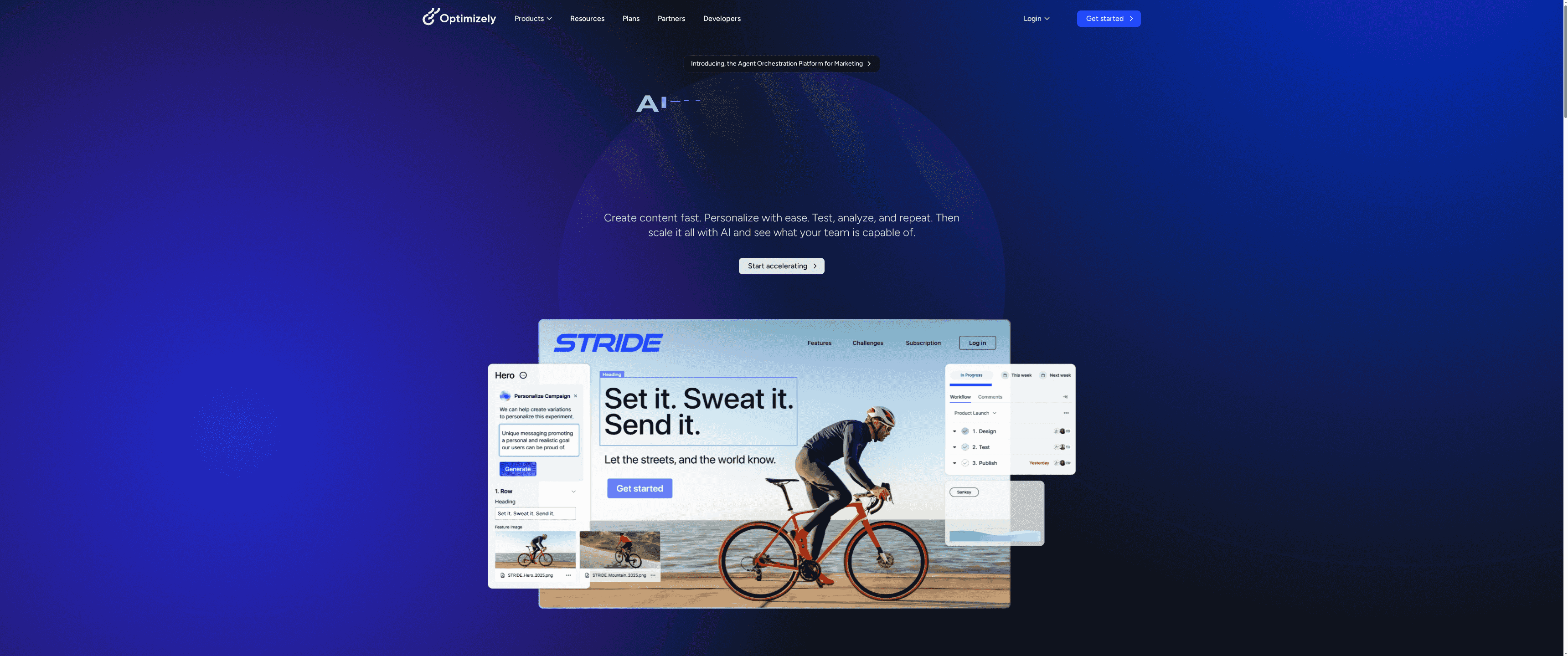
Optimizely is an enterprise-grade, AI-powered platform for experimentation, personalization, content management, and commerce optimization. It combines AI-driven insights and analytics to help marketers, developers, and product leaders run tests and personalize experiences at scale. The platform is broad in scope, so it excels for large teams but may feel heavyweight for smaller organizations. Bottom line: powerful and scalable, with a learning curve and pricing that typically require vendor engagement.
Core Features
Optimizely provides an AI-powered experimentation platform, AI-driven personalization, a content management system with robust APIs, digital asset management for marketing assets, and feature experimentation for rapid deployment and testing. It also supports optimization tied to commerce and customer data platforms, enabling teams to orchestrate content, run multivariate tests, and use analytics to measure impact across channels.
Pros
- Comprehensive toolset: Optimizely bundles experimentation, personalization, content management, and digital asset management into a single platform, reducing the need for multiple point solutions.
- Strong AI and analytics capabilities: The platform uses AI to surface insights and drive personalization, which helps teams prioritize experiments and interpret results faster.
- Robust integrations: Optimizely integrates with popular apps and data platforms, allowing teams to connect experimentation results with analytics, commerce, and customer data systems.
- Scalable for large teams: The architecture and feature set are designed to support enterprise use cases and cross-functional teams working across multiple brands or regions.
- Supports experimentation and personalization at scale: Optimizely enables both A/B and multivariate testing alongside personalization workflows, making it easier to combine testing with targeted experiences.
Cons
- Pricing transparency is limited: Pricing details are not provided upfront, so you must contact sales to get a quote and scope costs to your scale and needs.
- Complex setup for new users: The platform’s breadth can lead to a complex initial setup, which may require dedicated resources or professional services for implementation.
- Steep learning curve for extensive features: Teams that need only basic A/B testing may find the full feature set overwhelming and might need training to unlock advanced capabilities.
Who It's For
Optimizely is best suited for enterprises and large organizations that need a unified solution for experimentation, personalization, and content orchestration. It’s ideal for cross-functional teams—marketing, product, and engineering—who want to run sophisticated experiments, personalize at scale, and tie those efforts directly to commerce and analytics platforms.
Unique Value Proposition
Optimizely’s unique value lies in combining AI-powered experimentation with content and commerce optimization under one roof, allowing organizations to test, personalize, and manage digital experiences while leveraging analytics to measure impact and drive decisions.
Real World Use Case
A large e-commerce retailer used Optimizely to run experiments on product pages, personalize experiences based on user behavior, and analyze results across channels, which led to measurable improvements in conversion rates and customer satisfaction.
Pricing
Pricing details are available upon request; specific costs depend on the selected solutions and scale.
Website: https://optimizely.com
VWO (Visual Website Optimizer)

At a Glance
VWO is a comprehensive digital experience optimization suite that combines experimentation, personalization, and behavioral analytics into a single platform. It’s built for teams that need enterprise-ready security and advanced targeting while still wanting a unified workflow for A/B tests, heatmaps, session recordings, and surveys. Expect a powerful toolkit with a learning curve for nontechnical users and pricing that depends on the features and scale you choose.
Core Features
VWO bundles A/B testing and multivariate testing with personalization and segmentation, letting you run experiments and tailor content to visitor groups from one interface. Behavioral tools — heatmaps, session recordings, surveys, and form analysis — feed directly into experimentation hypotheses. The platform also supports feature flag and rollout management, advanced triggers and targeting, API access and integrations, and AI-driven insights via VWO Copilot. On top of that, enterprise-focused security, compliance, and user management are available to meet organizational requirements.
Pros
- All-in-one experimentation and insights platform: You can design tests, analyze heatmaps, record sessions, and collect survey feedback without juggling separate tools. This reduces friction and speeds iteration.
- Enterprise-grade security and compliance: VWO provides the controls larger teams need to manage access, privacy, and regulatory requirements, which matters for data-sensitive organizations.
- Advanced targeting and automation with AI support: Robust segmentation, trigger conditions, and VWO Copilot’s recommendations help you find and act on high-impact opportunities faster.
- Seamless integrations and API access: The platform connects to other systems in your stack, enabling data flow and automation across analytics, CRM, and marketing tools.
- Flexible plan structure for different business sizes: From smaller teams to enterprise deployments, VWO offers tiered plans so you only pay for the capabilities you need.
Cons
- Pricing and tiers can be complex and opaque: With multiple plans and add-ons, it can be hard to estimate total cost without contacting sales.
- Advanced features can raise costs significantly: If you require personalization, feature flags, or premium support, total spend can increase beyond entry-level pricing.
- Some advanced functionality has a learning curve: Nontechnical users may need training or support to use multivariate tests, rollout management, and APIs effectively.
Who It's For
VWO targets medium to large businesses, enterprise digital teams, and CRO professionals who need a single platform to optimize web and mobile experiences at scale. If you run cross-functional experimentation programs, require compliance controls, or want integrated behavioral insights, VWO is a strong candidate.
Unique Value Proposition
VWO’s strength lies in combining experimentation, behavioral analytics, and personalization within an enterprise-ready framework. That unified approach shortens the feedback loop between insight and action while offering advanced targeting and governance required by larger organizations.
Real World Use Case
A retail company runs A/B tests on homepage layouts and product pages, uses personalization to surfacing different offers to segmented visitors, analyzes heatmaps and recordings to refine page layouts, and captures shopper feedback through surveys — all driving higher conversion rates and better engagement.
Pricing
VWO offers tiered plans including Starter, Growth, Pro, and Enterprise, with custom pricing for large organizations; exact costs depend on usage, selected features, and support needs, so you’ll typically request a quote to understand total investment.
Website: https://vwo.com
Experimentation Platforms Comparison
This table compares key features, pros, cons, pricing, and ideal users for three experimentation platforms: Stellar, Optimizely, and VWO. It aims to help you make an informed decision based on your organization's needs.
| Platform | Core Features | Pros | Cons | Pricing |
|---|---|---|---|---|
| Stellar | No-code editor, real-time analytics, dynamic keyword insertion, custom JS/CSS, AI recommendations | Fast speed, easy integration, affordable, strong support | Limited advanced enterprise features | Free plan, Pro at $99/month |
| Optimizely | AI-driven experimentation, personalization, content management, commerce features | Comprehensive tools, strong AI, scalable integration | Complex setup, costly for small businesses | Pricing upon request |
| VWO | A/B and multivariate testing, behavioral analytics, personalization, heatmaps, session recordings | All-in-one platform, enterprise security, AI-driven insights | Higher cost for small teams, learning curve for advanced features | Tiered plans; custom pricing for enterprises |
Unlock Faster, Smarter A/B Testing for Your Online Store
The "Best 5 A/B Test Tools for Online Stores – Expert Comparison 2025" highlights a critical challenge many marketers face: balancing speed and site performance while running meaningful experiments. If you want to avoid the frustration of slow-loading pages and complex setups that drain your team’s energy, Stellar is designed just for you. Our platform offers a no-code visual editor, dynamic keyword insertion, and advanced goal tracking all wrapped in the lightest script on the market. This ensures your tests run smoothly with near-zero impact on page speed and SEO, so your conversion rates can grow without sacrificing user experience.
Whether you are a marketer or growth hacker in a small to medium-sized business, Stellar’s real-time analytics empower data-driven decisions that speed up iteration cycles and boost results. Unlike bulky alternatives, Stellar puts simplicity and performance first, letting you scale your A/B testing without costly overhead or developer bottlenecks.
Get started with the right tool for growth now and see the difference for yourself.
Explore how Stellar revolutionizes A/B testing for marketers like you by visiting the Stellar landing page. Take control of your testing with a fast, lightweight, and intuitive platform built to accelerate your online store’s success. Don’t wait let Stellar drive your experiments today at https://gostellar.app and transform how you optimize your digital experience.
Frequently Asked Questions
What are A/B testing tools?
A/B testing tools are software applications that allow online stores to compare two or more versions of a webpage or app feature to determine which one performs better. Use these tools to run tests on aspects like design, content, or call-to-action buttons, and analyze the results to make data-driven decisions.
How can A/B testing improve my online store’s conversion rate?
A/B testing can increase your conversion rate by identifying which variations of your website elements resonate more with visitors. Implement tests on key areas, such as headlines or product images, and aim to make changes that could improve conversions by 10-20% within a few weeks.
What key features should I look for in A/B test tools for online stores?
When selecting A/B test tools, look for features such as real-time analytics, user-friendly interfaces, and easy integration with your existing systems. Ensure the tool also allows for segmentation of your audience and customizable test parameters to maximize its effectiveness.
How long should I run A/B tests to see significant results?
To achieve reliable results, run A/B tests for at least two to four weeks, depending on your website traffic. This duration allows enough time to gather meaningful data to make informed decisions and validate hypotheses.
Can I conduct A/B tests without technical expertise?
Yes, many A/B testing tools come with no-code or low-code visual editors that enable users without technical backgrounds to create and manage tests easily. Choose a tool that prioritizes usability and provides templates or guidance for setting up experiments.
What metrics should I track during A/B testing?
Track metrics such as conversion rates, bounce rates, and time on page to evaluate the performance of different variations. Focus on specific goals relevant to your store, like increasing sales or improving user engagement, to better assess the impact of each test.
Recommended
- A/B-Test erklärt: Methoden, Tools und Best Practices
- Top 10 A/B Testing Platforms for 2025: Find the Best Web A/B Testing Tool for You
- Setting Up Online Stores for Membership Organisations in 2025|CS
- Optimizing Product Listings for Increased Sales Success | Prodcast
Published: 11/26/2025