
A/B Testing Definition: The Marketer's Guide to Smarter Decisions
Most marketers think A/B testing means swapping a red button for a green one and calling it science. That's not testing. That's guessing with extra steps. Real A/B testing is a randomized controlled experiment that removes opinion from your decisions and replaces it with evidence. When done right, it tells you exactly which version of a page, headline, or offer drives more conversions. This guide breaks down the real definition, the step-by-step methodology, the expert-level pitfalls, and how to apply it efficiently even if you're running a lean team without a data scientist on staff.
Table of Contents
- What is A/B testing?
- The core methodology: How A/B testing actually works
- Advanced approaches and common pitfalls
- When and how to use A/B testing for real business impact
- Put A/B testing to work with smarter tools
- Frequently asked questions
Key Takeaways
| Point | Details |
|---|---|
| A/B testing is an experiment | It measures which version of a site or asset leads to better user outcomes by randomly splitting the audience. |
| Valid tests need planning | Reliable results require hypothesis-driven changes, correct sample sizes, and patience to reach statistical significance. |
| Avoid common pitfalls | Don’t peek at results early, run tests with enough visitors, and consider data quality for actionable insights. |
| Advanced options exist | Explore Bayesian methods, multi-armed bandits, or multivariate testing as your skills or needs grow. |
| SMBs can benefit most | A/B testing gives small teams a powerful, data-backed path to continually growth and improvement. |
What is A/B testing?
At its core, A/B testing is a randomized controlled experiment where you split your audience randomly into two groups. Group A sees the original version (the control). Group B sees a modified version (the variation). You measure a specific outcome, like signups or purchases, and let the data tell you which version wins.
The purpose isn't novelty. It's removing guesswork. Instead of debating in a meeting whether a new headline will work, you test it against real users and measure the actual difference. That shift from opinion to evidence is what makes A/B testing one of the highest-leverage tools in a marketer's toolkit.
Here's what a basic A/B test looks like in practice:
- Define your goal: Pick one metric to improve, like landing page conversion rate.
- Create your variation: Change one element, such as the headline, CTA text, or hero image.
- Split your traffic: Send 50% of visitors to version A and 50% to version B.
- Run the test: Let it run until you hit statistical significance.
- Analyze results: Determine which version performed better and by how much.
For example, imagine you run a SaaS landing page. You suspect your headline is too generic. You write a new one focused on a specific pain point, split your traffic, and after two weeks you find the new headline drives 18% more trial signups. That's A/B testing working as intended.
"The goal of A/B testing is not to find a winner. It's to learn what your audience actually responds to."
Before you run your first test, it's worth reviewing A/B testing best practices to make sure you're setting up experiments that produce reliable, actionable data.
The core methodology: How A/B testing actually works
Knowing the definition is one thing. Running a valid test is another. The core methodology follows a clear sequence, and skipping any step is where most tests go wrong.
- Form a data-informed hypothesis. Don't test randomly. Start with analytics or user research. If heatmaps show users ignoring your CTA, hypothesize that moving it above the fold will increase clicks.
- Calculate your sample size. Use the formula: n = 16 × p × (1 - p) / (MDE)². Here, p is your baseline conversion rate and MDE is the minimum detectable effect you care about. This tells you how many visitors you need before results are meaningful.
- Split your traffic. A 50/50 split is standard for two variants. Uneven splits slow down the test unnecessarily.
- Run to significance. Don't stop early. Let the test run until you've hit your required sample size and reached at least 95% statistical confidence.
- Analyze and document. Record what you tested, what you expected, what happened, and what you'll test next.
Here's a quick reference table for key inputs when planning a test:
| Input | Example value | Why it matters |
|---|---|---|
| Baseline conversion rate | 3% | Sets your starting benchmark |
| Minimum detectable effect | 0.5% | Defines the smallest win worth detecting |
| Statistical confidence | 95% | Controls false positive risk |
| Required sample size per variant | ~5,000 visitors | Ensures reliable results |
| Estimated test duration | 2 to 3 weeks | Covers full business cycles |
For tests involving landing pages specifically, the guide on A/B testing for landing pages walks through how to apply these inputs in a real campaign context.
Pro Tip: The 95% confidence threshold means there's a 5% chance your result is a false positive. That's acceptable for most business decisions, but if you're making a major product change, consider pushing to 99% confidence before acting.
One of the most common mistakes is "peeking," which means checking results daily and stopping the test the moment you see a positive trend. This inflates your false positive rate dramatically. Commit to your sample size before you start, and don't touch the test until you hit it. For a deeper look at what your numbers actually mean, the article on interpreting statistical significance is worth your time.

Advanced approaches and common pitfalls
Once you've run a few basic tests, you'll encounter situations where the standard A/B setup isn't the right tool. That's when understanding your options becomes critical.
Frequentist vs. Bayesian testing is the most common framework debate:
| Framework | Best for | Trade-off |
|---|---|---|
| Frequentist | Causal claims, regulatory contexts | Requires fixed sample size upfront |
| Bayesian | Business intuition, faster decisions | Results are probabilistic, not definitive |
Beyond the two-variant test, you have several other approaches:
- A/B/n testing: Tests three or more variants simultaneously. Useful when you have multiple strong hypotheses but increases false positive risk. Apply the Bonferroni correction to adjust your significance threshold.
- Multivariate testing (MVT): Tests combinations of multiple elements at once. Powerful but requires significantly more traffic. Learn more about multivariate testing before committing to this approach.
- Bandit algorithms: Automatically shift traffic toward the winning variant in real time. Great for revenue-sensitive environments but sacrifices some statistical rigor.
For teams exploring A/B testing for AI systems, bandit methods are especially relevant since AI-driven personalization often requires adaptive traffic allocation.
Pro Tip: Always monitor secondary metrics alongside your primary goal. A headline change might boost clicks but tank time-on-page. Guardrail metrics catch these unintended consequences before they hurt your business.
Here are the expert-level pitfalls that even experienced marketers fall into:
- Sample ratio mismatch: Your traffic split isn't actually 50/50 due to a tracking bug or redirect issue. Always verify your split before analyzing results.
- Stopping early: The single most common mistake. A test that looks like a winner on day three often reverts to neutral by week two.
- Ignoring seasonality: Running a test over a holiday weekend skews your data. Always cover at least one full business cycle.
- Testing too many things at once: Multiple simultaneous tests on the same page can contaminate each other's results.
For practical frameworks on structuring tests that avoid these traps, the resource on landing page A/B testing strategies covers real-world setups that work.
When and how to use A/B testing for real business impact
A/B testing isn't always the right tool. Knowing when to use it, and when not to, is what separates efficient growth teams from ones that spin their wheels.
Reliable A/B testing requires more than 1,000 unique visitors per variant per month, a clear and specific hypothesis, tests that run through full business cycles, and a combination of qualitative and quantitative validation. Without these conditions, your results are likely to mislead you.
When A/B testing is the wrong call:
- Your site gets fewer than 500 visitors a month. You won't reach significance in a reasonable timeframe.
- You don't have a clear metric tied to a business outcome.
- You're testing a complete redesign. Too many variables change at once.
A readiness checklist before you launch a test:
- You have a specific hypothesis based on data, not a hunch.
- You've calculated the required sample size and estimated duration.
- Your tracking is verified and your analytics are firing correctly.
- You've identified your primary metric and at least two guardrail metrics.
- You've committed to not stopping the test early.
Here's a real scenario. A small e-commerce brand notices their product page has a 2.1% conversion rate. User session recordings show visitors scrolling past the CTA without clicking. They hypothesize that adding a trust badge near the CTA will increase conversions. They run a three-week test, hit their sample size, and find a 14% lift. That single test, run correctly, adds meaningful revenue without any ad spend increase.
"Every test you run is a question you're asking your audience. The quality of your question determines the quality of your answer."
Insights compound over time. A team that runs two well-structured tests per month builds a library of knowledge about their audience that no competitor can easily replicate. For inspiration on what to test next, browse A/B test ideas for conversions, explore headline A/B testing as a high-impact starting point, or follow a structured approach with these conversion improvement steps.
Put A/B testing to work with smarter tools
Understanding the methodology is the foundation. But for most small and medium-sized teams, the real barrier isn't knowledge. It's execution. Setting up tests, splitting traffic, tracking goals, and reading results correctly takes time and technical overhead that most lean marketing teams don't have to spare.
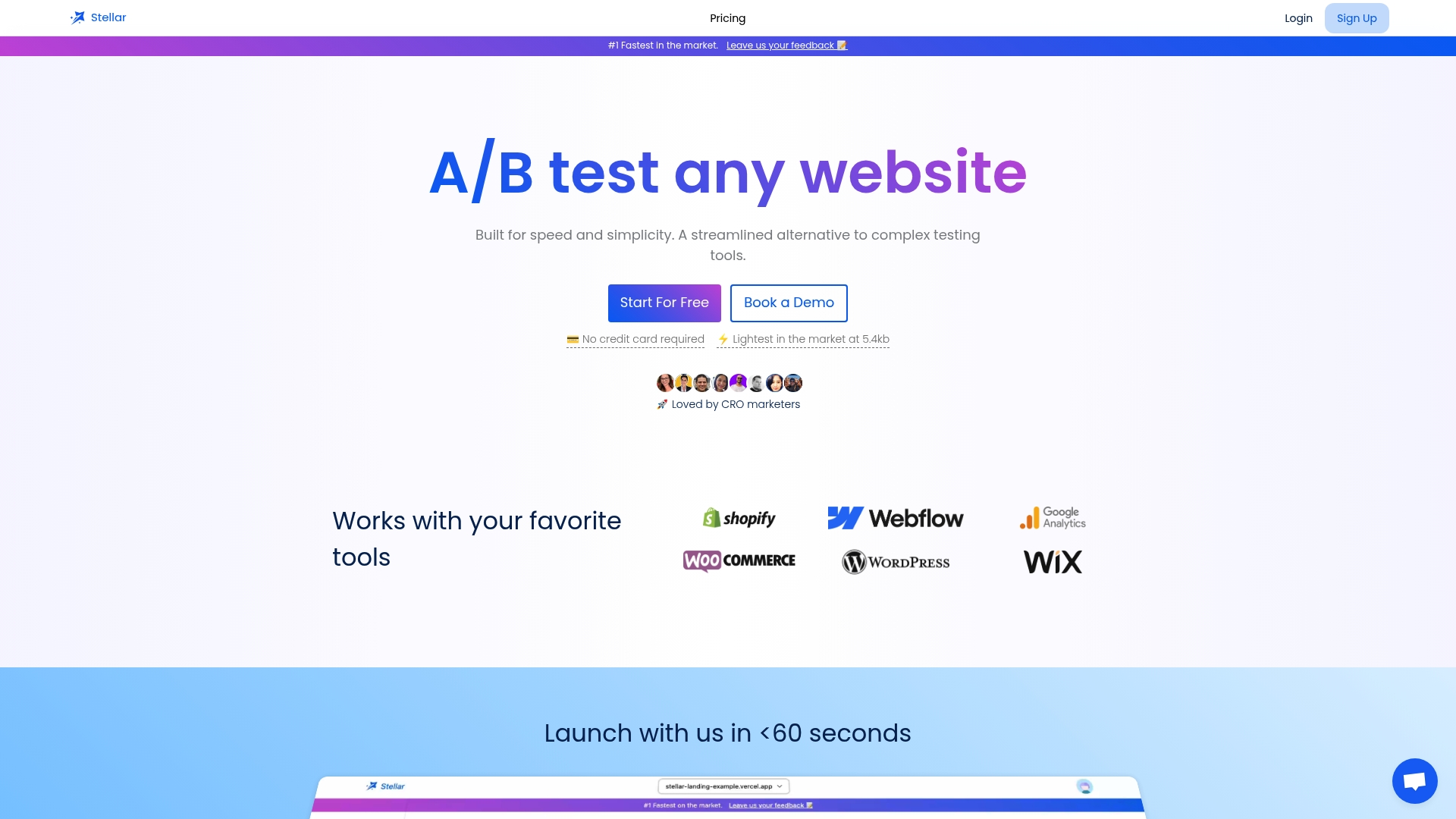
That's exactly what Stellar is built for. With a no-code visual editor, you can set up and launch A/B tests on your landing pages without touching a single line of code. The platform's 5.4KB script keeps your site fast while real-time analytics surface results you can actually act on. Dynamic keyword insertion lets you personalize pages for different audiences, and advanced goal tracking means you're always measuring what matters. There's even a free plan for sites with under 25,000 monthly tracked users, so you can start running real experiments today without a budget commitment.
Frequently asked questions
What is the definition of A/B testing in marketing?
A/B testing is a controlled experiment where two versions of a web page, ad, or email are compared to see which performs better on metrics like conversions by randomly splitting the audience.
How much traffic is needed for effective A/B tests?
Aim for at least 1,000 unique visitors per variant per month to achieve statistically meaningful results. Below that threshold, your test is unlikely to reach significance in a reasonable timeframe.
What's the difference between A/B and multivariate testing?
A/B testing compares two versions of one element, while multivariate testing evaluates multiple elements or variations simultaneously and requires significantly more traffic to produce reliable results.
What is a 'control' and 'variation' in A/B testing?
The control is the original version (A), and the variation is the new version (B) being tested. Your audience is split randomly between the two so results reflect genuine behavioral differences, not sampling bias.
Recommended
Published: 3/29/2026