
A/B Testing Impact: Maximizing ROI for SMBs
Nearly 90 percent of American businesses say A/B testing is central to driving better results, yet many small teams still struggle to measure true impact. For digital marketers and growth hackers, finding simple ways to track ROI can directly shape revenue and campaign decisions. This article breaks down proven A/B testing strategies that make tracking gains easy and actionable, helping you get more value from every experiment without technical headaches.
Table of Contents
- Defining A/B Testing And ROI
- Types And Methods Of A/B Testing
- How A/B Testing Drives Results
- Measuring ROI Gains From Experiments
- Costs, Risks, And Common Pitfalls
Key Takeaways
| Point | Details |
|---|---|
| A/B Testing Methodology | A/B testing involves comparing two variations to optimize business performance based on data-driven decisions. |
| ROI Measurement | Effective A/B testing requires comprehensive ROI analysis that evaluates direct financial gains and long-term strategic benefits. |
| Common Pitfalls | Businesses must avoid premature test termination and ensure proper sample sizes to achieve statistically significant results. |
| Iterative Improvement | Treat A/B testing as a continuous process to refine user experiences and enhance overall organizational performance. |
Defining A/B Testing and ROI
A/B testing represents a powerful statistical method for making data-driven business decisions. At its core, A/B testing involves comparing two variants to determine which performs better in achieving specific organizational goals. This experimental approach allows businesses to systematically test different versions of websites, marketing materials, product features, or user experiences to optimize performance and maximize returns.
In practical terms, A/B testing works by randomly dividing an audience into two groups, exposing each group to a different version of a variable, and then measuring key performance indicators to determine which variant produces superior results. Companies use this method to make informed decisions about design, functionality, messaging, and user experience without relying on intuition or guesswork. Return on Investment (ROI) in A/B testing specifically measures the financial and strategic value generated from these experimental insights, helping businesses quantify the tangible benefits of their optimization efforts.
The process typically involves several critical steps: defining a clear hypothesis, selecting a measurable metric, creating variants, splitting the audience, collecting data, and performing statistical analysis. Controlled experiment methodologies ensure that the results are statistically significant and can be confidently used to drive strategic decision-making. This approach transforms subjective choices into objective, evidence-based improvements across marketing, product development, and user experience design.
Pro tip: Always establish a clear baseline metric before conducting your A/B test to accurately measure the true impact of your experimental variations.
Types and Methods of A/B Testing
A/B testing encompasses several sophisticated methodologies designed to help businesses make data-driven decisions. Classic A/B testing methods primarily involve comparing two distinct variants to determine which performs more effectively. The most fundamental approach is the single variable test, where only one element is modified between the control and experimental groups, allowing for precise measurement of specific changes' impact.
Beyond traditional single-variable testing, more advanced techniques have emerged. Multivariate testing enables simultaneous evaluation of multiple variables, providing a more comprehensive understanding of potential interactions between different design or content elements. This method is particularly powerful for complex optimization scenarios, such as website redesigns or comprehensive marketing campaign adjustments. Another sophisticated approach is sequential testing, which allows continuous monitoring and analysis of results throughout the experimental process, enabling more dynamic and responsive decision-making.
Businesses can choose from several testing frameworks depending on their specific goals. Split testing and bucket testing represent popular methods for evenly distributing user traffic between variants. Some organizations implement continuous experimentation models, which involve ongoing, iterative testing across multiple variables. These approaches range from simple two-variant comparisons to complex multivariate experiments that simultaneously evaluate numerous potential improvements.
Pro tip: Select your A/B testing method based on your specific business objective, ensuring you have sufficient traffic and clear, measurable goals before launching your experiment.
Here's a comparison of common A/B testing methodologies and their business impact:
| Methodology | What It Tests | Business Impact |
|---|---|---|
| Single Variable | One element at a time | Precise measurement, easy analysis |
| Multivariate | Multiple elements | Identifies complex interactions |
| Sequential | Ongoing experiment | Faster insights, adaptive changes |
| Split/Bucket | User traffic splits | Balanced data, reduces bias |
How A/B Testing Drives Results
A/B testing drives transformative business results by providing a systematic approach to measuring and improving key performance metrics. Controlled experiments enable iterative innovation by validating changes across multiple business dimensions, from user interface design to marketing messaging. This methodology allows companies to make data-driven decisions with unprecedented precision, reducing guesswork and minimizing potential risks associated with large-scale changes.

Quantitative performance measurement sits at the heart of A/B testing's effectiveness. By comparing different variants across specific metrics, businesses can objectively evaluate the impact of potential improvements. Companies can track critical indicators like conversion rates, user engagement, revenue per user, and customer retention. These insights go beyond simple numerical comparisons, offering deep understanding of user behavior, preferences, and interaction patterns that can fundamentally reshape strategic decision-making.
Firms can quickly identify optimal modifications by testing changes on small user segments before broader implementation. This approach dramatically reduces the potential for adverse impacts while providing a low-risk environment for experimentation. Successful A/B testing transforms intuition-based decisions into statistically validated strategies, enabling businesses to continuously refine their products, services, and user experiences with confidence and scientific rigor.
Pro tip: Always establish clear, measurable hypotheses before launching an A/B test, and ensure you have a statistically significant sample size to draw meaningful conclusions.
Measuring ROI Gains from Experiments
Measuring the return on investment (ROI) from A/B testing requires a strategic and nuanced approach that goes beyond simple numerical comparisons. Identifying responsive customer segments becomes crucial in understanding the true value of experimental interventions. This means analyzing not just overall performance, but drilling down into specific demographic and behavioral characteristics that indicate which modifications generate the most significant financial impact.
Key performance indicators form the foundation of ROI measurement in A/B testing. Businesses typically track metrics such as conversion rates, average order value, customer acquisition costs, and long-term customer lifetime value. Statistical validation of test outcomes ensures that observed improvements are not random fluctuations but genuine, reproducible gains. This rigorous approach transforms experimental results from mere data points into actionable strategic insights that directly contribute to bottom-line growth.

Comprehensive ROI calculation involves comparing the incremental revenue generated by the winning variant against the costs of implementing and running the experiment. Advanced organizations look beyond immediate financial gains, considering factors like improved user experience, reduced customer churn, and enhanced brand perception. By treating A/B testing as a continuous improvement process rather than a one-time activity, businesses can create a compounding effect of incremental gains that substantially impact overall organizational performance.
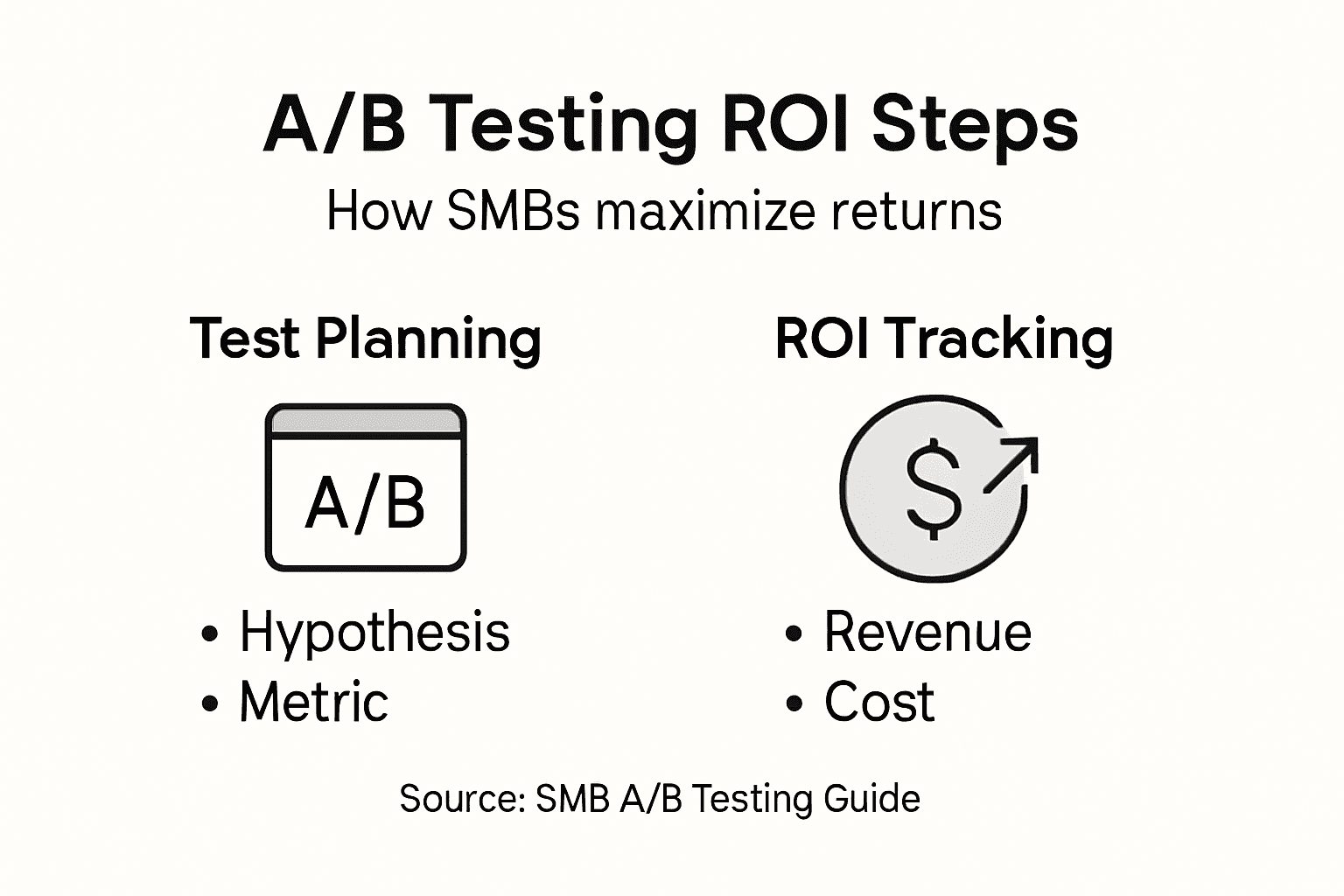
Pro tip: Calculate your experiment's ROI by comparing the financial impact of the winning variant against testing costs, and always factor in both direct revenue improvements and potential long-term strategic benefits.
Use this summary of ROI measurement metrics in A/B testing:
| KPI | What It Reveals | Strategic Use |
|---|---|---|
| Conversion Rate | User action effectiveness | Boosts sales/engagement |
| Average Order Value | Revenue per transaction | Guides pricing strategies |
| Customer Acquisition Cost | Cost to gain each customer | Optimizes marketing spend |
| Lifetime Value | Total value per customer | Improves retention focus |
Costs, Risks, and Common Pitfalls
A/B testing offers powerful insights, but businesses must navigate several critical challenges to ensure meaningful results. Common experimental design pitfalls can undermine the entire testing process, potentially leading to misguided strategic decisions. Understanding these risks becomes crucial for small to medium-sized businesses looking to maximize their experimental investments without squandering resources on ineffective approaches.
Key risks in A/B testing include premature test termination, insufficient sample sizes, and improper statistical analysis. Companies often make the mistake of stopping experiments too early when initial results seem promising, which can lead to statistically insignificant conclusions. Experimental design challenges frequently emerge from overcomplicating test variables or failing to control external factors that might skew experimental outcomes. This means carefully isolating the specific element being tested and maintaining consistent conditions across different test variants.
The financial implications of A/B testing extend beyond direct experiment costs. Poorly designed tests can result in missed opportunities, misallocated resources, and potential damage to user experience. Successful organizations approach A/B testing as a nuanced strategic tool, implementing rigorous methodologies that account for segment-specific impacts, user interaction effects, and long-term performance metrics. By developing a sophisticated understanding of experimental limitations, businesses can transform potential pitfalls into opportunities for meaningful optimization.
Pro tip: Establish clear, statistically robust parameters before launching your A/B test, including minimum sample size, significance level, and predetermined test duration to mitigate the risk of premature or misleading conclusions.
Unlock Higher ROI with Streamlined A/B Testing for SMBs
The challenge of executing statistically robust A/B tests while avoiding common pitfalls like insufficient sample sizes and premature test endings is real for many small to medium-sized businesses. This article highlights the need for clear hypotheses, precise measurement, and easy-to-use tools that deliver actionable insights without overwhelming complexity. At Stellar, we understand that SMB marketers and product managers demand fast, reliable experiments that minimize performance impact on their websites and provide real-time analytics to confidently optimize conversion rates and customer engagement.
Experience the power of a lightweight 5.4KB script combined with a no-code visual editor that makes setting up single variable or multivariate tests effortless. Maximize ROI by pinpointing the highest-impact changes with advanced goal tracking and dynamic keyword insertion designed specifically for growth-focused SMB teams. Don't let complicated software slow down your experimentation process. Start testing smarter and driving better results today with Stellar's A/B Testing Tool, engineered for the speed and simplicity your business needs to turn data into profitable decisions.
Frequently Asked Questions
What is A/B testing and how does it work?
A/B testing is a statistical method for making data-driven business decisions by comparing two variants to see which performs better. It involves randomly dividing an audience into two groups, exposing each group to different versions of a variable, and measuring key performance indicators to determine which variant produces superior results.
How can A/B testing help maximize ROI for small to medium-sized businesses (SMBs)?
A/B testing helps SMBs maximize ROI by enabling them to make informed, data-driven decisions. By identifying effective changes in areas like design, messaging, and user experience, companies can increase conversion rates, improve customer engagement, and ultimately drive more revenue.
What are the common pitfalls to avoid when conducting A/B tests?
Common pitfalls include stopping tests too early, using an insufficient sample size, and failing to control for external variables. These issues can lead to unreliable data and may result in misguided strategic decisions, undermining the effectiveness of A/B testing.
How do I measure the ROI of my A/B testing experiments?
To measure ROI, compare the incremental revenue generated by the successful variant against the costs of running the experiment. Consider both direct financial gains, such as increased conversion rates, and long-term benefits like improved user experience and brand perception.
Recommended
Published: 1/11/2026