
A/B Testing in Mailchimp: SMB Guide for 2026
TL;DR:
- Mailchimp's native A/B testing is effective for large email lists but limited for smaller teams and cross-channel experiments. Small lists produce unreliable results, making external tools like Gostellar better for landing-page tests and real-time data. Selecting the right approach depends on list size, testing scope, and whether email or page experiments are the priority.
Mailchimp's built-in A/B testing works well for email campaigns already running inside the platform, but its variation limits, plan gating, and scale requirements make some experiments impractical for smaller teams. The short version: if you have a sufficiently large number of subscribed contacts per variation and a paid plan, Mailchimp's native testing covers most email use cases. Below that threshold, results are often inconclusive, and you're better off running fewer, higher-impact tests or moving landing-page experiments to a lightweight external tool like Gostellar.
Two facts decide whether Mailchimp's testing fits your situation:
- List size: Mailchimp recommends at least 5,000 subscribed contacts per variation for reliable results. Smaller lists produce noisy results.
- Plan tier: A/B testing requires Essentials or higher; multivariate testing requires Standard or higher.
The industry benchmark for a credible result is 95% statistical confidence. Mailchimp calculates significance automatically, but it can't manufacture it from a thin list.
Table of Contents
- What does Mailchimp actually let you test?
- How to set up an A/B test in Mailchimp
- How to read Mailchimp test reports without fooling yourself
- When Mailchimp's testing isn't enough
- What are the real alternatives to Mailchimp for A/B testing?
- How should SMBs choose the right A/B testing approach?
- Which email A/B tests should SMBs run first?
- Mailchimp vs. Gostellar: which one fits your situation?
- Key Takeaways
- The test that actually moves the needle
- Gostellar: A/B testing beyond the inbox
- Useful sources
What does Mailchimp actually let you test?
Mailchimp supports four variables for email A/B tests: subject line, From name, content, and send time. SMS campaigns can test content only. Standard A/B testing lets you test one variable at a time across up to three variations. Multivariate testing, available on Standard plans and above, supports up to three variables simultaneously, generating up to eight combinations.
Key structural limits at a glance:
- Single-variable A/B: one variable, up to 3 variations
- Multivariate: up to 3 variables, up to 8 combinations
- Plan gating: Essentials+ for A/B; Standard+ for multivariate
- Minimum test send: 10% of your list must receive test combinations (the slider won't go below this)
- Send-time exception: send-time tests must go to 100% of the audience because a winning time slot can't be sent retroactively.
Mailchimp constructs combinations automatically and distributes them randomly so no subscriber receives more than one version. That's clean methodology, but it also means you can't control which segment sees which variant.

How to set up an A/B test in Mailchimp
The setup sequence is straightforward once you know the order:
- Create a campaign and select "A/B Test" as the campaign type, then name it.
- Choose your audience or segment — this determines your pool size.
- Pick one variable (subject line, From name, content, or send time) and add up to 3 variations. For multivariate, select up to 3 variables; Mailchimp builds the combinations.
- Set the test percentage. The minimum is 10% of your list. For send-time tests, set it to 100%.
- Choose winner criteria: automatic (open rate, click rate, or total revenue) or manual.
- Set test duration and send. For click-rate accuracy, allow 1–3 hours; revenue tests need 12–24 hours.
Pro Tip: When testing content variations, set click rate as your winner metric, not open rate. Opens are recorded before anyone actually reads the email, so they tell you nothing about how well the content performed.
For multivariate tests, Mailchimp recommends waiting at least 4 hours before manually finalizing winners. Rushing that decision on a small list is one of the most common ways teams end up acting on noise.
How to read Mailchimp test reports without fooling yourself
Mailchimp's reports surface three primary metrics: open rate, click rate, and total revenue. The right one to watch depends on what the campaign is supposed to do.
- Open rate is the right metric for subject line and From name tests.
- Click rate is the right metric for content tests — opens register before content is viewed, so they're a poor proxy for content quality.
- Total revenue is the right metric when your store is connected and the campaign goal is direct sales.
Pro Tip: Before declaring a winner, check secondary signals: unsubscribe rate, spam complaints, and downstream revenue. A version with a higher click rate but elevated unsubscribes may be winning the battle and losing the war.
Small lists are the biggest trap here. Small differences in click rate with low recipient counts are statistically meaningless. If your list per variation is relatively small, treat results as directional, not definitive, and run manual winner selection so you can weigh qualitative signals before sending to the remainder.
When Mailchimp's testing isn't enough
Mailchimp's native testing covers a lot of ground, but these are the scenarios where it starts to break down:
- Small lists: Multivariate testing with multiple combinations needs a large number of contacts per combination for meaningful data. Most SMBs don't have 40,000 subscribers to spare.
- Send-time constraints: Because winning time slots can't be retro-sent, send-time tests inform future scheduling rather than delivering an immediate lift.
- Scope limits: Each A/B test covers one variable. If you want to understand how subject line and CTA interact, you need multivariate, which requires a Standard plan.
- Analytics depth: Mailchimp's reporting is solid for email metrics but doesn't offer real-time dashboards, custom goal tracking, or cross-channel attribution out of the box.
- Cost-benefit on small lists: Paying for Standard or higher to unlock multivariate testing may not pencil out if your list is too small to generate significant results anyway.
For teams running landing-page experiments or cross-channel tests, Mailchimp's email-centric scope is a hard ceiling.
What are the real alternatives to Mailchimp for A/B testing?
Three categories cover most SMB needs:
- Lightweight visual editors and landing-page A/B tools (e.g., Gostellar): best for fast, no-code page experiments with minimal site performance impact. Free tiers available. No engineering required.
- Full-featured experimentation platforms (e.g., Optimizely, VWO, Convert): best for large-scale multivariate testing, personalization at scale, and teams with dedicated CRO resources. Pricing reflects that scope.
- Server-side or analytics-driven experimentation: best for product-level funnel tests and backend experiments where front-end flicker is unacceptable.
The right category depends on four signals: list or traffic size, need for multivariate interaction effects, cross-channel goals, and how deep your analytics requirements go.
How should SMBs choose the right A/B testing approach?
Run through this checklist before committing to a tool or method:
| Question | Mailchimp fits | External tool fits |
|---|---|---|
| Primary goal | Opens, clicks, email revenue | Page conversions, cross-channel |
| List size per variation | sufficiently large | Any (tool-dependent) |
| Technical resources | None needed | None needed (visual editors) |
| Multivariate interactions | Standard plan required | Varies by platform |
| Real-time analytics | Limited | Yes (most dedicated tools) |
| Budget | Included in email plan | Free tiers available |
If you have fewer than 5,000 subscribers per variation, run single-variable tests on your highest-impact elements rather than multivariate. The difference between A/B and multivariate isn't just complexity — it's a sample-size requirement that most small lists can't meet.
Which email A/B tests should SMBs run first?
Prioritize by signal-to-noise ratio, not by what sounds interesting:
Priority 1 — Subject lines. Emojis, urgency framing, personalization tokens, question vs. statement. Subject line tests need the smallest sample sizes to detect meaningful differences and deliver the clearest lift signal. Email test prioritization consistently points here first.
Priority 2 — CTA wording or placement. A single button change tied directly to your click or conversion goal. Keep everything else identical. Effective CTA testing is one of the fastest ways to move revenue metrics without a large list.
Priority 3 — Send time. Useful for informing future scheduling, but remember: the data informs, it doesn't retro-send. Don't treat send-time results as a quick win.
Lower priority — Layout tweaks and micro-copy. These require large lists and multivariate support to detect real differences. With a small audience, the noise drowns the signal.
Mailchimp vs. Gostellar: which one fits your situation?
| Dimension | Mailchimp | Gostellar |
|---|---|---|
| Best for | Email campaigns inside Mailchimp | Landing-page and cross-channel tests |
| Free tier | No (paid plans required for A/B) | Yes (up to 25,000 monthly tracked users) |
| Multivariate support | Up to 8 combinations (Standard+) | Visual editor-based experiments |
| Ease of use | Integrated with email builder | No-code visual editor, no dev needed |
| Performance impact | N/A (email only) | 5.4KB script, minimal site impact |
| Real-time analytics | Limited | Yes |
| List/traffic suitability | At least 5,000 per variation recommended | Any size, scales with traffic tiers |
Mailchimp wins when your experiments live entirely inside email and your list is large enough to generate significance. Gostellar fits when you need to test landing pages, want real-time data, or don't have the list size to make Mailchimp's multivariate tier worthwhile.
Key Takeaways
Mailchimp's A/B testing is reliable for email campaigns with sufficiently large contacts per variation, but SMBs with smaller lists or cross-channel goals get more value from a dedicated lightweight tool.
| Point | Details |
|---|---|
| Plan requirements matter | A/B testing needs Essentials+; multivariate requires Standard+ with up to 8 combinations. |
| List size is the real limit | Mailchimp recommends at least 5,000 subscribed contacts per variation for reliable results. |
| Pick the right metric | Use click rate for content tests; open rate for subject line tests; revenue for sales campaigns. |
| Small lists, simple tests | Fewer than 5,000 subscribers per variation? Run single-variable subject line or CTA tests only. |
| Gostellar for page tests | Gostellar's free tier and 5.4KB script make it a practical option for landing-page experiments outside email. |
The test that actually moves the needle
Most SMB teams I see make the same mistake: they treat A/B testing as a sophistication exercise rather than a signal-extraction exercise. They set up multivariate tests with eight combinations on a 3,000-person list, wait a week, get inconclusive results, and conclude that testing doesn't work for them.
It does work. The problem is that statistical significance doesn't care about your enthusiasm — it cares about sample size. A test that can't reach 95% confidence isn't a failed test; it's an underpowered one. The fix isn't more variables. It's fewer, bigger bets: one subject line change, one CTA swap, one send-time hypothesis.
Manual winner selection gets underused, too. Automatic selection is convenient, but on important campaigns, spending five minutes reviewing unsubscribe rates and spam complaints before sending to the remaining 80% of your list is worth it. A version that wins on clicks but spikes complaints is a short-term gain with a long-term cost.
For teams that genuinely need cross-channel experimentation or real-time data, Gostellar's no-code editor and lightweight script remove the engineering dependency that usually kills testing momentum at small companies.
Gostellar: A/B testing beyond the inbox
When Mailchimp's email tests hit their limits, the next question is usually: where do we test the landing page? Gostellar was built for exactly that gap. Its no-code visual editor lets you run page experiments without touching code, and its 5.4KB script keeps site performance intact while the test runs. Dynamic keyword insertion personalizes landing pages to match ad copy, and real-time analytics mean you're not waiting 24 hours to see whether a variant is working.
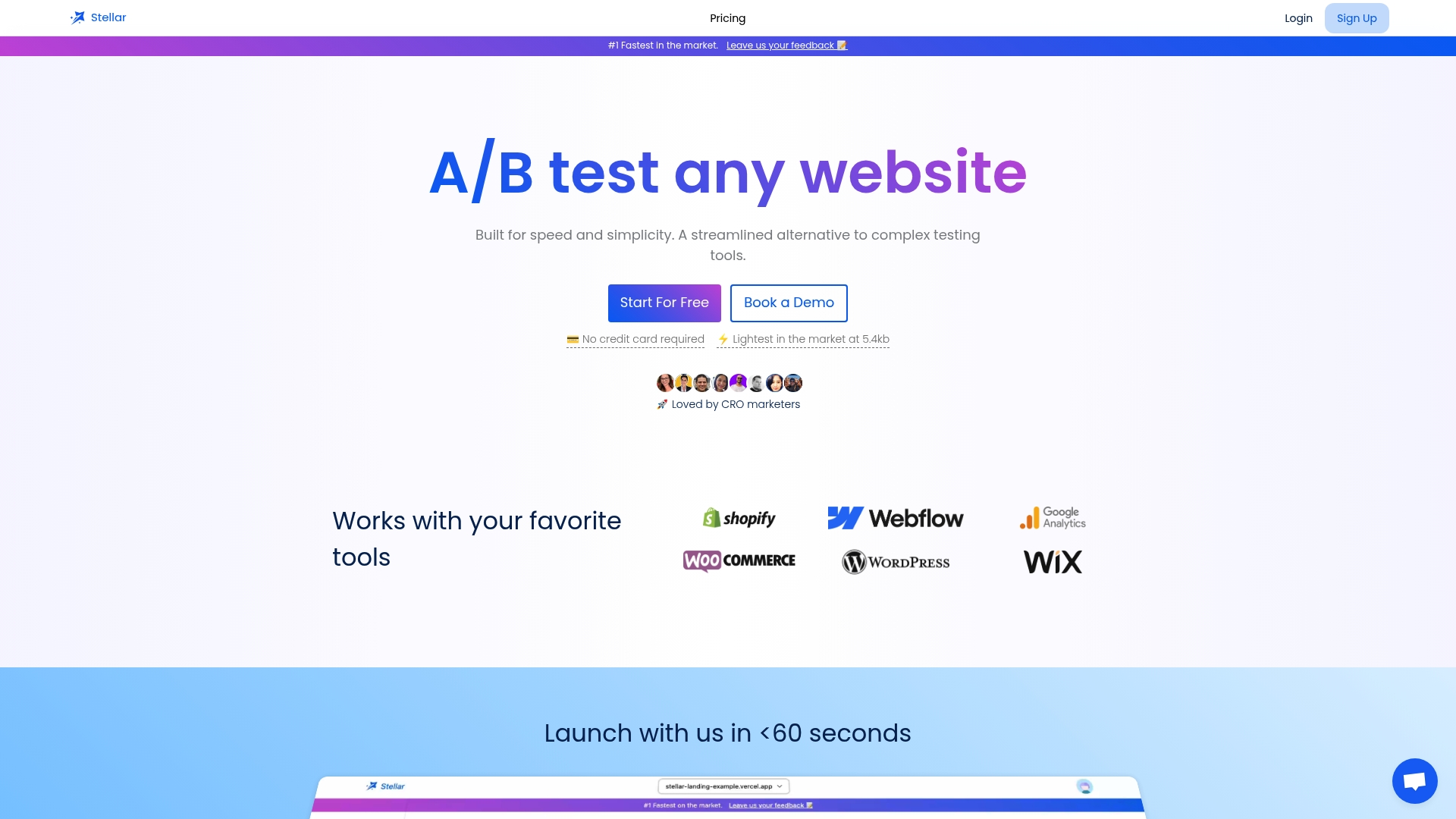
The free plan covers up to 25,000 monthly tracked users, which makes it accessible for teams that aren't ready to commit to enterprise pricing. Advanced goal tracking and revenue attribution give you the depth Mailchimp's email reports don't. If your growth experiments are outgrowing the inbox, start a free trial and see how fast a no-code test can go live.
Useful sources
- About A/B Tests — Mailchimp Help: covers variables, variation limits, winner criteria, and plan requirements.
- Create an A/B Test — Mailchimp Help: step-by-step setup, minimum send percentages, and send-time nuances.
- Create a Multivariate Test — Mailchimp Help: combination limits, timing recommendations, and archive behavior.
- Email A/B Testing Solutions — Mailchimp: sample-size guidance, metric selection, and test prioritization.
- Gostellar — Landing Page A/B Testing: free tier, visual editor, and real-time analytics for page experiments.
Recommended
Published: 7/25/2026