
A/B vs. multivariate testing: optimize conversions faster
TL;DR:
- A/B testing compares two versions to identify a clear winner with lower traffic needs.
- Multivariate testing analyzes multiple elements at once but requires significantly more traffic.
- Use A/B tests first on small sites, then apply multivariate testing after establishing a baseline.
Choosing between A/B and multivariate testing feels straightforward until you're staring at a landing page with five elements you want to change and a traffic report that could go either way. Most marketers either oversimplify by only running A/B tests forever, or they jump into multivariate testing before they have the traffic to support it. The right framework cuts through that confusion fast. This article walks you through the core differences, the criteria that drive the decision, the tools worth considering, and how to actually read your results once the data rolls in.
Table of Contents
- Understanding A/B and multivariate testing
- Key criteria for choosing your testing strategy
- Popular multivariate and A/B testing tools
- Interpreting results: What success looks like
- Why multivariate testing often works best after A/B
- Start your optimization journey with Stellar
- Frequently asked questions
Key Takeaways
| Point | Details |
|---|---|
| Multivariate needs more traffic | You’ll need far more visitors to gain statistical significance compared to A/B testing. |
| Start simple with A/B | Begin with A/B testing on big layout decisions before moving to multivariate for element-level optimization. |
| Choose tools wisely | Select testing tools based on usability, pricing, and scalability for your business. |
| Interpret results for growth | Always use your test outcomes to target new improvements—not just to declare wins. |
Understanding A/B and multivariate testing
A/B testing is the practice of showing two versions of a page to different visitor segments and measuring which one performs better. Version A is your control. Version B is your variation. One change. One answer. That simplicity is its biggest strength, and it's why A/B testing for revenue growth remains one of the most reliable tools in a marketer's toolkit.
Multivariate testing (MVT) goes further. Instead of changing one element, you change several at once and test every possible combination. If you have two headline options and three button colors, that's six combinations running simultaneously. The goal is not just to find the best combination but to understand how elements interact with each other. A bold headline might lift conversions on its own, but paired with a red button, it might actually hurt them. MVT surfaces those interaction effects that A/B testing simply cannot.

Understanding multivariate testing essentials helps clarify one important practical reality: MVT demands a lot of traffic. 12 combinations need roughly 800,000 visitors to reach statistical significance if a standard A/B test only needs around 66,000. That's not a minor gap. It's a 12x difference in traffic requirements, and it's the single most common reason MVT fails to deliver useful results for smaller sites.
Here's a quick breakdown of when each method fits:
- A/B testing: One variable, clear winner, lower traffic threshold, faster results
- Multivariate testing: Multiple variables, interaction insights, high traffic required, longer test duration
- Use A/B when: You're testing a major layout change, a new value proposition, or a completely different design direction
- Use MVT when: You're optimizing a page that already converts well and you want to squeeze more performance from specific elements
Pro Tip: Start with A/B tests for big structural decisions like page layout or headline copy. Once a page is performing consistently, layer in multivariate testing to fine-tune the elements that are already working.
Key criteria for choosing your testing strategy
With the core methods defined, the next question is: which one is right for your situation right now? The answer depends on four practical criteria.
-
Traffic volume. This is the most decisive factor. If your page gets fewer than 50,000 monthly visitors, A/B testing is almost always the better choice. MVT splits your audience across many combinations, which means each variation gets fewer visitors and takes longer to reach statistical significance. For AB testing for small businesses, A/B is the practical starting point.
-
Number of elements you want to test. If you want to test one or two things, A/B is faster and cleaner. If you have three or more elements with multiple variations each, and you genuinely need to understand how they interact, MVT becomes worth considering, provided you have the traffic.
-
Your optimization objective. A/B testing is ideal when you want a clear directional answer: does this new CTA button outperform the old one? MVT is better when you want to understand compound effects across a page. A complete AB test guide reinforces this: match the test type to the question you're actually trying to answer.
-
Time available. MVT tests run longer because they need more data. If you're working on a campaign with a tight deadline, A/B testing delivers results faster and lets you act sooner.
"The recommended workflow is A/B first for layout decisions, then MVT for element optimization on high-traffic pages." Source
This workflow matters more than most marketers realize. Jumping straight to MVT on a page that hasn't been validated through A/B testing is like tuning a car engine before confirming the transmission works. You might improve something, but you're optimizing on a shaky foundation.
Pro Tip: Use A/B testing to validate big changes first. Once you know a page layout drives strong baseline conversions, apply advanced A/B testing strategies and then move to MVT to refine the details.
Popular multivariate and A/B testing tools
Once you know your criteria, the next step is picking a platform that matches your needs. The market has no shortage of options, but they vary significantly in price, ease of use, and support for multivariate experiments.
Here are the most widely used platforms for small to medium-sized businesses:
- Optimizely: Powerful and feature-rich, with strong MVT support. Better suited for larger teams with technical resources. Our Optimizely A/B testing overview covers what marketers actually need to know before committing.
- VWO (Visual Website Optimizer): Good balance of features and usability. Supports both A/B and multivariate tests with solid reporting. Pricing scales with traffic.
- Google Optimize: Deprecated as of 2023, but worth knowing historically since many teams still reference it in their documentation and workflows.
- AB Tasty: Mid-market tool with a clean interface and decent MVT capabilities. Good for teams that want guided experiment setup.
- Stellar: Built specifically for SMBs. Lightweight 5.4KB script, no-code visual editor, real-time analytics, and a free plan for sites under 25,000 monthly tracked users.
Platforms that uncover interaction effects between page elements give you a genuine edge in optimization, but only if the tool is easy enough to use consistently. A powerful platform that your team avoids because it's complicated is worse than a simpler tool used every week.
Here's a side-by-side comparison for SMB decision-making:
| Platform | MVT support | No-code editor | Free plan | Best for |
|---|---|---|---|---|
| Stellar | Yes | Yes | Yes (under 25K users) | SMBs, speed, simplicity |
| VWO | Yes | Yes | No | Mid-market teams |
| Optimizely | Yes | Partial | No | Enterprise or technical teams |
| AB Tasty | Yes | Yes | No | Mid-market, guided setup |
For teams running effective mobile ad A/B tests, the tool's ability to segment by device type and render quickly on mobile is also worth factoring in. A slow-loading test script can skew results by affecting user behavior before they even see your variation.
Pro Tip: Choose a tool that scales with your traffic and element complexity. If you're just getting started, prioritize ease of use and real-time reporting over advanced features you won't use for months.
You can also review our A/B testing software comparison for a deeper breakdown of how these platforms stack up across pricing tiers and feature sets.
Interpreting results: What success looks like
Having the right tool matters, but knowing how to read your results is what separates teams that improve from teams that just run tests. This is where many SMBs stumble.
Here's a structured approach to making sense of your test data:
-
Check statistical significance before acting. A result is only meaningful when it reaches your target confidence level, typically 95%. Acting on early data that hasn't reached significance is one of the most common and costly mistakes in conversion optimization.
-
Look at interaction effects in MVT reports. The point of multivariate testing is not just finding the winning combination. It's understanding why it won. If headline A with button color 2 outperforms all other combinations, dig into whether the headline or the button is driving the lift, or whether it's truly the pairing.
-
Segment your results. A variation that wins overall might lose for mobile users or a specific traffic source. Marketing psychology basics play a real role here. Different audiences respond to different cues, and aggregate data can hide important segment-level insights.
-
Plan your next test before closing the current one. Every test result, win or loss, tells you something. A losing variation still reveals what your audience doesn't respond to. Use that to sharpen the hypothesis for your next experiment.
"Running tests without a documented hypothesis and follow-up plan turns experimentation into guesswork rather than a growth system." Source
Here's a sample outcomes table to illustrate what different test results typically indicate:
| Test type | Result | What it means | Next step |
|---|---|---|---|
| A/B test | Variation wins by 15% | Change is directionally valid | Implement and test next element |
| A/B test | No significant difference | Hypothesis was wrong | Revisit page strategy |
| MVT | One combo wins clearly | Strong interaction effect found | Scale winning combo, test new elements |
| MVT | Results scattered | Insufficient traffic or too many combos | Reduce combinations or increase traffic |
The 800,000-visitor threshold for 12-combination MVT tests is a useful gut-check. If your monthly traffic is well below that, scattered MVT results are almost guaranteed. Reducing combinations to four or six can bring that threshold down significantly and make results actionable.
Integrating your test results with A/B automation integration workflows also helps. When winning variations automatically trigger downstream actions in your CRM or email platform, the ROI of each test compounds over time.
Why multivariate testing often works best after A/B
Here's a perspective most marketers overlook: multivariate testing is not a more advanced version of A/B testing. It's a different tool for a different job, and using it too early is one of the most reliable ways to waste time and budget.
The uncomfortable truth is that most SMBs don't have the traffic volume to run statistically valid MVT experiments. They run them anyway, get inconclusive results, and either abandon testing altogether or draw wrong conclusions from noisy data. Neither outcome helps the business.
What actually works is using A/B testing to build a foundation of validated decisions. You learn what your audience responds to. You establish a baseline conversion rate worth optimizing. You develop intuition about which elements move the needle. Then, when you have a high-performing page and sufficient traffic, MVT becomes genuinely powerful because you're refining something that already works.
This sequenced approach also makes MVT results easier to interpret. When you already know your headline drives engagement, and you run an MVT to test button color and image combinations, the interaction effects are cleaner and more meaningful. You're not trying to untangle three unknowns at once.
The split vs. multivariate testing debate often misses this point. The question isn't which method is better. It's which method is appropriate given your traffic, your current optimization stage, and the specific question you're trying to answer. Treat them as sequential phases of a maturing optimization program, not competing alternatives.
Start your optimization journey with Stellar
Running both A/B and multivariate tests doesn't have to mean managing complex platforms or waiting on developers to implement changes.
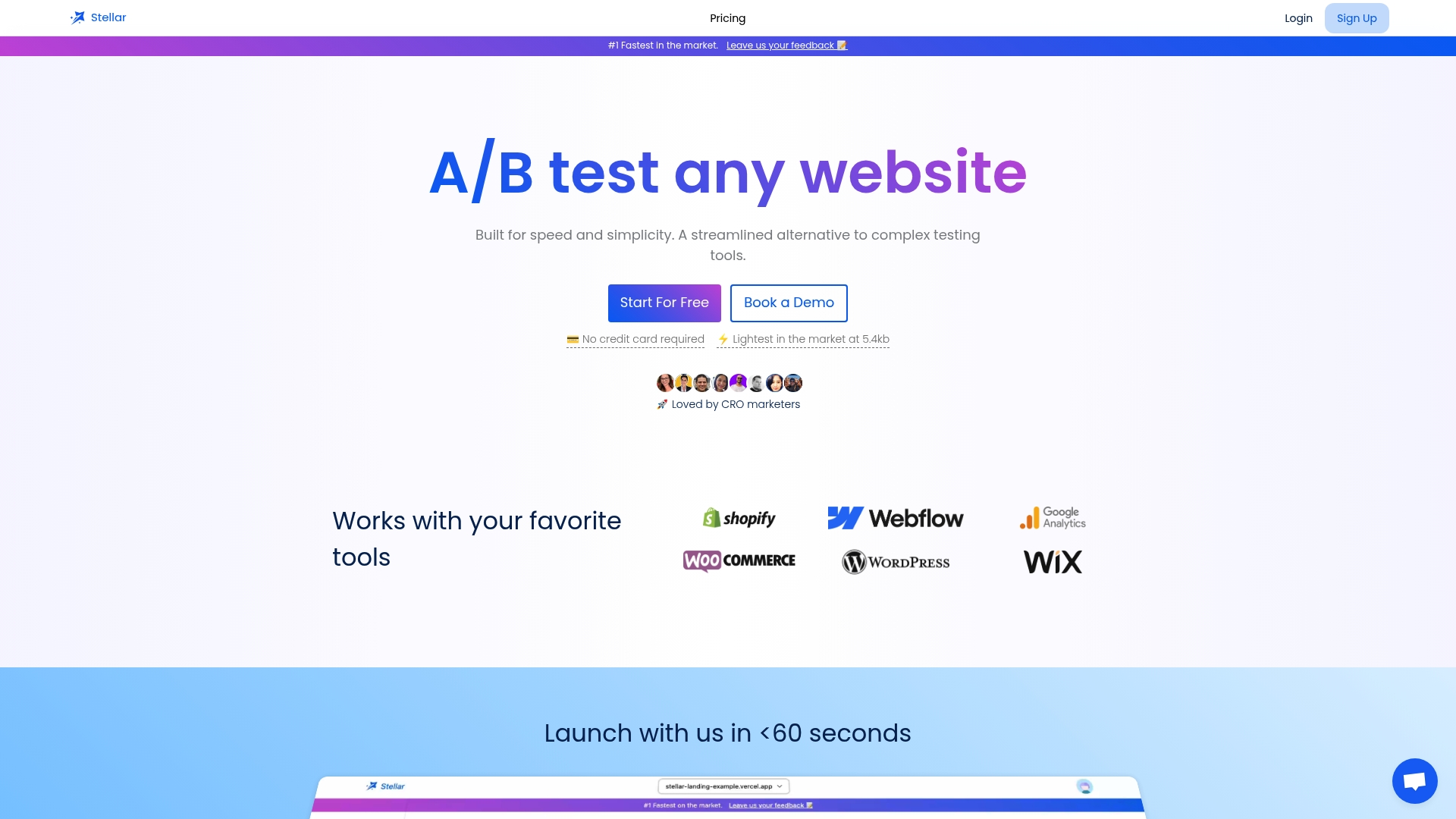
Stellar is built for exactly the kind of iterative, evidence-based optimization this article describes. Its no-code visual editor lets you set up A/B tests in minutes, and its lightweight 5.4KB script means your tests won't slow down the pages you're trying to improve. Real-time analytics give you the data you need to make decisions quickly, and the free plan covers sites with up to 25,000 monthly tracked users, so you can start building your testing foundation without any upfront cost. When you're ready to scale into multivariate experiments, Stellar grows with you.
Frequently asked questions
What is the main difference between A/B and multivariate testing?
A/B testing compares one change at a time, while multivariate testing analyzes multiple element variations and their interaction effects simultaneously, revealing which combinations perform best.
How much website traffic is needed for effective multivariate testing?
Multivariate testing requires significantly more traffic than A/B testing. For example, 12 combinations need roughly 800,000 visitors to reach statistical significance, compared to about 66,000 for a standard A/B test.
Should I use A/B or multivariate for small business sites?
Small business sites should start with A/B testing due to lower traffic volumes, then move to multivariate testing only when optimizing high-performing pages with sufficient visitor numbers.
Can multivariate testing replace A/B testing?
No. Multivariate testing is most effective after foundational A/B tests have been completed. It refines and optimizes what's already working rather than replacing the directional insights A/B testing provides.
What is an example of a multivariate test?
Testing two headlines and three button colors simultaneously produces six combinations. Multivariate testing then reveals which specific pairing delivers the highest conversion rate, including how the elements interact with each other.
Recommended
Published: 4/28/2026