
A/B/n Test Guide: Run Multi-Variant Experiments Faster
An A/B/n test compares a control against three or more full-page variants simultaneously, letting you evaluate competing design directions under identical traffic conditions. Use it when you have at least 50,000 monthly visitors, two or more genuinely distinct hypotheses, and an expected effect size large enough to detect with diluted traffic.
When A/B/n is the right call:
- Your traffic can support splitting across a few groups without starving any variant of statistical power
- Your hypotheses are independent (each variant tests a different concept, not a tweak of the same idea)
- You need directional answers faster than sequential A/B tests would allow
Pro Tip: Limit your A/B/n test to 3–5 variants; beyond five, the per-variant traffic drops to impractical levels for most sites, making reliable detection very difficult.
Table of Contents
- How does A/B/n testing actually work?
- Which test type should you actually choose?
- How to design an A/B/n experiment that actually teaches you something
- Sample size, duration, and the math that changes with more variants
- What goes wrong in A/B/n tests and how to prevent it
- Your A/B/n test runbook: plan, launch, measure, validate, roll out
- The efficiency case for A/B/n testing, backed by research
- Key Takeaways
- Why most teams get A/B/n wrong before the test even starts
- Gostellar makes A/B/n testing fast for growth teams
- Useful sources and calculators
How does A/B/n testing actually work?
Every visitor who hits a tested page gets assigned to exactly one variant, typically via a randomization algorithm that fires on page load or at the server before the response is sent. That assignment persists for the duration of the test so the same visitor always sees the same experience. Metrics — clicks, form submissions, purchases — are captured against each variant bucket and compared once the test reaches its predetermined stopping point.
The two main implementation paths differ in where that assignment happens.
| Dimension | Client-side | Server-side |
|---|---|---|
| Where assignment runs | Browser (JavaScript on load) | Web server or CDN before response |
| Persistence method | Local storage or cookie | Session token or user ID |
| Flicker risk | Higher (page renders before variant loads) | None |
| Best for | Front-end copy and layout tests | Authenticated users, multi-device consistency |
| Setup complexity | Low (no-code tools work well) | Higher (requires engineering involvement) |
Client-side frameworks often persist variant selection in local storage and ease front-end implementation. Server-side routing centralizes allocation and is the better choice when you need consistent assignment across devices for logged-in users. The most common errors occur at two points: variant leakage (a visitor sees more than one variant across sessions) and metric misfires (events firing before the variant is confirmed loaded).
Which test type should you actually choose?
The decision comes down to two questions: are your hypotheses independent, and do you have enough traffic to split it further?
- A/A test: Run this before any experiment to confirm your testing tool assigns traffic evenly and your metrics baseline is stable. If your A/A shows a statistically significant difference, fix your setup before running anything else.
- A/B test: One control, one variant. Use it when you have a single, well-formed hypothesis and limited traffic. Fastest to reach significance.
- A/B/n test: Control plus two or more full-page variants. Best for exploratory phases where you're choosing between fundamentally different directions — competing headline strategies, distinct pricing page layouts, or three separate landing-page formats. Each variant is self-contained; you're not testing element interactions.
- Multivariate test (MVT): Tests combinations of independently varying elements (headline × hero image × CTA button). Use MVT when you need to understand how elements interact, not just which full design wins. It scales combinatorially, so traffic requirements are steep.
For most copy testing and landing-page experiments, A/B/n hits the sweet spot: enough variants to find a direction, simple enough to analyze cleanly.
How to design an A/B/n experiment that actually teaches you something
Start with a hypothesis you can write in one sentence: "If we [change X], then [metric Y] will [increase/decrease] because [reason Z]." That "because" clause is what separates a test from a guess — it forces you to commit to a mechanism before you see results.

Experiment design reference table
| Element | What it is | Example |
|---|---|---|
| Primary metric | The one number that decides the winner | Checkout completion rate |
| Guardrail metric | A metric that must not degrade | Revenue per visitor, page load time |
| Segmentation variable | The audience split that might moderate the effect | Device type (mobile vs. desktop) |
| Sample allocation | Traffic percentage per variant | equal traffic allocation across variants |
| Stopping rule | Pre-set condition to end the test | Reach target sample size OR 4 weeks, whichever comes first |
Pick one primary metric per test. Adding three "primary" metrics is how teams end up declaring winners on the metric that happened to move. Guardrail metrics protect against a variant that lifts conversions but tanks revenue per visitor or slows the page. Segmentation by device or traffic source is worth pre-planning when you expect the effect to differ across groups — but run the overall test first and treat segment analysis as secondary unless you pre-registered it.
Pre-register your stopping rules before launch. Write down your target sample size, your maximum run time, and what you'll do with each outcome. Teams that skip this step tend to stop tests when results look good, which inflates false-positive rates.
Sample size, duration, and the math that changes with more variants
More variants means less traffic per group, which means longer tests to reach the same confidence level. An A/B/C test with equal allocation gives each group roughly 33% of traffic; an A/B/C/D test gives each group roughly 25%. The practical implication: a test that would take a two-arm A/B experiment might take notably less time than a four-arm A/B/n test on the same site.
Illustrative sample-size requirements by variant count and MDE
| Variants | MDE (relative) | Approx. sample per variant | Total sample needed |
|---|---|---|---|
| 2 (A/B) | 10% | — | — |
| 3 (A/B/C) | 10% | — | — |
| 4 (A/B/C/D) | 10% | — | — |
| 3 (A/B/C) | 5% | — | — |
Assumes 5% baseline conversion, 80% power, α = 0.05 per comparison, two-tailed test. These are illustrative figures; always run your own calculation with your actual baseline.
The multiple-comparisons problem compounds this. With four groups, you have six pairwise comparisons. At α = 0.05 per comparison, the family-wise false-positive probability can rise to roughly 26% without correction. Two common corrections:
- Bonferroni: Divide your alpha by the number of comparisons (e.g., 0.05 ÷ 6 = 0.0083 per comparison). Conservative but simple.
- Benjamini-Hochberg: Controls the false discovery rate rather than the family-wise error rate. Less conservative, better for exploratory tests with many comparisons.
Duration floor: Allow at least 1–2 weeks as a minimum duration, but always compute your required sample size first based on your baseline conversion rate and minimum detectable effect. A test that hits two weeks but hasn't reached the sample size isn't done.
Use a sample-size calculator (Evan Miller's is widely used; Optimizely's Stats Engine documentation covers sequential testing). Input your baseline rate, your MDE, your alpha, your desired power (80% is standard), and your number of variants.
What goes wrong in A/B/n tests and how to prevent it
Most failed experiments trace back to a small set of predictable mistakes.
- Peeking: Checking results before the target sample size is reached and stopping when a variant looks good. Fix: pre-register your stopping rule and don't look at significance until you've hit it, or use a sequential testing method (like a Bayesian approach or a proper sequential probability ratio test) that's designed for continuous monitoring.
- False positives from multiple comparisons: Covered above. Apply Bonferroni or Benjamini-Hochberg correction before declaring a winner.
- Seasonality confounds: A test that runs over a holiday weekend or a major sale event captures behavior that doesn't represent your baseline. Controlling for seasonality means running tests across full weekly cycles and avoiding known traffic anomalies.
- Novelty effects: Users click a new design simply because it's new, not because it's better. The effect fades. Mitigate by running tests long enough to capture return visitors and checking whether early-period results differ from later-period results.
- Mid-test changes: Changing a variant after launch invalidates the statistical assumptions for that group entirely. Pre-register stopping rules and treat any mid-run change as a test restart.
Pro Tip: After declaring a winner, validate it with a short holdout test before full rollout. The "winner's curse" — where the winning variant underperforms in production — is common when tests are stopped slightly early or run on non-representative traffic.
Your A/B/n test runbook: plan, launch, measure, validate, roll out
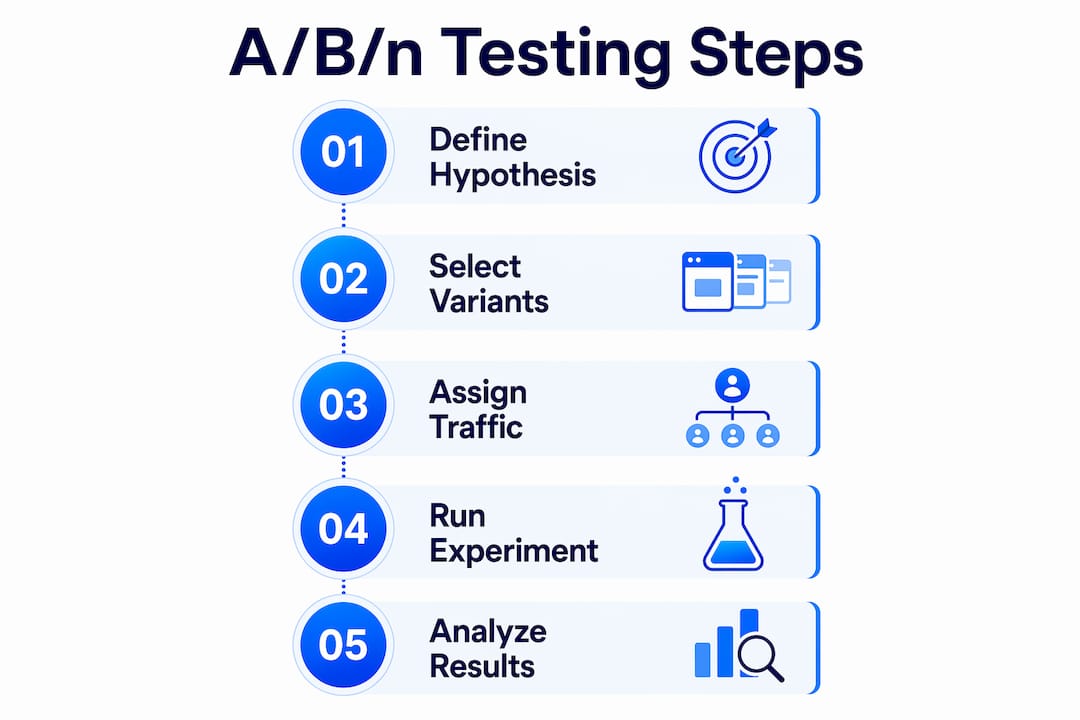
A clean A/B/n test follows a fixed sequence. Skipping steps, especially QA and pre-registration, is where most teams lose confidence in their results.
- Write the hypothesis using the if/then/because template. Confirm the "because" clause is testable.
- Define your primary metric and guardrail metrics before touching the test setup.
- Calculate required sample size using your baseline conversion rate, MDE, α = 0.05, 80% power, and number of variants.
- Set your stopping rule — a target sample size, a maximum calendar duration, or both.
- Build variants in your testing tool. Keep each variant self-contained; don't let variants share elements that could interact.
- QA the implementation — confirm variant assignment is random, persistent, and mutually exclusive. Check that your tracking events fire correctly for each variant.
- Launch and monitor for instrumentation errors in the first 24–48 hours. Look for unexpected traffic splits or broken event tracking, not significance.
- Do not peek for significance until you've reached your pre-set sample size or stopping date.
- Analyze results — apply your multiple-comparisons correction, check primary and guardrail metrics, and run pre-registered segment analyses.
- Validate the winner with a short holdout or a follow-up confirmation test before full rollout.
- Roll out the winning variant incrementally if possible (e.g., 50% → 100%) and monitor production metrics for 1–2 weeks post-launch.
- Document findings — what you tested, what you learned, and what you'd test next. This compounds over time.
The efficiency case for A/B/n testing, backed by research
A/B/n testing compresses months of sequential A/B tests into a single experiment cycle when traffic and hypotheses allow. That's not a minor convenience. Sequential testing exposes each test to different external conditions — seasonal shifts, competitor moves, algorithm changes — that make direct comparison unreliable. Running three variants simultaneously eliminates that calendar-time confound entirely.
The efficiency gain is real, but it has limits. On low-traffic sites, the per-variant sample dilution extends run times to the point where the calendar-time advantage disappears. For subtle effects (MDE below 5%), the sample requirements per variant become impractical for most small and mid-size sites. A/B/n is the right tool when you have multiple strong hypotheses and enough traffic to test them simultaneously — not when you're squeezing a single incremental tweak out of a low-volume page.
When to prefer A/B/n over sequential A/B tests:
- You have 3+ distinct concepts and want to avoid temporal confounds
- Your site generates enough traffic to split across groups without extending the test beyond 4–6 weeks
- You're in an exploratory phase where directional answers matter more than precise effect estimates
Key Takeaways
A/B/n testing is most valuable when you have multiple independent hypotheses, enough traffic to split across 3–5 variants, and a pre-registered stopping rule that prevents false positives from early peeking.
| Point | Details |
|---|---|
| Variant cap matters | Limit your test to 3–5 variants; beyond five, per-variant traffic drops to impractical levels for most sites. |
| Multiple comparisons inflate risk | Six pairwise comparisons at α = 0.05 can push family-wise false-positive probability to roughly 26% without correction. |
| Duration floor is 1–2 weeks minimum | Always compute required sample size first; hitting 1–2 weeks is a minimum, but you must reach your sample size for a valid result. |
| Pre-register before launch | Write down your stopping rule, primary metric, and sample allocation before the test goes live. |
| Gostellar for fast execution | Gostellar's a lightweight script and no-code visual editor let small and mid-size teams launch A/B/n tests without engineering support. |
Why most teams get A/B/n wrong before the test even starts
The conventional wisdom says the hard part of multi-variant testing is the statistics. It isn't. The statistics are solved problems — Bonferroni correction, sample-size calculators, sequential testing frameworks. The hard part is discipline: writing a hypothesis with a real mechanism, committing to a stopping rule before you see any data, and resisting the urge to call a winner when one variant is leading at day three.
Most A/B/n failures happen in the planning phase, not the analysis phase. Teams pick variants that are too similar to each other (so the test can't distinguish them), or they pick too many variants for their traffic (so the test runs for months and gets contaminated by seasonality anyway). The efficiency argument for A/B/n is genuine — testing three concepts simultaneously under identical conditions is objectively better than testing them sequentially. But that efficiency only materializes if you've done the sample-size math honestly and capped your variants at a number your traffic can actually support.
One thing worth saying plainly: a well-designed two-arm A/B test on a high-impact page will teach you more than a sloppy five-variant test on a low-traffic page. The method is a multiplier, not a substitute for clear thinking. Start with the hypothesis. Everything else follows from that.
Gostellar makes A/B/n testing fast for growth teams
Running a multi-variant test shouldn't require a sprint ticket and two weeks of engineering time. Gostellar loads via a a lightweight script that adds no meaningful weight to your page, so your test doesn't degrade the experience you're trying to improve. The no-code visual editor lets marketers build and launch variants directly, and real-time analytics surface results as they accumulate.

For optimization teams running A/B/n experiments on landing pages and conversion flows, Gostellar removes the setup friction that usually delays test launches:
- Low performance impact: The lightweight script keeps page speed intact across all variants
- No-code variant building: Create and QA full-page variants without touching the codebase
- Real-time goal tracking: Monitor primary and guardrail metrics as the test runs, with results ready when you hit your stopping rule
Gostellar includes a free plan for smaller sites. Start your first multi-variant test and see results without waiting on a development queue.
Useful sources and calculators
- A/B/n Testing Explained | Atticus Li — The clearest practitioner-level breakdown of when A/B/n beats sequential testing, with guidance on variant limits and multiple-comparisons corrections.
- A/B/n Testing Made Simple | Mailchimp — Practical guidance on test duration, stopping rules, and avoiding mid-test changes; good for teams setting up their first multi-variant experiment.
- What Is A/B/n Testing? | Harness Glossary — Concise definition that distinguishes A/B/n from multivariate testing; useful for aligning teams on terminology.
- A Refresher on A/B Testing | Harvard Business Review — Accessible overview of A/B testing principles from HBR; good for stakeholder alignment and explaining statistical significance to non-technical audiences.
- react-abn-test | GitHub — Open-source React library showing how client-side variant assignment and local-storage persistence work in practice; useful for front-end teams evaluating implementation options.
- Evan Miller's Sample Size Calculator — The most widely used free calculator for two-proportion tests; run it once per variant pair to get your per-group sample requirement.
- What Is A/B/n Testing? | Optimizely Glossary — Optimizely's glossary entry covers the core definition and links to their Stats Engine documentation for teams using sequential testing methods.
Recommended
Published: 7/30/2026