
Advanced analytics: what it means for smarter marketing
TL;DR:
- Advanced analytics predicts future outcomes and recommends specific actions beyond traditional reporting.
- Techniques include machine learning, data mining, forecasting, and optimization to inform smarter marketing decisions.
- Most SMBs underuse advanced analytics due to fear of complexity, but clear hypotheses and quality data enable effective application.
Most marketers assume advanced analytics is just a fancier dashboard. It isn't. The difference between basic reporting and true advanced analytics is the difference between reading a scoreboard and having a system that predicts the final score before the game ends, then tells you exactly which plays to call. For product managers and marketers at growing companies, that gap directly affects how fast you learn from campaigns, how confidently you allocate budget, and whether your A/B testing program delivers real wins or just data noise.
Table of Contents
- What is advanced analytics?
- How advanced analytics powers smarter A/B testing
- Key methodologies: From machine learning to optimization
- Predictive vs. prescriptive analytics: What's the difference?
- Why most SMBs underuse advanced analytics—and how you can set yourself apart
- Next steps: Empower your marketing analytics journey
- Frequently asked questions
Key Takeaways
| Point | Details |
|---|---|
| What advanced analytics is | Advanced analytics uses techniques like machine learning and predictive modeling to automate and optimize marketing decisions. |
| Beyond traditional BI | Unlike basic reporting, advanced analytics uncovers trends, predicts outcomes, and recommends actions autonomously. |
| Better A/B testing | AI-powered testing methods allow marketers to get answers faster with less traffic, improving returns on experimentation. |
| Accessible for SMBs | You don't need a big data team—SMBs can start small and see real benefits. |
| Action plus prediction | Combining predictive and prescriptive analytics drives better marketing strategies and customer outcomes. |
What is advanced analytics?
Now that we've set the stage, let's define exactly what advanced analytics means and why it stands apart from traditional approaches.
At its core, advanced analytics is the autonomous or semi-autonomous examination of data using sophisticated techniques beyond traditional BI, including data mining, machine learning, forecasting, and neural networks to discover insights, make predictions, or generate recommendations. The word "autonomous" matters here. Traditional business intelligence requires a human to frame every question, run every query, and interpret every chart. Advanced analytics systems can surface patterns and flag opportunities without someone manually configuring the report first.
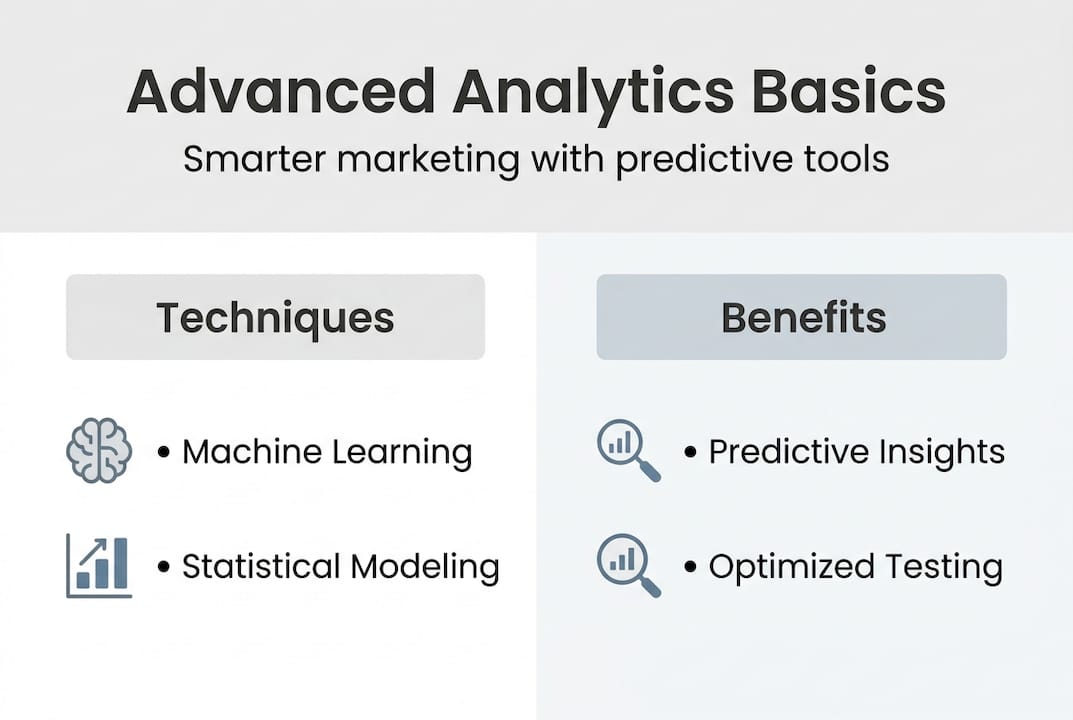
Traditional BI tools are retrospective. They answer "what happened last month?" Advanced analytics answers "what will happen next quarter, and what should we do about it?" That shift from backward-looking to forward-looking is fundamental.
| Feature | Traditional BI | Advanced analytics |
|---|---|---|
| Focus | Past performance | Future predictions and recommendations |
| Data handling | Structured, clean | Structured and unstructured |
| Human input | High (manual queries) | Low (automated discovery) |
| Speed to insight | Hours to days | Real-time or near real-time |
| Skill required | Analyst or power user | Accessible via modern tools |
The core techniques powering advanced analytics include:
- Machine learning: Algorithms that learn from data and improve their predictions over time without being explicitly reprogrammed
- Data mining: Finding meaningful patterns buried in large datasets, especially useful for audience segmentation
- Forecasting: Statistical models that project future outcomes based on historical trends
- Neural networks: Computing systems that loosely mimic the human brain, used for complex pattern recognition like image or text analysis
There is also a hierarchy worth understanding. Descriptive analytics tells you what happened. Predictive analytics tells you what will likely happen. Prescriptive analytics tells you what action to take. Most marketing teams operate almost entirely at the descriptive level, even when they think they're doing something more sophisticated.
As Alteryx notes, advanced analytics encompasses predictive analytics (forecasting future outcomes using statistical models and ML) and prescriptive analytics (recommending optimal actions via optimization and simulation). Both are essential to extracting maximum value from your data.
For practical context, think about your last campaign review. If you analyzed click rates and conversion data after the campaign ended, that's descriptive analytics. If a model had predicted which audience segments were most likely to convert before you spent budget, that's predictive. If the system had automatically shifted budget toward the highest-probability segments mid-campaign, that's prescriptive. Understanding marketing analytics basics is the foundation, but the real competitive edge lives a few layers up.
How advanced analytics powers smarter A/B testing
With a foundational understanding, let's see how advanced analytics makes A/B testing more efficient and effective.
Standard A/B testing is powerful but slow. You split traffic, wait for statistical significance, and then act on the result. That process works, but it wastes traffic on losing variants and requires enough volume to reach reliable conclusions. Advanced analytics changes the equation significantly.
AI-powered adaptive testing optimizes A/B testing by enabling multi-armed bandits for real-time traffic reallocation, predictive modeling for variant performance forecasting, and personalization at scale. Multi-armed bandit testing is one of the clearest examples. Instead of splitting traffic 50/50 until a test concludes, a multi-armed bandit algorithm continuously monitors variant performance and dynamically shifts more traffic toward the better-performing version. Your users are less likely to see the losing variant, you lose less revenue during the test, and you often reach a confident conclusion faster.
Predictive modeling layers on top of this. A model can analyze early patterns from a test, such as the first 500 sessions, and forecast which variant is likely to win before you've collected enough data for traditional statistical significance. This is particularly valuable for SMBs with moderate traffic volumes where reaching 95% confidence on a test could take weeks.

A/B testing for SMBs shows 98% of small businesses report positive results, yet many still cite resource and traffic limits as barriers. Advanced analytics bridges this gap through automation, though it requires quality data and clear hypotheses to avoid introducing bias.
Here's a practical sequence for integrating advanced analytics into your A/B testing program:
- Define a specific, measurable hypothesis before you touch any tool. Vague tests produce vague results, no matter how sophisticated the analytics.
- Audit your data quality. Machine learning models built on messy or incomplete data will produce confident but wrong recommendations.
- Select an adaptive testing method appropriate to your traffic levels. Multi-armed bandits work better than traditional splits for lower-volume situations.
- Set up automated reporting triggers so insights surface without someone manually checking dashboards every day.
- Act on results within a defined window. Advanced analytics generates recommendations, but those recommendations lose value if you take three weeks to implement them.
Pro Tip: Pair your adaptive testing setup with segment-level analysis. A variant that "wins" overall might actually underperform for a specific audience segment. Predictive models can surface these nuances that aggregate results miss entirely.
For teams ready to go deeper, advanced A/B strategies and a solid grasp of A/B testing definitions will help you connect methodology to practical execution.
Key methodologies: From machine learning to optimization
Understanding what advanced analytics can do in testing, it's useful to look at the practical methods that power those results.
The phrase "advanced analytics" can feel overwhelming because it bundles together several distinct disciplines. Let's break them into concrete tools you'll actually encounter as a marketer or product manager.
Key methodologies include machine learning, statistical modeling, data and text mining, pattern matching, multivariate statistics, simulation, and optimization techniques like linear programming. Each has a specific role in marketing and product decisions.
Machine learning is the engine behind recommendation engines, churn prediction models, and lookalike audience generation. When a platform identifies users who behave like your best customers, it's running machine learning in the background.
Statistical modeling is what powers most well-run A/B tests. Regression models, for example, can help you understand which variables (device type, session time, traffic source) most influence conversion rate, so you can design more targeted experiments.
Data mining excels at finding patterns in behavior data at scale. If you want to discover which combinations of actions predict a free trial conversion, data mining algorithms can scan millions of sessions and surface those patterns without you specifying them in advance.
Optimization techniques like linear programming are used to solve resource allocation problems. For marketers, this might mean determining the optimal budget distribution across channels to maximize return within a set of constraints, such as budget caps or minimum spend thresholds per platform.
Simulation lets you model hypothetical scenarios before committing resources. Running a simulation that tests ten different pricing structures or landing page flows before any live experiment saves both time and budget.
- Predicting user churn by analyzing login frequency, feature usage, and support ticket patterns
- Segmenting audiences dynamically based on behavioral signals rather than static demographic categories
- Optimizing promotional offers by modeling price sensitivity across different customer cohorts
- Forecasting campaign lift before launch using historical response rate patterns
Pro Tip: You don't need to master the math behind these methodologies. What matters is knowing which questions each method can answer, so you ask for the right analysis at the right time. A good A/B testing integration guide will show you how these methods connect to real campaign workflows.
Predictive vs. prescriptive analytics: What's the difference?
The sophistication of advanced analytics comes into full view when we differentiate the types of questions it answers.
Both predictive and prescriptive analytics sit under the advanced analytics umbrella, but they answer fundamentally different questions. Confusing them leads to misapplied tools and missed opportunities.
Predictive analytics answers: What will happen? It uses historical data, statistical algorithms, and machine learning to forecast future outcomes. Classic marketing use cases include predicting which leads are most likely to convert, which customers are at risk of churning, or which campaign creative will generate the highest click-through rate based on past performance.
Prescriptive analytics answers: What should I do about it? It goes one step further by recommending specific actions. It uses the output of predictive models combined with optimization and simulation to suggest the best course of action given your goals and constraints.
The distinction between these two is critical because prescriptive analytics requires you to define what "optimal" means. Optimal for revenue? For customer lifetime value? For retention? Without that clarity, prescriptive recommendations can actually push you in the wrong direction.
Here's a concrete example. Suppose you're running a subscription SaaS product. A predictive model flags 200 users with an 80% probability of canceling within 30 days. That's valuable information, but it doesn't tell you what to do. A prescriptive model looks at those 200 users, their plan type, usage patterns, and previous response to promotions, and then recommends specific interventions. Maybe 80 of them should receive a personalized email with a feature walkthrough, 60 should get a discount offer, and 60 are unlikely to respond to any intervention and probably shouldn't receive outreach at all. That level of specificity is where prescriptive analytics earns its value.
Key principles for combining both types effectively:
- Start with a clear business question before selecting your analytics approach
- Use predictive models to identify where to focus your attention and resources
- Apply prescriptive analysis only after you've defined your optimization goal with precision
- Validate prescriptive recommendations with small-scale tests before scaling actions
The most common mistake we see: teams generate excellent predictions and then make decisions based on intuition anyway. The prediction becomes a data point in a gut-feel process rather than the foundation of a structured action plan.
Getting started doesn't require building a data science team. Reviewing getting started with analytics and applying even basic predictive thinking to your existing campaigns will move you ahead of most competitors in your space.
Why most SMBs underuse advanced analytics—and how you can set yourself apart
Here's what we've noticed working with marketers across small and medium-sized businesses: the barrier to advanced analytics isn't technology. Modern platforms have made sophisticated analysis genuinely accessible. The real barrier is the fear of doing it wrong, combined with a habit of reaching for familiar reports instead of asking sharper questions.
Most teams default to basic metrics because those metrics are fast, easy to explain in a meeting, and don't require anyone to defend a modeling assumption. That comfort is costing you. Competitors who commit to structured hypotheses and act on strategic A/B testing insights are compounding their learning faster than teams still debating last month's bounce rate.
The uncomfortable truth is that the value of advanced analytics doesn't come from the sophistication of the tool. It comes from the discipline to ask a specific question, collect clean data, and actually change your behavior based on what the model tells you. We've seen teams with expensive analytics stacks produce no actionable change because no one was responsible for operationalizing the output.
You don't need a data scientist. You need a clear hypothesis, a reliable data source, and a culture that treats test results as decisions rather than talking points. Start with one predictive question relevant to your current biggest challenge. Build from there.
Next steps: Empower your marketing analytics journey
Ready to put these insights to work? Here's where to go from theory to action.
Advanced analytics doesn't require a six-figure data team or months of setup. With the right platform, your team can move from basic reporting to adaptive testing and real-time insights quickly. Stellar is built specifically for marketers and product managers who want that capability without the complexity.
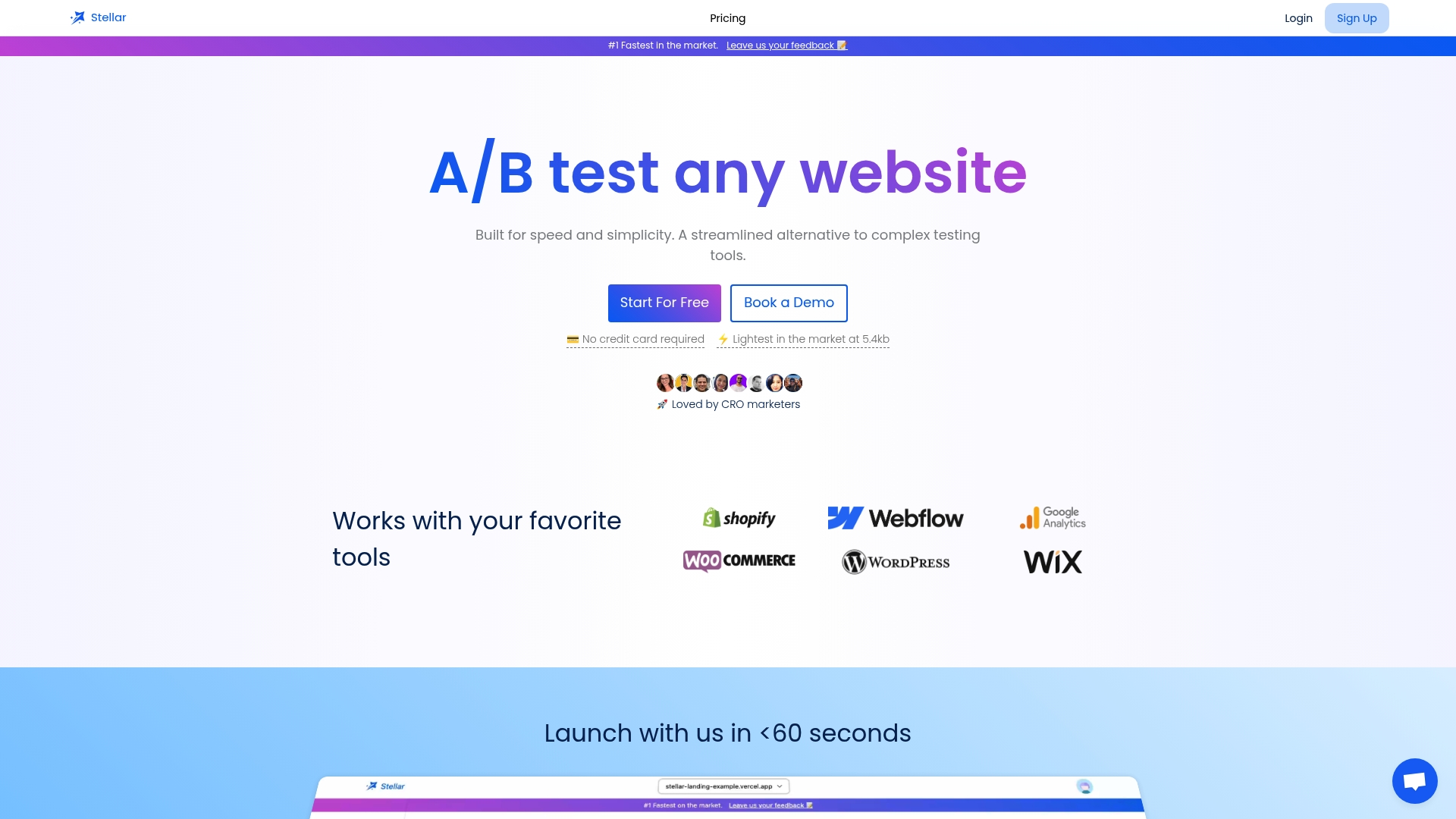
Stellar's real-time analytics and advanced goal tracking give you the foundation to run smarter experiments from day one. Whether you're just getting started or ready to level up, you can explore advanced strategies to sharpen your testing program, or start with analytics if you want to build the foundation first. Stellar's free plan covers up to 25,000 monthly tracked users, so there's no reason to wait.
Frequently asked questions
What makes analytics "advanced" versus basic reporting?
Advanced analytics uses machine learning and predictive modeling to automate discoveries and surface recommendations, unlike basic reporting that only summarizes past data. The key distinction is autonomy: advanced analytics finds answers to questions you haven't explicitly asked.
Is advanced analytics only for big companies?
No. AI-powered adaptive testing and other advanced analytics capabilities are increasingly accessible through modern SaaS platforms designed for SMBs, often without requiring a dedicated data science team.
What is a real-world example of advanced analytics in marketing?
Predictive models can forecast which customers are likely to cancel within 30 days, while prescriptive analytics then recommends specific retention actions tailored to each user's behavior and history.
Do I need perfect data for advanced analytics to be effective?
Not perfect, but reasonably clean. Quality data and clear hypotheses are essential foundations; most SMBs can start generating value without flawless datasets as long as goals are specific and data collection is consistent.
Recommended
Published: 4/26/2026