
Best Google Optimize Alternatives for Marketers in 2026
TL;DR:
- Google Optimize was discontinued in September 2023, prompting marketers to seek replacements that integrate well within the Google ecosystem.
- Choosing the right alternative depends on factors like traffic volume, compliance needs, and whether the focus is on testing or personalization, with options ranging from free open-source tools to enterprise platforms.
Google Optimize was officially discontinued on September 30, 2023, leaving marketers scrambling for a replacement that matched its simplicity and tight Google ecosystem integration. The problem is not a shortage of google optimize alternatives. There are dozens. The real challenge is that these tools vary wildly in compliance architecture, personalization depth, pricing logic, and the traffic volumes they actually serve well. Picking the wrong one wastes budget, creates data gaps, and slows down your testing program before it even starts. This article cuts through the noise with clear criteria, honest tool breakdowns, and a decision framework matched to your actual situation.
Table of Contents
- Key takeaways
- The best google optimize alternatives ranked for 2026
- 1. VWO
- 2. Convert.com
- 3. AB Tasty
- 4. GrowthBook
- 5. Statsig
- 6. Optimizely
- 7. Kameleoon
- 8. Dynamic Yield
- Side-by-side comparison of top alternatives
- How to pick the right tool for your situation
- My honest take after watching teams navigate this transition
- Why Gostellar is worth a serious look post-Google Optimize
- FAQ
Key takeaways
| Point | Details |
|---|---|
| Google Optimize is gone | The platform shut down in September 2023, making a replacement search unavoidable for active testing programs. |
| Match tool to traffic volume | Sites under 50,000 monthly visitors should start with free or open-source tools before investing in paid platforms. |
| Compliance comes first | If your business operates under GDPR or CCPA, prioritize platforms with privacy-first architecture from the start. |
| Integration saves hours | Native GA4 integration prevents data reconciliation headaches that manual API setups routinely create. |
| Build hypotheses before buying | Starting with qualitative research tools builds a testing backlog that makes any paid platform far more effective. |
The best google optimize alternatives ranked for 2026
Before reviewing specific tools, you need a clear framework. Picking a platform based on a features page or a G2 rating alone is how teams end up with expensive software that runs one test per quarter. Here is what actually matters when you evaluate any Google Optimize competitor.
Compliance architecture. GDPR and CCPA are not checkbox features. Some platforms bolt on a consent banner and call it compliant. Others are built privacy-first at the data layer. If you operate in the EU or California, this distinction matters enormously.
Personalization vs. pure testing. These are genuinely different workflows. A/B testing answers "does version B convert better?" Personalization asks "which experience should this segment see?" Many tools do both, but they prioritize one. Know which one your program actually needs right now.
Traffic volume thresholds. Statistical significance takes longer to reach on low-traffic sites. Running underpowered tests produces misleading results. Your platform choice should reflect how much traffic you realistically have to work with.
Native GA4 integration. Native out-of-the-box GA4 integration significantly reduces data reconciliation effort compared to manual API setups. Google Optimize's biggest competitive edge was integration within the Google ecosystem, and any replacement should match that ease.
Pricing model fit. Flat monthly fees, session-based billing, and MAU (monthly active users) pricing all create different cost curves as you scale. Model your expected traffic against each pricing structure before signing up.
Pro Tip: Before you compare any tools, write down your monthly traffic number, your primary goal (testing or personalization), and whether GDPR compliance is a hard requirement. These three inputs will eliminate 80% of the options immediately.
1. VWO
VWO is the most frequently cited replacement for mature CRO programs. It combines A/B testing, heatmaps, session recordings, and on-page surveys under one roof with shared user identification. That consolidation alone saves 30 to 40% of program time previously spent jumping between tools. VWO works best for mid-market teams handling more than 50,000 monthly visitors who need diagnostic data and testing in one place. Pricing starts in the mid-hundreds per month, so it is not the right entry point for small sites.

2. Convert.com
Convert.com is the clearest choice when GDPR compliance is a non-negotiable architectural requirement. It was built privacy-first from the ground up, not retrofitted. The platform processes data in a way that minimizes personal data exposure by design, which matters for regulated industries and EU-facing businesses. Convert.com supports multivariate testing, A/B testing, and split URL testing. Platform selection mapped to compliance needs consistently points here when privacy is the primary constraint.
3. AB Tasty
AB Tasty sits at the intersection of testing and personalization, leaning more toward the latter. If your roadmap includes audience segmentation, dynamic content, and tailored experiences rather than simple A/B splits, AB Tasty fits that workflow well. It includes a visual editor, feature flagging, and real-time audience targeting. The tradeoff is price. AB Tasty is an enterprise-tier product, and the cost reflects that. It is not the right tool if you are still running your first dozen tests.
4. GrowthBook
GrowthBook is an open-source experimentation platform that has gained serious traction since Google Optimize shut down. For sites with fewer than 50,000 monthly visitors, it provides equivalent testing rigor at no cost. You can self-host it or use the cloud version. The catch is that setup requires engineering involvement. If you have a developer available, GrowthBook is hard to beat at the free tier. If you need a marketer-friendly no-code setup, it will frustrate you.
5. Statsig
Statsig is another strong free-tier option built originally for product teams but increasingly adopted by growth marketers. It handles feature flags, A/B tests, and product analytics. Like GrowthBook, it performs well for lower-traffic sites under 50,000 visits per month where paid platforms are cost-inefficient. Statsig also offers a generous free plan that scales surprisingly far before triggering paid tiers.
6. Optimizely
Optimizely is the original enterprise A/B testing platform. It offers some of the most advanced targeting, multipage experiments, and feature management capabilities on the market. The platform is genuinely powerful, but it is priced accordingly. Teams that used Google Optimize as a lightweight free tool will find the jump to Optimizely jarring. It belongs in a comparison only if your testing program is already mature and your organization is willing to invest at enterprise budget levels.
7. Kameleoon
Kameleoon specializes in AI-driven personalization and server-side testing. It is particularly strong for e-commerce and media companies that need real-time personalization at scale. Kameleoon also has solid GDPR compliance documentation, making it a viable option for European marketers who still want personalization depth. It sits in a similar price range to VWO and AB Tasty, so budget the same way.
8. Dynamic Yield
Dynamic Yield, now part of Mastercard, focuses almost entirely on personalization rather than traditional A/B testing. It uses machine learning to deliver individualized experiences across channels. This is a product for organizations that have already mastered A/B testing fundamentals and are ready to invest in true 1:1 experience optimization. If you are replacing Google Optimize because you need a basic testing tool, Dynamic Yield is three steps ahead of where you are.
Side-by-side comparison of top alternatives
| Tool | Starting price | GDPR compliant | A/B testing | Personalization | Best for traffic | Native GA4 | Key strength |
|---|---|---|---|---|---|---|---|
| VWO | ~$400/mo | Yes | Yes | Limited | 50K+ | Yes | All-in-one diagnostics |
| Convert.com | ~$200/mo | Privacy-first | Yes | Basic | 50K+ | Yes | Compliance architecture |
| AB Tasty | Enterprise | Yes | Yes | Advanced | 100K+ | Partial | Audience segmentation |
| GrowthBook | Free / self-host | Yes | Yes | No | Any | Via warehouse | Open-source flexibility |
| Statsig | Free tier | Yes | Yes | Limited | Under 50K | Manual | Product + growth overlap |
| Optimizely | Enterprise | Yes | Advanced | Advanced | 200K+ | Limited | Feature management |
| Kameleoon | ~$300/mo | Yes | Yes | Advanced | 50K+ | Partial | AI personalization |
| Gostellar | Free + paid tiers | Yes | Yes | Yes | Under 25K free | Yes | Speed + no-code setup |
How to pick the right tool for your situation
Stop reading feature comparison articles and start with your own constraints. Here is a practical decision path based on the most common marketer profiles.
-
Your primary concern is GDPR compliance. Go with Convert.com. Its data processing architecture is built for this. Do not try to make a less compliant platform work with extra configuration.
-
You need personalization more than testing. AB Tasty is the right call. Just budget for the enterprise tier and plan a 3 to 6 month onboarding period to use it properly.
-
Your site gets under 50,000 monthly visitors. Avoid expensive platforms for now. Start with qualitative research tools like Microsoft Clarity to build a hypothesis backlog, then run experiments with GrowthBook or Gostellar's free plan.
-
You have a mature CRO program and need diagnostics. VWO is the most time-efficient choice. The combined heatmaps, recordings, and testing in one shared data layer justifies the price at scale.
-
You are a small to mid-sized business with a marketer (not a developer) leading testing. You need a no-code visual editor, real-time analytics, and a lightweight script that does not tank your page speed. Gostellar's 5.4KB script and no-code editor were built exactly for this. Check out how other SMB marketers evaluate A/B tools before committing to a platform.
Pro Tip: Build a backlog of at least 10 test hypotheses before subscribing to any paid tool. If you cannot fill a backlog, you are not ready for a paid platform, and you should spend that budget on user research first.
Personalisation is a stage-three priority. Before chasing advanced segmentation, focus on reducing conversion friction with solid testing fundamentals. Most teams skip steps two and three and then wonder why their personalization investment underdelivers.
My honest take after watching teams navigate this transition
I have watched a lot of marketing teams make this transition since Google Optimize shut down. And the pattern that keeps coming up is not about which tool they picked. It is about when they bought it.
Marketers prematurely invest in paid testing platforms without a testing backlog, and the result is expensive software running idle for months. I have seen teams spend $500 a month on a platform and run two tests in six months because they had no hypotheses ready. That is not a tool problem. That is a process problem.
My take is that a stepwise approach starting with qualitative research is the most underrated advice in CRO. Spend two months with a free heatmapping tool before you open your wallet for a testing platform. The insights you collect will make every subsequent test sharper.
I am also skeptical of teams that jump straight to personalization. Personalization is genuinely powerful, but it requires clean data, a solid audience taxonomy, and a clear content strategy. Most SMBs do not have all three. They end up showing slightly different hero images to two segments and calling it personalization. Do the testing fundamentals first.
One more thing: native GA4 integration is not a nice-to-have. It is how you avoid spending Friday afternoons reconciling data that should match automatically. If your platform has GA4 integration built in, your reporting is cleaner and your decision-making is faster. Make it a filter, not a checkbox.
— Juan
Why Gostellar is worth a serious look post-Google Optimize
If you are a marketer or business owner at a small to mid-sized company, the last thing you need is a platform that requires a developer to set up every test. Gostellar was built for exactly the situation you are in right now.
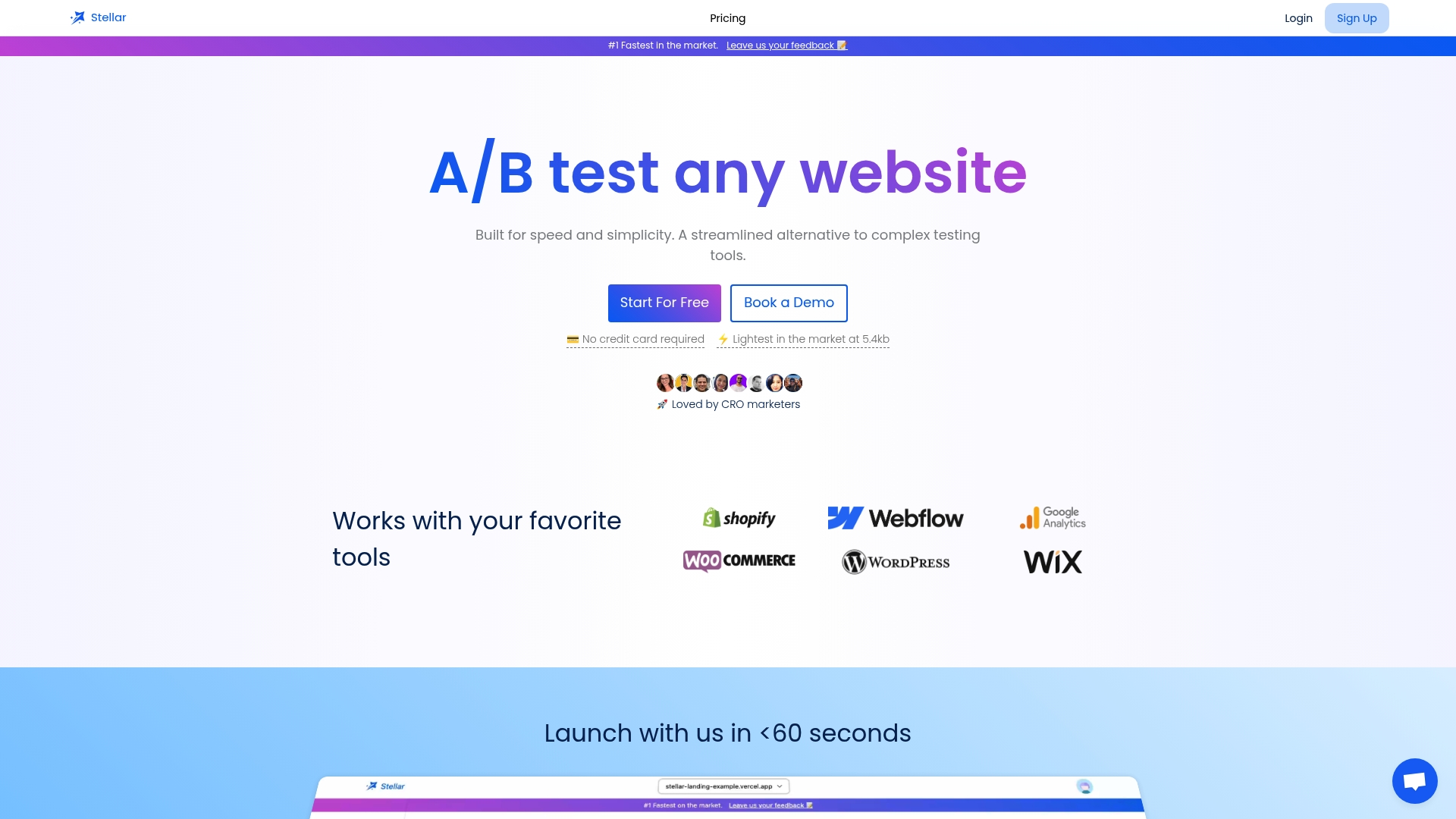
The platform runs on a 5.4KB script that loads fast enough to have zero perceptible impact on page speed, which matters when Google is measuring your Core Web Vitals. The no-code visual editor means you can set up an A/B test in minutes without touching code. Dynamic keyword insertion lets you personalize landing pages without building separate pages for each variation. And real-time analytics give you results you can actually act on without waiting for weekly reports.
For businesses with under 25,000 monthly tracked users, the free plan covers everything you need to start testing seriously. Paid tiers scale as your traffic grows. If you are still figuring out what Google Optimize was and how to think about your replacement options, that resource is a strong starting point. When you are ready to see how A/B testing platforms compare across the market, Gostellar consistently earns its spot on the shortlist for speed, simplicity, and practical conversion optimization.
FAQ
What replaced Google Optimize after it shut down?
There is no single official replacement. The most commonly adopted alternatives include VWO, Convert.com, AB Tasty, GrowthBook, and Statsig, each suited to different budget levels, traffic volumes, and compliance requirements.
Which Google Optimize alternative is best for small businesses?
For small businesses with under 25,000 monthly visitors, Gostellar's free plan and GrowthBook's open-source option offer the best value. Both require minimal technical setup and deliver real testing capability without a paid commitment.
Is there a free Google Optimize alternative?
Yes. GrowthBook, Statsig, and Gostellar all offer free tiers. GrowthBook is fully open-source and self-hostable. Gostellar's free plan covers up to 25,000 monthly tracked users with full access to its visual editor and goal tracking.
How do I choose between VWO and Convert.com?
Choose VWO if you need an all-in-one suite with heatmaps and session recordings for a mature CRO program. Choose Convert.com if GDPR compliance architecture is your primary requirement and you operate in regulated markets.
Do I need a developer to set up a Google Optimize alternative?
It depends on the tool. GrowthBook and Statsig benefit from engineering involvement. Gostellar and VWO offer no-code visual editors that let marketers build and launch tests without developer support.
Recommended
Published: 5/24/2026