
Best 6 Landing Page Testing Tools – Expert Comparison 2025
Choosing the right tool to run experiments on your website can shape the way you learn about your visitors and grow your business. Some platforms make it simple to try new ideas in minutes while others offer deeper analytics or help you personalize every experience. If you want to test headlines, compare page layouts, or track visitor behavior in detail, the differences matter. The right platform can turn curious clicks into real insights and help you find out what actually works. Discover which solution fits your goals best as you explore features built for fast results, privacy, and smarter decisions.
Table of Contents
- GoStellar
- Optimizely
- VWO (Visual Website Optimizer)
- Optimizely
- VWO (Visual Website Optimizer)
- Unbounce
GoStellar
At a Glance
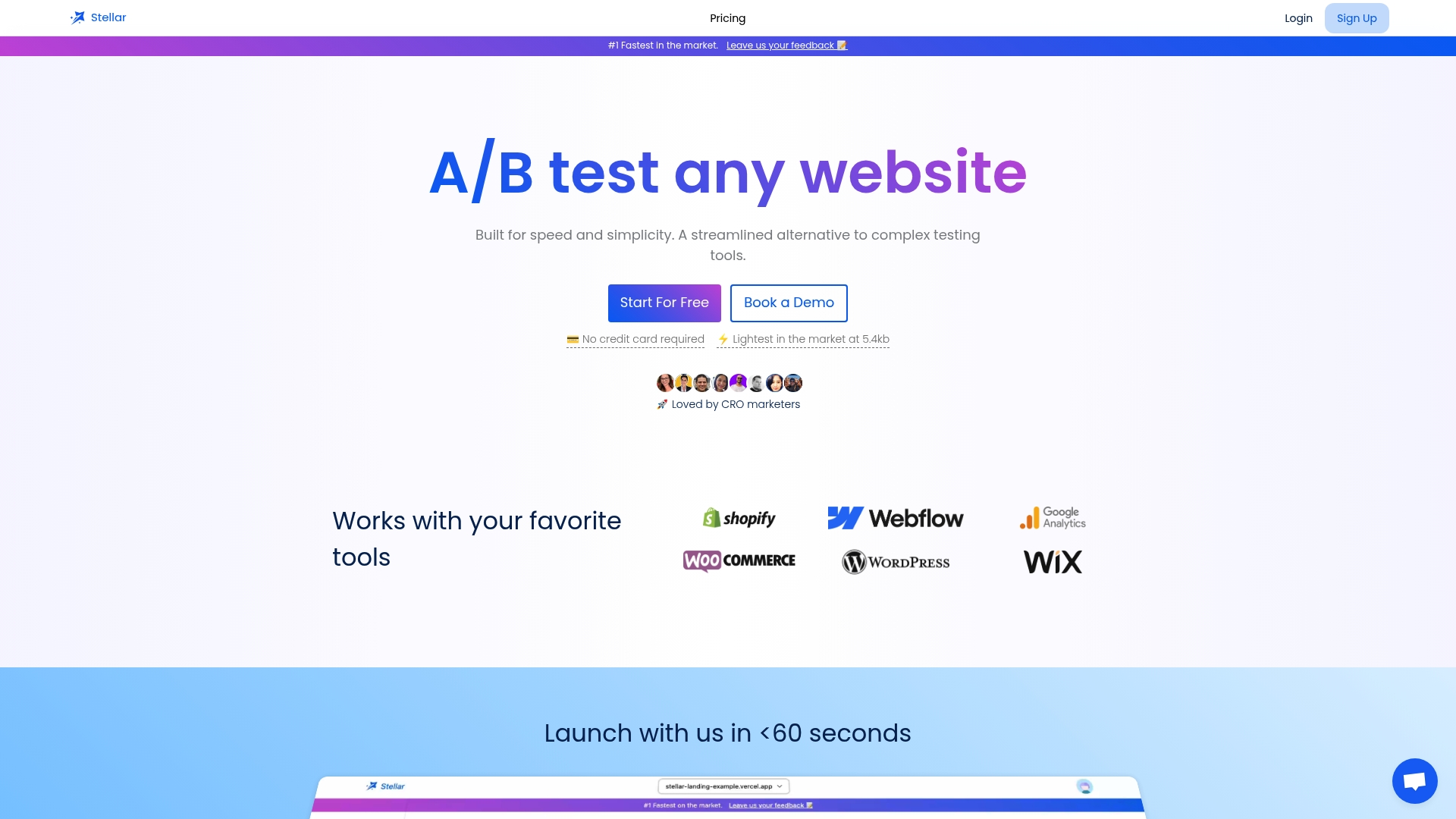
GoStellar is a fast, focused A/B testing platform built for marketers who need speed, simplicity, and actionable results. Its 5.4KB CDN-served script and cookie-free, GDPR-compliant approach minimize site performance and privacy friction, so experiments run without slowing pages or creating legal overhead. With a 21-day free trial, pay-as-you-go billing, and a free plan for smaller sites, it’s designed to get tests live quickly and deliver real-time insights you can act on.
Core Features
GoStellar combines a no-code visual editor with advanced customization options like custom JavaScript and CSS, so you can launch simple variants in minutes or implement complex changes when needed. The platform supports dynamic keyword insertion for personalized landing pages and features real-time performance analysis with detailed breakdowns. AI-powered conversion insights help prioritize winners faster, and built-in integrations with GA4, Segment, and Mixpanel simplify data centralization. Goal setup is straightforward, allowing you to track multiple conversions, while dynamic billing based on monthly tracked users (MTU) keeps costs aligned with actual usage.
Pros
- Easy to set up and use: The visual no-code editor lets you create and deploy experiments without engineering time, so marketers can iterate quickly.
- Lightweight with minimal speed impact: The 5.4KB script served via CDN dramatically reduces performance overhead compared with heavier solutions.
- Affordable, flexible pricing: A free tier for sites under 25,000 monthly tracked users plus pay-as-you-go billing makes it cost-effective for small and growing teams.
- Personalization and customization combined: Dynamic keyword insertion alongside custom JavaScript and CSS supports both simple personalization and developer-driven tweaks.
- Actionable analytics and AI insights: Real-time analysis and AI-powered conversion guidance cut down the time from data to decision.
- Positive support and reviews: Users report helpful customer support and a smooth onboarding experience.
Who It's For
GoStellar is ideal for marketers, CRO specialists, growth teams, and product managers at small to medium-sized businesses who need an uncomplicated, high-performance testing tool. If you prioritize page speed, privacy compliance, and rapid experimentation without heavy engineering resources, GoStellar fits perfectly.
Unique Value Proposition
GoStellar’s real advantage is its ruthless focus on speed and simplicity: a 5.4KB CDN script, cookie-free GDPR compliance, and a no-code editor that shortens the path from idea to test. That combination delivers the rare trifecta of performance, privacy, and practical insights—so you don’t trade site speed for experimentation capability. Its dynamic billing model and free tier make it accessible to teams with fluctuating traffic, while integrations with GA4, Segment, and Mixpanel preserve analytical continuity. Some trade-offs—like a deliberate emphasis on streamlined workflows over a sprawling feature set—are intentional design choices to keep the product nimble and approachable for the teams it serves.
Real World Use Case
An ecommerce team used GoStellar to test multiple product page layouts, launching variants via the visual editor and measuring results in real time. AI insights highlighted which layout elements drove conversions, and dynamic keyword insertion boosted relevance on paid landing pages, resulting in faster, data-driven wins.
Pricing
Free plan at $0 for up to 25,000 monthly tracked users; Pro plan at $99 per month with extra features; Enterprise plans available with custom pricing. A 21-day free trial is available to test the platform.
Website: https://gostellar.app
Optimizely
At a Glance
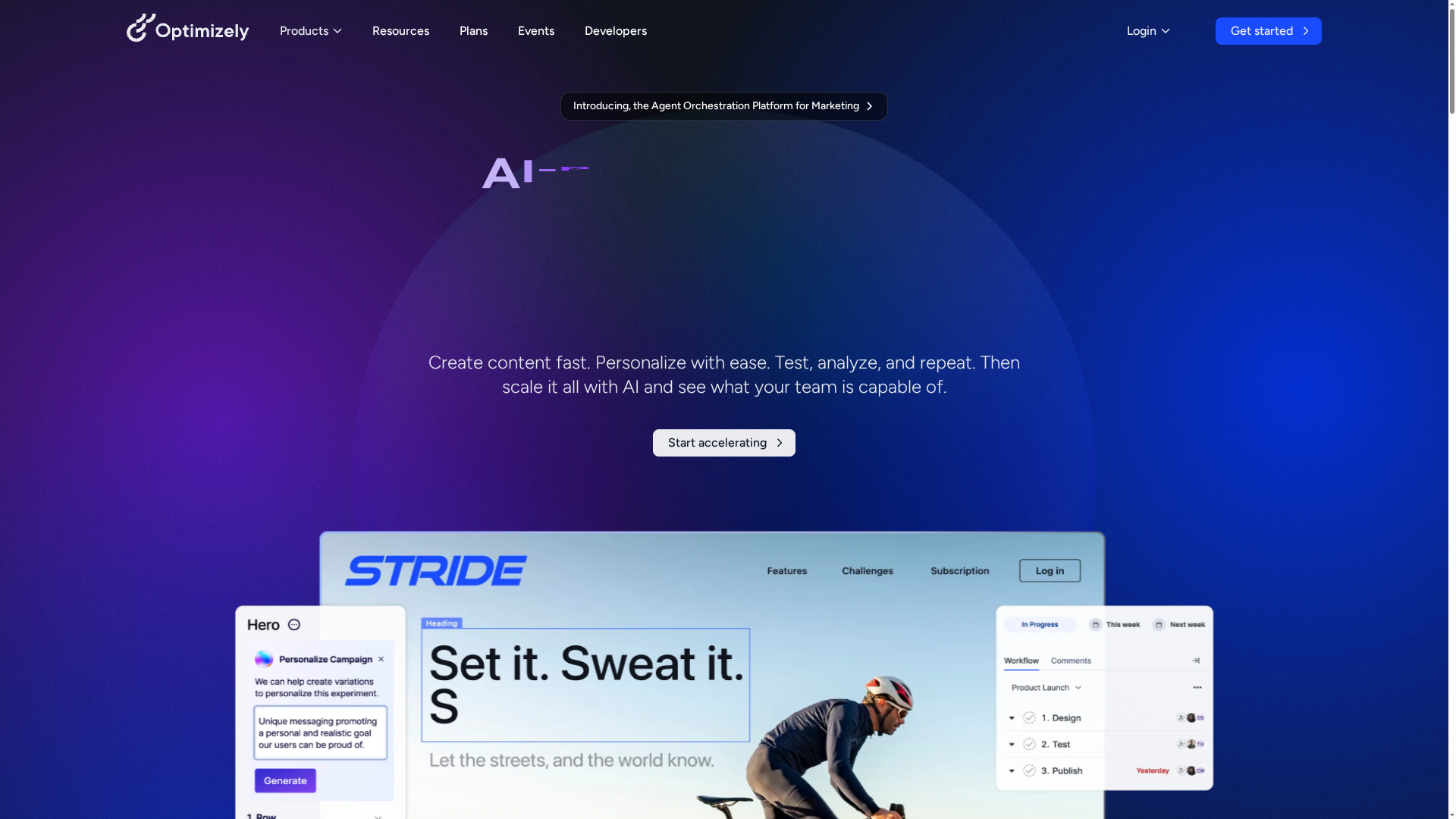
Optimizely is an enterprise-grade digital experience platform that combines experimentation, personalization, content management, analytics, and commerce capabilities under one roof. It uses AI-driven tooling to help marketing and development teams test and refine experiences at scale. If you need a single platform to run A/B tests, personalize content, and measure downstream impact, Optimizely is a strong candidate — though it may feel heavyweight for very small teams.
Core Features
Optimizely bundles an AI-powered digital experience platform with content creation and management tools, A/B testing and experimentation, personalization and targeting, and commerce features for online stores. Its analytics and insights are delivered via warehouse-native reports and dashboards so you can connect experiments to business metrics. The platform integrates with common apps and supports scalable customization, enabling both marketers and developers to collaborate on tests and personalized experiences.
Pros
- Comprehensive experimentation and personalization tools make it possible to run complex tests and deliver tailored experiences across channels.
- Seamless integration with various apps and tools simplifies data flow and reduces the need for custom engineering work.
- AI-driven insights and automation capabilities accelerate hypothesis generation and help prioritize tests that matter to business KPIs.
- Support for customization allows teams to adapt the platform to different technical stacks and business requirements.
- Robust analytics and reporting features provide clear, warehouse-native dashboards that tie experiments to measurable outcomes.
Cons
- Pricing details are provided on a case-by-case basis, which can make cost comparison and budgeting difficult for smaller organizations.
- The platform’s breadth and depth create complexity that may overwhelm small teams or groups new to experimentation platforms.
- Some advanced features require technical expertise to configure and maintain, so you may need developer resources to unlock full value.
Who It’s For
Optimizely is best suited for marketing teams, content creators, digital analysts, developers, and ecommerce leaders at mid-market to enterprise organizations that need a unified platform for experimentation, personalization, and content management. If your team runs frequent tests, relies on cross-team collaboration, and needs analytics tied directly to business data, Optimizely will likely fit your workflow.
Unique Value Proposition
Optimizely’s unique value lies in its all-in-one approach: it merges experimentation, content management, personalization, commerce, and warehouse-native analytics in a single platform with AI-assisted capabilities. That combination lets teams iterate faster while keeping measurement consistent across experiments and channels.
Real World Use Case
A retail or media company can use Optimizely to A/B test multiple landing page layouts, then apply AI-driven personalization to serve product recommendations or article variants to different audience segments. By linking experiment results to warehouse metrics, the team can quantify increases in engagement and revenue and roll out winning experiences confidently.
Pricing
Pricing is tailored to each customer and available upon request, with demos and custom quotes provided by the vendor. There is no public list price, so expect a sales consultation to determine costs based on your needs and scale.
Website: https://optimizely.com
VWO (Visual Website Optimizer)
At a Glance
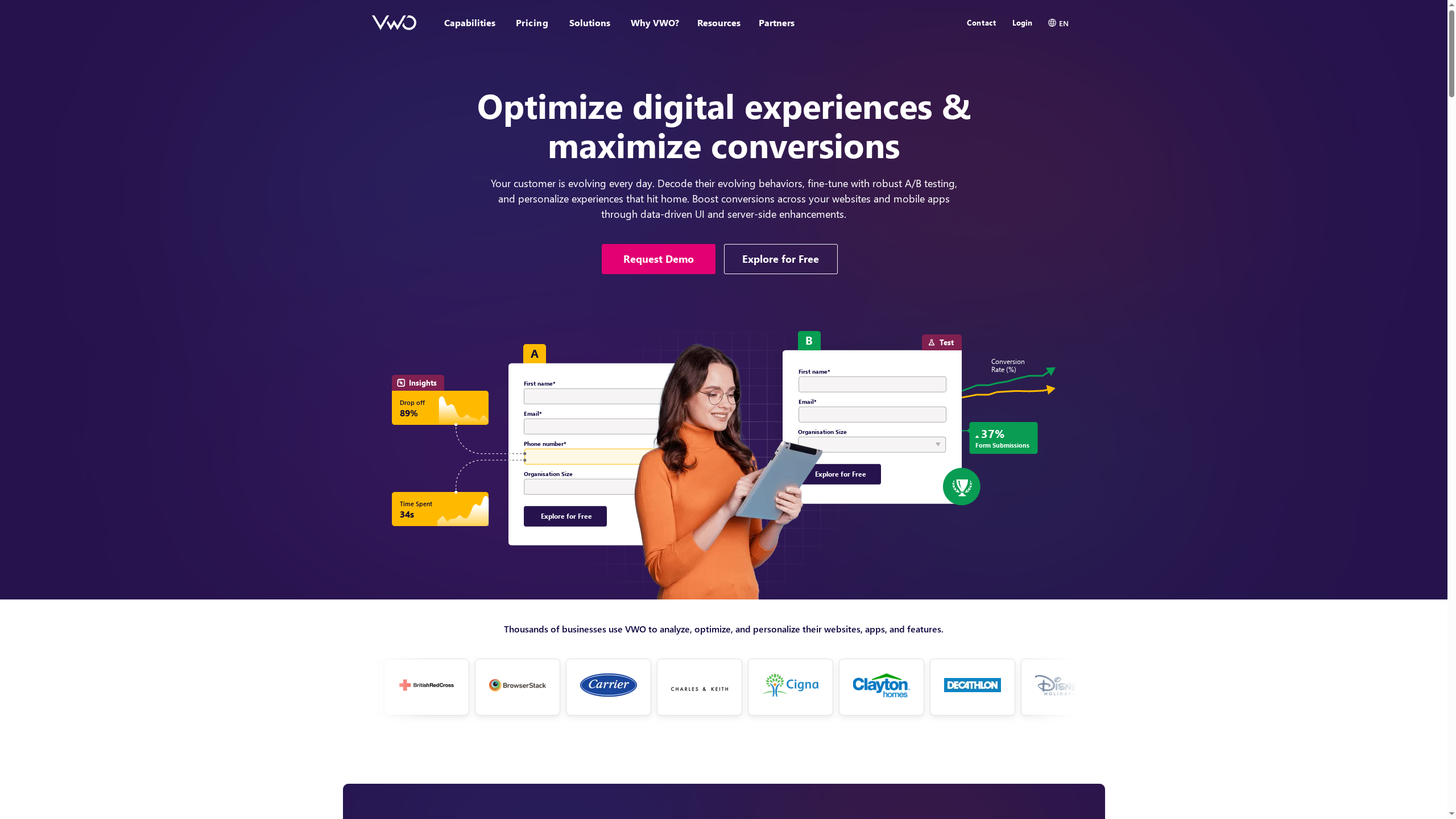
VWO is a comprehensive experimentation platform that brings A/B testing, personalization, and behavior analytics into a single suite. It’s built to support testing across websites and mobile apps while giving teams visual editors and no-code options to move faster. For teams that need a scalable, enterprise-ready solution, VWO delivers real-time analytics and integrations that reduce friction between insight and action. Expect a full feature set that requires investment in onboarding but repays it with deeper, data-driven optimizations.
Core Features
VWO combines A/B testing, split URL testing, and multivariate testing with robust personalization and segmentation tools to tailor experiences by behavior, device, geo, and custom attributes. The platform includes heatmaps, session recordings, click and scroll maps, surveys, and form analytics to contextualize quantitative results. Advanced targeting and third-party integrations extend its reach into existing tech stacks, while AI-powered recommendations and VWO Copilot help automate experiment ideas and prioritization. Multi-device support and enterprise-grade security complete the package for larger teams.
Pros
- Comprehensive testing and personalization suite: VWO covers A/B, split URL, and multivariate testing alongside personalization, so you can run end-to-end experimentation without stitching multiple tools together.
- Scalable for different business sizes: The platform is designed to scale from smaller teams to large enterprises, which makes it a one-stop solution as your experimentation program grows.
- Real-time analytics and reporting: VWO provides timely insights so you can act quickly on experiment results and iterate faster on winning variations.
- Seamless integration capabilities: The product integrates with third-party tools and APIs, easing dataflow between analytics, tag managers, and marketing systems.
- User-friendly visual editors and no-code options: Visual editors lower the barrier to entry for non-technical users, enabling marketers to build and launch tests without heavy developer support.
Cons
- Pricing is available upon request: VWO requires prospects to request pricing, which can be a barrier for small startups that need transparent, self-serve cost information.
- Steep learning curve for complex features: The breadth of capabilities means teams may need time and training to fully leverage advanced targeting, AI recommendations, and enterprise features.
- Some advanced features require add-ons: Not every capability is bundled by default, so unlocking certain enterprise-grade options may add additional cost or configuration complexity.
Who It's For
VWO is best suited for mid-sized to large businesses that want a robust experimentation and personalization platform integrated with their existing tech stack. It fits product and growth teams that need enterprise features, real-time reporting, and a single, scalable solution for web and mobile optimization.
Unique Value Proposition
VWO’s strength lies in combining experimentation, behavior analytics, and personalization in a single platform, backed by enterprise-grade security and AI-assisted recommendations. That unified approach shortens the feedback loop from test idea to measurable impact.
Real World Use Case
A retail company used VWO to test alternative product page layouts, implement personalized content for distinct customer segments, and analyze user interaction with heatmaps and session recordings—resulting in a significant increase in conversions and improved customer satisfaction.
Pricing
Pricing varies by plan and feature set, with options for Starter, Growth, Pro, and Enterprise plans and custom quotes available for enterprise needs.
Website: https://vwo.com
Optimizely
At a Glance
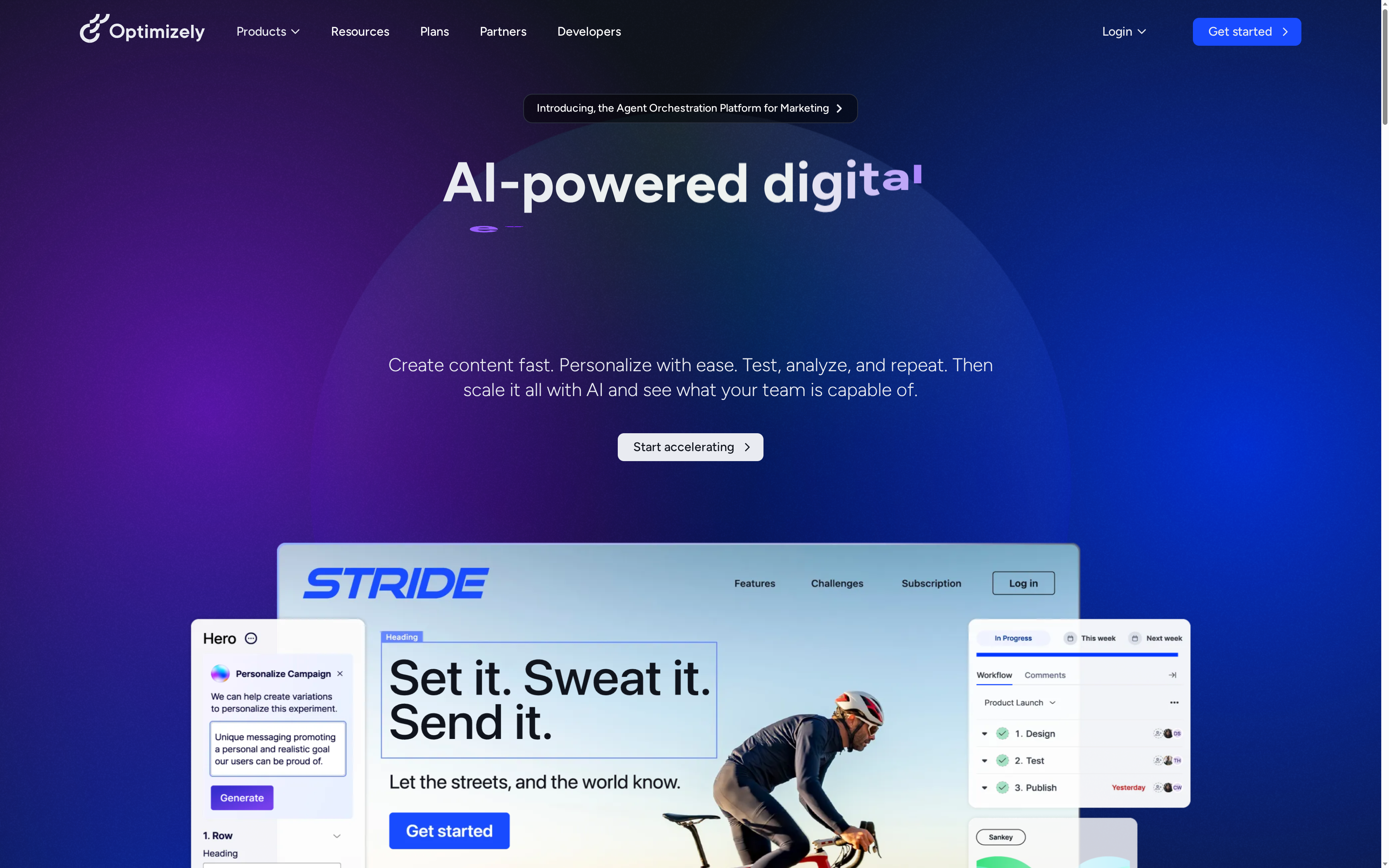
Optimizely is an all-in-one agent orchestration platform that combines experimentation, personalization, analytics, and content management into a single suite for marketing teams. If you need a platform that uses AI to speed up personalization and test at scale, Optimizely delivers a cohesive workflow from idea to measurement. However, the platform’s breadth means there’s a learning curve, and pricing details aren’t published online, so plan to engage sales before committing.
Core Features
Optimizely centers on AI-powered digital experience creation and personalization, an experimentation engine that supports A/B testing and beyond, and analytics built on warehouse-native data for deeper insights. It also offers a content management system with flexible authoring and digital asset management to control files and brand assets. Together, these features let you create content, run experiments, and measure lift without stitching multiple tools together, keeping the experiment-to-insight loop tight.
Pros
- Integrated platform reduces tool sprawl: You can manage content, run experiments, and analyze results inside one product, which simplifies workflows and reduces cross-tool friction.
- AI-powered personalization speeds execution: Built-in AI tools help automate personalization tasks and surface relevant experiences faster than manual processes.
- Strong analytics tied to warehouse data: Warehouse-native analytics enable deeper, more reliable reporting and let you align experimentation metrics with your core data stack.
- Flexible content authoring and asset management: The CMS and digital asset management make it easier for teams to produce and reuse on-brand content across experiments.
- Designed for scale and collaboration: Tools for testing and optimization are geared toward teams running many experiments, which supports growth-stage programs.
Cons
- Pricing not disclosed on the website, which complicates budgeting: You must contact sales to get a custom quote, so there’s less transparency for smaller teams comparing costs.
- May require technical expertise for full utilization: Many advanced features depend on integration with data warehouses and developer setup, which raises the bar for non-technical teams.
- Complexity could overwhelm small teams with limited resources: The platform’s depth is a strength for larger teams but can be overkill if you only need a simple A/B testing tool.
Who It's For
Optimizely is best for marketing teams, digital experience managers, and developers at organizations that want a single AI-driven platform to create, test, and measure digital experiences. If your team runs frequent experiments, relies on warehouse analytics, or needs robust CMS capabilities alongside personalization, Optimizely will likely match your needs.
Unique Value Proposition
Optimizely’s unique value lies in combining AI-assisted personalization, experimentation, and warehouse-native analytics within a single platform, reducing friction between content creation, testing, and measurement so teams can iterate faster and with clearer attribution.
Real World Use Case
A digital marketing team uses Optimizely to run sequential A/B tests on homepage layouts, personalize banners by visitor behavior with AI rules, and analyze lift using warehouse-linked metrics to attribute conversions accurately and scale winning variations.
Pricing
Pricing is not specified on the website; interested users are encouraged to contact sales for tailored pricing.
Website: https://optimizely.com
VWO (Visual Website Optimizer)
At a Glance
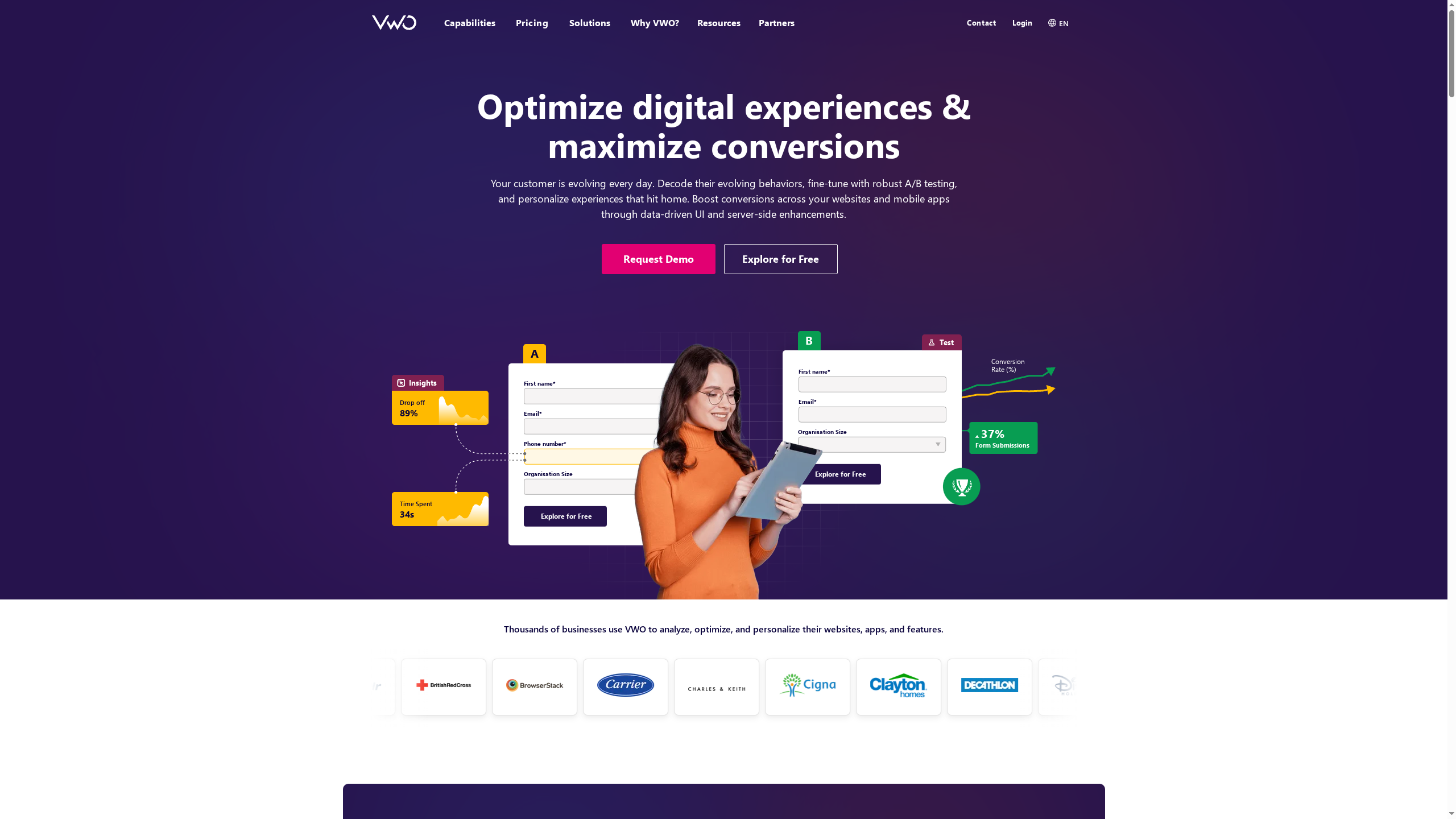
VWO is an all-in-one experimentation and optimization platform that combines A/B testing, personalization, and qualitative analytics to help teams improve conversions. It targets mid to large-sized businesses that need enterprise-grade security, rich targeting, and scalable integrations. If you want a single vendor to run experiments, gather heatmap and session data, and get AI-driven suggestions, VWO delivers — though the platform’s breadth can mean a steeper learning curve and custom pricing that may not suit smaller teams.
Core Features
VWO bundles standard and advanced testing methods — A/B tests, split URL experiments, and multivariate tests — with personalization and advanced targeting to tailor experiences by segment. It adds qualitative tools like heatmaps, session recordings, and surveys to explain the why behind behavior. Customer data integration and segmentation help you build precise audiences, and VWO Copilot offers AI-powered optimization suggestions and hypothesis prompts. Enterprise-focused SDK support and robust integrations extend capabilities to web and mobile apps.
Pros
- Comprehensive experimentation suite: VWO combines testing, personalization, and qualitative analytics in a single platform so your team can run end-to-end optimization programs without stitching multiple tools together.
- Enterprise-grade security and compliance: The platform emphasizes strong security and privacy controls, which makes it a safer choice for organizations with strict compliance requirements.
- Powerful targeting and segmentation: Rich targeting options let you create specific audience segments and run bespoke experiences, improving relevance and lift for key user groups.
- Robust integrations and SDK support: Native SDKs and integration options make it practical to deploy experiments across web and mobile environments without heavy engineering overhead.
- AI-driven insights with VWO Copilot: Automated suggestions and hypothesis generation accelerate test ideation and help teams prioritize experiments based on likely impact.
Cons
- Pricing is custom and can be expensive: Because pricing is available only upon request and tailored to each customer, small businesses may find costs prohibitive compared with simpler tools.
- Steep learning curve for beginners: The platform’s wide feature set can overwhelm teams new to experimentation, requiring time and resources to master advanced capabilities.
- Some advanced features require add-ons or higher tiers: Not all capabilities are included in base plans, so unlocking full functionality may require upgrading or purchasing additional modules.
Who It's For
VWO is best for mid to large-sized businesses and enterprise teams that need a unified experimentation platform with advanced targeting, compliance controls, and mobile/web SDK support. If your optimization program demands scalability, cross-channel testing, and AI-assisted ideation, VWO fits well; if you’re a solo marketer or a very small team on a tight budget, it may be more than you need.
Unique Value Proposition
VWO’s unique value is its combination of experimentation, personalization, and qualitative analytics in one integrated platform, coupled with enterprise security and AI-driven assistance. This reduces tool fragmentation and helps teams move faster from insight to impact while maintaining governance and scale.
Real World Use Case
A retail brand personalizes its homepage for distinct customer segments, runs A/B tests on checkout variations, and uses heatmaps and session recordings to diagnose friction points. VWO’s segmentation and Copilot help prioritize tests that increase conversion rates while maintaining data governance across teams.
Pricing
Pricing is available upon request, with tailored plans for growth, pro, and enterprise tiers that require custom quotes based on features and volume.
Website: https://vwo.com
Unbounce
At a Glance
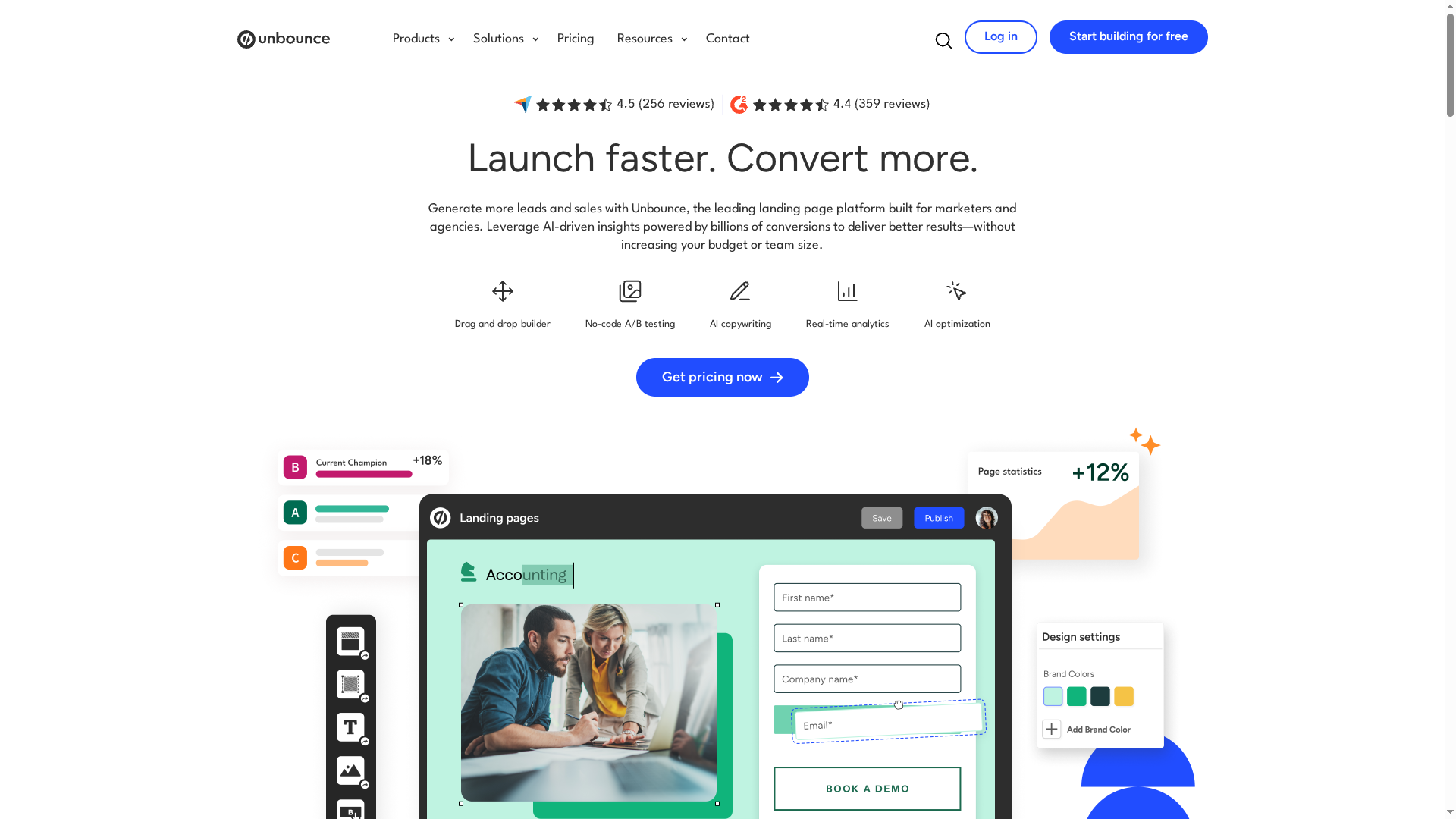
Unbounce is a marketer-focused landing page platform that combines a no-code drag-and-drop builder with AI-driven optimization and built-in A/B testing. It’s designed to help teams launch high-converting pages quickly, run experiments, and route traffic automatically to winning variants. For teams that need speed and integrations without heavy developer support, Unbounce delivers strong productivity gains — though the price and feature complexity can be barriers for very small teams.
Core Features
Unbounce’s core capabilities center on rapid landing page creation and data-driven optimization. The platform includes a visual drag-and-drop builder, AI copywriting and optimization tools, A/B testing with real-time analytics, Smart Traffic for AI-powered traffic routing, dynamic text replacement for personalization, and support for custom code and styling. It also integrates with common marketing platforms such as Salesforce, HubSpot, and Zapier, and ships with templates to accelerate campaign launches.
Pros
- Easy to use for non-technical marketers: The drag-and-drop builder lets you assemble pages and run experiments without developer resources, reducing setup time and friction.
- Advanced AI optimization tools: Built-in AI features, including AI copywriting and Smart Traffic, help surface better-performing variants without manual guesswork.
- Large template library speeds launches: Ready-made, conversion-focused templates let you spin up pages quickly for campaigns or client work.
- Strong integrations with marketing stacks: Native connections to platforms like Salesforce, HubSpot, and Zapier simplify lead routing and attribution.
- Generous page and conversion limits on plans: Plans support unlimited landing pages and conversions within their tiers, which is useful for agencies and teams managing many campaigns.
Cons
- Regional availability may be limited: The product notes potential availability constraints in some regions, which can complicate global rollout plans.
- Pricing can be steep for startups: Base plans start at $74 USD/month, and advanced experimentation or AI tiers rise from $112 USD/month, making it a heavier investment for small businesses.
- Feature depth can be overwhelming for beginners: The platform’s advanced options and customization generate a learning curve for complete novices who want only very simple landing pages.
Who It's For
Unbounce is aimed at marketers, digital marketing teams, and agencies that need an integrated solution to create, test, and optimize landing pages without relying on development resources. If you run frequent paid campaigns, manage multiple landing pages, or need rapid personalization and traffic optimization, Unbounce fits well.
Unique Value Proposition
Unbounce combines no-code page creation with AI-driven optimization and experiment automation, enabling marketers to run high-velocity campaigns and automatically steer traffic to winners. That combination reduces manual testing overhead and speeds up conversion improvements.
Real World Use Case
A digital marketing team uses Unbounce to launch multiple landing page variants for paid campaigns, applies AI-assisted copy and Smart Traffic to analyze performance, and automatically routes users to the best-performing pages — increasing conversions and lowering cost per acquisition.
Pricing
Plans start at $74 USD/month for the Build plan and $112 USD/month for the Experiment plan, with higher tiers available for AI optimization and agency needs; discounts are offered for annual billing.
Website: https://unbounce.com
A/B Testing Platforms Comparison
This table provides a comprehensive overview of various A/B testing platforms, highlighting their key features, pros, cons, pricing, and ideal users to help you choose the best one for your needs.
| Platform | Key Features | Pros | Cons | Pricing |
|---|---|---|---|---|
| GoStellar | No-code editor, AI insights, integrations with GA4, Segment, Mixpanel | Easy setup, lightweight, flexible pricing, actionable analytics | Limited feature set compared to larger platforms | Free for up to 25,000 MTU, $99/month |
| Optimizely | All-in-one platform, AI personalization, warehouse-native analytics | Comprehensive tools, AI-driven insights, scalable, strong analytics | Complex for small teams, pricing on request | Tailored pricing, sales consultation |
| VWO | A/B, split URL, multivariate testing, heatmaps, session recordings | Comprehensive testing suite, scalable, powerful integrations, AI-driven suggestions | Complex feature set, pricing on request | Tailored pricing, custom quotes |
| Unbounce | Drag-and-drop builder, AI optimization, Smart Traffic, dynamic text replacement | User-friendly, AI optimization, strong integrations, extensive template library | Limited regional availability, steep pricing for startups | Starts at $74/month, higher tiers available |
Accelerate Your Landing Page Testing with a Faster, Simpler Solution
Marketers face constant pressure to test landing pages quickly and effectively while avoiding slowdowns and complexity. The article highlights challenges like performance impact, technical hurdles, and the need for real-time insights to make confident decisions. If you want to escape heavy, slow tools and gain full control over experiments with a no-code visual editor, dynamic keyword insertion for personalization, and advanced goal tracking, then GoStellar is designed for you. Our platform is built to meet the needs of small to medium-sized businesses with a 5.4KB lightweight script that keeps your site fast and compliant.
Boost your conversion rates without sacrificing speed or simplicity by choosing a platform that delivers actionable real-time analytics and effortless setup. Try GoStellar to launch your A/B tests faster than ever. Discover how our focused approach matches the expert recommendations in the article and how you can get started with a free plan for smaller sites or a flexible paid tier that scales with your growth.
Ready to experience the fastest landing page testing tool created for marketers like you? Visit GoStellar's Landing Page now and start your 21-day free trial. Take control of your experiments today with a platform where performance meets simplicity, and see rapid results without needing any engineering support.
Frequently Asked Questions
What are the key features to look for in a landing page testing tool?
A reliable landing page testing tool should offer A/B testing capabilities, a user-friendly visual editor, real-time analytics, and integrations with other marketing platforms. Focus on tools that allow for easy setup of experiments and provide actionable insights, enabling you to optimize your pages quickly.
How can landing page testing improve conversion rates?
Landing page testing allows you to evaluate different designs, content, and CTAs to determine which combinations drive the most conversions. By continually testing and optimizing your pages, you could see improvements in your conversion rates by as much as 20% or more over a few months.
What is A/B testing and how does it work for landing pages?
A/B testing involves comparing two or more versions of a landing page to see which performs better. Set up different variations for a specific element, like headlines or images, then measure key performance indicators like click-through rates or sales conversions to identify the most effective version.
How long should I run tests on my landing pages?
Running tests for at least two weeks is advisable to gather significant data, accounting for variations in traffic and user behavior. Ensure you have enough visitors to produce statistically reliable results, which may take longer during peak traffic periods or for less visited pages.
Can I use a landing page testing tool for mobile optimization?
Yes, most landing page testing tools offer mobile optimization features, allowing you to test how pages perform on different devices. Ensure the tool provides responsive design capabilities, so you can create and analyze experiences tailored to mobile users effectively.
What are the costs associated with using landing page testing tools?
Costs vary depending on the tool and its features, ranging from free tiers for basic testing to monthly subscriptions for more comprehensive plans. Compare the features and scalability of each option to choose one that matches your budget and experimentation needs.
Recommended
Published: 11/28/2025