
Boost Sales and Brand Visibility with Store Blogging
TL;DR:
- Blogging is a high-ROI marketing channel that drives long-term organic search traffic and revenue.
- Strategic content focusing on high-intent topics and internal linking boosts conversions and authority.
- Measuring traffic, conversions, and engagement is crucial for optimizing blog performance and ROI.
Blogging for your online store isn't a side project or a "nice to have." It's one of the highest-ROI marketing channels available, yet most e-commerce brands treat it like an afterthought. Businesses that blog consistently see 13x more positive ROI than those that don't, and the gap between strategic bloggers and casual ones is enormous. If you've been publishing posts occasionally and wondering why the needle isn't moving, this guide explains exactly why, and what to do instead. We'll cover the data, the strategies, and the measurement frameworks top stores use to turn content into real revenue.
Table of Contents
- Why blogging matters for online stores
- Core blogging strategies for maximizing impact
- Measuring success: Blogging ROI and analytics
- Advanced tips: Scaling and innovating your store blog
- Our take: What stores miss about blogging ROI
- How to level up your e-commerce blogging
- Frequently asked questions
Key Takeaways
| Point | Details |
|---|---|
| Blogging drives e-commerce ROI | Consistent, strategic blogging substantially increases online store traffic, engagement, and sales. |
| Link blog content to products | Internal links from blogs to key pages boost conversions and maintain long-term SEO value. |
| Measure and optimize results | Tracking analytics helps maximize marketing budget by focusing on content that delivers sales. |
| Leverage AI for scale | AI and automation accelerate content creation, unlocking more growth with fewer resources. |
Why blogging matters for online stores
A lot of e-commerce owners think of blogging as a branding exercise. Write some posts, maybe get a few readers, and hope for the best. That mental model costs them real money.
The truth is that blogging is a direct revenue multiplier when it's done with intent. Organic search traffic from well-researched blog posts compounds over time. Unlike paid ads, which stop working the moment your budget runs out, a single strong blog post can drive thousands of visitors monthly for years. That's a fundamentally different kind of asset.
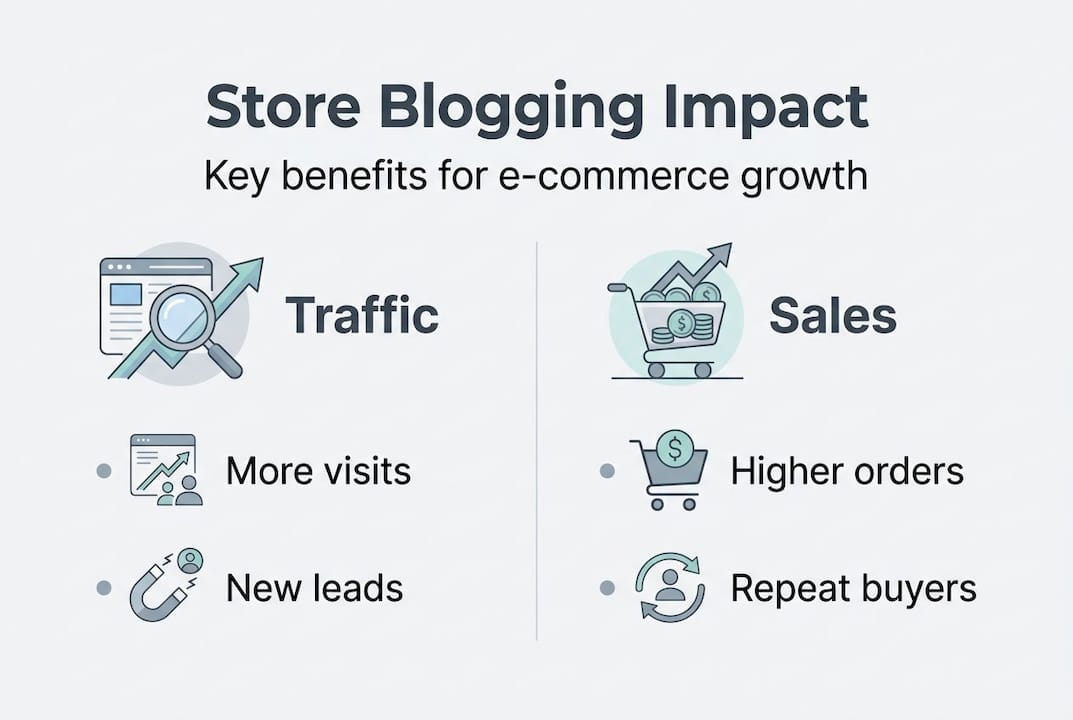
Consider the numbers. Content marketing ROI averages 300% across industries, with e-commerce specifically coming in around 240%, and long-form blogs delivering closer to 340%. Those aren't vanity stats. They reflect real purchase behavior, where buyers research products thoroughly before converting, and great blog content puts your store directly in their path during that research phase.
Here's what that looks like in practice:
| Content format | Average ROI | Time to results |
|---|---|---|
| Long-form blog posts | ~340% | 3 to 6 months |
| Short-form posts (under 500 words) | ~90% | 1 to 2 months |
| Video content embedded in blogs | ~49% faster payback | 2 to 4 months |
| E-commerce product descriptions only | ~60% | Immediate but flat |
The table above shows something important: patience rewards you. Short posts generate quick but shallow results. Long-form content takes longer to rank but delivers far higher returns over time.
"We often underestimate how much organic search drives purchase intent. Buyers who arrive through informational blog content convert at higher rates because they've already been educated by the time they hit your product page."
One documented case study generated 1.2M Euro in revenue over 12 months purely through targeted blog content, with 226K Euro of that coming directly from organic Google traffic, representing 20% of total revenue. That's not a fluke. It reflects the compounding nature of strategic content investment.
Understanding ecommerce content marketing basics is the first step to building a system like that. The stores that win treat each blog post as a business decision, not a creative exercise.
Blogging also builds brand authority in ways that paid media simply cannot replicate. When a shopper finds your post answering a detailed question about the product category you sell, they arrive at your store already trusting you. That trust dramatically reduces friction at checkout. Organic traffic from search is also intent-driven, meaning visitors are actively looking for what you sell, not passively scrolling through a feed. The combination of trust plus intent makes blog-driven traffic among the highest-quality traffic sources available.
Core blogging strategies for maximizing impact
Now that you understand why it works, let's talk about how to make it work for your store specifically.
Start with high-intent topic selection. Most stores make the mistake of writing about topics they find interesting rather than topics their buyers are actively searching for. High-intent topics are those where searchers are either ready to buy or very close to it. Think "best [product type] for [specific use case]," comparison posts like "[product A] vs [product B]," or tutorials that solve a specific problem your product addresses. These posts attract people who are in buying mode, not just browsing mode.

Use internal linking aggressively. This is one of the most underused tactics in e-commerce blogging. Internal linking from blogs to product pages is crucial because it passes authority between pages, keeps readers on your site longer, and creates natural pathways to purchase. When you write a post about how to choose the right running shoes, every mention of a shoe category should link to the corresponding product collection. Link to evergreen content too, because those links maintain value over time and won't break when you update your product catalog.
Embrace AI without abandoning quality. 88% of marketers now use AI for content creation, and those teams produce 42% more content monthly than teams that don't. AI accelerates ideation, outline creation, first drafts, and meta descriptions. The key is using it as a multiplier for your expertise, not a replacement for it. AI-generated content that isn't reviewed or enriched with genuine product knowledge and audience insight tends to be generic and fails to rank or convert.
Here's a practical comparison of content production approaches:
| Approach | Monthly output | Quality control | Cost |
|---|---|---|---|
| In-house writer only | 4 to 8 posts | High | High labor cost |
| AI-assisted in-house | 10 to 16 posts | High with review | Moderate |
| Freelancers without AI | 6 to 12 posts | Variable | Moderate |
| Agency with AI tools | 20+ posts | High with systems | Higher upfront |
The sweet spot for most small to medium stores is the AI-assisted in-house model, especially when you're just building momentum.
- Prioritize consistency over volume. Two well-researched posts per week outperform six rushed posts.
- Match content length to intent. Informational posts should run 1,500 to 2,500 words. Product-comparison posts perform best around 1,000 to 1,500 words.
- Refresh old posts quarterly. Updating content with new data, examples, and internal links is often faster than writing from scratch and can dramatically improve rankings.
- Write for real people first. Search engines have become very good at recognizing content that genuinely serves reader needs versus content stuffed with keywords for their own sake.
Pro Tip: Before writing any post, ask yourself: "What does someone who reads this post do next?" If the answer isn't clear, the post isn't ready to be written yet. Define the call-to-action and the next step before you write the first word.
Strategic blogging also feeds into your conversion optimization work. Posts that educate buyers can significantly increase your store's overall conversion rate. If you're actively working on boosting conversion rates, blog content that pre-educates visitors reduces the work your product pages have to do.
Measuring success: Blogging ROI and analytics
Writing good content is only half the job. Measuring its impact is where most stores fall short, and it's the difference between a blog that keeps improving and one that stagnates.
Here's how to build a proper measurement system for your e-commerce blog:
-
Set up goal tracking in Google Analytics 4. Define goals for newsletter signups, product page visits from blog posts, add-to-cart events, and completed purchases where the session originated from blog content. Without these goals, you're flying blind.
-
Track traffic by source and landing page. Know which posts are pulling the most organic traffic. High-traffic posts that don't convert deserve a content refresh or a stronger internal linking strategy to push visitors toward product pages.
-
Monitor time on page and scroll depth. If readers are leaving after 30 seconds, the post either doesn't match their intent or fails to hook them in the first two paragraphs. Both are fixable problems.
-
Calculate revenue per visitor. Divide total blog-attributed revenue by total blog visitors. This single number tells you more about content quality than page views ever will. Aim to improve it quarter over quarter.
-
Compare cost per engagement against cost per lead. Track cost per engagement rather than raw ROI alone, especially in early stages. It helps you understand whether your content budget is being spent efficiently, even before the revenue numbers compound enough to be meaningful.
Stores that follow this measurement approach and act on the data see compounding gains. Tracking blog-driven conversions precisely is what separates stores that iterate their way to success from those that guess.
Pro Tip: Set up a simple monthly blog review. For each post published 3 or more months ago, check rankings, traffic trend, time on page, and conversion rate. Posts dropping in traffic often just need updated statistics and a few added sections to regain their positions.
One nuance worth calling out: predictive marketing metrics matter more than lagging indicators. Engagement rate, return visitor rate, and email signups from blog content all predict future revenue even before they show up in your sales numbers. Building a dashboard that surfaces these early signals lets you course-correct faster.
Advanced tips: Scaling and innovating your store blog
Once you have the fundamentals in place, the next question is how to scale without sacrificing quality or burning out your team.
Add video strategically, not universally. Video content embedded in blog posts generates significantly higher engagement and, importantly, video ROI is 49% faster than text-only content. That doesn't mean every post needs a video. Focus video production on your highest-traffic posts and your most complex topics, where visual demonstration genuinely adds value. A how-to guide with an accompanying walkthrough video, for example, consistently outperforms the text version alone in both time on page and conversion rate.
Batch your content production. Rather than writing one post at a time, block out time to produce five or six posts in a single session. Batching reduces context-switching costs, keeps your editorial voice consistent, and ensures you always have content in reserve for busy periods. This is especially important for small teams where one sick day can derail your publishing schedule.
Repurpose aggressively. Every long-form blog post contains the material for multiple Instagram captions, a LinkedIn article, an email newsletter section, and a short-form video script. Building repurposing into your workflow multiplies the return on every piece of content you create without proportionally increasing your workload.
"The stores that scale fastest treat their content library like a product catalog. They regularly audit it, retire what's not performing, update what's outdated, and double down on what's working."
- Hire freelancers for subject matter depth. If you sell technical products, bringing in freelance writers with domain expertise produces content that genuinely answers buyer questions. Generic content agencies struggle to replicate this depth without significant briefing investment.
- Update your top posts before creating new ones. When a post that was ranking on page one starts slipping, updating it is almost always faster and cheaper than writing something new.
- Test post formats actively. Listicles, deep-dive tutorials, original research posts, and case studies all perform differently for different audiences. The only way to know what works for your specific audience is to test video vs. image content and track results rigorously.
Common pitfalls to avoid include publishing without a defined audience persona, ignoring search intent in favor of brand voice alone, failing to promote new content via email and social channels, and treating your blog as a static archive rather than a living content system that requires ongoing maintenance.
Staying agile means reviewing your content strategy quarterly. What worked six months ago may not be what your audience needs today. The stores that sustain blog-driven growth are those that treat their content calendar as a flexible plan, not a fixed commitment.
Our take: What stores miss about blogging ROI
Most e-commerce brands that struggle with blogging share one fundamental problem. They measure the wrong things and draw the wrong conclusions. They count posts published instead of revenue attributed. They celebrate traffic spikes without checking whether that traffic converted. And when they don't see immediate returns, they scale back or stop entirely, just before the compounding effects would have kicked in.
Strategic blogging rewards patience and measurement discipline above all else. The stores we see generating consistent ROI from content aren't necessarily publishing more than their competitors. They're publishing with sharper intent, tracking outcomes more precisely, and iterating based on data rather than intuition.
There's also a content-market fit problem that rarely gets named. A blog that serves your audience's actual questions and needs will outperform a blog that simply supports your product catalog with thin promotional content. The shift from output thinking (how many posts?) to outcome thinking (what revenue and leads did we generate?) is what separates high-performing content programs from expensive underperformers. Understanding content marketing lessons from stores that get this right will accelerate that shift significantly.
How to level up your e-commerce blogging
Building a high-performing blog takes the right strategy and the right tools working together. If you're serious about turning content into a measurable growth channel, you need more than good writing. You need a way to test what's working and optimize accordingly.
That's where GoStellar app comes in. Stellar's A/B testing platform lets you run experiments directly on your blog and landing pages, testing headlines, calls-to-action, page layouts, and content formats to find what actually converts your readers into buyers. With real-time analytics, a no-code visual editor, and a lightweight 5.4KB script that won't slow your site, Stellar gives you the experimentation infrastructure your content program needs to keep improving. Start with the free plan and see what data-driven content optimization looks like in practice.
Frequently asked questions
How often should an online store publish blog posts?
Aim for at least 1 to 2 posts per week for consistent growth and sustained audience engagement. Consistency matters more than volume, so a realistic publishing schedule you can maintain beats an ambitious one you can't.
What types of blog topics drive the most sales for e-commerce?
Product tutorials, buying guides, and case studies about real customer results tend to convert best. One targeted blog strategy generated over 1.2M Euro in 12 months by focusing on exactly these formats.
How can AI help with e-commerce blog content?
AI tools speed up writing, improve ideation, and let teams publish more content with less effort. With 88% of marketers using AI, teams that adopt it produce 42% more monthly content than those that don't.
How do you measure e-commerce blog ROI?
Track traffic, conversion rates, revenue attribution, and cost per engagement to get a complete picture. Stores that blog consistently see 13x more positive ROI over time, with mature programs averaging 2 to 3x returns.
Is blogging still effective for online stores in 2026?
Yes, e-commerce blogs continue to drive ROI and brand growth, especially with strategic topics and advanced tools. Long-form blog content delivers approximately 340% ROI, making it one of the strongest performers in digital marketing.
Recommended
Published: 4/27/2026