
Building a Testing Culture: Powering Continuous Growth
Over 80 percent of American tech startups struggle to move beyond basic split tests and actually embed a culture of experimentation. For digital marketers and growth hackers, building a testing culture is not just a buzzword, it is vital to optimizing conversion rates and decision making. This practical guide reveals how any team—even without advanced technical skills—can harness structured testing and create real business impact through simple, proven habits.
Table of Contents
- Defining A Testing Culture For Growth
- Types Of Testing: A/B, Multivariate, And Beyond
- Essential Elements For Teamwide Adoption
- Leadership Roles And Stakeholder Alignment
- Common Pitfalls And Misconceptions To Avoid
Key Takeaways
| Point | Details |
|---|---|
| Embrace a Testing Culture | Foster a strategic environment where continuous experimentation drives decision-making and learning throughout the organization. |
| Integrate Testing Across Teams | Encourage collaboration among departments to view testing as an opportunity for insights rather than just compliance. |
| Prioritize Psychological Safety | Create a space where team members feel comfortable proposing and executing experiments, learning from both successes and failures. |
| Invest in Training and Tools | Equip all team members with the necessary resources and knowledge to engage in meaningful testing practices actively. |
Defining a Testing Culture for Growth
A testing culture represents more than just random experiments—it's a strategic approach to organizational learning and growth. At its core, testing culture means embedding continuous experimentation into every aspect of business strategy, where data drives decisions and learning becomes a systematic process. Holistic testing frameworks emphasize transforming testing from a technical checkbox into a fundamental organizational value.
The most successful companies view testing not as an isolated activity but as an integrated philosophy. This means creating an environment where employees across departments—from marketing to product development—understand that every initiative is an opportunity to learn, validate hypotheses, and iterate. Experimental approaches to business allow organizations to reduce risk, validate assumptions, and make more informed strategic choices.
Effective testing cultures share several key characteristics. They prioritize curiosity over certainty, encourage cross-functional collaboration, and establish clear processes for designing, executing, and analyzing experiments. Teams must feel psychologically safe to propose and run tests, understanding that not every experiment will succeed—but every experiment provides valuable insights. Leaders play a critical role by modeling this mindset, investing in testing infrastructure, and celebrating learning over just positive outcomes.

Successful testing requires more than tools—it demands a fundamental shift in organizational thinking. Companies must develop robust mechanisms for capturing insights, sharing results transparently, and quickly incorporating learnings into future strategies. This means creating documentation systems, regular knowledge-sharing sessions, and metrics that reward experimentation and learning.
Pro tip: Start small by implementing a monthly cross-functional experiment meeting where teams can propose, review, and discuss potential tests across different business domains.
Types of Testing: A/B, Multivariate, and Beyond
Testing strategies have evolved dramatically, offering businesses increasingly sophisticated methods to understand user behavior and optimize performance. Online controlled experiments have become essential tools for data-driven decision making, with A/B testing emerging as the foundational approach for comparing different variations and measuring their impact.

A/B testing represents the most straightforward testing method, where two versions of a webpage, app screen, or marketing element are compared to determine which performs better. A/B testing techniques allow marketers and product teams to make statistically significant comparisons by exposing different user segments to variant designs and measuring specific outcomes like conversion rates, click-through rates, or engagement metrics.
Multivariate testing takes experimentation a step further by simultaneously testing multiple variables and their interactions. Unlike traditional A/B testing which compares two distinct versions, multivariate approaches enable teams to understand how different combinations of elements impact user experience. This method is particularly powerful for complex optimization scenarios where numerous design components might influence overall performance. By testing multiple hypotheses concurrently, organizations can uncover nuanced insights that simple binary comparisons might miss.
Beyond traditional A/B and multivariate approaches, advanced testing methodologies continue to emerge. Sequential testing, machine learning-driven experimentation, and adaptive testing frameworks are expanding the boundaries of what's possible. These sophisticated techniques allow for more dynamic, responsive experimentation that can adjust in real-time based on emerging data signals and user behavior patterns.
Here's how common testing strategies compare in structure and business value:
| Testing Type | Main Focus | Strength | Ideal Use Case |
|---|---|---|---|
| A/B Testing | Compare two variations | Simple, quick feedback | Single change impact |
| Multivariate Testing | Multiple variable combinations | Deeper insight, interaction effects | Complex page layouts |
| Sequential Testing | Ongoing adjustment | Fast iteration, minimizes bias | Real-time optimization |
| Machine Learning-driven Testing | Automated, adaptive experiments | Handles large datasets, finds subtle patterns | Personalization at scale |
Pro tip: Start with a simple A/B test focusing on one critical metric before advancing to more complex multivariate experiments to build your team's testing muscle.
Essential Elements for Teamwide Adoption
Teamwide testing adoption requires a strategic approach that transforms testing from a siloed activity into a collaborative organizational mission. Effective software testing strategies emphasize creating an environment where quality becomes everyone's responsibility, not just the domain of dedicated testing professionals.
Successful implementation demands clear communication channels and aligned goals across different teams. This means breaking down traditional departmental barriers and creating a shared understanding of testing's value. Developers, product managers, marketers, and support teams must view testing not as a hurdle but as a critical pathway to continuous improvement. Collaborative testing cultures thrive when team members understand that their diverse perspectives contribute to creating better products and experiences.
Key elements for successful adoption include comprehensive training programs, transparent performance metrics, and recognition systems that reward experimental thinking. Organizations must invest in tools and resources that make testing accessible and meaningful for all team members. This means providing user-friendly testing platforms, creating clear documentation, and establishing regular knowledge-sharing sessions where teams can discuss insights, challenges, and learnings from various experiments.
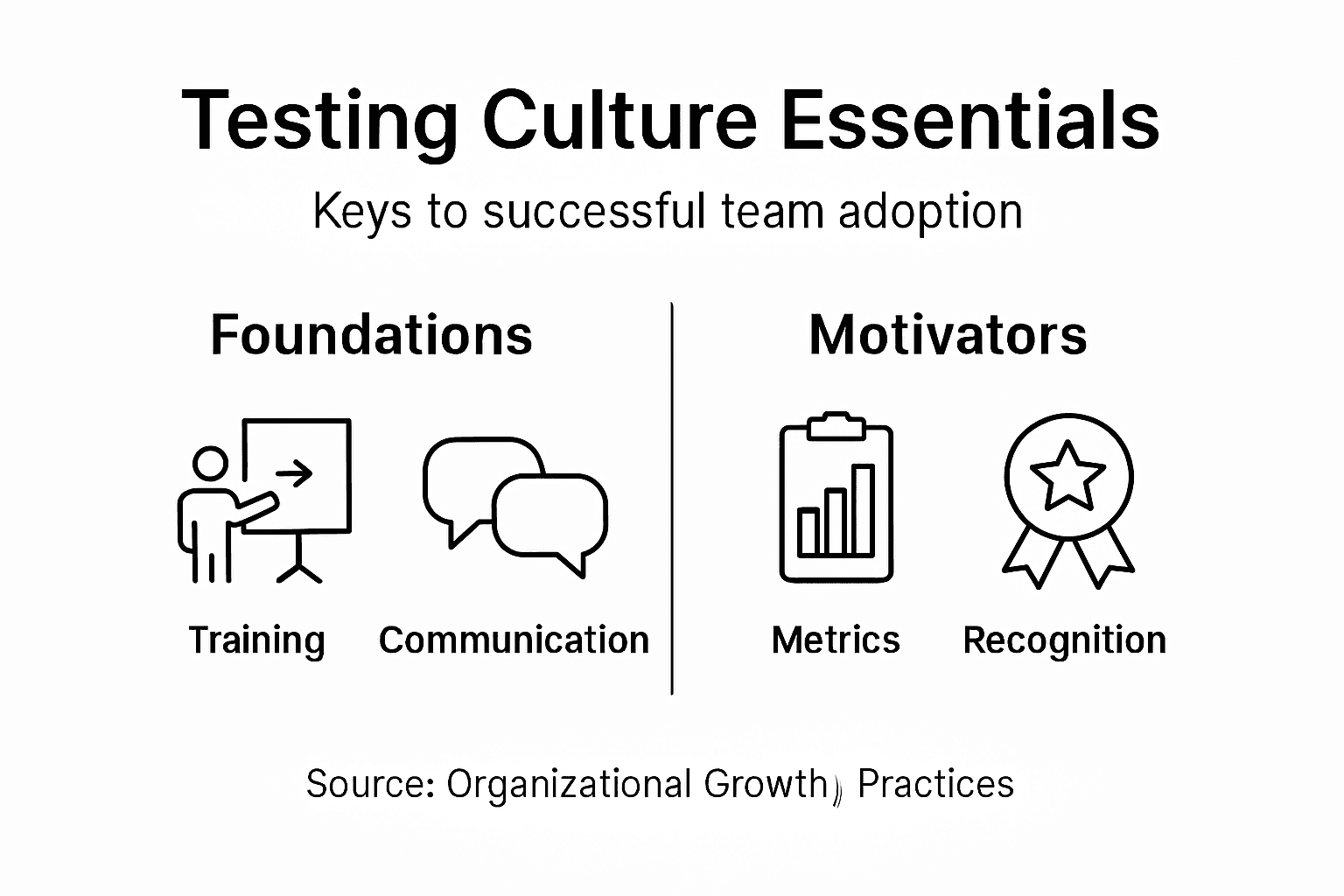
Leadership plays a crucial role in embedding a testing mindset. Executives and managers must model curiosity, embrace data-driven decision making, and create psychological safety where team members feel comfortable proposing and running experiments. This involves celebrating learning from both successful and unsuccessful tests, demonstrating that exploration and understanding are more important than achieving perfect outcomes every time.
Summary of factors essential for teamwide testing adoption:
| Factor | Why It's Important | Impact on Teams |
|---|---|---|
| Clear Communication | Ensures aligned objectives | Improves collaboration |
| Training & Tools | Empowers all team members | Reduces errors |
| Transparent Metrics | Tracks progress and outcomes | Builds team accountability |
| Leadership Support | Models expected behaviors | Increases psychological safety |
Pro tip: Create a monthly cross-functional testing showcase where teams present their experiments, insights, and learnings to build collective knowledge and motivation.
Leadership Roles and Stakeholder Alignment
Leadership transformation is critical in building a robust testing culture that permeates every organizational layer. Organizational culture dynamics reveal that leaders must do more than simply mandate testing—they must actively model and embed experimental thinking into the company's DNA.
Effective leaders understand that stakeholder alignment requires more than top-down directives. Strategic stakeholder engagement demands creating transparent communication channels that allow different departments to understand testing's collective value. This means breaking down silos between product, engineering, marketing, and customer support teams, ensuring everyone sees testing as a collaborative growth mechanism rather than a compliance checklist.
The most successful testing cultures emerge when leaders create structured frameworks that normalize experimentation. This involves establishing clear metrics that reward learning, creating safe spaces for discussing test results—both successful and unsuccessful—and investing in tools and training that make testing accessible across skill levels. Leaders must cultivate an environment where curiosity is celebrated, data is trusted, and continuous improvement becomes the standard operating procedure.
Stakeholder alignment is fundamentally about building trust and shared understanding. Executives must communicate the strategic importance of testing, demonstrate its impact through concrete examples, and ensure that resources are allocated to support testing initiatives. This means developing comprehensive communication strategies that translate technical testing insights into business value, helping every team member understand how their experimental efforts contribute to organizational growth.
Pro tip: Develop a quarterly "Testing Impact Report" that showcases concrete business outcomes generated through experimental insights, making the value of testing tangible for all stakeholders.
Common Pitfalls and Misconceptions to Avoid
Testing misconceptions can derail even the most well-intentioned organizational efforts. Software testing challenges reveal that many teams unknowingly sabotage their testing culture by falling into predictable traps that compromise quality and efficiency.
One of the most critical misconceptions is believing that testing is a purely technical activity isolated from broader business strategies. In reality, testing is a holistic approach that requires cross-functional collaboration and strategic thinking. Experimentation culture fundamentals demonstrate that successful testing goes far beyond simply running technical checks—it's about creating a systematic approach to learning and continuous improvement.
Common pitfalls include overreliance on manual testing processes, insufficient test planning, and neglecting comprehensive test data management. Organizations often make the mistake of treating testing as a last-minute checkpoint rather than an integral part of product development. This reactive approach leads to higher costs, increased risk, and missed opportunities for innovation. Effective testing cultures recognize that robust test design, strategic automation, and comprehensive coverage are essential for delivering high-quality products and experiences.
Leadership plays a crucial role in avoiding these misconceptions. Teams must move beyond viewing testing as a compliance activity and instead embrace it as a strategic tool for driving business growth. This requires creating an environment that values experimental thinking, celebrates learning from both successful and unsuccessful tests, and provides teams with the tools, training, and psychological safety needed to run meaningful experiments.
Pro tip: Implement a quarterly "Test Learning Review" where teams openly discuss experiment outcomes, sharing insights and lessons learned across the entire organization.
Accelerate Your Testing Culture with Stellar
Building a strong testing culture means embracing continuous growth through strategic experimentation and data-driven decision making. If you are struggling with complex testing tools or looking to empower your entire team to run effective A/B tests without technical barriers, Stellar is designed just for you. With our no-code visual editor and lightweight script, marketers and growth hackers at small to medium-sized businesses can quickly launch meaningful experiments that deliver actionable insights.

Discover how easy it is to foster a collaborative testing culture by starting simple and scaling up with features like dynamic keyword insertion and advanced goal tracking. Take advantage of real-time analytics to measure and learn from every experiment across your marketing and product efforts. Visit Stellar's A/B Testing Tool now to streamline your growth journey and empower your team with the fastest and most user-friendly experimentation platform. Do not wait to turn your testing strategy into measurable business impact.
Frequently Asked Questions
What is a testing culture?
A testing culture is a strategic approach to organizational learning that prioritizes continuous experimentation across all business aspects. It involves embedding data-driven decisions and systematic learning into the organization's values.
Why is testing important for business growth?
Testing is crucial for business growth because it allows organizations to validate assumptions, reduce risks, and make informed strategic decisions. Continuous experimentation fosters innovation and improves product and service quality.
What are the key characteristics of an effective testing culture?
Effective testing cultures prioritize curiosity, cross-functional collaboration, and structured processes for designing and analyzing experiments. They also foster psychological safety, encouraging teams to propose and run tests without the fear of failure.
How can organizations implement a successful testing culture?
Organizations can implement a successful testing culture by establishing clear communication, investing in training and tools, creating transparent performance metrics, and ensuring leadership support. Regular knowledge-sharing sessions and recognition systems for experimental thinking also contribute to a thriving testing environment.
Recommended
Published: 1/9/2026