
Choosing Conversion Actions: Drive Better A/B Test Results
Over 80 percent of American digital marketers say defining the right conversion action is the hardest part of A/B testing. This step matters because every click, sign-up, or purchase must genuinely reflect business success, not just empty numbers. Choosing the wrong action skews your findings and wastes effort. Discover which conversion actions truly matter so your next test delivers results that move your American business forward.
Table of Contents
- Defining Conversion Actions In A/B Testing
- Types Of Conversion Actions Marketers Track
- How To Align Conversion Actions With Business Goals
- Practical Setup: Tracking, Tools, And Best Practices
- Common Mistakes And Pitfalls To Avoid
Key Takeaways
| Point | Details |
|---|---|
| Defining Conversion Actions | Conversion actions must align with business goals and be measurable to ensure meaningful insights in A/B testing. |
| Types of Conversion Actions | Marketers should categorize micro, macro, and soft conversions to better understand user engagement and optimize performance. |
| Aligning with Business Goals | It's critical to map conversion actions directly to business objectives for effective decision-making and to track relevant user behaviors. |
| Common Mistakes | Avoid pitfalls like premature result checking and reliance on proxy metrics to maintain the validity of A/B testing frameworks. |
Defining Conversion Actions in A/B Testing
In A/B testing, a conversion action represents the specific user behavior that indicates success in your digital experiment. These actions are the measurable objectives that demonstrate whether a variation outperforms the control. Think of conversion actions as the critical signposts that tell you whether your marketing or design changes genuinely move the needle.
Defining precise conversion actions requires strategic alignment with core business goals. Researchers using advanced Bayesian decision frameworks emphasize the importance of selecting metrics that directly connect to profitability, not just proxy measurements. For digital marketers, this might mean tracking actions like completed purchases, newsletter sign-ups, or product page interactions.
The selection process demands careful consideration. A well-defined conversion action should be:
- Directly tied to business objectives
- Measurable and quantifiable
- Representative of meaningful user engagement
- Statistically significant enough to draw reliable conclusions
Statistical properties of control variates further underscore the necessity of accurate conversion action definition. Imprecise metrics can lead to misleading test results, potentially causing businesses to make incorrect strategic decisions. By choosing conversion actions that reflect genuine user value, marketers can ensure their A/B tests provide actionable, high-integrity insights that drive real business growth.
Types of Conversion Actions Marketers Track
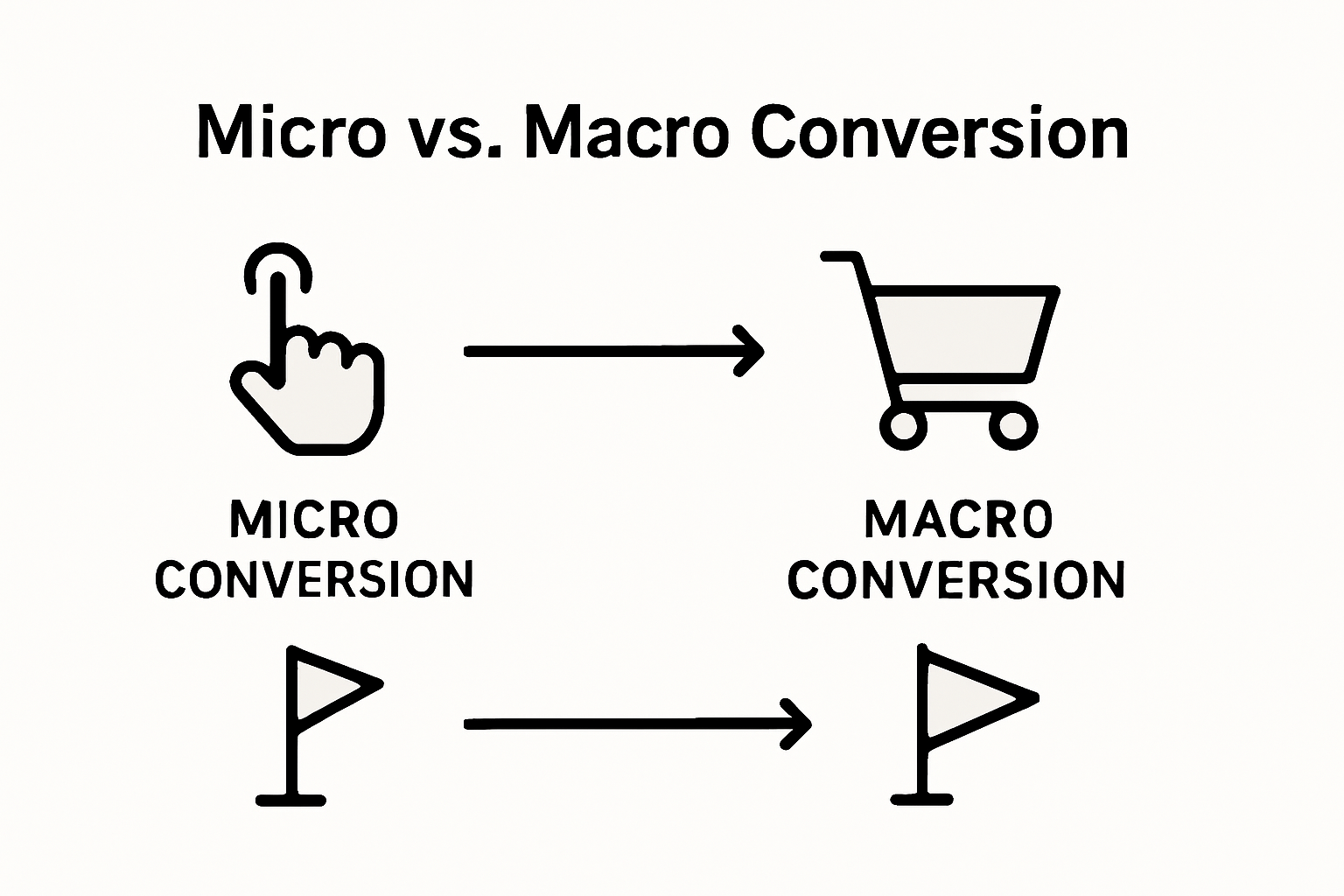
Marketers track a diverse range of conversion actions that capture different stages of user engagement and business value. These conversion types can be strategically categorized into distinct groups that help businesses understand and optimize their digital performance.
Typically, conversion actions are divided into several key classifications:
-
Micro Conversions: Small, incremental user actions that indicate potential interest
- Clicking a product page
- Adding items to a shopping cart
- Downloading a resource
- Watching a product video
-
Macro Conversions: Significant actions representing primary business objectives
- Completing a purchase
- Subscribing to a service
- Requesting a product demo
- Signing a contract
-
Soft Conversions: Low-commitment interactions that build initial user relationships
- Newsletter sign-ups
- Creating an account
- Following social media profiles
- Downloading a white paper
Digital marketing strategies often leverage multiple conversion tracking methods to create a comprehensive view of user behavior. By understanding the nuanced differences between these conversion types, marketers can design more targeted experiments and create more effective user journeys that progressively move potential customers through the sales funnel.

How to Align Conversion Actions With Business Goals
Aligning conversion actions with business goals requires a strategic approach that goes beyond simple metric tracking. Advanced Bayesian decision frameworks demonstrate that successful conversion optimization must directly connect experimental outcomes to core organizational objectives.
To effectively align conversion actions, marketers should follow a systematic process:
-
Identify Core Business Objectives
- Revenue generation
- Customer acquisition
- User engagement
- Long-term customer retention
-
Map Conversion Actions to Specific Goals
- Determine which user behaviors most directly impact business performance
- Prioritize actions with measurable financial implications
- Create a hierarchy of conversion importance
-
Implement Precision Tracking
- Use granular analytics to track nuanced user interactions
- Develop custom conversion paths that reflect unique business models
- Integrate multiple data points for comprehensive insights
Statistical variance reduction techniques reveal that precise alignment between conversion actions and business goals dramatically improves decision-making accuracy. By treating conversion tracking as a strategic investment rather than a tactical exercise, businesses can transform raw data into meaningful insights that drive sustainable growth and competitive advantage.

Practical Setup: Tracking, Tools, and Best Practices
A/B testing effectiveness hinges on meticulous setup and strategic tracking. Continuous monitoring techniques with always valid statistical methods provide marketers with robust frameworks for making real-time experimental decisions that drive meaningful insights.
Key components of a successful A/B testing tracking strategy include:
Tracking Setup
- Define clear conversion metrics
- Establish baseline performance benchmarks
- Configure event tracking granularly
- Implement cross-platform measurement
Technical Considerations
- Minimize script performance impact
- Ensure data privacy compliance
- Use server-side and client-side tracking
- Integrate multiple data collection methods
Sampling and Randomization
- Implement cluster-adaptive network testing procedures for more accurate user segmentation
- Create statistically significant sample sizes
- Randomize test group assignments
- Control for potential sampling biases
Successful A/B testing demands precision. By combining advanced statistical techniques with robust tracking infrastructure, marketers can transform experimental data into actionable strategic insights that drive meaningful business growth.
Common Mistakes and Pitfalls to Avoid
A/B testing can quickly derail without careful attention to statistical nuances and strategic planning. Researchers have identified critical pitfalls that systematically undermine experimental validity, warning against common errors that can compromise entire testing frameworks.
Key mistakes to avoid in A/B testing include:
Statistical Errors
- P-Value Peeking: Checking results prematurely
- Artificially inflates false positive rates
- Undermines statistical significance
- Leads to incorrect conclusions
Metric Selection Problems
- Relying on proxy metrics that don't reflect true business performance
- Conversion rates that don't translate to profitability
- Metrics disconnected from core business objectives
- Superficial measurements that misguide decisions
Experimental Design Flaws
- Insufficient sample sizes
- Improper randomization
- Lack of control group rigor
- Ignoring statistical variance
Successful A/B testing demands vigilance. By understanding and proactively addressing these common pitfalls, marketers can develop more robust, reliable experimental strategies that deliver genuine, actionable insights.
Master Conversion Actions to Maximize Your A/B Test Success
Choosing the right conversion actions is crucial for running effective A/B tests that truly reflect your business goals. This article highlights the importance of aligning measurable user behaviors with strategic objectives to avoid misleading results and costly mistakes. If you are a marketer or growth hacker struggling with pinpointing meaningful conversion metrics or managing complex experiment setups, Stellar offers the perfect solution.

With Stellar’s lightweight, no-code visual editor and advanced goal tracking, you can easily define precise conversion actions tailored to your business. Experience hassle-free A/B testing built for small to medium-sized businesses that want fast, actionable insights without the technical headache. Ready to transform your testing strategy today Visit Stellar’s landing page and discover how to drive better decisions with the fastest tool in the market. Explore detailed capabilities on Advanced Goal Tracking and see why thousands of marketers trust Stellar for real-time analytics and seamless experimentation.
Frequently Asked Questions
What are conversion actions in A/B testing?
Conversion actions in A/B testing refer to specific user behaviors that indicate success in your digital experiments, such as completed purchases or newsletter sign-ups.
Why is it important to define precise conversion actions?
Defining precise conversion actions is crucial because it ensures that the metrics tracked are directly tied to business objectives, resulting in reliable conclusions and actionable insights.
What types of conversion actions should marketers track?
Marketers typically track micro conversions (e.g., adding items to a cart), macro conversions (e.g., completing a purchase), and soft conversions (e.g., newsletter sign-ups) to understand user engagement comprehensively.
How can businesses align conversion actions with their goals?
Businesses can align conversion actions with their goals by identifying core business objectives, mapping conversion actions to these goals, and implementing precision tracking for meaningful insights.
Recommended
Published: 12/6/2025