
Code Test Website Guide for Developers and QA Teams
TL;DR:
- Choosing the right code test platform is crucial, as it ensures realistic development environments, validated questions, and proper AI policies. These factors enable more accurate skill assessment, reduce administrative overhead, and improve hiring quality. Ultimately, integrating reliable assessments with behavioral insights leads to better long-term candidate selection.
Choosing the wrong code test website costs you more than time. It costs you candidates who drop off halfway through a clunky browser editor, hiring managers who can't trust the results, and engineering leads who dismiss the data because the questions tested trivia instead of real skills. A programming assessment platform that actually works for technical hiring needs to do three things well: simulate real development environments, produce results you can defend, and scale without administrative overhead. This guide covers exactly how to find, configure, and get the most from a code evaluation site that meets that bar.
Table of Contents
- Key takeaways
- What makes a code test website worth using
- How to set up and run coding assessments
- Analyzing and interpreting coding test results
- Common challenges and how to handle them
- My take on where code testing is actually headed
- Take your hiring process further with Gostellar
- FAQ
Key takeaways
| Point | Details |
|---|---|
| Prioritize environment realism | Platforms with full VS Code tooling produce more accurate skill signals than stripped-down browser editors. |
| Validate your question library | Assessments backed by IO psychologist research predict actual job performance better than generic puzzle questions. |
| Configure AI tool policies deliberately | Deciding whether to allow or restrict AI assistants during tests reflects how your team actually works. |
| Use integrity features beyond plagiarism | Suspicion scores and leak sweeps catch AI-assisted cheating that basic copy-paste detection misses. |
| Combine test data with other signals | Coding scores are most useful when paired with behavioral interview data for a complete candidate picture. |
What makes a code test website worth using
Not all platforms are built for the same use case. Before you sign up for any online coding test service, you need to map your actual requirements against what the platform delivers. The gap between a generic software testing website and one designed for technical recruiting is significant.
Environment quality
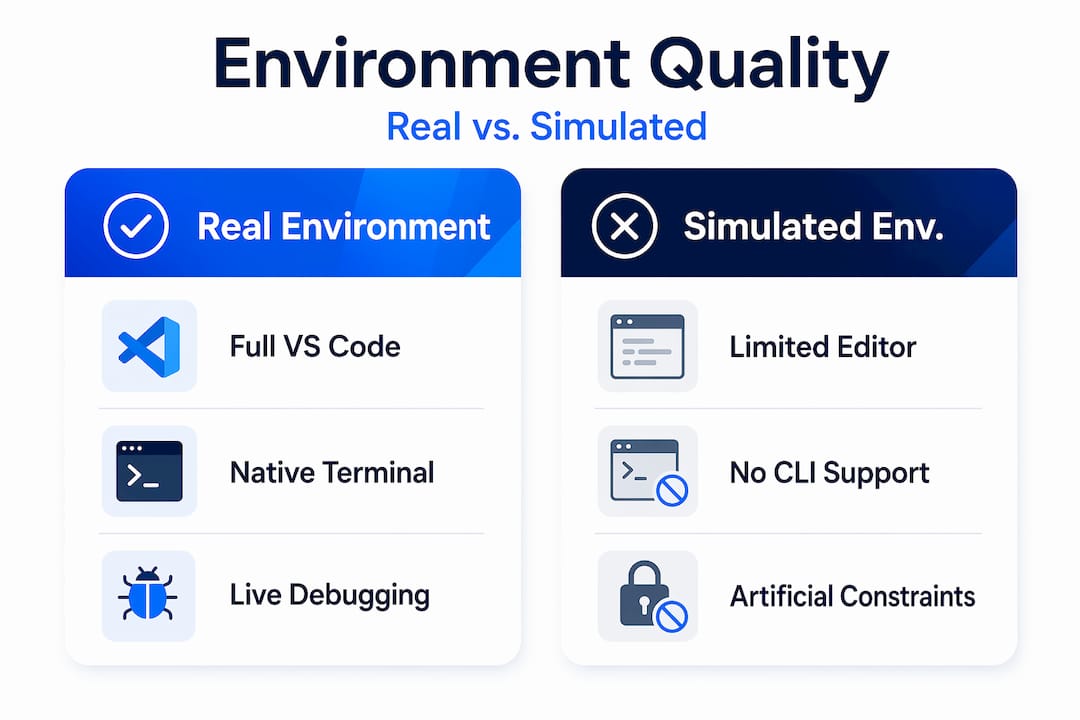
The single biggest differentiator between platforms is the coding environment itself. Browser-based editors with artificial constraints misrepresent developer skills because professionals never write production code in those conditions. When a candidate can only use a stripped-down text area with no autocomplete, no linting, and no package access, you are measuring their ability to work around the tool, not their engineering ability. Platforms like Codility address this by letting candidates work in real VS Code with full tooling, which gives you results that actually predict on-the-job performance.
Question library depth and validity
You want a question bank built on research, not gut instinct. CodeSignal offers a library of 1,000+ certified assessments and over 4,000 role-based questions, some validated with thousands of hours of psychological research. Codility provides over 1,200 tasks designed to reflect real-world job performance across multiple tech stacks. Assessments validated by IO psychologists help predict real job performance by focusing on tasks a developer would actually encounter rather than abstract whiteboard puzzles. The practical upshot: when you use validated questions, you spend less time defending your hiring decisions to skeptical engineering managers.
Pricing models that scale
Pricing structures vary dramatically and the wrong model will wreck your budget at volume. Some platforms charge a flat monthly fee regardless of how many assessments you run. Others, like Equip, charge approximately $1 per test per candidate, scaling linearly with the number of coding questions included. Two questions cost $2, five questions cost $5. That per-candidate model works well for low-volume specialized roles but adds up quickly for high-volume engineering pipelines.
| Pricing model | Best for | Watch out for |
|---|---|---|
| Per candidate | Low-volume, senior roles | Costs spike with high applicant pools |
| Flat monthly | High-volume hiring pipelines | Paying for capacity you don't use |
| Per question per candidate | Fine-grained budget control | Complex cost forecasting |
Integrity and proctoring features
A code evaluation site without serious integrity features is an expensive way to get unreliable data. Modern platforms include proctoring, identity verification, and plagiarism detection, but the most important tools are the ones built for the current threat environment: suspicion scores and leak sweeps that monitor AI-assisted behavior. These go well beyond simple copy-paste detection.

Pro Tip: When evaluating a platform's proctoring capabilities, ask specifically whether their AI-assisted cheating detection flags behavior patterns or only detects copied code. The former catches far more sophisticated attempts.
How to set up and run coding assessments
Once you've selected a platform, the setup process follows a predictable path. Getting each step right determines whether your assessment produces clean, comparable data or a mess you have to manually sort through.
-
Build your test from the question bank or from scratch. Most platforms offer pre-built question sets organized by role, language, and difficulty. Start there unless you have a specific internal codebase you want candidates to work with. Custom questions are powerful but require maintenance as your technology stack evolves.
-
Set time limits by question type, not total test length. Algorithmic challenges and debugging tasks have different natural completion curves. A senior candidate should finish a well-calibrated algorithm question in 30 to 45 minutes. If your time limit is too tight, you are measuring stress tolerance, not engineering skill.
-
Configure your AI tool policy explicitly. Platforms like CodeSignal allow you to configure AI tool usage to either restrict or enable AI assistants during the assessment. This decision should reflect how your engineering team works day-to-day. Banning AI in a company where developers use GitHub Copilot constantly creates an artificial test condition that doesn't map to real performance. The key challenge is evaluating candidates' effective use of AI tools, not banning them outright.
-
Set up ATS integration before you send a single invitation. ATS integrations automate test invitations and candidate tracking, which eliminates the most common source of administrative error in technical hiring. Map your candidate stages before go-live so results flow into the right buckets automatically.
-
Send invitations with clear instructions and a realistic time window. Candidates who receive vague instructions or a 24-hour deadline for a three-hour assessment produce worse results and drop off at higher rates. Give candidates at least 72 hours and explain exactly what tools they are allowed to use.
-
Monitor live or asynchronous sessions through the platform dashboard. Real-time assessments let candidates write, test, and debug code as part of the evaluation, which gives you behavioral data beyond just the final output. Watch for unusual session patterns that trigger proctoring flags.
Pro Tip: Run a test assessment yourself before deploying it to candidates. Catching a broken test case or a confusing prompt before it reaches your applicant pool saves significant relationship damage.
Analyzing and interpreting coding test results
Collecting results is the easy part. Interpreting them correctly is where most hiring teams fall short.
Automated grading runs candidates' code against hidden test cases to verify correctness and efficiency. The hidden aspect matters because candidates who know the exact test cases will write code that passes those cases specifically rather than solving the general problem. A strong result here means the candidate's solution generalizes correctly.
Beyond pass or fail rates on test cases, look at these dimensions:
- Code quality breakdowns. Does the platform score for readability, complexity, and adherence to language-specific conventions? A candidate who passes all test cases with deeply inefficient or unreadable code is a different hire than one who writes clean, maintainable solutions.
- Integrity flags. Suspicion scores and AI-assisted cheating detection add a layer of nuance that simple plagiarism checks miss. A high suspicion score doesn't automatically disqualify a candidate. It's a prompt to dig deeper in the interview.
- Time and iteration data. How many attempts did the candidate make before reaching a passing solution? Constant, small iterations reflect a different problem-solving style than one large submission.
| Signal | What it tells you | What to do next |
|---|---|---|
| High test case pass rate, low code quality | Can solve problems but may struggle in code review | Probe code habits in technical interview |
| High suspicion score | Possible AI assistance or answer leak | Cross-reference with follow-up questions |
| Low pass rate, strong iteration pattern | Methodical approach but may need more preparation | Consider pairing with structured mentoring assessment |
Online evaluation platforms shift hiring from theoretical knowledge toward measurable, practical developer skills. Use the platform data as one input, not the final verdict. Pair coding results with behavioral interview data to get a complete picture of how a candidate thinks and communicates under pressure.
Common challenges and how to handle them
Even a well-configured software testing website creates friction points. Knowing what to expect lets you resolve issues before they affect your hiring pipeline.
- Candidate technical difficulties. Browser-based environments sometimes conflict with corporate VPNs or security tools on a candidate's machine. Include a technical requirements checklist in your invitation email and offer a support contact they can reach during the assessment window.
- AI tool fairness issues. If you allow AI assistants, define what "allowed" means precisely. Copilot for autocomplete is different from using a chatbot to write the entire solution. Vague policies create disputes you can't resolve objectively after the fact.
- False positives on cheating flags. Plagiarism detection can flag two candidates who independently arrive at the same canonical solution for a well-known problem. Calibrate your response to integrity flags by reviewing the flagged code before taking action.
- Candidate dropout rates. Research consistently shows that lengthy or confusing assessments increase abandonment. Keep your total assessment time under 90 minutes for most roles, and tell candidates upfront how long the test takes.
- Fitting the platform to different roles. A QA engineer assessment looks nothing like a backend algorithm challenge. Use role-specific question sets and adjust time limits accordingly rather than running everyone through the same general test.
"The best technical assessment doesn't feel like a test to the candidate. It feels like a problem worth solving." This mindset separates platforms that produce reliable signals from ones that just filter by who tolerates frustration longest.
My take on where code testing is actually headed
I've reviewed hiring pipelines across dozens of engineering organizations, and the pattern I keep seeing is the same mistake repeated: teams invest in a code test website, deploy it broadly, and then treat the output as ground truth without ever validating whether the results correlate with actual on-the-job performance. That's not a technology problem. It's a process problem.
What I've found genuinely useful is the shift toward realistic development environments. When a candidate codes in a real VS Code setup with access to documentation and their preferred extensions, you get data that means something. The results from constrained browser editors tell you who can memorize syntax. That's not the hire you want.
The AI question is the one I find most interesting right now. The right move isn't to ban AI tools during assessments. It's to design assessments where using AI poorly produces a visibly worse result than using it well. That separates candidates who understand what they're doing from those who are just prompting their way through. Platforms that let you configure AI policies thoughtfully are ahead of the curve here.
My honest advice: run a retrospective on your last 20 hires. Pull their assessment scores and compare them against six-month performance reviews. If there's no correlation, your assessment isn't measuring the right things. Fix the questions before blaming the platform.
— Juan
Take your hiring process further with Gostellar
If you're building a technical hiring workflow that needs to move fast and produce results you can trust, Gostellar is worth a close look. The platform gives you automatic code evaluation and real-time analytics without requiring you to build scoring infrastructure from scratch.
Gostellar's approach to assessment combines ease of setup with the kind of data depth that engineering leads actually want to see. You get configurable test environments, proctoring features that go beyond basic plagiarism detection, and goal tracking capabilities that connect assessment outcomes to hiring pipeline metrics. Whether you're running five assessments a month or five hundred, the workflow stays consistent. Visit Gostellar to see how the platform fits your current hiring stack.
FAQ
What is a code test website used for in hiring?
A code test website lets recruiters and engineering teams evaluate technical candidates through structured coding assessments before interviews. It replaces unstructured phone screens with standardized, comparable performance data.
How do I choose between platforms for online coding tests?
Prioritize environment realism, question library quality, and integrity features. A platform that uses a real VS Code environment and IO-validated questions will produce more reliable hiring signals than a generic browser editor with trivia questions.
Can candidates use AI tools during a programming assessment?
That depends on how the platform is configured. Some code evaluation sites let you explicitly allow or restrict AI assistants during tests, which lets you assess how well candidates work alongside AI tools rather than pretending those tools don't exist.
How does automated grading work on a code test website?
Automated grading runs submitted code against hidden test cases to verify correctness and efficiency. Candidates can't see the test cases, which prevents solutions tailored specifically to passing the grader rather than solving the general problem.
What should I do when an integrity flag appears on a candidate's result?
Don't automatically disqualify. Review the flagged code directly, check whether the solution matches a commonly known approach, and follow up with targeted questions in the technical interview to verify the candidate's understanding of their own submission.
Recommended
Published: 5/17/2026