
7 Common A/B Testing Mistakes Marketers Must Avoid
More than half of American digital marketers report that unclear A/B testing strategies drain resources and stall growth. If you have ever felt lost sifting through analytics or doubted what really moves your conversion needle, you are not alone. This guide cuts through the guesswork and highlights proven solutions to the pitfalls that cost small business teams critical revenue, helping you focus on what truly delivers measurable improvement.
Table of Contents
- Not Defining Clear and Measurable Goals
- Running Tests Without a Large Enough Sample Size
- Stopping Tests Too Early for Quick Results
- Testing Too Many Variables at Once
- Ignoring Statistical Significance in Results
- Overlooking the Impact of Website Speed
- Failing to Implement Learnings From Past Tests
Quick Summary
| Key Message | Explanation |
|---|---|
| 1. Set Clear and Measurable Goals | Define specific, quantifiable objectives that align with your business goals to ensure meaningful A/B testing outcomes. |
| 2. Use Adequate Sample Sizes | Ensure tests have enough participants to accurately reflect user behavior and minimize statistical risks. Aim for at least 1000 total conversions. |
| 3. Avoid Stopping Tests Prematurely | Do not halt experiments early; allow sufficient time for statistically significant results to emerge, typically one to two full business cycles. |
| 4. Test One Variable at a Time | Focus tests on individual elements rather than multiple changes to clearly understand what drives user behavior and improvements. |
| 5. Implement Learnings from Past Tests | Continuously document and analyze test results, using insights to inform future strategies and improve overall conversion optimization. |
1. Not Defining Clear and Measurable Goals
One of the most common A/B testing mistakes marketers make is launching experiments without crystal clear, quantifiable objectives. Vague goals like "improve conversion" are recipes for testing failure.
Successful A/B testing requires laser focused measurement of specific outcomes that directly impact business performance. Many marketers fall into the trap of tracking high traffic metrics that look impressive but provide minimal real value. For instance, some analytics experts warn that high click through rates might actually lead to lower revenue if those clicks do not represent high quality potential customers.
To define meaningful goals, you need to establish precise numerical targets connected to your core business objectives. Are you aiming to increase checkout completions by 15%? Reduce cart abandonment rates by 20%? Lower customer acquisition costs by 10%? Each goal should be specific, measurable, achievable, relevant, and time bound.
When setting up an A/B test, identify your primary metric first. This becomes your north star metric that determines test success or failure. Select metrics that provide actionable insights into user behavior and directly correlate with revenue generation. Secondary metrics can provide additional context, but keep your focus on the core objective.
Better goal setting means tracking metrics like conversion value, revenue per visitor, and customer lifetime value instead of superficial engagement numbers. These metrics tell a deeper story about your experiment's true impact.
Pro tip: Always ask yourself "How will this specific metric drive meaningful business growth?" before launching any A/B test experiment.
2. Running Tests Without a Large Enough Sample Size
Running A/B tests with tiny sample sizes is like diagnosing a patient after checking their pulse for just two seconds. Your results will be fundamentally unreliable and potentially misleading. Inadequate sample sizes introduce massive statistical risks that can derail your entire optimization strategy.
Understanding proper test duration guidelines becomes critical when designing experiments. Small sample populations mean random variations and statistical anomalies can easily skew your findings. When testing parameters are insufficient, even significant improvements might go completely undetected.
Statistical significance requires robust data collection. Your sample must be large enough to represent your entire user population accurately. This means tracking enough conversions and interactions to eliminate random chance and highlight genuine user behavior patterns.
To determine appropriate sample size, consider factors like:
- Total website traffic
- Conversion rate variability
- Minimum detectable effect
- Desired statistical confidence level
Most digital marketing experts recommend collecting at least 1000 total conversions per variation before drawing conclusions. This helps minimize statistical noise and ensures your insights reflect real user preferences.
Pro tip: Always calculate your required sample size before launching an experiment and resist the temptation to stop testing prematurely.
3. Stopping Tests Too Early for Quick Results
Impatience kills A/B testing effectiveness faster than almost any other mistake. Marketers often make the critical error of halting experiments prematurely, chasing immediate gratification instead of waiting for statistically significant results.
The digital marketing landscape demands continuous optimization. Avoiding false positive conclusions requires discipline and a systematic approach to testing. Stopping tests too early introduces several dangerous risks:
Statistical Risks:
- Misinterpreting random variations as meaningful trends
- Drawing incorrect conclusions about user behavior
- Wasting resources on potentially misleading insights
Professional A/B testing requires patience. Most experiments need sufficient time and traffic to generate reliable data. Experts recommend allowing tests to run for at least one to two full business cycles to account for daily and weekly user behavior variations.
To prevent premature test termination, establish clear statistical significance thresholds before launching your experiment. Typically, this means achieving a 95% confidence level with a minimal margin of error. This ensures your results represent genuine user preferences rather than momentary fluctuations.
Remember that digital consumer behavior is dynamic. Continuous testing remains crucial for staying competitive as market trends and user expectations constantly evolve.
Pro tip: Always predetermine your minimum sample size and test duration before launching an A/B test, and resist the temptation to stop early based on initial results.
4. Testing Too Many Variables at Once
Multivariable testing is like trying to solve a complex puzzle while wearing a blindfold. When marketers throw multiple changes into a single experiment, they create a statistical nightmare that muddles their understanding of what truly drives user behavior.
Structured testing approaches demand laser focused precision. If you modify headlines, graphics, call to action buttons, and page layout simultaneously, you'll never know which specific change triggered a performance shift. This shotgun approach guarantees inconclusive results.
The Golden Rule of A/B Testing:
- Test one variable at a time
- Isolate specific elements
- Track precise performance metrics
- Draw clear conclusions
Consider a landing page experiment. Instead of changing everything at once, create sequential tests. First, test headline variations. Next, test button color. Then experiment with graphic placement. Each test provides a clear signal about user preferences.
Precise variable isolation allows marketers to understand exactly what drives conversions. When you modify multiple elements simultaneously, you're essentially throwing darts in the dark. Your data becomes noise instead of insight.
Successful A/B testing requires patience and methodical approach. Resist the urge to make sweeping changes. Focus on incremental, measurable improvements that build a comprehensive understanding of your audience.
Pro tip: Create a testing roadmap that sequences individual variable experiments, ensuring each test provides clear and actionable insights into user behavior.
5. Ignoring Statistical Significance in Results
Some marketers treat A/B testing like a coin flip a chance event rather than a precise scientific method. Ignoring statistical significance turns potentially powerful insights into dangerous guesswork.
Understanding p-value principles becomes crucial for making data driven decisions. Statistical significance tells you whether your test results represent genuine user behavior or just random chance.
Key Statistical Significance Concepts:
- Confidence levels matter
- Random variations are not real trends
- Small sample sizes create unreliable data
Most professional marketers use a 95% confidence level as their standard. This means there is only a 5% probability that your observed results occurred by pure chance. However, running multiple tests increases the risk of false positives. Interpreting statistical significance correctly requires careful analysis and understanding of these mathematical probabilities.
Imagine running 10 simultaneous tests at a 95% confidence level. Statistically, you are likely introducing at least one false positive result. This is why rigorous statistical analysis matters more than quick hunches or surface level observations.
Real world A/B testing demands more than surface metrics. Look beyond simple conversion rates. Analyze effect sizes, confidence intervals, and potential statistical noise that could skew your understanding.
Pro tip: Always set a predetermined confidence threshold before launching tests and use statistical calculators to validate your results before making any strategic decisions.
6. Overlooking the Impact of Website Speed
Website speed is not just a technical detail it is the silent killer of conversion rates. Every second of loading delay can dramatically reduce user engagement and torpedo your A/B testing results.
Breaking through performance bottlenecks requires understanding how speed impacts user behavior. Most users will abandon a website that takes more than three seconds to load, making site performance a critical factor in any meaningful testing strategy.
Website Speed Performance Metrics:
- First contentful paint time
- Total loading duration
- Interactive readiness
- Mobile responsiveness
Your A/B tests can produce completely misleading results if website performance varies between variations. Imagine testing two different landing page designs where one loads significantly slower. The performance difference could overshadow any actual design impact, rendering your entire experiment invalid.
Professional marketers understand that speed is not just about technology. It is about creating seamless user experiences that keep visitors engaged. A fast loading page communicates professionalism, reliability, and respect for the user's time.
Consider running performance tests alongside your A/B experiments. Ensure consistent loading times across all variations to maintain experimental integrity. Use tools that measure not just overall speed but granular performance metrics that reveal potential bottlenecks.
Pro tip: Always normalize website speed across your test variations and use performance monitoring tools to validate consistent loading times before drawing any conclusions.
7. Failing to Implement Learnings From Past Tests
A/B testing is not a one time event but a continuous learning process. Many marketers collect valuable insights and then promptly forget them, turning potentially transformative data into digital dust.
Digital marketing strategies evolve rapidly, requiring constant adaptation and refinement. Each test you run is a treasure trove of user behavior insights that can fundamentally reshape your approach to conversion optimization.
Strategic Test Learning Implementation:
- Document every test result
- Analyze both successful and unsuccessful experiments
- Create a centralized knowledge repository
- Develop iterative improvement frameworks
Successful organizations treat A/B testing as a cumulative learning experience. When you uncover that users prefer certain color schemes, messaging styles, or layout configurations, you should integrate those learnings across multiple marketing channels and future experiments.
Continuous optimization remains critical for staying competitive. The digital landscape changes constantly, and what worked six months ago might be completely irrelevant today. Systematic knowledge transfer between tests helps you build a robust understanding of your audience.
Consider creating an internal knowledge base where test results, hypotheses, and key insights are systematically recorded and easily accessible to your entire marketing team. This transforms individual experiments into collective organizational intelligence.
Pro tip: Schedule quarterly review sessions to synthesize A/B testing learnings and develop strategic recommendations for future optimization efforts.
The table below provides a comprehensive summary of common A/B testing mistakes and strategies to avoid them in digital marketing.
| Mistake | Description | Key Strategies |
|---|---|---|
| Not Defining Clear Goals | Launching experiments without specific, measurable objectives leading to insufficient insights. | Set precise numerical targets tied to business objectives; focus on core metrics. |
| Insufficient Sample Size | Using small sample sizes which can skew results and lead to unreliable conclusions. | Calculate needed sample size before testing; aim for 1000 conversions per variation. |
| Stopping Tests Too Early | Halting experiments prematurely, leading to false conclusions and wasted resources. | Run tests for one to two full business cycles; establish significance thresholds. |
| Testing Multiple Variables | Changing too many elements at once, which leads to inconclusive results and confusion. | Test one variable at a time using a structured testing approach. |
| Ignoring Statistical Significance | Overlooking the need for statistical rigor, which can lead to poor decision-making based on chance. | Use a 95% confidence level; analyze effect sizes and intervals carefully. |
| Overlooking Website Speed | Ignoring the impact of loading times can skew A/B test results and user behavior insights. | Ensure consistent speed across variations; run performance tests alongside A/B tests. |
| Failing to Implement Learnings | Not leveraging insights from past tests, leading to missed opportunities for optimization. | Document results; create a knowledge repository and conduct quarterly reviews. |
Avoid Costly A/B Testing Mistakes with Stellar
Struggling with unclear goals, small sample sizes, or premature test endings? These common A/B testing mistakes can waste time, skew data, and slow your growth. Stellar is built to solve these exact challenges with a lightweight and fast platform that keeps your website performance intact while delivering precise, actionable insights. Benefit from features like a no-code visual editor and advanced goal tracking to define measurable objectives and achieve statistical significance with ease.
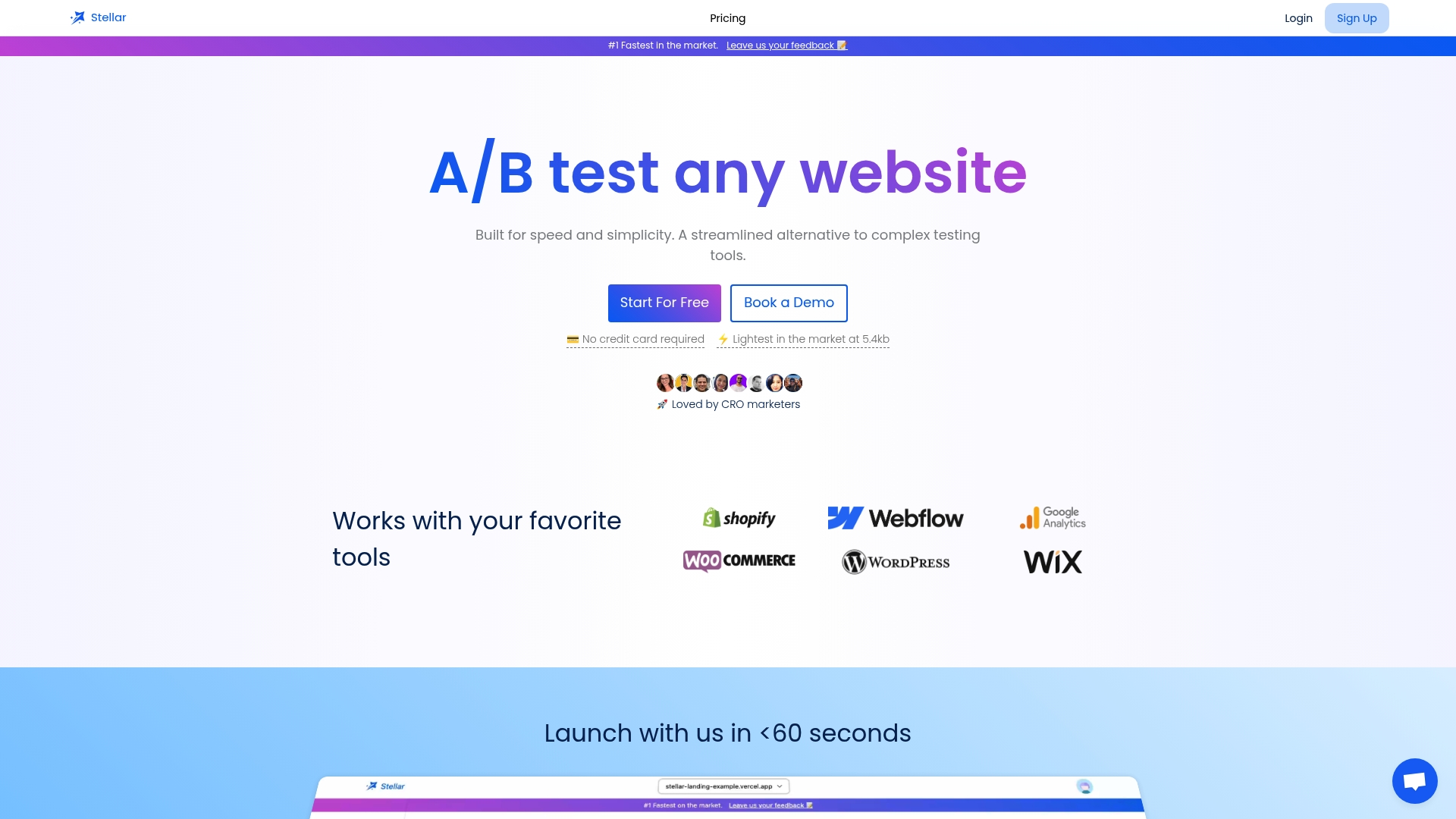
Ready to stop guessing and start optimizing confidently? Explore how Stellar’s real-time analytics and dynamic keyword insertion can drive meaningful results for your business. Don’t let speed issues or testing confusion hold you back. Visit Stellar’s landing page to get started today and join marketers transforming their A/B testing approach. To learn more about how to avoid common pitfalls and improve your experimentation strategy, check out this guide and see why thousands trust Stellar to simplify their growth journey.
Frequently Asked Questions
What are the most common A/B testing mistakes to avoid?
The most common A/B testing mistakes include not defining clear goals, running tests with small sample sizes, stopping tests too early, testing multiple variables at once, ignoring statistical significance, overlooking website speed, and failing to implement learnings from past tests. Focus on setting specific, measurable goals before starting your test to guide your efforts.
How do I define clear and measurable goals for my A/B tests?
To define clear goals, establish precise numerical targets linked to your business objectives, like increasing conversion rates by 15% or reducing cart abandonment by 20%. Write down these goals before launching your test to maintain focus throughout the process.
What is the minimum sample size I should use for A/B testing?
You should aim for at least 1,000 total conversions per variation to ensure your results are statistically reliable. Before starting any test, calculate your required sample size to minimize the risk of drawing incorrect conclusions based on insufficient data.
How long should I run my A/B tests for accurate results?
Run your A/B tests for at least one to two full business cycles to gather sufficient data and account for variations in user behavior. Establish a predetermined test duration before launching to avoid stopping too early for quick results.
Why is statistical significance important in A/B testing?
Statistical significance helps determine whether your test results reflect genuine user behavior or are merely due to random chance. Always set a confidence level of 95% or higher to validate your results before making strategic decisions based on them.
How can I implement learnings from past A/B tests effectively?
Document every test result, analyze both successful and unsuccessful experiments, and maintain a centralized knowledge repository for easy access. Schedule regular review sessions to synthesize insights and develop actionable strategies for continuous improvement.
Recommended
Published: 12/24/2025