
7 Common CTA Optimization Mistakes Marketers Must Avoid
Crafting an effective call-to-action button can feel overwhelming when every tiny design choice impacts your conversion rates. You have to consider everything from button placement to text clarity, and even small mistakes can send your visitors elsewhere. Sorting out what actually works is a challenge when advice is contradictory and trends change fast.
This list will reveal proven strategies that help you build CTAs people actually notice and understand. You’ll find practical solutions backed by research so you can stop guessing and start implementing changes that matter.
Get ready to uncover actionable insights about button placement, copy, color, and more. Each tip is designed to improve your CTAs and give you an edge over competitors—so you can turn more clicks into customers.
Table of Contents
- Ignoring CTA Button Placement Best Practices
- Using Generic or Unclear Call-to-Action Text
- Failing to Test Button Colors and Sizes
- Overlooking Mobile Responsiveness for CTAs
- Cluttering Pages with Multiple CTAs
- Neglecting Personalization and Dynamic Content
- Skipping A/B Testing for Continuous Improvement
Quick Summary
| Key Insight | Explanation |
|---|---|
| 1. Optimize CTA Button Placement | Place your main call-to-action button in the Terminal Area for maximum visibility and effectiveness. |
| 2. Use Specific CTA Text | Make your call-to-action clear with specific, actionable language to drive better conversion rates. |
| 3. Test Button Colors and Sizes | Regularly test different button colors and sizes to identify what resonates best with your audience and maximizes clicks. |
| 4. Ensure Mobile Responsiveness | Design CTAs specifically for mobile users, considering size and placement for easier navigation on small screens. |
| 5. Limit CTAs on a Page | Focus on one primary call-to-action per page to reduce confusion and increase the likelihood of user engagement. |
1. Ignoring CTA Button Placement Best Practices
Where you place your CTA button can make or break your conversion rates. Most marketers treat button placement as an afterthought, sliding it wherever there's empty space on the page. This casual approach costs you conversions.
Your visitors don't scan web pages randomly. Their eyes follow predictable patterns shaped by how we naturally read. The Gutenberg Principle explains how users' eyes move across your page, starting at the top left corner and traveling diagonally toward the bottom right. This natural reading pattern creates four distinct zones on your layout, and not all zones perform equally for CTAs.
The Terminal Area sits at the bottom right of your page, and it's where users' eyes naturally settle after scanning your content. This is your prime real estate for primary CTAs. When visitors reach this zone, they've already consumed your message, considered your offer, and are primed to take action. Placing your main conversion button here aligns with how your audience naturally navigates your page. The Primary Optical Area (top left) grabs attention quickly, but it's actually less effective for CTAs because users haven't yet learned why they should click.
Beyond placement zones, the physical dimensions of your button matter significantly. Make your buttons at least 48 pixels wide and tall to ensure they're easy to tap on mobile devices and click on desktop. Small buttons get missed. They frustrate users. They kill conversions. Pair this size with contrasting colors that make your button stand out from surrounding elements. If your page uses blues and grays, a bright orange or red CTA pops off the screen and draws the eye naturally.
Placement also means proximity to relevant content. Don't bury your CTA three sections below the content it relates to. A user reads about your product benefits, sees your CTA button right below that section, and takes action while the pitch is fresh in their mind. Long scrolls between content and action create friction. Users forget why they were interested. They get distracted. They leave.
For small to medium-sized businesses running A/B tests, button placement variations deliver measurable results. Test your primary CTA in the terminal area against placement in the hero section. Test button size from 40 pixels to 60 pixels. Test color contrast levels. These aren't guesses. They're experiments backed by user behavior data. When you have tools designed for rapid CTA button testing, you can run these experiments quickly and find what converts best for your specific audience.
Pro tip: Use heat mapping or session recording to watch where users' eyes actually go on your pages, then position your primary CTA where natural eye movement already leads them.
2. Using Generic or Unclear Call-to-Action Text
Your CTA button text is doing more work than you think. It's not just a label. It's your last chance to convince someone to act before they click away forever.
Generic phrases like "Click here" or "Read more" create confusion. They fail to tell your visitor what actually happens next. When someone sees "Click here," they don't know if they're about to sign up for a newsletter, download a PDF, start a free trial, or watch a video. This ambiguity introduces friction. Your brain needs clarity to feel confident making a decision, and vague CTAs prevent that confidence from forming.
The research is clear on this point. Generic CTA text lacks specific actionable instructions that motivate people to act. When your button says "Submit" instead of "Get Your Free Audit," you're asking visitors to take a leap of faith. They have to guess what comes next. Some will click anyway. Most won't. The ones who do click might feel surprised or disappointed when the outcome doesn't match their expectations.
Effective CTAs spell out exactly what happens when clicked. Instead of "Learn more," try "See pricing plans." Instead of "Go," try "Start your free 14-day trial." Instead of "Sign up," try "Join 5,000+ marketers getting daily growth tips." Notice the difference? Each one tells the visitor exactly what action they're taking and often hints at the benefit they'll receive.
Your CTA text should also match the action on the other side. If clicking the button takes visitors to a signup form, don't say "Get started." Say "Create my free account." If it opens a pricing page, don't say "Click here." Say "View all plans." This alignment between promise and reality builds trust. Visitors feel like you're being straight with them because you are.
Consider who you're asking to act. A CTA that works for enterprise clients might not work for individual users. "Schedule a demo" speaks to business buyers. "Try it free" speaks to skeptical individuals testing your solution. Your button text should reflect who you're talking to and acknowledge their position in the buying journey. Someone visiting your homepage has different needs than someone on your pricing page, and your CTAs should reflect that difference.
The length of your CTA text matters too. Aim for 2 to 5 words that pack clarity and urgency. "Download the complete guide" beats "Click to access the resource." "Reserve my spot" beats "Proceed." Short, specific text gets processed faster by the brain. It stands out on the button. It feels action oriented.
When testing CTAs, focus on specificity. Run "Get instant quote" against "Request quote." Test "Start free trial" against "Try free for 14 days." Test action verbs like "Download," "Claim," "Register," and "Unlock" to see which resonates with your audience. Different CTA button variations can significantly impact conversions, and testing reveals what your specific audience responds to best.
Avoid obscure language or industry jargon in your CTA. Your visitors might not understand "Initiate onboarding" as clearly as "Start now." They won't recognize "Leverage our solutions" as quickly as "See how it works." The person clicking your button came to solve a problem, not decode your message. Make the path forward obvious.
Pro tip: Use power words that evoke action and benefit ("Unlock," "Discover," "Claim," "Get") paired with specific outcomes ("Get your free template" not just "Download") and test variations weekly to continuously improve your conversion rates.
3. Failing to Test Button Colors and Sizes
You've optimized your copy. Your placement is strategic. Your landing page converts at a respectable rate. So you leave your button design alone, assuming it's fine as is. This assumption costs you conversions.
Button size and color are not decorative choices. They directly influence whether visitors notice your CTA and feel confident clicking it. Yet many marketers never test these elements, treating them as fixed parts of their design system rather than conversion levers.
Start with size. Your button needs to be large enough to be noticed and easy enough to click without frustration. Accessible button design requires a minimum of 44 pixels by 44 pixels, though 48 pixels by 48 pixels offers even better usability. On mobile devices especially, tiny buttons create friction. A visitor might want to click but miss the target, get frustrated, and leave. Larger buttons reduce this friction dramatically.
But what about color? The relationship between button color and conversions is more nuanced than many assume. While color choice matters for visibility and contrast, it's not the silver bullet some marketers believe it to be. Tests show that different action types and contexts influence conversion rates more significantly than color alone. A button saying "Buy now" converts differently than one saying "Add to list," regardless of whether it's red, green, or blue.
This doesn't mean ignore button color entirely. It means test strategically. Your button color should contrast sharply with your background so it stands out visually. A bright orange button on a white background gets noticed. A light gray button on a light background disappears. That contrast is what matters most. Beyond contrast, test button colors against your specific audience and page design to find what resonates with them.
Size variations offer more predictable results. Test a 48 pixel button against a 64 pixel button. Test wide buttons against tall buttons. Your data will show which dimensions your visitors prefer. Some audiences respond better to wide, low-profile buttons. Others prefer taller buttons that feel more substantial. Testing button variations systematically across your traffic reveals these preferences.
Consider the visual weight of your button too. A bold, solid color button feels different than an outlined button or a ghost button with transparent fill. Run your standard solid button against an outlined version to see which drives more clicks. The visual hierarchy you create through button style influences how prominently the CTA stands out from surrounding elements.
For small to medium-sized businesses with limited traffic, button testing requires patience and focus. Don't test color and size simultaneously. Run one test at a time so you understand what's actually driving changes in conversion rates. Test color this month. Test size next month. Build your knowledge incrementally.
Remember that button design doesn't exist in isolation. A perfectly sized button with excellent contrast still underperforms if placed poorly or paired with weak copy. The button works in concert with everything else on the page. When you optimize all these elements together through systematic testing, conversion rates improve noticeably.
Start where you are with your current button. Measure its performance. Then test one variation at a time. Does a larger button increase clicks? Does a different color improve conversions? Let the data answer these questions rather than guessing based on design trends or personal preference.
Pro tip: Run at least one button size test and one button contrast test on every major landing page, comparing your control against one meaningful variation, and let each test run for at least 2 weeks to gather sufficient data for reliable results.
4. Overlooking Mobile Responsiveness for CTAs
More than half of all web traffic comes from mobile devices. Yet many marketers design their CTAs with desktop users in mind, assuming the button will simply scale down and work fine on phones. This assumption destroys conversions on mobile.
Mobile CTAs operate in a completely different environment than desktop CTAs. Your visitor is holding a device in their hand, using their thumb to navigate, dealing with a smaller screen that shows less content at once. A button that works perfectly on desktop becomes awkward, hard to tap, or even invisible on a phone. The friction multiplies, and visitors abandon your page.
Size becomes critical on mobile. Your desktop button might be 200 pixels wide and look proportional on a 1200 pixel screen. Shrink that same button proportionally for a 375 pixel mobile screen, and it becomes nearly impossible to tap accurately. Your finger is about 10 millimeters wide, which translates to roughly 48 pixels on screen. This is the minimum touch target size. Most mobile buttons should be larger. Mobile CTA optimization requires sizing buttons for finger taps, not mouse clicks.
Placement changes too. On desktop, your CTA might sit in a sidebar while users scroll through your main content. On mobile, there is no sidebar. Your button needs to move into the main content area, appearing when users are most engaged. A button hidden below five paragraphs of text on mobile means visitors scrolled past it, forgot about it, and moved on. Test button placement specifically for mobile viewports.
Consider the finger reach zones on a phone held in one hand. Users naturally reach the lower portion of the screen with their thumb. Place your primary mobile CTA in this zone. Secondary CTAs can sit higher, but don't expect as many clicks. Design your mobile layout with thumb ergonomics in mind, not just visual aesthetics.
Screen obstruction is another mobile specific challenge. When a user taps near the bottom of the screen, their finger often covers content. Design your mobile CTA with space below it so users can see what happens after they click. Add subtle animations or transitions that confirm the click happened, giving users visual feedback that their action registered.
Responsive design means more than just making things smaller. It means reconsidering your entire CTA strategy for mobile contexts. A desktop page with three CTAs might work fine. The same page on mobile becomes cluttered and confusing. Choose one primary CTA for mobile and remove or hide secondary CTAs below the fold. Focus the mobile experience on a single, clear action.
Testing mobile CTAs separately from desktop is essential. Optimizing mobile landing pages requires understanding how mobile visitors behave differently than desktop visitors. They scroll faster. They have less patience. They're often distracted by notifications or other apps. Your CTA needs to capture their attention quickly and make the action easy.
Text changes matter too. A desktop button might say "Register now for our exclusive webinar." On mobile, that text wraps awkwardly or gets cut off. Shorten your mobile button text to fit comfortably without wrapping. "Register" might work better than "Register now" on a small screen. Every character counts when screen space is limited.
Background and contrast need special attention on mobile. A button that pops off the background on desktop might blend in on a phone if the user has adjusted their brightness or if they're viewing in sunlight. Test your buttons in real mobile lighting conditions, not just in a darkened office. What works under office lighting might fail in bright sunlight.
Colors should remain consistent across devices, but visibility might change. A light gray button that seems fine on a desktop display might become nearly invisible on a mobile phone with different color calibration. Test your actual button designs on actual mobile devices, not just browser emulators.
Pro tip: Use your phone to test every CTA on your site weekly, paying attention to button size for thumb tapping, text wrapping, and visibility in different lighting, then adjust sizing and copy based on what you experience as a real mobile user.
5. Cluttering Pages with Multiple CTAs
You want visitors to have options. You've got a signup button, a download button, a contact form link, a pricing page button, and a live chat prompt all competing for attention on the same page. What you've actually created is confusion.
Multiple CTAs on a single page dilute the power of each one. When visitors see competing buttons, they freeze. They don't know which action matters most. They don't know which one serves their current need. This decision paralysis costs conversions. Instead of clicking one of several buttons, they click none and leave your page.
The problem isn't having options. The problem is presenting them as equals. Your visitor arrived with a specific intent. They want to accomplish one primary goal. Yet your page presents five different actions with equal visual weight. They're forced to decide between options that weren't part of their original plan. Most visitors resolve this confusion by doing nothing.
Think about your visitor's journey. Someone landing on your homepage has different needs than someone on your pricing page. A homepage visitor might want to learn more about your product, so they need an educational CTA like "See how it works." That same visitor probably doesn't need to download your resource guide, start a free trial, and schedule a demo all at once. Each of those secondary actions dilutes focus on the primary action.
Multiple CTAs create visual clutter that confuses users and triggers decision paralysis. Too many competing buttons reduce the likelihood that visitors click any of them. The solution is ruthless prioritization. Choose one primary CTA per page section. One button that represents the action you most want visitors to take right now.
On your homepage, make the primary CTA something like "Start free." That single button focuses the visitor's attention. Secondary CTAs can exist, but they should be visually subordinate. Use a text link instead of a button. Place it lower on the page. Use a neutral color instead of a bold one. The hierarchy becomes clear. Visitors see the primary action first and understand it's the recommended path.
Different page types require different primary CTAs. Your homepage might prioritize "Get started." Your pricing page should prioritize "Choose your plan." Your blog article should prioritize "Download the guide" or "Subscribe." Your product demo page should prioritize "Book a demo." Match the CTA to the page's purpose and visitor intent.
Remove secondary CTAs from above the fold. If visitors have to scroll to reach your secondary options, fewer people will see them. This isn't a problem. It's a feature. The people who scroll down are engaged. They've already consumed your main message. If they want additional information or options, they can find them below the fold. But your fold should feature only the primary action.
When you do include secondary CTAs, make them visually distinct from the primary one. Your main button might be bold and red. Secondary buttons might be outlined and gray. Use button styles, colors, and sizes to create clear visual hierarchy. Visitors instinctively know which action matters most based on these visual cues.
Test the impact of reducing CTAs. Create a version of your high converting page and remove all secondary CTAs. Keep only the primary action button above the fold. Run this version against your current page. Most likely, your simplified version converts better. Fewer options paradoxically increase conversions because visitors feel confident about taking action.
For small to medium-sized businesses, this principle matters even more. Your traffic is limited. Every visitor counts. You can't afford the conversion loss from decision paralysis. Focus each page on driving one specific action. Build your funnel to guide visitors through sequential actions rather than offering everything at once.
Consider the user experience too. When a visitor lands on your page and immediately sees five different buttons, your page feels desperate. It feels like you're throwing everything at them hoping something sticks. A page with one clear, well-designed CTA feels confident. It feels like you know exactly what value you're offering and what action you want them to take.
Pro tip: Audit every page on your site and identify which CTA is truly primary, then remove or significantly de-emphasize all other buttons above the fold, keeping only secondary CTAs as subtle text links lower on the page.
6. Neglecting Personalization and Dynamic Content
Every visitor to your page is different. They arrived from different sources, they have different needs, and they're at different stages of their buying journey. Yet most marketers show them the same generic CTA. This missed opportunity costs conversions.
Personalization transforms CTAs from generic requests into relevant, contextual invitations. When a first-time visitor sees "Learn how it works" and a returning visitor sees "Start your free trial," each feels like the CTA was designed specifically for them. Because it was.
Dynamic CTAs adapt based on what you know about the visitor. This goes beyond simple name insertion. Real personalization uses behavioral data, journey stage, traffic source, and past interactions to craft messaging that resonates with each individual. A visitor who spent 10 minutes exploring your pricing page has different needs than someone who just arrived from a blog post about industry challenges.
Advanced CTA personalization dynamically adapts messaging based on user behavior and journey stage, significantly increasing relevance and conversions. The data supporting this is clear. When your CTA feels targeted to the visitor's specific situation, they're more likely to click.
Start with the most basic personalization variables. If you know someone's company size, adjust your CTA accordingly. A startup founder might see "Start building your stack" while an enterprise prospect sees "Schedule a consultation." The action changes because the context changes. A 10-person team has different needs and decision-making processes than a 500-person organization.
Traffic source provides another clear personalization opportunity. Someone arriving from a paid ad saw a specific promise. Your CTA should reinforce that promise. If your ad said "See 5 ways to automate your workflow," your landing page CTA might say "Get the automation guide" instead of the generic "Sign up." The continuity makes the experience feel intentional rather than random.
Visitor behavior on your site tells you volumes. How many pages did they visit? How long did they stay? Which features did they explore? Someone who visited three product pages and spent five minutes reading your features is further along in their decision journey than someone who just landed on your homepage. Their CTAs should reflect this difference.
For someone showing high buying intent, personalize toward action. "Start your free trial" or "Schedule a demo" acknowledges their readiness. For someone still learning, personalize toward education. "Download our buying guide" or "Watch the product demo" gives them the information they need without asking for too much commitment yet.
Past interactions matter too. A visitor who downloaded your guide last month and is now back on your site is different from a cold visitor. They're familiar with your brand. They've shown interest. Your CTA can be bolder. "Start your 14-day trial" feels appropriate for a returning prospect. For a cold visitor, "See how it works" feels more natural.
Geographic location enables personalization too. If someone visits from Europe, you might personalize for GDPR compliance or regional features. Someone visiting from Asia might see different social proof or success stories featuring companies in their region. These contextual details matter. They signal that you understand and serve their market.
Device type opens personalization possibilities as well. Someone browsing on mobile might see a button saying "Call our team" while someone on desktop sees "Schedule a demo." Mobile users might prefer phone contact while desktop users prefer scheduling systems. Adapt your CTA to the device and its implied context.
Industry information, if you have it, should influence CTA messaging. A healthcare professional has different compliance concerns than a retailer. Your CTA might emphasize "HIPAA compliant" for healthcare or "PCI compliant" for retailers. Speaking directly to their industry needs makes your CTA more persuasive.
The technical implementation of personalization requires collecting data thoughtfully. You need to track what visitors do, where they come from, and what they interact with. Modern marketing platforms make this possible without requiring engineering expertise. Tools designed for rapid experimentation can incorporate personalization logic into dynamic CTAs.
Start small if personalization feels overwhelming. Begin with traffic source variations. Create one CTA for paid traffic and another for organic traffic. Test email list segments with different CTAs based on their signup source or engagement level. Gradually layer in additional personalization variables as you gather more data and confidence.
Test your personalized CTAs to ensure they perform better than generic versions. Run a personalized variant against your standard CTA to measure the impact. Most companies discover that personalized CTAs convert 15 to 30 percent higher than generic ones. The exact improvement depends on your audience and how well your personalization reflects their actual needs.
Personalized touchpoints profoundly influence customer experience, with tailored communication and CTAs enhancing engagement and conversion outcomes across industries and customer segments.
For small to medium-sized businesses, personalization doesn't require massive data infrastructure. You can start with behavioral segmentation based on page visits, time on site, and content consumed. You can personalize based on traffic source and device type. These basic personalization strategies deliver measurable improvements without requiring advanced technology.
Pro tip: Start with one personalization variable (traffic source or returning visitor status) and create two CTA variations, then measure which performs better before layering in additional personalization logic.
7. Skipping A/B Testing for Continuous Improvement
You optimized your CTA. It looks good. It converts reasonably well. So you leave it alone and move on to the next project. This is where most marketers stop. It's also where they leave conversions on the table.
A/B testing isn't a one-time activity. It's a continuous practice that compounds over time. Each test teaches you something about your audience. Each insight informs the next experiment. The marketers who dominate their categories aren't smarter than their competitors. They're more committed to systematic testing.
Continuous A/B testing optimizes CTAs through systematic experimentation with design, placement, and copy variations. This provides empirical data to refine CTAs and align them with evolving user behaviors. A testing regimen that runs indefinitely compounds improvements month after month.
Think about compounding returns. Imagine your CTA currently converts at 3 percent. You run a test and improve it to 3.3 percent. That's a 10 percent relative improvement. Small, right? But run that same 10 percent improvement every month for a year, and your conversion rate compounds to 4.2 percent. That's 40 percent more conversions from the same traffic with no increase in marketing spend.
Most marketers stop after one successful test. They found a winner and assume they've optimized the CTA. But your audience changes. Market conditions shift. Competitor messaging evolves. What worked last quarter might underperform next quarter. Continuous testing keeps your CTAs fresh and relevant.
Structure your testing program around clear hypotheses. Don't just test random variations and hope something works. Start with a hypothesis based on user feedback, analytics data, or past test results. "Users arriving from mobile devices respond better to phone call CTAs than signup forms" is a hypothesis. "Users with high engagement on the product page convert better with action oriented copy" is another. Test these hypotheses systematically.
Run one meaningful test at a time. Testing three button colors simultaneously makes it impossible to understand what drives results. Test button color against your control. Let that test run until you have statistical significance, typically 2 to 4 weeks depending on traffic volume. Document the results. Then move to the next test.
What should you test next? Look at your analytics and user feedback. Are visitors spending time on your pricing page but not converting? Test your CTA copy and messaging. Are mobile conversions lagging? Test button size and placement for mobile. Are repeat visitors converting at lower rates? Test personalized CTAs for returning visitors. Let data guide your testing calendar.
Each test doesn't need to be a dramatic change. Small, incremental improvements compound over time. Test changing your button copy from "Get started" to "Start your free trial." Test moving your button 20 pixels down on the page. Test changing your button color from one shade of blue to another shade of blue. These micro improvements feel minor individually but add up significantly.
Document everything. Keep a testing log that tracks what you tested, the result, and what you learned. This creates institutional knowledge. When you hire a new team member, they can review your testing history and understand why your CTAs are designed the way they are. Over time, your testing log becomes your competitive advantage.
Involve your team in the testing process. When your content writer understands that "Get instant access" converts better than "Download now," they write stronger CTAs everywhere. When your designer understands that high contrast buttons perform better, they create designs with better visual hierarchy. Testing educates your entire organization about what works.
Don't wait for perfect traffic to start testing. Start with the traffic you have. Small to medium-sized businesses often think they don't have enough traffic for A/B testing. But testing with modest traffic simply takes longer. A company with 10,000 monthly visitors can absolutely run A/B tests. They might need 6 weeks where a company with 100,000 monthly visitors needs 2 weeks. The principle remains the same.
Use testing to build competitive advantages. Your competitors might test occasionally. You test continuously. After 12 months of systematic testing, your CTAs perform 30 to 40 percent better than when you started. Your competitors haven't moved. You've pulled ahead. This compounds into a significant competitive advantage.
Consider the cumulative impact of optimization. Each month, you run one CTA test. You implement the winner. By year end, you've run 12 tests. Most don't produce dramatic improvements individually. But collectively, they transform your conversion performance. A/B testing is a cornerstone of data-driven decision-making that improves performance incrementally and systematically.
Measure not just immediate conversions but downstream metrics too. Does a CTA variant that gets more clicks also get more quality customers? Does it improve customer lifetime value or reduce churn? Sometimes an optimization that increases clicks decreases quality. Test not just conversion metrics but profitability metrics.
Build testing into your quarterly planning. Identify 3 to 4 areas where you want to improve CTA performance. Allocate resources to run tests in those areas. At the end of the quarter, review results and plan tests for the next quarter. This systematic approach ensures testing never stops and improvements accumulate.
For marketers managing multiple pages or campaigns, prioritize testing on high-traffic pages first. A 10 percent improvement on a page getting 10,000 monthly visitors matters more than a 10 percent improvement on a page getting 100 monthly visitors. Start where the volume is, prove the methodology works, then expand to other pages.
Pro tip: Commit to running one CTA test every month for the next 12 months, documenting each test result in a shared spreadsheet, so you build institutional knowledge while compounding improvements month after month.
Below is a comprehensive table summarizing strategies for optimizing Call-to-Action (CTA) button effectiveness based on the well-researched content of the article.
| Aspect | Description | Key Principles |
|---|---|---|
| Placement | Optimal placement aligns with the user's natural scanning pattern. | Position the primary CTA in the Terminal Area for maximum visibility. |
| Button Design | Visual aspects like size and color significantly impact user engagement. | Ensure the button is at least 48 pixels in size, contrasts with the background, and is easy to recognize. |
| Text Specificity | Clear and specific language increases likelihood of user action. | Craft precise and descriptive CTAs aligning with user intent, such as "Start my free trial." |
| Testing and Improvement | Continuous A/B testing refines effectiveness. | Regularly test variations in color, size, and text to find the optimal configuration. |
| Mobile Responsiveness | Tailor CTAs for mobile usability. | Adjust size, placement, and accessibility for touchscreens and smaller displays. |
| Singular Focus | Reduce distractions by limiting competing CTAs. | Focus each page on one primary action, minimizing secondary buttons. |
Avoid Common CTA Mistakes and Boost Your Conversions Today
Many marketers struggle with optimizing their call-to-action buttons due to issues like poor placement, unclear text, and lack of mobile responsiveness. These challenges can lead to lost conversions, frustrated visitors, and missed revenue opportunities. If you want to overcome problems such as decision paralysis from multiple CTAs or failing to personalize CTAs effectively, it is crucial to test and refine your strategies continuously.
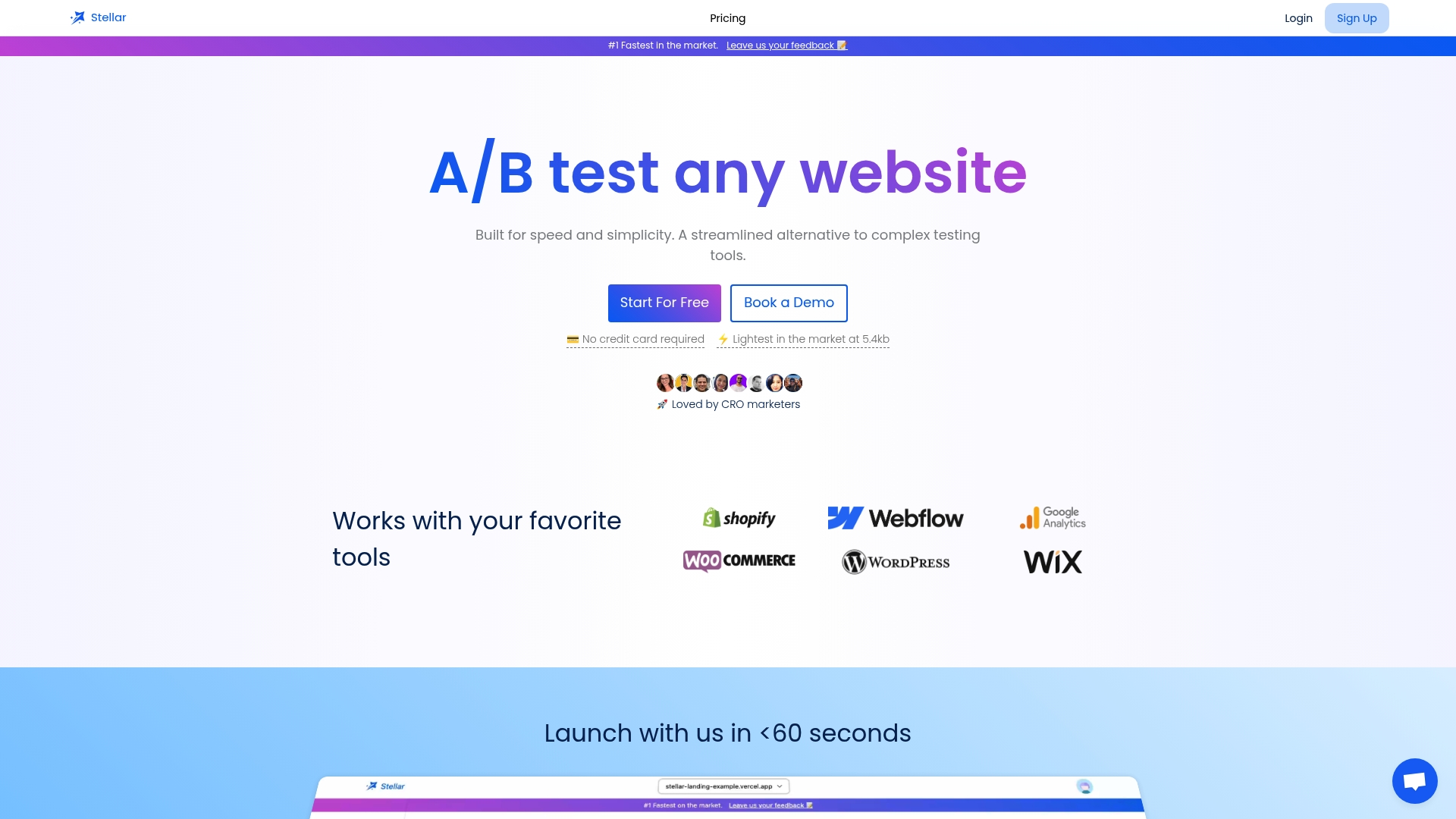
Experience how Stellar's A/B Testing Tool can help you identify the best CTA placements, button sizes, and personalized messaging tailored for your audience. With its no-code visual editor and real-time analytics, you can run rapid experiments and optimize your CTAs based on actual user behavior without technical complexity. Start improving your conversion rates now by visiting Stellar's landing page and see why marketers at small to medium-sized businesses trust Stellar for impactful decision-making and streamlined A/B testing.
Frequently Asked Questions
What are the key mistakes marketers make when optimizing CTAs?
Marketers often overlook best practices related to CTA button placement, text clarity, and personalization. To avoid these mistakes, focus on strategically placing your CTAs in areas where visitors naturally look first, and ensure the language is clear and action-oriented.
How can I improve my CTA button text to increase conversions?
Use specific and actionable language that clearly conveys the benefit or action. For example, replace vague phrases like "Click here" with something more direct, such as "Get Your Free Quote" or "Start Your Free Trial."
What should I consider when testing CTA colors and sizes?
Ensure your CTA buttons are large enough (preferably at least 48 pixels) and contrast sharply with the background for visibility. Test different sizes and colors over a few weeks to determine what resonates best with your audience and drives the highest click-through rate.
How does mobile responsiveness affect my CTAs?
Mobile responsiveness is critical because more than half of web traffic comes from mobile devices. Ensure that your CTA buttons are touch-friendly, ideally larger than the minimum size, and easily accessible without excessive scrolling, to enhance the user experience on mobile devices.
How important is continuous A/B testing for my CTAs?
Continuous A/B testing is essential for optimizing CTAs, as it helps you identify what works best for your audience over time. Commit to testing one key change each month to improve your conversion rates significantly, potentially increasing conversions by 10% or more over the year.
What can I do to avoid overwhelming visitors with too many CTAs on a page?
To prevent confusion, focus on a single primary CTA per page that aligns with the visitor’s intent. Remove secondary CTAs from above the fold and make them visually distinct, ensuring that visitors know which action to prioritize.
Recommended
- 7 Common Pitfalls in Digital Marketing and How to Avoid Them
- Top Common Landing Page Errors CRO Teams Must Avoid in 2025
- Digital Marketing Mistakes: Complete Expert Guide
- A/B Testing Digital Marketing: Strategies and Best Practices 2025
- Strategie Di Comunicazione Sui Media: Guida Completa • Gio Talente
Published: 1/22/2026