
Conversion Funnels: Maximizing Results for Marketers
Most American businesses lose nearly 80 percent of prospects before those visitors complete a purchase, according to recent funnel research. For digital marketers and growth hackers at small and medium-sized companies, understanding each stage of the conversion funnel can mean the difference between flat results and measurable growth. This guide breaks down the foundational concepts, funnel strategies, and practical A/B testing tactics that help teams worldwide convert more leads efficiently, without any technical headaches.
Table of Contents
- Conversion Funnels And Core Concepts Defined
- Stages Of Conversion Funnels Explained
- Types And Variations For Different Goals
- Optimizing Funnels With A/B Testing
- Common Mistakes And How To Avoid Them
- Key Metrics And Tools For Analysis
Key Takeaways
| Point | Details |
|---|---|
| Conversion Funnel Stages | The funnel consists of Awareness, Interest, Decision, and Action, which help diagnose customer engagement and optimize conversions. |
| Tailored Strategies | Different types of funnels, such as E-commerce, B2B, Lead Generation, and Subscription-based, require unique approaches for effective customer guidance. |
| A/B Testing Importance | Systematic A/B testing can significantly enhance conversion rates by evaluating different marketing elements to identify what resonates best with customers. |
| Critical Metrics | Monitoring key performance indicators like Conversion Rate and Drop-off Rate provides valuable insights into customer behavior and funnel effectiveness. |
Conversion funnels and core concepts defined
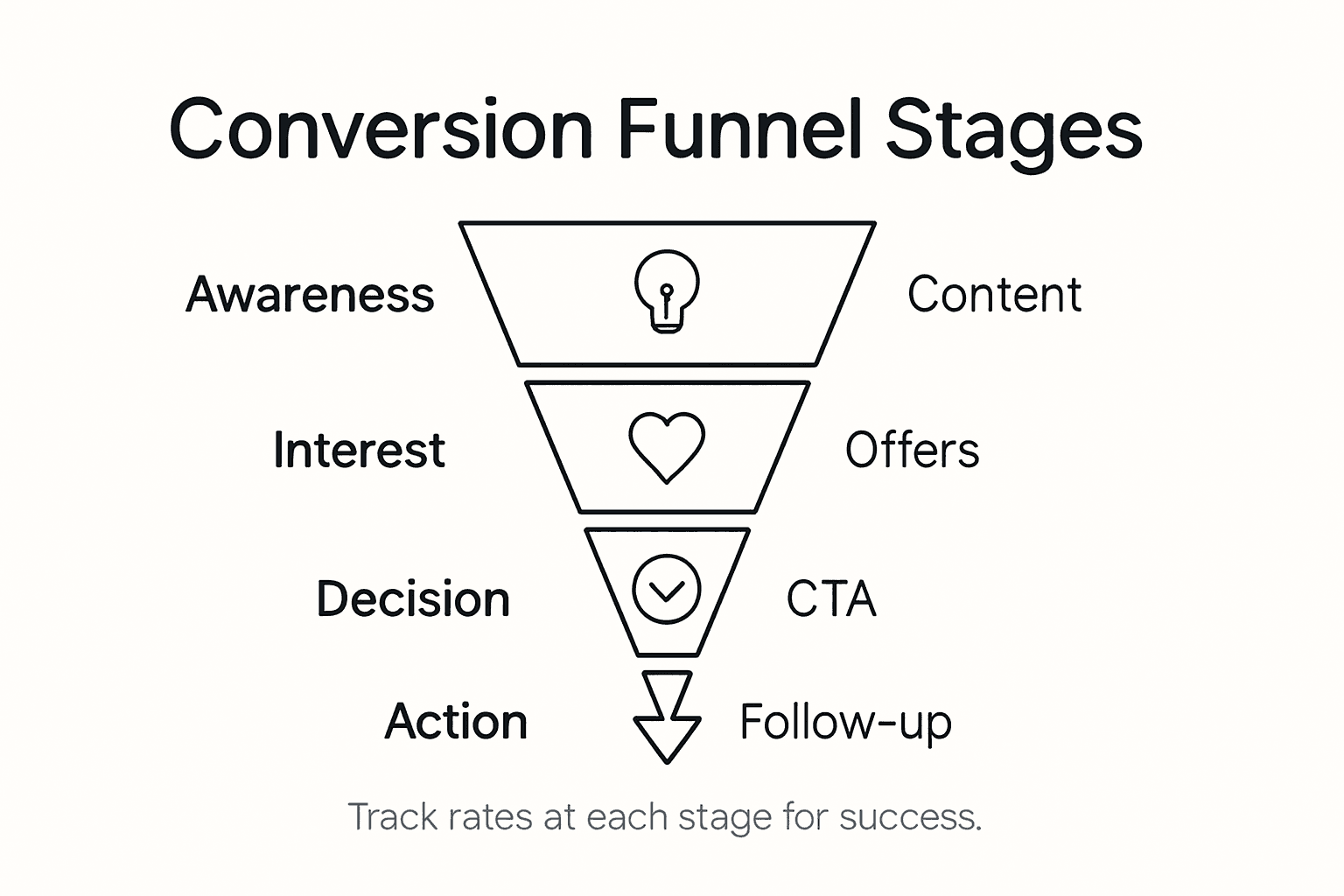
A conversion funnel is a strategic marketing model that visualizes the customer's journey from initial awareness to final purchase. Think of it like a physical funnel: wide at the top, progressively narrowing as potential customers move through different stages of engagement. At its simplest, the funnel describes the pathway potential customers take from discovering a product to completing a desired action.
The conversion funnel typically consists of four critical stages that help marketers understand and optimize customer interactions. These stages include Awareness (where potential customers first learn about a product), Interest (when prospects start showing curiosity), Decision (evaluating whether to purchase), and Action (completing the purchase or conversion). Each stage represents a filtration process where fewer people progress, much like liquid moving through a physical funnel's progressively narrower channels.
Understanding this framework allows marketers to diagnose potential bottlenecks and strategically allocate resources. The primary purpose of a conversion funnel is to bring structure and measurability to the customer journey, breaking it down into distinct stages with specific goals, channels, and key performance indicators (KPIs). By tracking how many potential customers move through each stage, businesses can identify where prospects might be dropping off and develop targeted strategies to improve conversion rates.
Pro tip: Track your conversion rates at each funnel stage and create specific interventions to address drop-off points, focusing on moving more potential customers toward the final action stage.
Stages of conversion funnels explained
Conversion funnels are strategically divided into distinct stages that map out the customer's journey from initial awareness to final purchase. These core stages systematically track how potential customers progress through different levels of engagement, with each stage representing a strategic filtering mechanism.
Traditionally, conversion funnels are structured around four primary stages, often referred to by marketing professionals using the acronyms TOFU, MOFU, and BOFU:
-
Top of Funnel (TOFU) - Awareness Stage: Potential customers first become conscious of their needs or challenges. This is where broad marketing efforts generate initial interest and attract a wide audience.
-
Middle of Funnel (MOFU) - Interest and Consideration Stage: Prospects start actively researching solutions, comparing options, and evaluating potential products or services that might address their specific requirements.
-
Bottom of Funnel (BOFU) - Decision and Conversion Stage: Potential customers narrow down their choices, preparing to make a final purchasing decision. This stage involves more targeted, personalized marketing approaches to encourage conversion.
-
Post-Funnel - Loyalty and Advocacy Stage: After the initial purchase, customers are nurtured to become repeat buyers and potential brand advocates.
The customer journey through these stages mirrors a progressive narrowing process, where fewer individuals advance from initial awareness to final purchase. Successful marketers optimize each stage by creating targeted messaging that addresses specific customer needs and pain points, ultimately guiding more prospects toward conversion.

Pro tip: Develop unique, stage-specific content and messaging that directly addresses the evolving needs and questions of potential customers as they move through each funnel stage.
Types and variations for different goals
Conversion funnels are not one-size-fits-all strategies, but highly adaptable frameworks that can be customized to meet specific business objectives. Different industries and marketing goals require unique funnel approaches that reflect their distinct customer journeys and conversion pathways.
Various types of conversion funnels emerge across different business contexts:
-
E-commerce Funnel: Typically shorter and more direct, focusing on product discovery, consideration, and immediate purchase. Emphasizes visual product presentation, quick decision-making, and streamlined checkout processes.
-
B2B Sales Funnel: Characterized by longer, more complex decision-making processes involving multiple stakeholders. These funnels often include additional stages like:
- Initial awareness
- Detailed research
- Qualification
- Proposal
- Negotiation
- Final contract
-
Lead Generation Funnel: Designed to capture potential customer information and nurture prospects through educational content, webinars, downloadable resources, and targeted communications.
-
Subscription-Based Funnel: Common in SaaS and digital service industries, focusing on demonstrating ongoing value, offering trial periods, and converting users from free to paid models.
Here's a summary of how funnel types differ in purpose and strategy:
| Funnel Type | Unique Features | Main Business Goal | Common Tactics |
|---|---|---|---|
| E-commerce | Quick purchases, visuals | Immediate transaction | Streamlined checkout, promos |
| B2B Sales | Longer cycles, many stages | Relationship-building | Personalized outreach, demos |
| Lead Generation | Content-driven nurturing | Data capture & follow-up | Gated resources, emails |
| Subscription-Based | Trials, long-term retention | Recurring revenue | Free trials, onboarding flows |
Pro tip: Map out your specific customer journey and design a conversion funnel that precisely matches your business model, focusing on the unique decision-making triggers of your target audience.
Optimizing funnels with A/B testing
A/B testing is a powerful methodology for systematically improving conversion funnel performance by comparing two different versions of a marketing element to determine which generates better results. Effective A/B testing requires a structured approach that focuses on defining clear goals, selecting relevant elements to test, and analyzing results with statistical rigor.
Key elements marketers can test within conversion funnels include:
- Landing Page Design: Comparing different headline variations, color schemes, image placements, and call-to-action button designs
- Copywriting: Testing alternative messaging, value propositions, and emotional triggers
- Form Layouts: Experimenting with form length, field requirements, and information requests
- Pricing Presentation: Evaluating different pricing structures, discount strategies, and visual representations
- User Flow: Analyzing alternative navigation paths and conversion step configurations
Successful A/B testing involves a methodical process:
- Develop a Hypothesis: Create a clear, measurable prediction about what change might improve conversion rates
- Design Variations: Create two distinct versions with a single, controlled variable
- Split Traffic: Randomly distribute audience segments between original and test versions
- Collect Data: Gather comprehensive metrics on user interactions and conversion performance
- Statistical Analysis: Evaluate results to determine statistically significant differences
- Implementation: Apply winning variation and continue iterative testing
The most impactful A/B tests focus on understanding user behavior, removing friction points, and incrementally improving the conversion experience. Marketers should approach testing as an ongoing optimization strategy rather than a one-time exercise.
Pro tip: Start with high-impact, low-effort tests that can quickly provide insights, and always ensure your test sample size is large enough to generate statistically meaningful results.
Common mistakes and how to avoid them
Conversion funnels are sophisticated marketing tools that can quickly become ineffective when common pitfalls are not recognized and addressed. Marketers can significantly improve their funnel performance by understanding and proactively preventing typical strategic errors.
Critical mistakes that undermine conversion funnel effectiveness include:
- Neglecting Audience Segmentation: Treating all potential customers as a homogeneous group instead of recognizing diverse needs, behaviors, and motivations
- Overlooking User Experience: Creating complex, friction-filled conversion paths that discourage potential customers
- Insufficient Data Analysis: Failing to track and interpret key performance metrics throughout the funnel
- Inconsistent Messaging: Presenting misaligned communication across different funnel stages
- Ignoring Mobile User Experience: Designing funnels primarily for desktop without optimizing for mobile interactions
To counteract these challenges, marketers should implement strategic interventions:
- Develop Detailed Buyer Personas: Create comprehensive profiles that capture nuanced customer characteristics
- Simplify Conversion Paths: Minimize steps required to complete desired actions
- Implement Advanced Analytics: Use robust tracking tools to monitor user behavior
- Craft Consistent Brand Narratives: Ensure messaging remains coherent across all touchpoints
- Prioritize Responsive Design: Create seamless experiences across all device types
Successful funnel optimization requires continuous learning, adaptation, and a willingness to experiment with new approaches. Marketers must remain flexible and data-driven, constantly refining their strategies based on real-world performance insights.
Pro tip: Regularly conduct user feedback surveys and analyze dropoff points to identify and address conversion barriers before they significantly impact your marketing performance.
Key metrics and tools for analysis
Effective conversion funnel analysis requires tracking a comprehensive set of key performance indicators that provide actionable insights into customer behavior and marketing performance. Modern marketing teams rely on sophisticated analysis tools that offer flexible funnel creation, advanced segmentation, and detailed visualization capabilities.
Critical metrics marketers should monitor throughout the conversion funnel include:
- Visitor Volume: Total number of potential customers entering the funnel
- Conversion Rate: Percentage of visitors completing the desired action
- Drop-off Rate: Proportion of potential customers leaving at each funnel stage
- Average Time in Funnel: Duration prospects spend moving through conversion stages
- Customer Acquisition Cost: Total investment required to convert a single customer
- Lifetime Value: Projected total revenue generated by each customer
Top analytical tools for comprehensive funnel tracking provide robust features:
- Google Analytics 4 (GA4): Offers advanced tracking and cross-platform insights
- Mixpanel: Provides deep behavioral analytics and user segmentation
- Amplitude: Enables sophisticated product and marketing performance analysis
- Heap: Automatically captures user interactions without manual event tracking
- Mitzu: Delivers intuitive funnel visualization and real-time performance monitoring
Successful marketers understand that metrics are not just numbers, but storytelling tools that reveal complex customer journeys and hidden optimization opportunities. Continuous measurement and strategic interpretation separate high-performing marketing teams from average performers.
Compare these core funnel metrics to better understand performance analysis:
| Metric | What It Measures | Business Impact |
|---|---|---|
| Conversion Rate | % completing desired action | Reveals funnel effectiveness |
| Drop-off Rate | % leaving at each stage | Pinpoints weak touchpoints |
| Customer Acquisition Cost | Cost per new customer | Showcases efficiency |
| Lifetime Value | Revenue per customer | Guides long-term strategy |
Pro tip: Integrate multiple analytical tools to cross-validate metrics and gain a more comprehensive understanding of your conversion ecosystem.
Transform Your Conversion Funnel with Fast and Easy A/B Testing
Understanding and optimizing your conversion funnel is crucial to turning potential customers into loyal advocates. This article highlighted the importance of analyzing each stage of the funnel and the value of continuous A/B testing to identify and fix drop-off points. If you struggle with complex testing tools or want a lightweight, user-friendly platform tailored for marketers and growth hackers, Stellar offers the perfect solution.
Experience the fastest A/B testing tool designed to minimize website performance impact with a lightweight 5.4KB script. Stellar features a no-code visual editor, dynamic keyword insertion, and advanced goal tracking that helps you create targeted experiments aligned with your funnel stages. Elevate your marketing strategy today by exploring how easy it is to optimize your campaigns on Stellar, then start testing with confidence to maximize your conversion results. Act now to unlock clear real-time insights and turn your funnel into a high-performing revenue machine.
Frequently Asked Questions
What is a conversion funnel?
A conversion funnel is a strategic marketing model that visualizes the customer journey from initial awareness to final purchase, consisting of distinct stages that help marketers understand and optimize interactions with potential customers.
What are the main stages of a conversion funnel?
The main stages of a conversion funnel are Awareness (TOFU), Interest (MOFU), Decision (BOFU), and Action. Additionally, there’s a Post-Funnel stage that focuses on customer loyalty and advocacy.
How can I optimize my conversion funnel?
You can optimize your conversion funnel by tracking key performance indicators, conducting A/B testing, simplifying user experiences, and developing stage-specific content that addresses potential customer needs throughout each stage of the funnel.
What common mistakes should I avoid in managing a conversion funnel?
Common mistakes to avoid include neglecting audience segmentation, overlooking user experience, failing to analyze performance data, presenting inconsistent messaging, and not optimizing for mobile interactions.
Recommended
Published: 12/30/2025