Conversion Funnels: Boosting SaaS Growth With Data
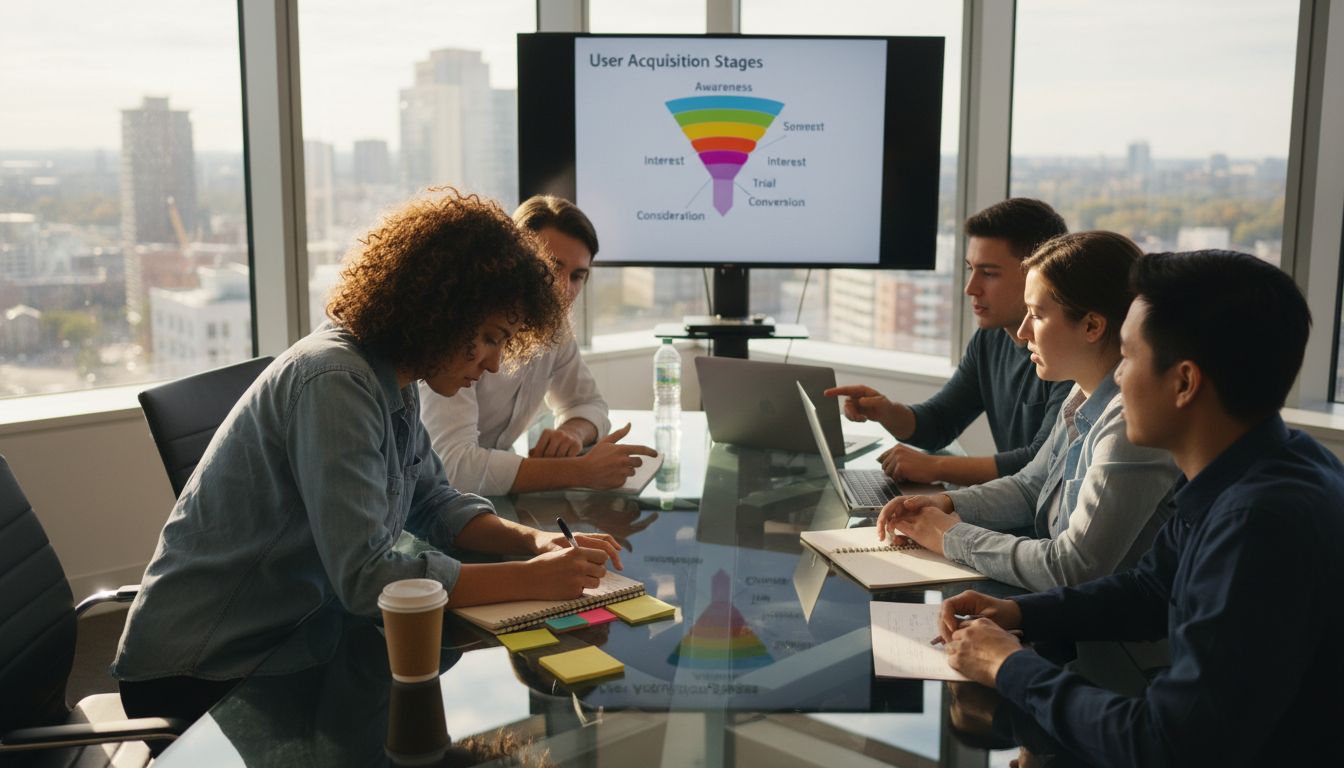
More than 90 percent of American SaaS companies rely on conversion funnels to guide users from curiosity to committed customers. Understanding the path someone takes before subscribing or buying makes a real difference for long-term growth. Whether you are a startup founder or a product manager, grasping how a conversion funnel works can reveal what keeps users moving forward and where they drop out, turning complex data into practical next steps.
Table of Contents
- Defining Conversion Funnels In SaaS
- Stages And Types Of Conversion Funnels
- How Conversion Funnels Drive Optimization
- Measurement And Analytics Best Practices
- Common Mistakes In Funnel Analysis
Key Takeaways
| Point | Details |
|---|---|
| Understanding Conversion Funnels is Crucial | Recognizing the stages of the conversion funnel helps SaaS companies optimize user engagement and identify potential bottlenecks in customer acquisition. |
| Dynamic Nature of Conversion Funnels | Conversion funnels should be viewed as adaptable frameworks that require ongoing refinement and optimization based on user behavior analytics. |
| Importance of Measurement and Analytics | Implementing sophisticated tracking and analytics strategies allows organizations to derive actionable insights and improve conversion rates effectively. |
| Common Mistakes in Funnel Analysis | Organizations often oversimplify user journeys or neglect post-conversion engagement, missing opportunities for optimization and user retention. |
Defining Conversion Funnels in SaaS
A conversion funnel represents the strategic journey potential customers navigate from initial awareness to final purchase in software-as-a-service (SaaS) environments. Much like a physical funnel that narrows from wide to narrow, this digital framework illustrates how users progressively move through distinct stages of engagement, with each step filtering out less committed participants.
The traditional conversion funnel in SaaS typically encompasses four critical stages: awareness, interest, desire, and action. During the awareness phase, potential users first discover your software solution. Interest develops as they recognize how your product might solve their specific challenges. The desire stage involves deeper exploration and evaluation, where prospects compare your offering against alternatives. Finally, the action stage represents the crucial moment when a user commits to purchasing or subscribing.
Understanding conversion funnels allows SaaS companies to precisely track user behavior and optimize each interaction point. By analyzing how users progress through these stages, businesses can identify potential bottlenecks, improve user experience, and incrementally reduce friction that might prevent conversion. Tracking user movement through the conversion funnel provides invaluable insights into customer acquisition strategies, helping teams make data-driven decisions that enhance overall growth performance.
Key elements that influence conversion funnel effectiveness include:
- Clear value proposition
- Intuitive user interface
- Transparent pricing structures
- Compelling call-to-action mechanisms
- Streamlined onboarding processes
Successful SaaS organizations recognize that conversion funnels are not static constructs but dynamic frameworks requiring continuous refinement and strategic optimization.
Stages and Types of Conversion Funnels
Conversion funnels in SaaS environments are dynamic frameworks that map the intricate customer journey from initial awareness to final conversion. The AIDA model outlines four fundamental stages that potential customers navigate: Attention, Interest, Desire, and Action. Each stage represents a critical transition point where businesses must strategically engage and guide prospects toward becoming committed users.
Comprehensive SaaS conversion funnels typically expand beyond the traditional four-stage model. Modern SaaS marketing funnels often incorporate five distinct stages: Awareness, Consideration, Decision, Onboarding, and Retention. This expanded framework acknowledges that customer acquisition is not just about initial conversion but also about sustained engagement and long-term value creation.

Different types of conversion funnels emerge based on specific business objectives and customer interaction models. Product-led funnels prioritize self-service and intuitive user experience, while sales-led funnels involve more direct human interaction. Marketing-driven funnels focus on generating high-quality leads through targeted content and strategic nurturing. Each funnel type demands unique optimization strategies tailored to its specific characteristics.
Key variations in conversion funnel approaches include:
- Product-Led Funnel: Emphasizes product features and user experience
- Sales-Led Funnel: Relies on direct sales team interactions
- Marketing-Driven Funnel: Centers on content and lead generation strategies
- Customer Success Funnel: Focuses on post-purchase engagement and retention
Successful SaaS organizations recognize that conversion funnels are not one-size-fits-all solutions but adaptable frameworks requiring continuous refinement and data-driven insights.
How Conversion Funnels Drive Optimization
Conversion funnels are powerful optimization tools that enable SaaS businesses to systematically improve user acquisition and retention strategies. Advanced decision-making algorithms now leverage funnel structures to analyze user progression, allowing companies to develop more sophisticated approaches to understanding and predicting customer behavior through multi-task learning techniques.

The optimization process involves meticulously analyzing each stage of the customer journey, identifying potential bottlenecks, and implementing targeted interventions. Computational methods now provide sophisticated trajectory analysis, enabling businesses to compute accurate funnel estimates and develop more precise optimization strategies that go beyond traditional linear approaches.
Key optimization strategies driven by conversion funnel analysis include:
- Precise user segmentation
- Personalized engagement tactics
- Predictive behavior modeling
- Friction point identification
- Conversion rate enhancement
Optimization through conversion funnels transforms raw data into actionable insights, allowing SaaS companies to create more intelligent, responsive user experiences that dynamically adapt to changing customer needs and preferences.
Measurement and Analytics Best Practices
Funnel analysis provides a critical framework for understanding user behavior, enabling SaaS businesses to map the intricate journey from initial awareness to final conversion. By meticulously tracking each stage of user interaction, companies can identify precise moments where potential customers engage or disengage, transforming raw data into strategic insights that drive meaningful improvements.
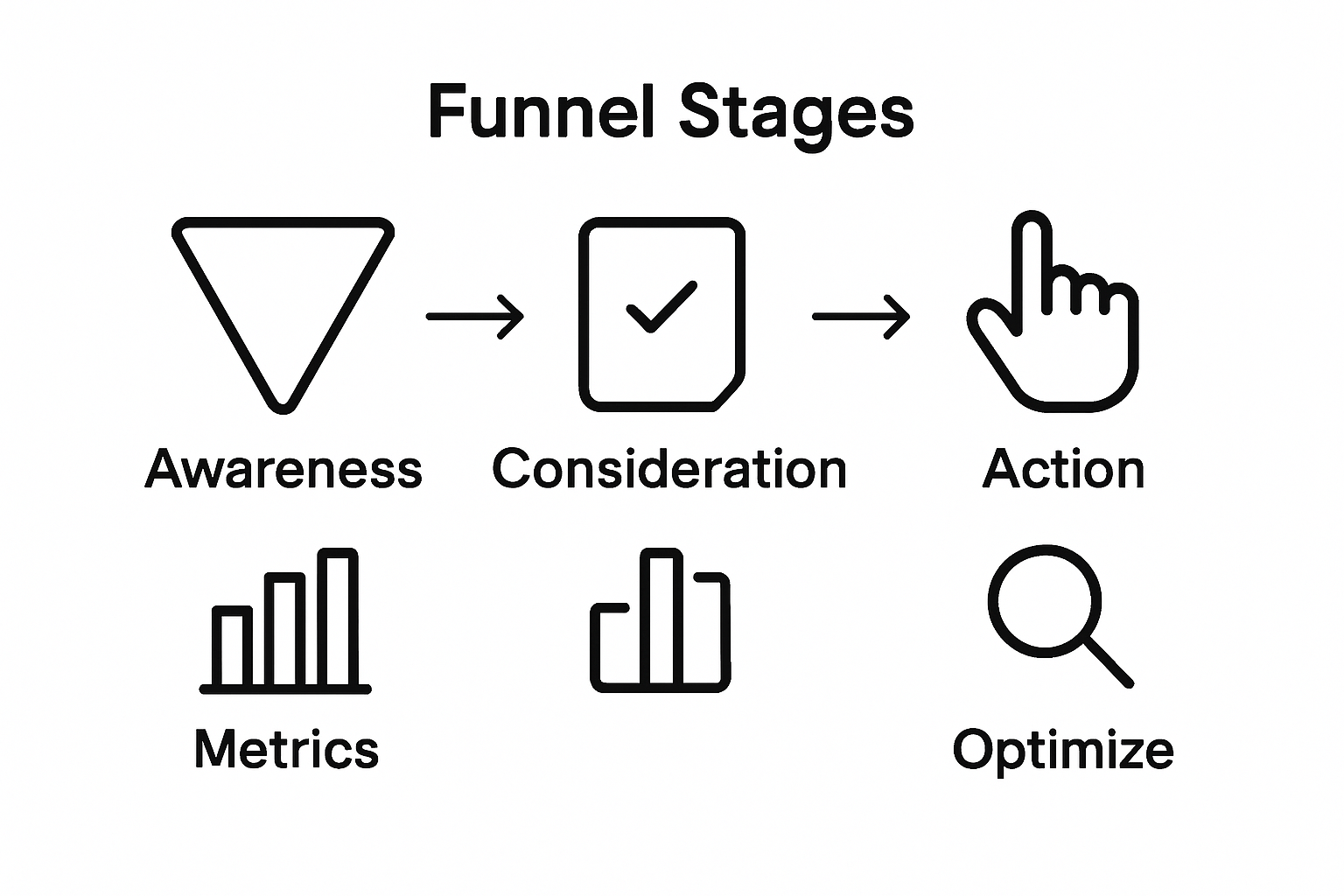
Conversion funnels serve as powerful visualization tools that help businesses track the path users take from initial product discovery to completing a desired action. Effective measurement strategies go beyond simple tracking, requiring sophisticated analytics that capture nuanced user interactions, dropout points, and potential optimization opportunities across different stages of the customer journey.
Key best practices for conversion funnel measurement and analytics include:
- Establish clear, measurable conversion goals
- Implement comprehensive tracking across all funnel stages
- Use segmentation to understand different user behavior patterns
- Monitor key performance indicators (KPIs) consistently
- Develop granular, actionable metrics
- Utilize cohort analysis for deeper insights
- Integrate qualitative and quantitative data
Successful SaaS organizations approach analytics as a continuous improvement process, recognizing that meaningful insights emerge from persistent, detailed observation and strategic interpretation of user interaction data.
Common Mistakes in Funnel Analysis
Modern SaaS sales funnels are complex, cyclical systems that require nuanced understanding beyond traditional linear approaches. Many organizations inadvertently sabotage their conversion strategies by treating funnels as static, one-dimensional pathways, failing to recognize the dynamic and iterative nature of user engagement.
Effective funnel analysis demands comprehensive strategies that provide valuable resources and maintain clear, intuitive user experiences across multiple interaction points. Companies frequently overlook critical aspects of user journey mapping, resulting in missed opportunities and ineffective optimization efforts.
Common pitfalls in conversion funnel analysis include:
- Oversimplifying user journey complexity
- Neglecting post-conversion engagement
- Failing to segment user behaviors
- Ignoring qualitative feedback
- Relying exclusively on quantitative metrics
- Using generic, non-personalized approaches
- Infrequent funnel performance review
Successful SaaS organizations understand that conversion funnels are living ecosystems requiring continuous observation, adaptation, and strategic refinement to effectively capture and retain user interest.
Accelerate Your SaaS Growth With Smarter Funnel Optimization
The article highlights how understanding and optimizing each stage of the conversion funnel is essential to overcoming challenges like user drop-off and ineffective engagement. If you want to turn these insights into actionable strategies without the usual complexity or slow tools, our platform is designed specifically for marketers and growth hackers eager to boost user conversions and retention. With features like a no-code visual editor and advanced goal tracking, you can quickly test different funnel elements to reduce friction points, personalize experiences, and increase your conversion rates.
Ready to transform your funnel analysis into real growth? Visit Stellar to start A/B testing with the fastest, easiest platform that helps small to medium-sized businesses optimize every step of the customer journey. Explore how our A/B Testing Tool and Advanced Goal Tracking can provide the actionable insights you need to make data-driven decisions today.
Frequently Asked Questions
What is a conversion funnel in SaaS?
A conversion funnel in SaaS is the strategic journey that potential customers take from first discovering your software to making a purchase or subscribing. It includes key stages like awareness, interest, desire, and action, helping businesses track user engagement and optimize interactions.
How can I improve my SaaS conversion funnel?
Improving your SaaS conversion funnel involves analyzing each stage for potential bottlenecks, refining your value proposition, enhancing user experience, and implementing effective call-to-action strategies. Continuous optimization and data-driven insights are key to driving user acquisition and retention.
What are the key stages of a conversion funnel?
The traditional conversion funnel consists of four key stages: awareness, interest, desire, and action. A more comprehensive model includes five stages: awareness, consideration, decision, onboarding, and retention, addressing the entire customer lifecycle from acquisition to long-term engagement.
Why is analytics important for conversion funnel optimization?
Analytics are crucial for conversion funnel optimization as they provide insights into user behavior, identify dropout points, and highlight potential improvements. Comprehensive measurement strategies enable businesses to track performance consistently and make necessary adjustments to enhance the overall user experience.
Recommended
Published: 12/8/2025