
SMB Experience Platform: 6 Features for Faster, Safer A/B Tests
An experience platform, in the sense that matters to marketers and growth teams, is an A/B testing tool that lets you launch experiments on a website or app without writing code or waiting on a developer. It handles variant creation, traffic splitting, and results tracking in one dashboard. For a small or midsize team, the right one turns a two-week dev request into a same-day experiment.
TL;DR:
- Smaller testing scripts and no-code editors ensure experiments do not slow down website performance or require developer involvement.
- Reliable results depend on predeclared sample sizes and avoiding early checks, as continuous monitoring inflates false positives without proper statistical methods.
- Cross-browser testing, assignment persistence, and accurate goal tracking are critical prelaunch checks to prevent misleading experiment outcomes.
- Platforms like Gostellar offer free tiers with lightweight scripts and integrated real-time analytics tailored for small teams' quick and easy testing needs.
- Speed-focused tests should match their design to the decision's size, with quick, low-stakes experiments being suitable for rapid, tactical changes.
Table of Contents
- What Does an Experience Platform Actually Do?
- What Features Actually Matter for Small Teams?
- How Do You Run an A/B Test From Start to Finish?
- Why Does Checking Your Dashboard Early Ruin the Test?
- What Should You Check Before Every Test Goes Live?
- How Does a Lightweight, No-Code Platform Fit This Checklist?
- When Should You Choose Speed Over an Exhaustive Test?
- Try Gostellar Free for Fast, No-Code A/B Testing
- Sources
- FAQ
What Does an Experience Platform Actually Do?
An experience platform runs controlled experiments on your site or app: it splits visitors between a control and one or more variants, tracks how each group behaves, and reports which version wins against a defined goal. The core toolkit includes a visual editor for building variants, a script that assigns and persists traffic groups, an analytics layer for conversion tracking, and integrations with whatever you already use to publish and measure your site.

This term gets confused with enterprise digital experience platforms, the kind built for orchestrating customer data across dozens of channels. That is a different category with a different buyer. What SMB teams need is narrower and faster: a lightweight testing layer that answers one question at a time (does this headline convert better?) without a procurement cycle. Speed and a small script footprint matter here because a bloated testing tag can slow the exact page you are trying to improve, undermining the test before it starts.
What Features Actually Matter for Small Teams?
Most feature lists for experimentation tools read like a checklist built for enterprise buyers with dedicated data teams. Strip that down, and six things determine whether a platform works for a five-person marketing team.
- A no-code visual editor. You should be able to swap a headline, reorder a page section, or change a button color without a ticket in a dev queue.
- A lightweight script. Every testing tag adds load time. The smaller the script, the less risk of the test itself skewing the page speed metrics you're trying to protect.
- Goal and event tracking that goes beyond pageviews. Clicks, form submits, scroll depth, and revenue events all need to be trackable without custom coding.
- Real-time analytics built for correct inference, not just a live number that tempts you to call a winner on day two.
- Native integrations with the platforms you already run on, whether that's WordPress, Shopify, Webflow, Wix, Squarespace, Framer, or Bubble.
- Transparent, usage-based pricing with a free or low-cost entry tier so you can test the tool before committing budget.
Pro Tip: Before you demo any platform, write down your current monthly traffic and your top three testing use cases. Half the "feature comparison" work disappears once you know whether you actually need multivariate testing or just simple two-way splits.
How Do You Run an A/B Test From Start to Finish?
A reliable experiment follows the same sequence whether you're testing a headline or a checkout flow. The Stanford practical guide to controlled experiments lays out this workflow, and skipping steps is the most common reason tests produce answers nobody trusts.
- Define the business question and the primary metric. Pick one number that will decide the outcome, whether that's signup rate or add-to-cart rate. Secondary metrics are fine to watch, but only one governs the decision.
- Write the hypothesis and define the audience. State what you're changing, why you expect it to help, and which segment of traffic sees the test.
- Estimate sample size and duration. Account for your baseline conversion rate, the minimum lift worth detecting, and delayed conversions. A subscription signup that finalizes three days later needs a longer window than a same-session click.
- Build the variant and run QA. Check rendering across browsers and devices before a single visitor sees it live.
- Launch and monitor data quality, not just the leaderboard. Watch for broken tracking or lopsided traffic splits in the first hours.
- Analyze effect size with its uncertainty range, not a single point estimate. A 4% lift with a wide confidence interval tells a different story than a 4% lift with a tight one.
- Decide: ship, iterate, or archive. If the primary metric hits the bar you set in step one, ship it. If not, decide whether the hypothesis deserves a second attempt or a clean exit.
Why Does Checking Your Dashboard Early Ruin the Test?
Checking a live dashboard every morning feels responsible. Statistically, it's one of the fastest ways to convince yourself a losing test is a winner. This is peeking, and combined with optional stopping (calling the test the moment the p-value looks good), it inflates your false positive rate well beyond the 5% most teams assume they're working with.
The research on this is blunt: continuous monitoring with standard p-values, without correction, systematically produces more false positives than teams expect. The fix isn't to stop watching your dashboard. It's to use methods built for continuous monitoring.
- Always-valid p-values (sometimes called mSPRT) let you check results at any time without inflating error rates, because the method accounts for repeated looks mathematically.
- Predeclared stopping rules work even without fancy statistics: decide your sample size or run duration before launch, and don't call the test early no matter how good it looks on day three.
- Sequential testing frameworks are worth adopting specifically when your team checks dashboards daily, since that behavior is exactly what these methods were built to make safe.
- Program-level governance matters once you're running more than a handful of tests a month. The CMU tutorial on large-scale sequential experimentation recommends methods like online false discovery rate control to prevent a portfolio of tests from accumulating hidden statistical risk.
Dashboards that surface a live p-value without any of these safeguards are, according to industry analysis on experimentation risk, a direct incentive to stop early. If your platform shows you a real-time significance indicator, ask whether it's built on always-valid math or a plain p-value dressed up in a nice chart.
What Should You Check Before Every Test Goes Live?
Most bad experiment results trace back to an implementation bug, not a flawed hypothesis. A short prelaunch checklist catches the majority of these before they cost you a week of misleading data.
- Cross-browser and cross-device rendering. A variant that looks perfect in Chrome on desktop can break entirely in Safari on mobile.
- Assignment persistence. Confirm that a visitor who sees variant B on their first visit still sees variant B on their second, whether that's tracked by cookie or user ID.
- Analytics event wiring. Verify that every goal you're tracking actually fires, and that your conversion window matches how your customers actually behave.
- Fallback behavior. Decide what happens if the script fails to load. Visitors should default to the control experience, not a broken page.
- Documentation. Write down the hypothesis, audience, decision rule, and primary metric before launch, so nobody redefines success after seeing the results.
Pro Tip: Run every new variant through a private/incognito window on at least two browsers before launch. It takes five minutes and catches the rendering bugs that would otherwise waste a full week of traffic.
How Does a Lightweight, No-Code Platform Fit This Checklist?
Gostellar was built around the assumption that most SMB teams don't have a developer on standby, and that a testing script should never be the reason a page loads slowly. Its client script runs at 5.4KB, small enough to avoid the page-speed drag that heavier tools introduce.
The platform's no-code visual editor covers the variant-building step from the workflow above without a ticket into engineering. Dynamic keyword insertion personalizes landing pages by traffic source, and goal tracking captures the conversion events that matter, not just pageviews. Real-time analytics are built to support the decision-making step directly, so a team running its first test and a team running its fiftieth can both read results without a statistics background. Pricing scales by monthly tracked users, with a free tier for businesses under 25,000 monthly tracked users, which matters if you want to test the workflow before committing budget.

When Should You Choose Speed Over an Exhaustive Test?
Not every test needs statistical power sufficient for a peer-reviewed paper. A homepage headline change with a two-week deadline and modest traffic doesn't justify a six-week run chasing a tiny effect size. Match your test's rigor to the size of the decision: a pricing page redesign deserves careful sample-size planning, while a subject-line tweak usually doesn't.
The mistake I see most often at small companies isn't running tests too fast. It's running them without a documented decision rule, so a borderline result gets argued over for a week instead of decided in five minutes.
— Juan
Try Gostellar Free for Fast, No-Code A/B Testing
Everything covered above, the lightweight script, the no-code editor, the goal tracking, the real-time analytics built for actual decisions, maps directly onto what Gostellar offers out of the box. If your team has been putting off experimentation because it means waiting on engineering, that's the exact friction this platform removes.
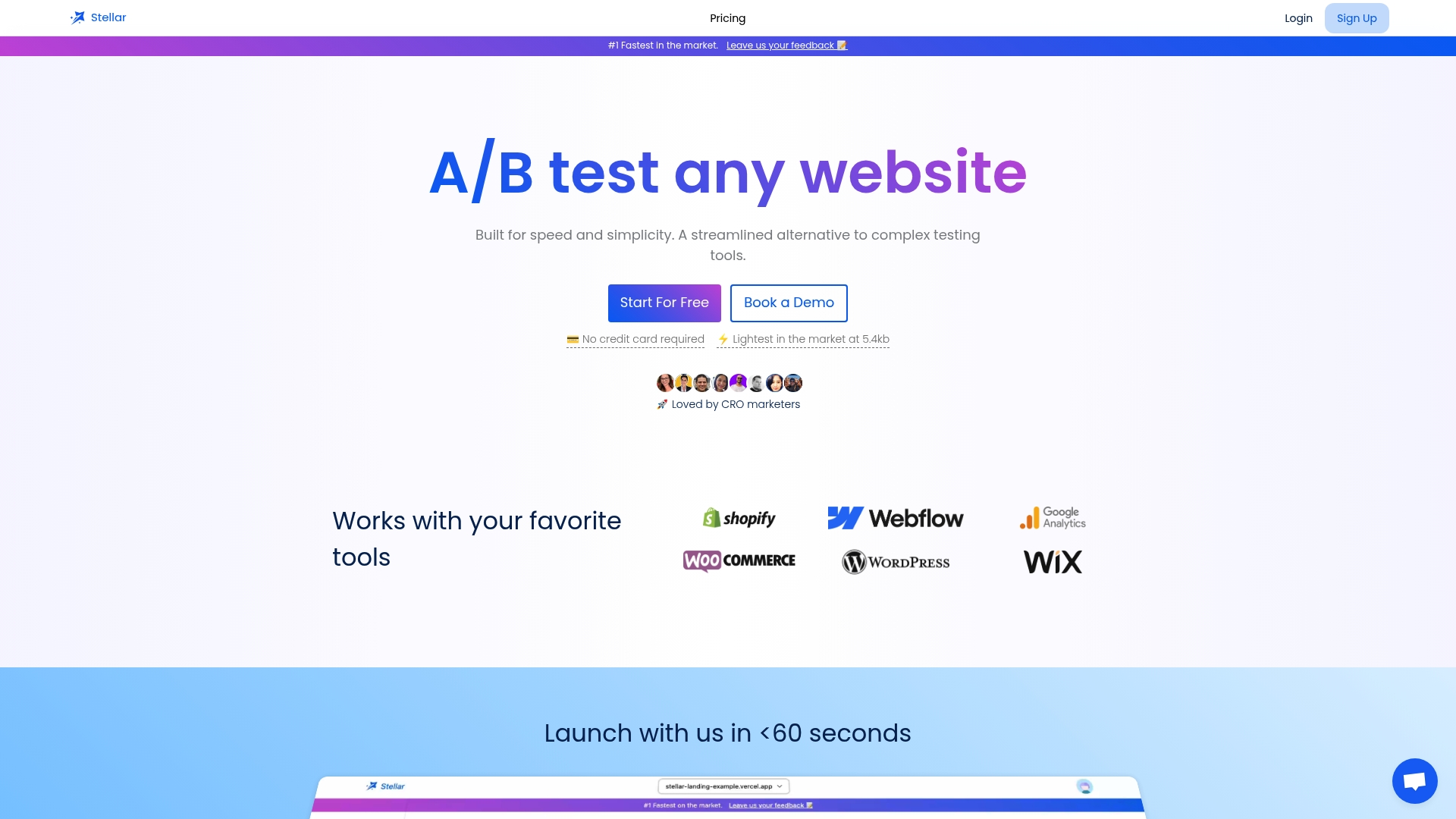
There is a free plan available for businesses with lower monthly tracked users, allowing you to run your first real experiment quickly. Paid tiers unlock higher traffic limits and deeper feature sets as your testing program grows; current prices are available on the pricing page. If you want a lower-friction starting point, the free FOMO popup generator shows how the no-code editor works before you commit to a full experiment. Head to Gostellar to pick a plan and launch your first test.
Sources
The statistical and operational guidance in this article draws on three sources worth reading directly if you're building out a testing program. The Stanford practical guide to controlled experiments remains one of the clearest breakdowns of end-to-end experiment mechanics, including operational issues around delayed conversions and treatment quality that trip up most first-time testers.
For the statistics behind safe dashboard monitoring, the Optimizely research on always-valid p-values explains exactly why peeking inflates false positives and how sequential methods solve it. And for teams scaling beyond a handful of tests a month, the CMU tutorial on large-scale sequential experimentation covers the program-level governance question: how to keep error rates in check across dozens of simultaneous experiments. For a deeper look at metric selection specifically, this guide on measuring website success walks through choosing KPIs that actually tie to business outcomes.
- Practical Guide to Controlled Experiments on the Web (Stanford)
- Peeking at A/B Tests (Optimizely / academic paper)
- Foundations of Large-Scale Sequential Experimentation (CMU)
- Industry analysis on experimentation dashboards and risks (excerpted analysis)
FAQ
What Is an Experience Platform in A/B Testing?
An experience platform, in this context, is software for running A/B and multivariate tests on a website or app, typically with a no-code editor, traffic-splitting logic, and a results dashboard. It's distinct from enterprise digital experience platforms, which manage customer data and content across many channels rather than run controlled experiments.
How Long Should an A/B Test Run?
There's no fixed number of days that works for every test. The Stanford guide recommends basing duration on your traffic volume, expected effect size, and conversion lag, since a test that ignores delayed conversions can call a winner before the data has fully settled.
Why Is Checking Test Results Every Day Risky?
Checking daily isn't the problem by itself, but stopping a test early because the numbers look good is. This practice, called optional stopping, inflates your false positive rate well beyond what a standard p-value threshold assumes, unless your platform uses always-valid statistical methods built for continuous monitoring.
Does Gostellar Work Without a Developer?
Yes. Gostellar's no-code visual editor lets marketers build and launch variants directly, and its script runs at 5.4KB to avoid slowing down the pages being tested. Businesses under 25,000 monthly tracked users can use the Sandbox plan free, with paid tiers starting at $29 per month for higher traffic and additional features.
What's the Difference Between an Experience Platform and a DXP?
An experience platform for A/B testing focuses narrowly on running experiments: variant creation, traffic assignment, and conversion analysis. An enterprise digital experience platform (DXP) is a broader system for managing content and customer data across many channels, aimed at large organizations with dedicated implementation teams rather than SMB marketers who need to launch a test this week.
Recommended
Published: 9/23/2026