
Fast Website Scripts: Driving Conversions and Growth
Slow website scripts can turn eager visitors into impatient drop-offs long before any real engagement begins. For digital marketers and growth hackers striving to refine A/B testing and elevate conversion rates, the importance of fast website scripts cannot be overstated. When scripts execute efficiently in the browser, they deliver immediate user feedback and streamline every experiment, giving you clear, actionable data to guide smarter decisions and drive measurable business results.
Table of Contents
- Defining Fast Website Scripts and Their Role
- How Script Speed Impacts User Experience
- Script Speed and A/B Testing Results
- SEO Benefits From Lightweight Scripts
- Risks and Pitfalls of Slow Website Scripts
- Best Practices for Script Optimization
Key Takeaways
| Point | Details |
|---|---|
| Importance of Fast Scripts | Fast website scripts enhance user experience by reducing load times and improving interactivity. Efficient scripts lead to higher conversion rates and better SEO outcomes. |
| Impact on User Engagement | Slow script execution can significantly increase bounce rates and frustrate users, especially on mobile devices. Optimizing script speed is essential for retaining visitors. |
| Strategic Script Optimization | Continuous performance auditing and optimization of scripts define a competitive edge in web performance. Implementing techniques like code minification and asynchronous loading can vastly improve page responsiveness. |
| A/B Testing Accuracy | Fast scripts contribute to reliable A/B testing outcomes by minimizing latency in data collection. Consistent script performance ensures accurate experimental results and insights into user preferences. |
Defining Fast Website Scripts and Their Role
Web scripts are the digital architects that transform static web pages into dynamic, interactive experiences. Web scripting processes enable websites to respond instantly to user actions, creating fluid and engaging digital environments. These lightweight code snippets run directly in web browsers, executing complex tasks without requiring full page reloads.
At their core, fast website scripts serve multiple critical functions. They handle user interactions, update content dynamically, validate form inputs, and manage real-time data exchanges. Client-side scripts specifically operate within the user's browser, reducing server load and enabling near-instantaneous responses. This means when a user clicks a button or submits information, the script can process and display changes immediately without waiting for a complete server roundtrip.
The performance characteristics of website scripts are paramount. Lightweight scripts minimize page load times, improve user experience, and contribute directly to conversion rates. Marketers and developers prioritize script efficiency, seeking solutions that deliver maximum functionality with minimal computational overhead. Efficient scripts typically range between 5-10 kilobytes, ensuring rapid execution without compromising website performance.

Pro tip: When implementing website scripts, always measure their performance impact using browser developer tools to ensure they enhance rather than hinder user experience.
How Script Speed Impacts User Experience
User experience is fundamentally shaped by the speed and responsiveness of website scripts. Script evaluation times directly influence how quickly users can interact with web content, creating either a smooth, engaging experience or a frustrating, laggy encounter. Slow script execution can transform what should be an instantaneous interaction into a test of user patience, potentially driving visitors away before they fully engage with your website.
The consequences of sluggish scripts extend far beyond mere inconvenience. Page speed fundamentally impacts user engagement, with research consistently showing that users expect near-instantaneous responses. Websites with scripts that take more than three seconds to load can experience bounce rates exceeding 50%, meaning half of potential customers might abandon the site before it becomes fully interactive. Mobile users are particularly sensitive to performance, with slow scripts creating even more significant barriers to engagement.
Performance metrics reveal the critical nature of script speed. Google and other search engines now incorporate page load times into their ranking algorithms, meaning slow scripts not only frustrate users but can also reduce a website's search visibility. Script optimization becomes a strategic imperative, requiring developers to minimize unnecessary code, leverage browser caching, and prioritize critical rendering paths. Efficient scripts can reduce load times, improve perceived performance, and create a more responsive user experience that keeps visitors engaged and encourages deeper interaction.
Below is a comparison of script effects on user experience and business outcomes:
| Script Speed | User Experience Impact | Business Consequence |
|---|---|---|
| Fast (Under 3 sec) | Smooth, responsive | Higher engagement, better SEO |
| Moderate (3-5 sec) | Noticeable delay | Increased bounce risk, lost leads |
| Slow (Over 5 sec) | Frustrating, laggy | Reduced conversions, ranking drop |
Pro tip: Use browser developer tools to profile your website scripts and identify performance bottlenecks that might be slowing down user interactions.
Script Speed and A/B Testing Results
A/B testing methodologies fundamentally depend on precise performance measurements, where script speed becomes a critical factor in generating reliable experimental outcomes. Faster scripts enable more accurate data collection, reducing potential biases that could skew conversion metrics and experimental results. When scripts execute quickly, they capture user interactions with minimal latency, ensuring that test variants are evaluated under consistent and comparable conditions.
The relationship between script performance and testing accuracy is profound. Slow scripts introduce significant variability that can compromise experimental integrity. Research demonstrates that even milliseconds of delay can impact user behavior, potentially leading to misinterpreted test results. Performance optimization becomes crucial, as faster scripts not only improve user experience but also provide more reliable insights into which webpage variations truly drive higher engagement and conversions.
Technical considerations play a pivotal role in A/B testing precision. Different script execution times across test variants can create unintended experimental noise, potentially leading marketers to draw incorrect conclusions about user preferences. Accurate performance measurement requires minimizing these technical variables, ensuring that script speed remains consistent across all tested experiences. By prioritizing lightweight, efficient scripts, businesses can obtain more trustworthy data that directly reflects genuine user interactions and preferences.
Pro tip: Implement script performance monitoring during A/B tests to track execution times and identify potential performance-related biases in your experimental results.
SEO Benefits from Lightweight Scripts
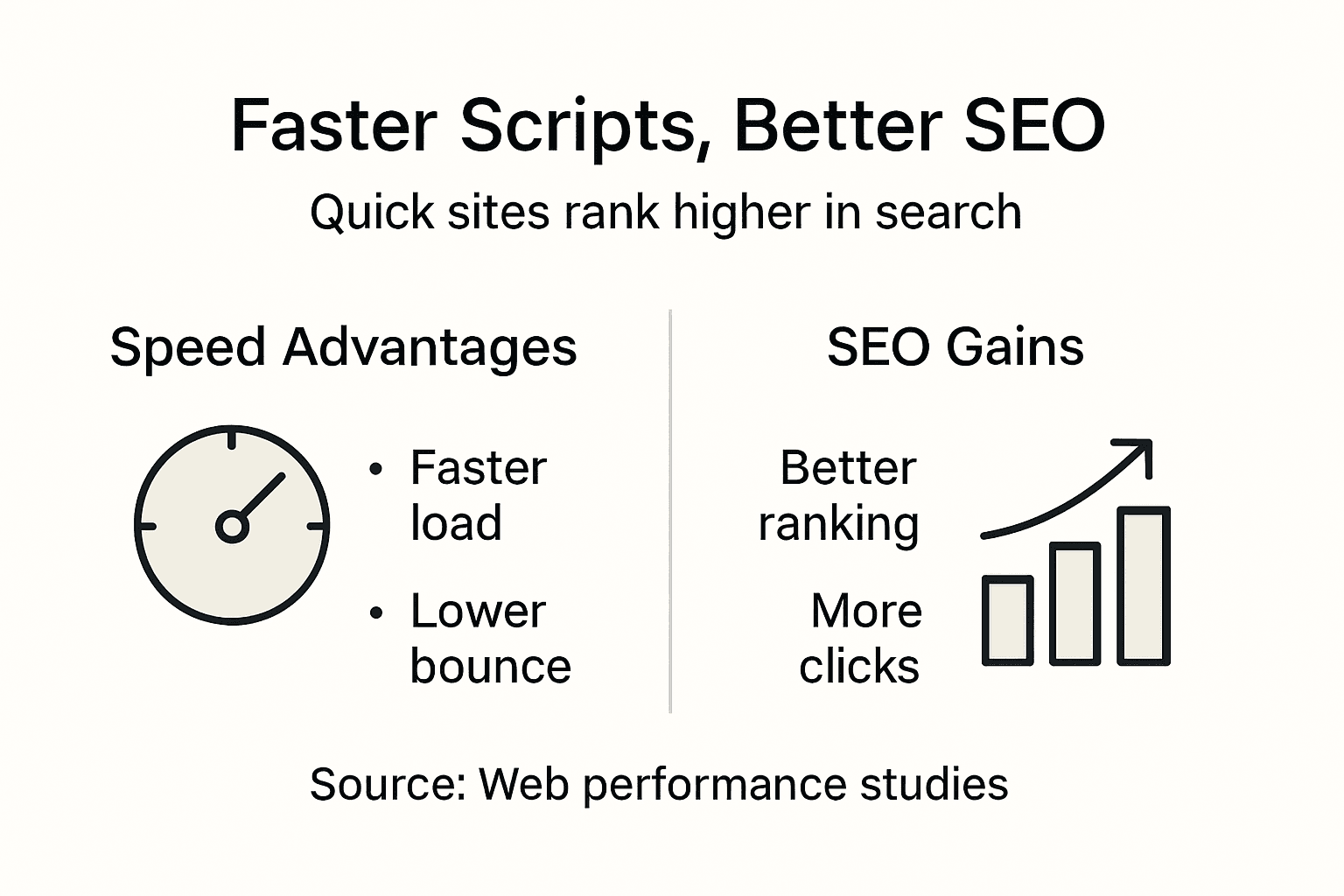
Lightweight scripts play a critical role in improving search engine optimization by directly enhancing website performance metrics that Google and other search engines prioritize. These efficient code snippets reduce page load times, improve user experience, and signal technical quality to search algorithms. By minimizing script weight, websites can dramatically improve their Core Web Vitals scores, which are increasingly important ranking factors in modern search engine optimization strategies.
Search engines have become increasingly sophisticated in evaluating website performance, with script efficiency emerging as a key differentiator. Lighter scripts enable faster page rendering, reduce server processing time, and create a smoother user experience that search algorithms reward. Websites with optimized scripts typically experience lower bounce rates, longer user engagement, and more consistent mobile performance - all critical signals that search engines use to determine content relevance and ranking potential.
The technical implications of script optimization extend beyond immediate performance metrics. Faster websites achieve better search rankings by enabling more efficient crawling and indexing. Search engine bots can more quickly parse and understand lightweight websites, which means content becomes discoverable faster and with greater accuracy. Performance optimization thus becomes a strategic approach to improving organic visibility, transforming script management from a technical consideration into a critical marketing tool for digital growth.
Pro tip: Regularly audit your website scripts using performance tools to identify and remove unnecessary code that might be hindering your search engine optimization efforts.
Risks and Pitfalls of Slow Website Scripts
Slow website scripts create substantial performance challenges that can dramatically undermine digital business success. These performance bottlenecks manifest through increased page load times, reduced user engagement, and compromised conversion potential. When scripts become overly complex or numerous, they block critical rendering paths, preventing users from quickly accessing content and interacting with web interfaces.
The technical consequences of sluggish scripts extend far beyond mere inconvenience. Large, unoptimized scripts consume significant bandwidth, increase server processing demands, and create substantial friction in user experiences. Search engines penalize websites with poor performance, meaning slow scripts directly impact organic search rankings. Performance delays harm conversion rates by creating user frustration and increasing the likelihood that potential customers will abandon the site before completing desired actions.
Technical teams must recognize that script performance is not just a development concern but a critical business strategy. Third-party scripts are particularly problematic, often introducing unexpected delays and security vulnerabilities. Each additional script increases complexity, creating potential points of failure that can compromise website reliability. Businesses must adopt a rigorous approach to script management, continuously auditing and optimizing code to maintain peak performance and user satisfaction.
Pro tip: Implement a strict script evaluation process that assesses performance impact, loading priority, and necessity before integrating any new third-party code into your website.
Best Practices for Script Optimization
Script optimization techniques require a strategic approach that balances performance, efficiency, and user experience. Developers must carefully evaluate each script's purpose, ensuring that every line of code contributes meaningfully to website functionality. By adopting a minimalist mindset, teams can dramatically reduce unnecessary computational overhead and create more responsive web experiences that load quickly and interact smoothly.
Technical optimization involves multiple critical strategies. Asynchronous and deferred loading techniques prevent scripts from blocking page rendering, allowing critical content to become visible faster. JavaScript performance demands careful profiling to identify and eliminate bottlenecks. Developers should prioritize native JavaScript functions over heavy frameworks, minimize external script dependencies, and implement code splitting to ensure only essential scripts load initially.
Implementation of optimization strategies requires continuous monitoring and refinement. Performance auditing becomes crucial, with regular script evaluations identifying potential improvements. Techniques like minification, which removes unnecessary characters without changing functionality, and leveraging browser caching can significantly reduce script load times. Modern web development demands a proactive approach where script efficiency is viewed as an ongoing process rather than a one-time configuration.
Here's a summary of common script optimization techniques and their primary benefits:
| Optimization Technique | Key Benefit | Typical Use Case |
|---|---|---|
| Code Minification | Reduced script file size | Making websites load faster |
| Asynchronous Loading | Faster content rendering | Preventing scripts from blocking display |
| Browser Caching | Quicker repeat visits | Improving performance for return users |
| Code Splitting | Faster initial page load | Large websites with complex features |
| Native JavaScript Usage | Lower resource consumption | Avoiding heavy external libraries |
Pro tip: Use browser developer tools to conduct comprehensive script performance audits, identifying and removing scripts that contribute minimal value but consume significant loading resources.
Accelerate Your Growth with Faster Website Scripts and Smarter A/B Testing
Today’s marketers know that script speed directly affects user experience, conversion rates, and SEO rankings. Slow or bulky scripts create frustrating delays that can push potential customers away and skew valuable A/B testing results. You need a solution that combines lightweight scripts with powerful testing tools to deliver accurate insights and seamless user journeys.
Stellar is designed precisely for this challenge. With a remarkably small 5.4KB script size, Stellar ensures minimal performance impact while empowering you with a no-code visual editor, dynamic keyword insertion, and advanced goal tracking. It delivers fast, reliable A/B testing so your experiments reflect true user behavior without technical delays harming your decision-making.

Ready to unlock faster page loads and precise growth insights? Visit Stellar now and start optimizing your scripts and experiments with the fastest A/B testing tool tailored for small to medium-sized businesses. Experience how lightweight, efficient scripts can drive conversions and elevate your marketing results today.
Frequently Asked Questions
What are fast website scripts, and why are they important?
Fast website scripts are lightweight code snippets that run in web browsers to create interactive and dynamic web experiences. They're important because they enhance user experience, reduce page load times, and ultimately improve conversion rates by providing users with quick responses to their actions.
How does script speed impact user experience and engagement?
Script speed significantly affects user experience by determining how quickly a website responds to user interactions. Fast scripts lead to smooth and responsive experiences, while slow scripts can frustrate users, increasing bounce rates and reducing engagement times.
What are some best practices for optimizing website scripts?
Best practices for optimizing website scripts include code minification, asynchronous loading, leveraging browser caching, and using native JavaScript functions to minimize resource consumption. Regular performance audits can also help identify and eliminate bottlenecks.
How do lightweight scripts influence SEO performance?
Lightweight scripts improve SEO performance by reducing page load times and enhancing user experience. Search engines reward faster websites with better rankings, as they tend to have lower bounce rates and longer user engagement times.
Recommended
Published: 1/20/2026