
Free user testing tools to optimize your A/B testing
Selecting the right free user testing tools can feel overwhelming when you're trying to stretch every marketing dollar while improving A/B testing outcomes. You need behavioral insights to understand why visitors convert or bounce, but budget constraints limit your options. The good news? Several powerful free tools deliver genuine value for small to medium-sized businesses. This guide walks you through essential selection criteria, highlights top free options like Hotjar and Microsoft Clarity, compares their capabilities, and shows you how to choose the best approach for your specific testing goals and traffic levels.
Table of Contents
- Key takeaways
- Criteria for choosing free user testing tools
- Top free user testing tools for SMBs
- Comparing free user testing tools: features and fit
- Choosing the right free user testing approach for your project
- Optimize your A/B testing with Go Stellar
- Frequently asked questions about free user testing
Key Takeaways
| Point | Details |
|---|---|
| Traffic volume matters | Choose free tools that fit your monthly visitors and data needs, since high traffic supports quantitative analytics while low traffic benefits qualitative sessions. |
| Feature set alignment | Select tools that provide session recordings heatmaps and feedback widgets that support your A/B testing workflow. |
| Recruitment options vary | Some tools offer participant panels while others require you to recruit testers yourself and may cap sessions. |
| Reliability and guardrails | Prioritize tools with confidence metrics and guardrails to avoid premature conclusions from incomplete data. |
Criteria for choosing free user testing tools
Choosing the right free user testing tool starts with understanding your baseline requirements. Traffic volume matters significantly because behavioral analytics tools need sufficient data to generate meaningful patterns. Sites with minimum 1,000 visitors per month can reliably use quantitative behavioral tools, while lower traffic sites benefit from moderated testing or simulated user sessions to gather actionable feedback before scaling.
Your feature requirements should align with your A/B testing best practices strategy. Look for tools offering session recordings to watch real user interactions, heatmaps revealing click patterns and scroll depth, and feedback widgets capturing qualitative insights. These features transform abstract metrics into concrete behavioral understanding. Session recordings show exactly where users hesitate or abandon forms, while heatmaps expose which page elements attract attention versus being ignored completely.
User recruitment capabilities vary dramatically across free platforms. Some tools provide access to participant panels, while others require you to recruit your own testers. For SMBs without existing user bases, panel access becomes critical. However, free panel options typically impose strict session limits or participant quotas. Consider whether you can leverage your existing customer email lists or social media followers for recruitment, which gives you more control over participant profiles and testing frequency.
Data reliability separates useful insights from misleading conclusions. Free tools should support confidence level calculations and guardrail metrics to prevent premature decisions based on incomplete data. Avoid peeking at results mid-test, as this introduces statistical bias. Integration ease matters too because complicated setup processes waste time and increase abandonment risk. Look for tools offering simple script installation, visual editors, and clear documentation. Cost transparency ensures you understand exactly what's included in free tiers versus paid upgrades, preventing surprise limitations mid-project.
Pro Tip: Start with one tool offering broad capabilities like session recordings and heatmaps, then add specialized tools as you identify specific gaps in your testing workflow.
Top free user testing tools for SMBs
Several robust free user testing tools serve SMB marketers effectively without requiring enterprise budgets. Each platform offers distinct strengths matching different testing priorities and organizational constraints.
Hotjar provides comprehensive free features including session recordings, heatmaps, surveys, and feedback widgets, serving over 1.3 million websites globally. The free forever plan supports 35 daily sessions, making it ideal for observing real user behavior patterns without laboratory setups or recruitment costs. You can watch exactly how visitors navigate your landing pages, identify friction points causing abandonment, and collect spontaneous feedback through on-page widgets. Hotjar excels at qualitative insights that explain the why behind your quantitative A/B test metrics.
Microsoft Clarity delivers completely free behavioral analytics with unlimited session recordings and heatmaps regardless of traffic volume. This makes Clarity particularly attractive for growing SMBs concerned about hitting usage caps. The platform integrates seamlessly with Google Analytics, allowing you to correlate behavioral patterns with conversion data. Clarity's rage click detection automatically flags user frustration moments, while scroll maps show exactly where visitors lose interest. The zero-cost model removes budget concerns entirely, though the feature set focuses primarily on behavioral observation rather than active user recruitment or structured testing protocols.
UXtweak offers unlimited free testing on small projects, supporting diverse test types including session recordings, first-click tests, preference tests, and surveys. This versatility helps you match testing methodology to specific research questions. First-click tests validate navigation effectiveness, preference tests compare design alternatives, and surveys capture structured feedback. UXtweak also provides participant recruitment options within paid tiers, but the free version works well when you recruit your own testers. The platform suits teams wanting flexibility across multiple testing approaches without committing to a single methodology.
Each tool addresses different aspects of user testing. Hotjar balances breadth and depth for general behavioral analysis. Clarity removes all usage restrictions for pure observational research. UXtweak provides methodological variety for teams running structured usability studies. Your choice depends on whether you prioritize comprehensive features, unlimited usage, or testing flexibility. Consider your landing page testing tools comparison needs when evaluating these options against your specific conversion optimization goals.
Comparing free user testing tools: features and fit
Understanding how free user testing tools differ helps you select the right match for your SMB's testing priorities and constraints. This comparison clarifies capabilities, limitations, and ideal use cases.

| Tool | Session Limit | Key Features | Best For | Recruitment |
|---|---|---|---|---|
| Hotjar | 35 daily sessions | Recordings, heatmaps, surveys, feedback widgets | Balanced qualitative and quantitative insights | Self-recruit |
| Microsoft Clarity | Unlimited | Recordings, heatmaps, rage click detection | High-traffic sites needing unrestricted behavioral data | Self-recruit |
| UXtweak | Project-based | Recordings, first-click, preference tests, surveys | Diverse testing methodologies and structured studies | Panel available (paid) |
Each platform presents distinct advantages and trade-offs worth considering carefully. Hotjar's comprehensive feature set makes it excellent for teams wanting multiple research methods in one platform, though the 35 daily session limit requires strategic sampling on high-traffic sites. Microsoft Clarity's unlimited usage removes capacity anxiety entirely, making it perfect for growing businesses that might exceed other tools' free tier caps. UXtweak's methodological variety serves teams running formal usability studies requiring specific test protocols beyond passive observation.
Pros of free user testing tools include zero financial barrier to entry, immediate access to behavioral insights, and sufficient capabilities for most SMB testing needs. You can start gathering actionable data today without budget approvals or procurement delays. Cons include session or feature limitations compared to paid alternatives, potential learning curves for advanced features, and lack of dedicated support channels. Some free tools also restrict historical data retention or limit team member access.
Pro Tip: Combine behavioral data from free tools with structured A/B testing protocols to validate qualitative observations with quantitative evidence, ensuring decisions rest on both what users do and why they do it.
Scalability considerations matter as your traffic grows. Hotjar requires upgrading when you consistently exceed 35 daily sessions. Clarity scales infinitely without cost increases but lacks some advanced features like user recruitment or sophisticated filtering. UXtweak's project-based model works well for episodic testing but becomes limiting for continuous optimization programs. Evaluate your A/B testing for landing pages guide strategy to determine whether free tools will suffice long term or serve as stepping stones toward paid platforms offering expanded capabilities.
Choosing the right free user testing approach for your project
Matching your tool selection and testing methodology to your specific situation maximizes insight value while minimizing wasted effort. Follow this framework to make informed choices aligned with your traffic, resources, and goals.
-
Assess your monthly visitor volume and test type requirements. Sites receiving fewer than 1,000 monthly visitors should prioritize moderated testing or simulated user sessions before investing heavily in behavioral analytics tools requiring statistical significance. Higher traffic sites can leverage passive recording tools like Clarity or Hotjar to gather behavioral patterns continuously without active recruitment.
-
Define your primary research questions and select tools matching those needs. If you want to understand navigation effectiveness, choose tools offering first-click tests or heatmaps showing interaction patterns. For conversion funnel analysis, prioritize session recordings revealing abandonment points. When seeking direct user feedback, select platforms with survey or feedback widget capabilities.
-
Implement proper segmentation and guardrails to avoid misleading conclusions. Segment results by traffic source, device type, and user behavior to identify patterns within specific audiences rather than treating all visitors identically. Set confidence thresholds before analyzing results and resist peeking at data mid-test, which introduces statistical bias and increases false positive risk.
-
Integrate qualitative insights with quantitative A/B testing metrics for robust decision making. Use session recordings and heatmaps to generate hypotheses about user behavior, then validate those hypotheses through controlled A/B tests measuring conversion impact. This combination prevents acting on anecdotal observations while ensuring statistical rigor supports your optimization decisions.
-
Establish iterative testing cycles with small user groups and actionable metrics. Testing with 5 users per iteration captures most usability issues efficiently, allowing weekly test cadences that support agile improvement cycles. Focus on metrics directly tied to business outcomes like conversion rate, form completion, or feature adoption rather than vanity metrics lacking actionable implications.
-
Prepare for inconclusive results and maintain a learning orientation. Not every test produces clear winners, especially with limited traffic or subtle variations. Document learnings from inconclusive tests to inform future hypotheses and avoid repeating ineffective approaches. SMBs benefit more from consistent small improvements than occasional home runs, so treat testing as an ongoing learning process rather than a one-time optimization event.
Your landing page A/B testing strategies should evolve as you gather more behavioral data and refine your understanding of visitor preferences. Start with foundational tools offering broad capabilities, then add specialized solutions addressing specific gaps in your testing workflow. This incremental approach prevents tool overload while ensuring you build testing competency progressively.
Optimize your A/B testing with Go Stellar
Now that you understand how to select and implement free user testing tools, you need a platform that transforms those insights into conversion improvements efficiently. Go Stellar streamlines your entire A/B testing workflow with a lightweight 5.4KB script that won't slow your site while delivering real-time analytics and a no-code visual editor.
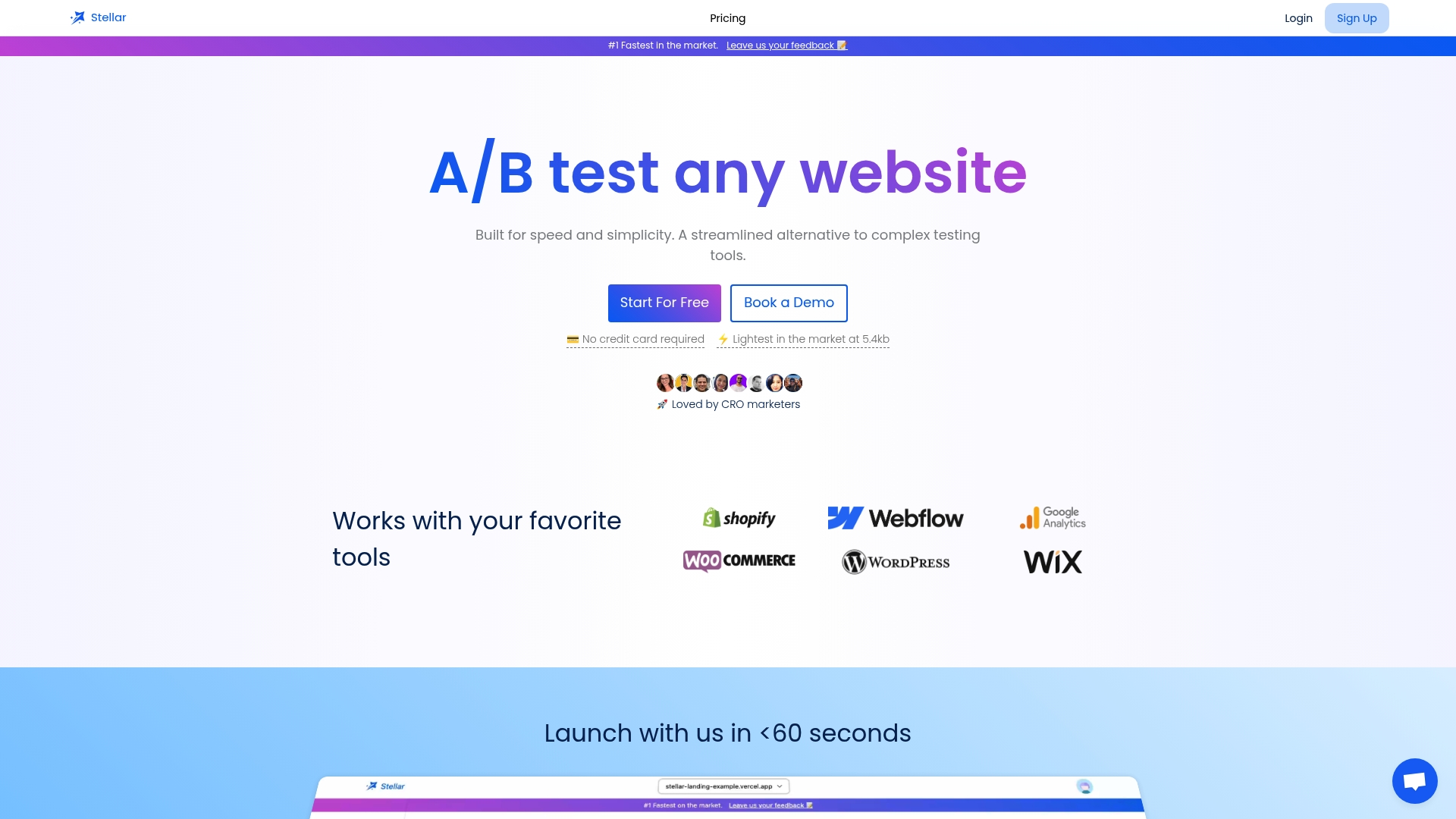
Our platform helps SMB marketers put behavioral insights into action without requiring technical resources or complex integrations. Whether you're testing headline variations, call-to-action buttons, or entire page layouts, Go Stellar provides the speed and simplicity you need to iterate quickly. Explore our complete A/B testing guide for implementation strategies, or discover A/B testing ideas to boost conversions that complement your user testing findings. Visit Go Stellar to see how our platform turns testing insights into measurable growth.
Frequently asked questions about free user testing
What qualifies as free user testing?
Free user testing includes tools offering behavioral analytics, session recordings, heatmaps, or feedback collection without subscription costs. Most free plans impose session limits, feature restrictions, or participant quotas but provide sufficient capabilities for SMB testing needs. True free tools require no credit card and don't force upgrades after trial periods.
How many users do I need for effective insights?
Testing with 5 users per iteration identifies approximately 85% of usability issues, making small sample sizes surprisingly effective for qualitative research. Quantitative behavioral tools like heatmaps require minimum 1,000 monthly visitors for reliable pattern detection. A/B tests need sufficient traffic to reach statistical significance, typically requiring hundreds to thousands of conversions depending on expected effect size.
Can free tools replace paid testing platforms?
Free tools serve SMB needs effectively for foundational behavioral research and conversion optimization. They replace paid platforms when your traffic falls within free tier limits and required features match available capabilities. Paid platforms become necessary when you need advanced features like multivariate testing, sophisticated segmentation, dedicated support, or unlimited usage exceeding free tier restrictions.
How to integrate user testing data with A/B testing results?
Use qualitative user testing insights to generate A/B test hypotheses, then validate those hypotheses through controlled experiments measuring conversion impact. Session recordings reveal friction points to test removing, while heatmaps identify high-attention areas for testing messaging variations. Combine both data types in analysis dashboards to correlate behavioral patterns with conversion outcomes, ensuring decisions rest on comprehensive evidence rather than isolated metrics.
Recommended
Published: 3/25/2026