
7 Key Trends Shaping the Future of A/B Testing 2025
Over half of american marketers face challenges adapting to the speed of digital experimentation. As technology evolves, teams need solutions that make rapid testing and data-driven decisions accessible without technical roadblocks. Whether you are a startup or a growing enterprise, understanding the latest approaches to A/B testing can unlock smarter, faster strategies. This guide highlights practical ways to streamline your processes so you can stay ahead in a fast-paced market.
Table of Contents
- 1. Embracing No-Code Visual Editors For Rapid Experimentation
- 2. Leveraging Lightweight Scripts To Minimize Site Impact
- 3. Personalizing Experiences With Dynamic Keyword Insertion
- 4. Utilizing Real-Time Analytics For Instant Decision Making
- 5. Advanced Goal Tracking To Measure Deeper User Behavior
- 6. Integrating AI And Automation Into A/B Testing Workflows
- 7. Scaling Experiments For Growing Businesses Efficiently
Quick Summary
| Takeaway | Explanation |
|---|---|
| 1. Embrace no-code tools for rapid testing | No-code visual editors enable quick A/B testing without technical skills, allowing teams to experiment and implement changes efficiently. |
| 2. Use lightweight scripts for optimal performance | Implementing lightweight scripts improves website speed and user experience, essential for effective A/B testing without slowing down site performance. |
| 3. Personalize content dynamically for better engagement | Dynamic keyword insertion allows personalized experiences which increase user relevance and improve conversion rates based on user attributes. |
| 4. Implement real-time analytics for swift decision-making | Real-time analytics processes user interaction data instantly, allowing immediate adjustments to experiments, enhancing responsiveness to trends. |
| 5. Scale experiments with standardized processes | Standardizing testing frameworks and automating workflows helps growing businesses efficiently manage multiple experiments without losing quality. |
1. Embracing No-Code Visual Editors for Rapid Experimentation
No-code visual editors are transforming how marketers and product teams conduct A/B testing by eliminating complex coding requirements. These intuitive drag-and-drop interfaces empower professionals to design and launch experiments without deep technical expertise.
Research from arXiv.org reveals a groundbreaking visual programming paradigm that dramatically reduces entry barriers for non-experts. By enabling users to create deep learning models through simple interface interactions, visual editors are democratizing advanced experimentation techniques.
Key Benefits of No-Code Visual Editors:
- Accelerate experiment creation and deployment
- Reduce dependency on technical resources
- Lower learning curve for complex testing strategies
- Enable faster iteration and data driven decisions
The most powerful visual editors allow seamless manipulation of webpage elements without writing a single line of code. Marketers can now adjust layouts, modify text, swap images, and configure conversion goals with point-and-click simplicity. This approach transforms experimentation from a complex technical process into an accessible, user friendly workflow.
To effectively leverage no-code visual editors, start by identifying key conversion elements on your website. Select a tool with an intuitive interface that provides real time preview capabilities. Experiment with small changes first, track performance metrics, and progressively build more sophisticated testing strategies.
By embracing these visual experimentation tools, your team can quickly test hypotheses, optimize user experiences, and drive meaningful business growth without getting bogged down in technical complexity.
2. Leveraging Lightweight Scripts to Minimize Site Impact
In the competitive digital landscape, website performance is paramount. Lightweight scripts have emerged as a critical strategy for maintaining fast loading times while enabling advanced functionality like A/B testing.
Research from arXiv.org introduces SlimWeb, an innovative system that classifies and blocks non essential JavaScript in real time. This breakthrough highlights how intelligent script management can dramatically enhance user experience by reducing page load times.
Why Lightweight Scripts Matter:
- Improve website speed and responsiveness
- Reduce bounce rates caused by slow loading
- Enhance overall user experience
- Maintain robust testing capabilities
Website owners must carefully evaluate each script they implement. By prioritizing compact, efficient code and eliminating unnecessary javascript, you can create a seamless browsing experience. The goal is not just speed but also maintaining the robust functionality needed for effective A/B testing and user engagement.
To optimize your approach, start by auditing current scripts. Use performance measurement tools to identify heavyweight resources. Look for A/B testing solutions with minimal script sizes smaller than 10 kilobytes to ensure rapid page rendering without compromising experimental capabilities.
Additionally, 5 Lightweight A/B Testing Platforms That Won't Slow Your Site can provide deeper insights into selecting the right tools that balance functionality and performance.
3. Personalizing Experiences with Dynamic Keyword Insertion
Dynamic keyword insertion represents a powerful strategy for creating hyper personalized website experiences that speak directly to individual user needs and preferences. By automatically tailoring content based on specific user attributes, marketers can dramatically improve engagement and conversion rates.
Research from IJERT.org reveals how low code and no code platforms are revolutionizing personalization by enabling dynamic content insertion without complex programming requirements.
Key Benefits of Dynamic Keyword Insertion:
- Enhance user relevance and connection
- Increase conversion probability
- Reduce cognitive friction during user interactions
- Create more targeted marketing experiences
Successful implementation requires understanding user segments and mapping appropriate keywords. For example, an ecommerce site could dynamically adjust product descriptions based on a user geographic location, browsing history, or previous purchase behavior. This approach transforms generic content into a tailored conversation that feels personally crafted.
To execute effectively, leverage tools with robust segmentation capabilities. Select platforms that allow granular targeting and real time content modification. Start with simple personalizations like inserting a user first name or referencing their location, then progressively build more sophisticated personalization strategies.
For additional strategic insights, explore our guide on Personalizing Website Content for Higher Conversions, which provides comprehensive tactics for implementing dynamic content strategies.
4. Utilizing Real-Time Analytics for Instant Decision Making
The landscape of data driven marketing is rapidly transforming with real-time analytics enabling marketers to make lightning fast decisions that can significantly impact business performance. Gone are the days of waiting days or weeks to understand experiment results.
Research from the KWF Foundation reveals how no-code development platforms are empowering organizations to implement advanced real-time analytics that facilitate instant decision making and agile market responses.
Key Components of Effective Real-Time Analytics:
- Instantaneous data processing
- Interactive visualization dashboards
- Automated performance tracking
- Immediate actionable insights
Successful real-time analytics strategies require integrating robust tracking mechanisms that capture user interactions the moment they happen. This means setting up dashboards that update in microseconds, allowing you to see experiment performance metrics immediately after they occur.
To maximize your real-time analytics approach, focus on granular metrics that provide meaningful insights. Track conversion rates, user engagement, and behavioral patterns with precision. Configure alerts for significant statistical changes so you can quickly pivot strategies when experiments demonstrate unexpected results.
For deeper understanding, explore our Real-Time Analytics for Websites: Complete Guide which offers comprehensive strategies for implementing instant decision making tools in your marketing workflow.
5. Advanced Goal Tracking to Measure Deeper User Behavior
Modern A/B testing demands more than surface level conversion metrics. Advanced goal tracking enables marketers to understand intricate user interactions that reveal deeper insights about customer behavior and motivation.
Research from JETIR.org highlights the transformative potential of sophisticated goal tracking mechanisms within low code platforms, empowering businesses to analyze nuanced engagement metrics beyond traditional conversion rates.
Key Elements of Advanced Goal Tracking:
- Multistep conversion pathway analysis
- Granular user interaction mapping
- Behavioral segmentation tracking
- Predictive engagement scoring
Successful advanced goal tracking requires moving beyond binary conversion measurements. Instead, focus on understanding the entire user journey by tracking micro conversions, time spent on specific page elements, scroll depth, and complex interaction sequences that reveal user intent and potential friction points.
To implement effective tracking, configure goals that capture nuanced user behaviors. Track not just whether a user converted, but how they moved through your funnel, which elements captured their attention, and what specific actions preceded their decision making process.
For comprehensive strategies on implementing these advanced tracking techniques, explore our guide on Tracking Ecommerce Conversions: Strategies for Marketers that provides actionable insights for modern digital marketers.
6. Integrating AI and Automation into A/B Testing Workflows
Artificial intelligence is revolutionizing A/B testing by transforming manual experimentation into intelligent, automated processes that adapt and optimize in real time. These advanced technologies enable marketers to move beyond traditional testing approaches and unlock unprecedented insights.
Research from arXiv.org highlights Trinity, a groundbreaking no code AI platform that demonstrates how artificial intelligence can efficiently handle complex datasets and streamline experimental workflows with remarkable precision.
Key Components of AI Driven A/B Testing:
- Predictive variant performance analysis
- Automatic experiment design and allocation
- Machine learning powered statistical significance detection
- Real time result interpretation and recommendation
Successful AI integration requires selecting tools that can automatically generate test hypotheses, intelligently distribute traffic across variations, and dynamically adjust experiments based on emerging patterns. The most advanced platforms use machine learning algorithms to identify subtle performance differences that human analysts might overlook.
To implement AI powered testing effectively, start by understanding your specific optimization goals. Configure your AI tools to focus on meaningful metrics that align with business objectives. Begin with smaller experiments to build confidence and gradually expand the scope of automated testing strategies.
For additional strategic insights, check out our Advanced A/B Testing Strategies for CRO Marketers in 2025 which provides comprehensive guidance on leveraging cutting edge technologies in your experimentation workflow.
7. Scaling Experiments for Growing Businesses Efficiently
As businesses expand, their A/B testing strategies must evolve to handle increased complexity without sacrificing performance or increasing operational overhead. Efficient experimentation scaling becomes crucial for maintaining competitive edge and continuous improvement.
Research from arXiv.org highlights an innovative assistance system supporting domain experts in programming low code platforms, demonstrating how growing businesses can systematically expand their experimental capabilities without extensive technical resources.
Strategic Scaling Approaches:
- Implement modular testing frameworks
- Develop reusable experiment templates
- Standardize data collection processes
- Automate reporting and analysis workflows
Successful scaling requires building flexible infrastructure that can accommodate increasing experiment complexity. This means creating standardized protocols that allow your team to quickly design, launch, and analyze tests across multiple channels and audience segments without reinventing processes for each new experiment.
To maximize efficiency, invest in tools that offer centralized experiment management. Look for platforms that enable collaboration, provide comprehensive analytics, and allow easy knowledge transfer between team members. Prioritize solutions that can handle multiple concurrent experiments while maintaining statistical rigor.
For more comprehensive strategies, explore our guide on Scaling A/B Testing Efforts: Proven Strategies for 2025 which offers in depth insights for businesses looking to optimize their experimentation workflows.
Below is a comprehensive table summarizing the main concepts and strategies discussed throughout the article on no-code solutions, lightweight scripts, personalization, real-time analytics, advanced goal tracking, AI in A/B testing, and scalability in experimentation.
| Topic | Description | Key Considerations |
|---|---|---|
| No-Code Visual Editors | Tools that enable non-experts to conduct experiments via drag-and-drop interfaces. | Choose intuitive tools, start small, and gradually develop complex strategies. |
| Lightweight Scripts | Minimize site impact while maintaining functionality. | Audit current scripts and prioritize scripts optimized for speed and efficiency. |
| Dynamic Keyword Insertion | Personalizes website experiences by altering content with user-specific attributes. | Map user segments and implement based on user behavior and preferences. |
| Real-Time Analytics | Facilitates immediate decision-making through instant data processing. | Integrate robust tracking and update dashboards frequently. |
| Advanced Goal Tracking | Measures nuanced user interactions beyond basic metrics. | Track comprehensive user journeys and configure nuanced goals. |
| AI in A/B Testing | Automates and optimizes testing with machine learning. | Select tools that align with business objectives and enable small-start projects. |
| Experiment Scaling | Efficiently handle increased complexity as businesses grow. | Implement modular frameworks and automate reporting for efficiency. |
Accelerate Your A/B Testing Success with Stellar
The article highlights major challenges like the need for no-code visual editors, lightweight scripts, and real-time analytics that empower marketers to run efficient experiments without technical barriers. You want to avoid slow sites, complicated setups, and delayed insights. Stellar directly answers these needs by offering a fast, easy-to-use platform that minimizes website impact while maximizing results through advanced features like dynamic keyword insertion and detailed goal tracking.
If you are ready to transform experimentation into a growth engine without the usual complexity and performance problems, it is time to explore Stellar’s powerful A/B testing solution.
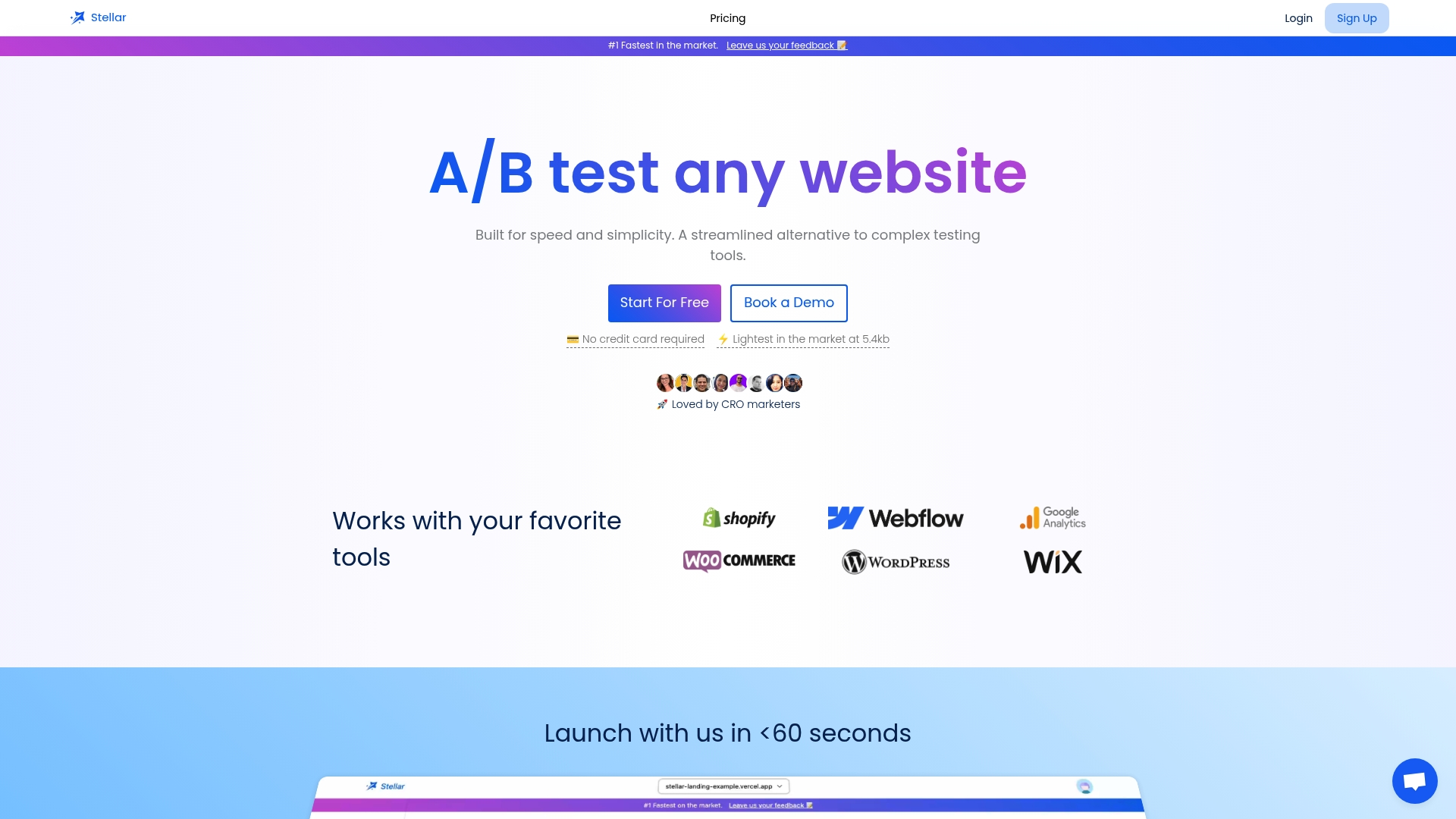
Take control of your testing workflows today with Stellar’s no-code visual editor and real-time analytics designed for marketers and growth hackers. Visit our main landing page now and start boosting conversions effortlessly. Don’t wait for months to see results when you can optimize your campaigns instantly.
Frequently Asked Questions
What are no-code visual editors in A/B testing, and how can they help my team?
No-code visual editors allow marketers and product teams to create A/B test variations without any coding skills. Start by selecting a user-friendly tool that offers drag-and-drop features, enabling you to quickly prototype and launch experiments.
How can I effectively reduce site impact while running A/B tests?
Using lightweight scripts helps maintain your website’s speed even when implementing A/B testing. Begin by auditing existing scripts, prioritizing those that are under 10 kilobytes, to ensure better performance without hindering testing capabilities.
How does dynamic keyword insertion enhance personalization during A/B testing?
Dynamic keyword insertion customizes web content based on user attributes, thus improving engagement rates. Test simple variations, like using a user’s first name, and expand to more complex content changes as you gather insights.
What should I track with real-time analytics to make better A/B testing decisions?
Focus on granular metrics like conversion rates, user engagement, and behavioral patterns during your A/B tests. Set up dashboards that update in real time to help you quickly adjust strategies based on immediate feedback.
How can advanced goal tracking improve my A/B testing results?
Advanced goal tracking captures detailed user interactions beyond just conversion rates. Consider implementing tracking for micro conversions and time spent on page elements to understand user behavior more comprehensively.
What are key steps to efficiently scale A/B testing as my business grows?
Build a modular testing framework and create reusable experiment templates to streamline your scaling efforts. Automate reporting and standardize data collection processes to handle multiple experiments seamlessly without sacrificing quality.
Recommended
- A B Testing Meaning: Uncover Data-Driven Insights for Better Conversions
- A/B Testing Digital Marketing: Strategies and Best Practices 2025
- A/B Testing for Ecommerce: Strategies and Trends for 2025
- Best A/B Test Ideas for Marketers in 2025
- Understanding the Future of Retail Technology | Prodcast
- Understanding Digital Transformation Trends 2025 - Stratgetic IT Consultants for Accountants
Published: 11/24/2025