
7 Key Homepage Design Trends 2025 for Marketers
Your homepage is often the first chance you get to impress visitors, but capturing attention and keeping users engaged is tougher than ever. Slow load times, confusing layouts, and generic content can send people away in seconds. In 2025, users expect instant results and seamless experiences, especially on mobile devices, and Google now ranks sites higher when they deliver speed and clarity.
This list reveals practical design strategies that directly impact user experience, SEO rankings, and conversion rates. You will discover how fast load times, clear navigation, interactive feedback, and dynamic visuals can transform your homepage from forgettable to compelling.
Get ready for actionable insights that will help you create a homepage users actually want to stay on and interact with. Each strategy addresses a real challenge and shows you what matters most for building a modern, competitive website.
Table of Contents
- Emphasizing Lightning-Fast Load Times For Engagement
- Using Minimalist Layouts To Boost Clarity
- Integrating AI-Powered Personalization Elements
- Leveraging Micro-Interactions For User Feedback
- Making Navigation Simpler And More Intuitive
- Highlighting Dynamic Content And Visuals
- Designing For Mobile-First And Responsive Performance
Quick Summary
| Takeaway | Explanation |
|---|---|
| 1. Prioritize Fast Load Times | Users expect websites to load in under three seconds; slow sites lead to higher abandonment rates. |
| 2. Embrace Minimalist Design | A clean, uncluttered layout enhances clarity and improves user experience by focusing on essential information. |
| 3. Implement AI Personalization | Utilize AI to create tailored user experiences that adapt content based on behavior and preferences. |
| 4. Simplify Navigation | Intuitive navigation design reduces cognitive load, helping users find information quickly and easily. |
| 5. Optimize for Mobile First | Design websites primarily for mobile users to ensure responsive performance across all devices. |
1. Emphasizing Lightning-Fast Load Times for Engagement
In the digital landscape of 2025, website load time is no longer just a technical detail - it's a critical factor for user engagement and business success. Visitors expect lightning-fast experiences, and mobile site speed benchmarks have become the new standard for online performance.
Website speed directly impacts user behavior and business metrics. Research shows that users abandon sites that take longer than two seconds to load, leading to significant drops in engagement and conversion rates. Consider these compelling statistics:
- 53% of mobile site visitors leave if a page takes longer than three seconds to load
- A one-second delay can reduce conversion rates by up to 7%
- Google prioritizes fast-loading sites in search rankings, making speed a key SEO factor
Performance Optimization Strategies
To create a lightning-fast homepage, marketers must focus on several key optimization techniques:
- Compress and optimize images
- Minimize HTTP requests
- Leverage browser caching
- Use content delivery networks (CDNs)
- Implement lazy loading for non-critical elements
Lightning-fast load times are no longer optional - they're the expectation for modern websites.
Beyond technical optimization, the goal is creating an instantaneous user experience that keeps visitors engaged. Increasing landing page speed requires a holistic approach that balances design, functionality, and performance.
Pro tip: Regularly audit your website's performance using tools like Google PageSpeed Insights to identify and eliminate speed bottlenecks before they impact user experience.
2. Using Minimalist Layouts to Boost Clarity
In the cluttered digital landscape of 2025, minimalist homepage design has emerged as a powerful strategy for capturing and maintaining user attention. By stripping away unnecessary visual noise, marketers can create user experience designs that guide visitors precisely where they need to go.
Minimalist design is more than just a visual aesthetic - it's a strategic approach to communication that prioritizes essential information and user intent. By reducing cognitive load, these layouts help visitors understand your value proposition faster and more intuitively.
Key benefits of minimalist homepage layouts include:
- Faster comprehension of key messages
- Reduced decision fatigue for users
- Improved mobile responsiveness
- Enhanced visual hierarchy
- Faster page load times
Core Principles of Minimalist Design
- Use abundant white space
- Limit color palette to 2-3 colors
- Choose clean typography
- Utilize high-quality, purposeful imagery
- Create clear navigation paths
Simplicity is the ultimate sophistication in modern web design.
Successful minimalist homepages transform complexity into clarity, allowing users to navigate and understand your offering within seconds. This approach requires discipline - every element must earn its place on the page.
Pro tip: Conduct user testing to ensure your minimalist design doesn't sacrifice crucial information while maintaining a clean, intuitive interface.
3. Integrating AI-Powered Personalization Elements
Artificial intelligence is transforming homepage design by enabling unprecedented levels of user personalization. By leveraging machine learning algorithms, marketers can now create personalization strategies that dynamically adapt content in real time.
AI-powered personalization goes far beyond simple demographic targeting. Modern systems analyze user behavior patterns, browsing history, and contextual signals to deliver hyper-relevant homepage experiences tailored to individual preferences.
Key capabilities of AI personalization include:
- Real-time content recommendations
- Dynamic website layout adjustments
- Predictive user journey mapping
- Intelligent product suggestions
- Contextual messaging optimization
Practical Implementation Strategies
- Integrate machine learning algorithms
- Collect and analyze user interaction data
- Create flexible content modules
- Implement continuous learning systems
- Maintain transparent personalization practices
Personalization is no longer optional - it's the new standard for digital experiences.
Successful AI personalization requires a delicate balance between data-driven insights and user privacy. Marketers must design experiences that feel helpful rather than invasive.
Pro tip: Start with small personalization experiments and gradually expand complexity as you understand your audience's preferences and comfort levels.
4. Leveraging Micro-Interactions for User Feedback
Micro-interactions are the subtle, sophisticated design elements that transform static web experiences into dynamic conversations between users and interfaces. By incorporating user experience testing techniques, marketers can create homepage interactions that feel intuitive and responsive.
These tiny animations and feedback mechanisms serve as powerful communication tools that guide users through digital experiences. Micro-interactions communicate system status and provide immediate visual or haptic responses to user actions, making websites feel more engaging and alive.
Key micro-interaction design principles include:
- Providing instant visual feedback
- Displaying system processing status
- Highlighting interactive elements
- Confirming user actions
- Creating emotional connections
Strategic Micro-Interaction Implementation
- Design purposeful animations
- Keep interactions subtle
- Ensure consistent design language
- Prioritize performance
- Test across different devices
Small interactions create significant user engagement experiences.
Successful micro-interactions require a delicate balance between functionality and aesthetic appeal. They should enhance user experience without becoming distracting or overwhelming.
Pro tip: Focus on creating micro-interactions that feel natural and provide clear communication rather than adding unnecessary visual complexity.
5. Making Navigation Simpler and More Intuitive
In 2025, website navigation is about creating seamless user journeys that feel effortless and intuitive. Website usability strategies have evolved to prioritize clarity and simplicity over complex menu structures.
Simplifying navigation means reducing cognitive load and helping users find exactly what they need with minimal effort. Intuitive design anticipates user intent and provides clear pathways that guide visitors naturally through your digital experience.
Key principles of streamlined navigation include:
- Limiting main menu items to 5-7 options
- Using clear and descriptive labels
- Implementing consistent menu placement
- Utilizing dropdown menus strategically
- Creating logical information hierarchies
Navigation Design Approaches
- Conduct user journey mapping
- Analyze click-through data
- Use heatmap tracking
- Implement breadcrumb navigation
- Create clear visual hierarchies
Simple navigation transforms user experience from frustrating to delightful.
Successful navigation design requires continuous testing and refinement. Your goal is to create a digital environment where users feel empowered and effortlessly guided.
Pro tip: Test your navigation design with real users and track their interaction patterns to continuously optimize your menu structure and labeling.
6. Highlighting Dynamic Content and Visuals
In the rapidly evolving digital landscape of 2025, homepages are transforming from static presentations to living, breathing experiences that adapt and respond in real time. Visual editor techniques enable marketers to create engaging interfaces that capture user attention instantly.
Dynamic content goes beyond traditional static imagery by presenting personalized visual experiences that change based on user interactions, preferences, and behavioral data. This approach creates more meaningful connections between brands and audiences.
Key dynamic content strategies include:
- Implementing video backgrounds
- Using animated infographics
- Creating personalized content blocks
- Designing interactive data visualizations
- Integrating real-time social proof elements
Dynamic Visual Implementation Techniques
- Leverage user behavior data
- Design modular content sections
- Use AI-driven personalization
- Ensure responsive design
- Optimize visual performance
Dynamic visuals transform websites from passive information displays to interactive storytelling platforms.
Successful dynamic content requires a delicate balance between engagement and performance. Marketers must focus on creating meaningful interactions that provide genuine value to users.
Pro tip: Always prioritize page load speed and user experience when implementing dynamic visual elements to prevent overwhelming or frustrating visitors.
7. Designing for Mobile-First and Responsive Performance
In 2025, mobile design is no longer an afterthought but the primary strategy for digital experiences. Responsive design strategies have become critical for marketers aiming to capture and retain user attention across multiple devices.
Mobile-first design prioritizes creating seamless experiences that begin with the smallest screen and scale intelligently to larger displays. Performance and usability are interconnected, demanding thoughtful approaches that go beyond simple screen resizing.
Key mobile-first design principles include:
- Implementing touch-friendly interfaces
- Ensuring fast load times
- Using flexible grid layouts
- Optimizing image and media sizes
- Creating readable typography
Mobile Performance Optimization Steps
- Conduct mobile usability testing
- Minimize HTTP requests
- Compress visual assets
- Use adaptive images
- Implement lazy loading techniques
Mobile design is not about making things smaller - it's about making experiences smarter.
Successful mobile-first design requires continuous testing and a deep understanding of user behavior across different devices and platforms.
Pro tip: Prioritize performance metrics and conduct regular mobile user experience audits to stay ahead of evolving design expectations.
Below is a comprehensive table summarizing the strategies and insights discussed throughout the article examining advanced website design and optimization techniques for 2025.
| Topic | Key Points | Insights |
|---|---|---|
| Lightning-Fast Load Times | Compress images, minimize HTTP requests, use CDNs, implement lazy loading, leverage caching. | Improves engagement, conversion rates, and SEO rankings. |
| Minimalist Layouts | Use white space, limit colors, employ clean typography, prioritize navigation clarity. | Enhances user comprehension and reduces decision fatigue. |
| AI-Powered Personalization | Utilize real-time recommendations, dynamic layouts, intelligent suggestions through AI tools. | Customizes user experience, creating relevance. |
| Micro-Interactions | Design feedback animations, ensure responsiveness, enhance aesthetic appeal. | Increases user engagement and satisfaction. |
| Simplified Navigation | Limit menu items, create logical hierarchies, use clear labels, optimize user journeys. | Makes navigation intuitive and seamless. |
| Dynamic Content and Visuals | Incorporate animated elements, personalized content blocks, interactive visual storytelling. | Captures user attention effectively and adapts in real time. |
| Mobile-First Design | Prioritize touch-friendly interfaces, compress media, optimize grid layouts, conduct usability tests. | Ensures superior mobile device experience. |
Accelerate Your Homepage Success with Stellar's Fast and Easy A/B Testing Solutions
The article highlights crucial homepage design trends for 2025 such as lightning-fast load times, AI-powered personalization, and streamlined navigation. Marketers face challenges like maintaining speed while delivering dynamic content and personalized experiences that truly engage users without causing frustration or delay. Achieving these goals demands tools that are both powerful and performance-friendly.
Stellar is designed to meet these exact needs. Its lightweight script minimizes impact on page speed, empowering you to optimize user experience without compromise. With a no-code visual editor and dynamic keyword insertion, you can create personalized, data-driven homepage variations effortlessly. Plus, real-time analytics and advanced goal tracking let you refine your strategies based on actionable insights that align perfectly with the 2025 trends outlined.
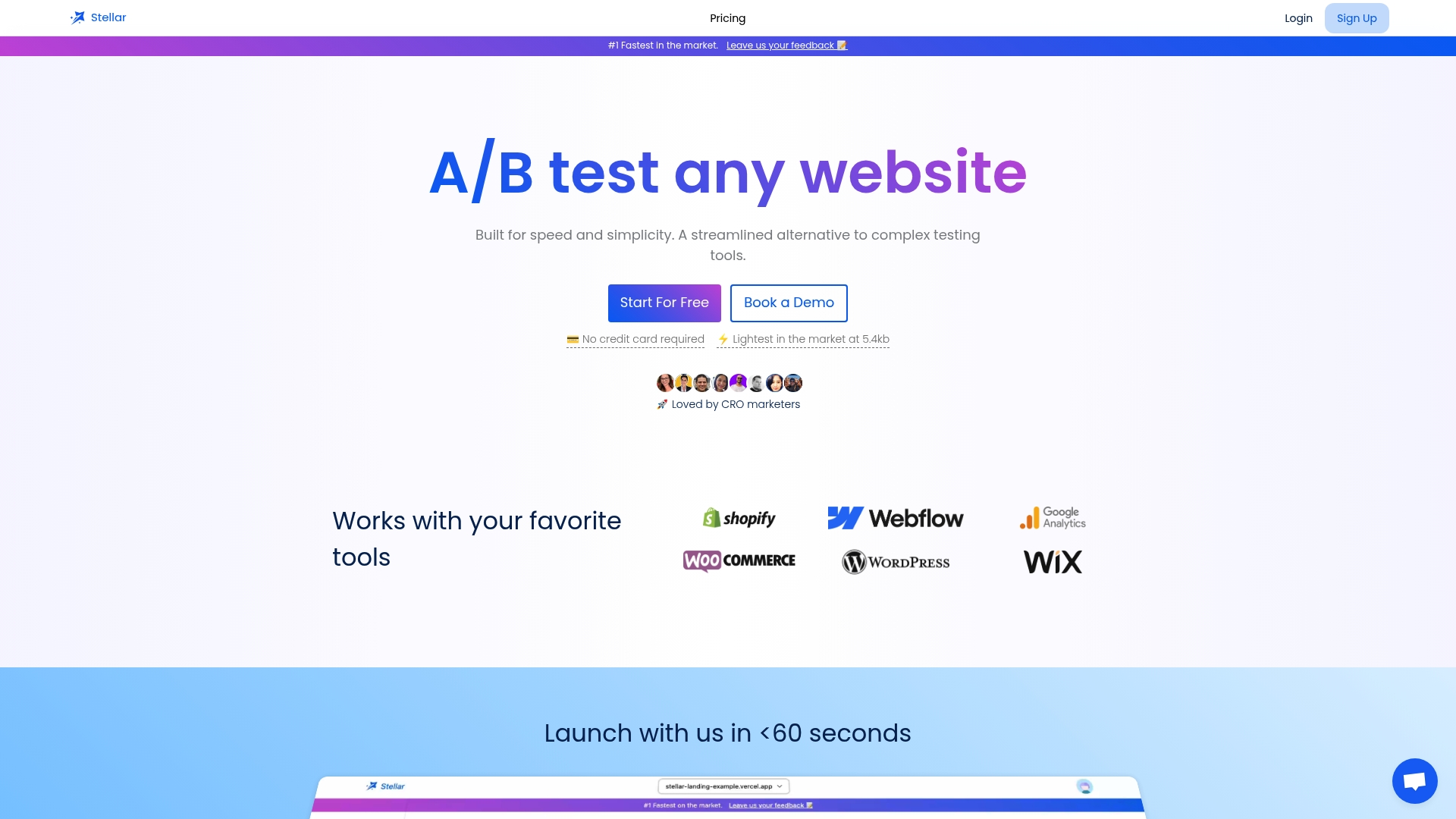
Elevate your homepage design by integrating A/B testing that keeps your site fast and your users engaged. Visit Stellar now to explore how our intuitive platform helps you implement cutting-edge strategies with ease. Start testing smarter and delivering better experiences today.
Frequently Asked Questions
What are the top homepage design trends for marketers in 2025?
The key homepage design trends for 2025 include lightning-fast load times, minimalist layouts, AI-powered personalization, micro-interactions, simplified navigation, dynamic content, and mobile-first design. To stay competitive, aim to implement at least three of these trends in your next website update.
How can I improve my website's load time?
To enhance your website's load time, focus on compressing images, minimizing HTTP requests, and leveraging browser caching. Regularly audit your website's performance every month to identify bottlenecks and make necessary improvements.
What are some essential principles of minimalist design?
Essential principles of minimalist design include using ample white space, limiting your color palette to 2-3 colors, and ensuring clear typography. Adopt these principles to streamline your homepage and communicate your key messages effectively.
How can AI enhance my homepage's user experience?
AI can enhance your homepage's user experience by providing real-time content recommendations and personalized layouts based on user behavior. Start by integrating basic machine learning algorithms and monitor their effectiveness within 30 days to improve engagement.
What types of micro-interactions should I include on my homepage?
Incorporate micro-interactions that provide instant visual feedback, confirm user actions, and highlight interactive elements. Focus on designing subtle animations that enhance usability without overwhelming visitors, testing their effectiveness after each implementation.
Why is mobile-first design crucial for my website in 2025?
Mobile-first design is crucial because it prioritizes user experiences that are optimized for smaller screens, ensuring functionality and speed across all devices. Transition to mobile-first strategies by redesigning your website with touch-friendly interfaces and responsive layouts, aiming to complete this process within 60 days.
Recommended
Published: 2/5/2026