
How to Design Experiments for Fast A/B Testing Success
Nearly **65 percent of American e-commerce businesses rely on data-driven A/B testing to uncover what truly drives higher conversions and deeper customer engagement. For global digital marketers aiming to compete with leading American brands, pinpointing clear goals and using easy-to-operate testing tools can be the difference between guesswork and strategic growth. This guide walks you through each step of effective A/B test setup—from goal definition to confident result verification—so you can create smarter experiments without coding headaches.
Table of Contents
- Step 1: Define Goals To Guide Experiment Design
- Step 2: Identify Variables And Create Test Scenarios
- Step 3: Set Up Experiments Using A Visual Editor
- Step 4: Implement Dynamic Keyword Insertion For Personalization
- Step 5: Track Outcomes And Verify Experiment Accuracy
Quick Summary
| Key Insight | Explanation |
|---|---|
| 1. Define Clear Goals | Establish specific, measurable objectives to focus your A/B testing efforts effectively. |
| 2. Focus on Relevant Variables | Select only the variables that are likely to influence your defined goals for precise impact measurement. |
| 3. Use Visual Editors for Ease | Implement A/B tests through visual editors to simplify the experiment setup and enhance agility. |
| 4. Personalize Content With Keywords | Leverage dynamic keyword insertion to tailor messaging that resonates directly with individual users' search intents. |
| 5. Maintain Statistical Rigor in Tracking | Ensure you use robust statistical methods to verify results and make reliable business decisions based on experimental data. |
Step 1: Define goals to guide experiment design
Successful A/B testing starts with crystal-clear objectives. In this step, you will learn how to craft precise experiment goals that transform random guesswork into strategic insights.
Designing effective experiments requires pinpointing exactly what you want to improve. Research shows that identifying primary outcome metrics is crucial for anchoring experiment success. This means moving beyond vague notions like "increase conversions" to specific, measurable targets such as "improve signup completion rate by 15% within 30 days".
Start by mapping your key performance indicators (KPIs) to specific user behaviors. Do you want more email signups? Higher checkout completion? Longer session times? Break down each goal into quantifiable metrics. For example, if you want to improve user engagement, define specific measurements like "increase average time on page by 45 seconds" or "reduce bounce rate from 65% to 50%".
Remember that stakeholder input is critical in conceptualizing meaningful experiments that drive data-driven innovation. Collaborate with team members to validate your goals and ensure they align with broader business objectives. Each goal should pass the SMART test: Specific, Measurable, Achievable, Relevant, and Time-bound.
Here’s a summary of how SMART goals enhance A/B test success:
| SMART Criteria | Why It Matters for A/B Testing | Example Application |
|---|---|---|
| Specific | Focuses efforts on one target | "Grow email signups by 20%" |
| Measurable | Enables quantifiable tracking | Track completed registrations |
| Achievable | Sets realistic expectations | Target based on prior data |
| Relevant | Aligns with business priorities | Match key marketing objectives |
| Time-bound | Defines a timeframe for results | Measure change within 30 days |
Pro tip: Always create a baseline measurement before starting your experiment to accurately track performance improvements and understand your starting point.
Step 2: Identify variables and create test scenarios
In this crucial stage of A/B testing, you will learn how to select and structure the specific variables that will transform your experiment from a random shot in the dark to a precision-targeted strategy.
Research highlights that successful A/B test designs require strategic manipulation of specific variables such as algorithms, visual elements, workflows, or processes. Think of these variables like ingredients in a recipe. You want to change just one key component at a time to understand its exact impact. For instance, if you are testing a landing page, you might experiment with headline wording, button color, image placement, or call-to-action text.

When identifying variables, focus on elements that directly connect to your defined goals. If your objective is increasing signup rates, potential variables could include form length, signup button design, social proof elements, or registration flow complexity. The key is selecting variables with meaningful potential to influence user behavior.
Creating effective test scenarios requires developing clear hypotheses about how these variables might impact user interactions. Will a more direct headline increase conversions? Will a simplified form reduce abandonment rates? Document your expected outcomes and the specific metrics you will use to measure success.
Pro tip: Always run a small pilot test to validate your variable selection and ensure your experiment design can reliably capture meaningful insights.
Compare the impact of variable choices on experiment outcomes:
| Variable Type | Potential Business Impact | Measurement Metric |
|---|---|---|
| Headline Text | Higher conversion rates | Signup clicks |
| Button Color | Increased user action | Click-through rate |
| Form Length | Lower abandonment | Completion rate |
| Social Proof | Enhanced trust | Engagement time |
Step 3: Set up experiments using a visual editor
Now you will transform your A/B testing strategy from complex coding challenges to a straightforward visual design process that empowers marketers to experiment quickly and effectively.

Visual editors enable users to create A/B test experiments without requiring advanced programming skills, allowing point and click modifications directly on the user interface. Think of it like designing a webpage using a drag and drop interface rather than writing intricate HTML and CSS code. You can modify button colors, adjust text, rearrange elements, and create multiple test variants with simple clicks and selections.
To get started, ensure you have integrated the necessary SDK into your website or application. Most visual editor platforms require a small snippet of code installed that connects your site with the testing environment. Once installed, you will typically see an overlay or sidebar that allows you to select specific elements you want to modify. Pay close attention to the exact elements you are changing and maintain consistency across your test variants to ensure accurate results.
Successful visual editor experiments require a strategic approach. Select one primary variable to modify at a time, whether that is button color, headline text, image placement, or form design. Carefully track how these small changes impact user behavior and conversion rates. Modern visual editors support front end web applications by providing intuitive tools for designing and deploying experiments without complex coding requirements.
Pro tip: Always preview your test variants across multiple device types to ensure design consistency and responsiveness before launching your experiment.
Step 4: Implement dynamic keyword insertion for personalization
Dynamic keyword insertion transforms your marketing content from generic messaging to hyper-targeted communication that speaks directly to individual user intent and search behaviors.
Dynamic keyword insertion uses AI to tailor content based on visitor intent, automatically adjusting website copy to boost organic reach and user engagement. Imagine creating a single landing page that magically adapts its headline, subtext, and call-to-action to match exactly what each visitor is searching for. If someone searches for "affordable running shoes" they see content about budget footwear, while another visitor searching "professional marathon gear" encounters a completely different, targeted message.
To implement dynamic keyword insertion effectively, you will need robust tracking and personalization tools that can parse incoming search terms and rapidly modify page content. Start by identifying the core keyword groups most relevant to your business. Create template content with flexible placeholders that can be swapped out based on detected user intent. This might involve preparing multiple headline variations, product descriptions, or call-to-action statements that can be dynamically inserted depending on the visitor's search context.
Personalizing for Higher Conversions: Step-by-Step Success suggests carefully monitoring how these dynamic adjustments impact user behavior. Track metrics like time on page, bounce rate, and conversion rates to understand which keyword insertions generate the most engagement. Remember that successful personalization is about relevance not just technical complexity.
Pro tip: Create a small library of pre-written content variations to ensure smooth and natural keyword insertions that feel organic rather than mechanical.
Step 5: Track outcomes and verify experiment accuracy
In this critical phase, you will transform raw experimental data into meaningful insights that drive confident business decisions by implementing rigorous statistical verification techniques.
Tracking outcomes requires statistical rigor to ensure observed effects are genuine and not artifacts of repeated testing or data peeking. The goal is to distinguish between random fluctuations and true performance differences. This means establishing clear statistical thresholds before launching your experiment and maintaining discipline in how you interpret results.
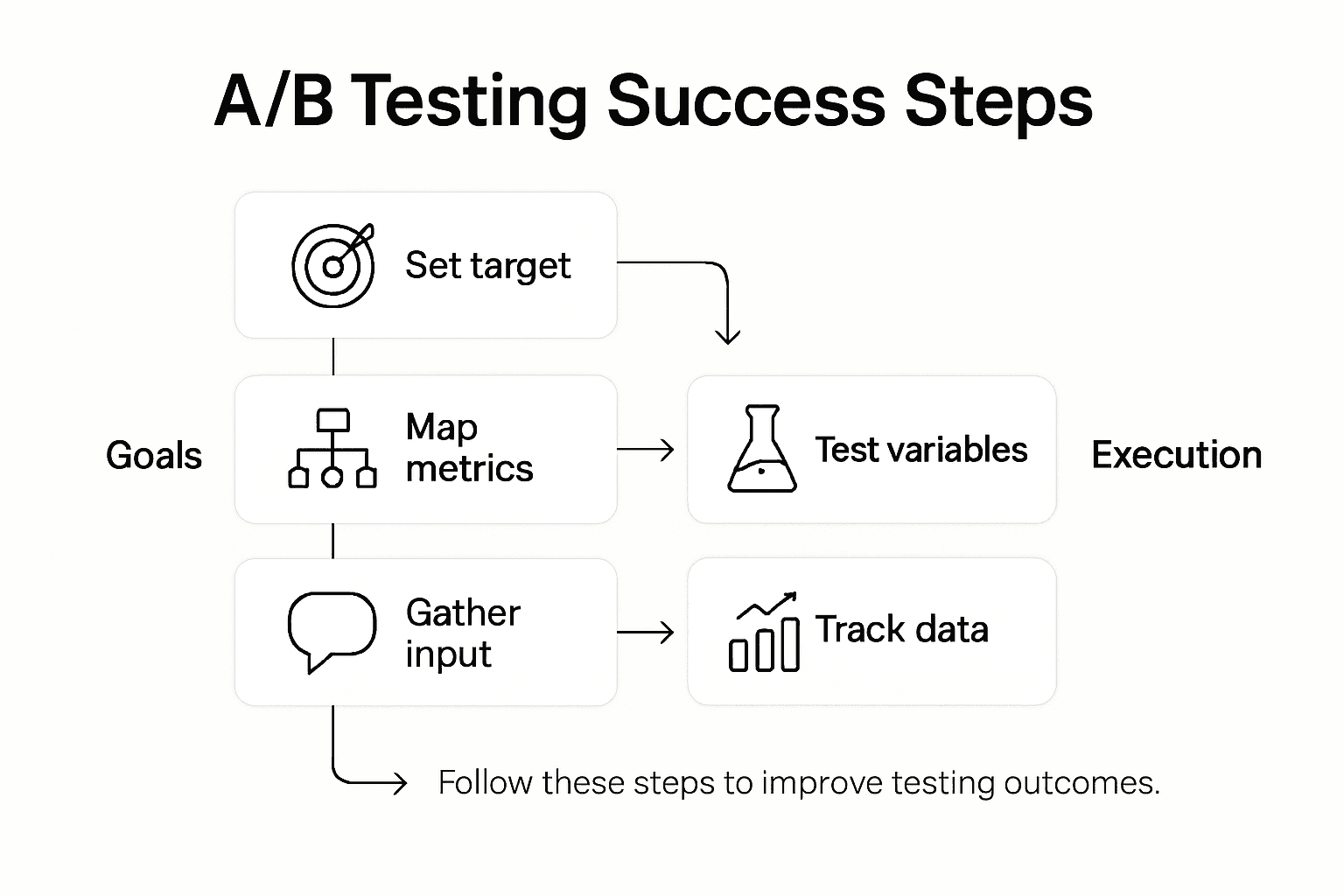
Random user allocation and persistent exposure are fundamental to maintaining experiment integrity. You will want to monitor key metrics like conversion rates, bounce rates, and user engagement, comparing your control and variant groups with sophisticated statistical techniques. Look for statistically significant differences that exceed predetermined confidence intervals typically set at 95% or 99%.
Key Metrics to Monitor AB Tests for Accurate Results recommends tracking not just primary conversion metrics but also secondary indicators that might reveal nuanced user behavior changes. Pay attention to potential side effects or unintended consequences that might not be immediately apparent in your primary success metric.
Pro tip: Never stop an experiment early based on initial results collect a full sample size to ensure your statistical conclusions are truly reliable.
Accelerate Your A/B Testing Success with Stellar
Designing precise experiments for fast A/B testing success requires clear goals, smart variable selection, and seamless implementation. If you want to avoid guesswork and start generating actionable insights quickly, Stellar offers the perfect solution. Its powerful but lightweight platform features a no-code visual editor, dynamic keyword insertion, and advanced goal tracking to help marketers and growth hackers confidently design and launch experiments without technical hurdles.
Key benefits you get with Stellar:
- Intuitive visual editor removes complexity
- Real-time analytics ensures you track progress accurately
- Dynamic keyword insertion personalizes user experience
Don’t let complicated setups slow down your experimentation. Start testing smarter and faster with Stellar today.
Ready to turn your A/B testing goals into measurable results? Visit Stellar’s platform to get started with the fastest and simplest A/B testing tool for small to medium-sized businesses. Explore the no-code visual editor and discover how easy it is to launch personalized experiments that drive growth.
Frequently Asked Questions
How do I define clear goals for my A/B testing experiments?
To define clear goals for A/B testing, ensure your objectives are specific, measurable, achievable, relevant, and time-bound (SMART). Break down your goals into quantifiable metrics, such as improving your signup completion rate by 15% within 30 days.
What variables should I test in my A/B experiments?
Focus on testing specific elements that directly relate to your defined goals. For instance, if you're aiming to increase signup rates, you might test variables like form length or button color to see which changes drive better user engagement.
How can I use a visual editor for A/B testing?
A visual editor allows you to modify your A/B test experiments without coding. Start by integrating the necessary tools into your website, then use a drag-and-drop interface to easily change elements such as text and button designs for your test variants.
What is dynamic keyword insertion, and how can it enhance A/B testing?
Dynamic keyword insertion tailors your content to match individual user intent, making your messaging more relevant. Implement this by creating template content that adapts automatically based on the keywords users search for to increase conversion rates and engagement.
How do I track outcomes accurately in my A/B tests?
To ensure accuracy in tracking outcomes, establish statistical thresholds before launching your experiment and consistently monitor key metrics. Focus on comparing conversion rates and other relevant indicators between control and variant groups to find statistically significant results.
When should I stop an A/B experiment?
You should not stop an experiment early based on initial results. Always collect a full sample size and allow the experiment to run its course to verify statistically reliable outcomes before making any conclusions.
Recommended
Published: 1/1/2026