
How to Interpret Analytics for Better A/B Test Results
Nearly 85 percent of American e-commerce teams admit that analytics errors have misled their A/B testing at least once. For digital marketers and growth hackers, even minor missteps in analytics tracking can mean wasted resources and lost growth opportunities. Getting your foundation right leads to crystal clear data that reveals what genuinely drives user engagement—and puts you ahead in the crowded global marketplace.
Table of Contents
- Step 1: Set Up Analytics Tracking Correctly
- Step 2: Define and Prioritize Key Metrics
- Step 3: Analyze Performance Data Trends
- Step 4: Identify Winning Test Variations
- Step 5: Validate Insights Before Implementing Changes
Quick Summary
| Main Insight | Detailed Explanation |
|---|---|
| 1. Implement Accurate Analytics Tracking | Properly set up analytics to capture user interactions and conversion data before A/B testing for reliable insights. |
| 2. Define Key Metrics Aligned with Objectives | Select and prioritize metrics that directly reflect significant business goals for actionable decision-making during A/B tests. |
| 3. Analyze Performance Data Trends Thoroughly | Examine trends over time to understand user behavior and ensure identified patterns are meaningful and consistent. |
| 4. Identify Winning Variations Systematically | Evaluate test variations using statistical significance to determine which provide genuine improvements in metrics. |
| 5. Validate Insights Before Implementation | Confirm insights through additional testing and strategic alignment with business goals to ensure reliable changes. |
Step 1: Set Up Analytics Tracking Correctly
Successfully interpreting A/B test results starts with implementing robust analytics tracking mechanisms that capture precise user interactions and conversion data. Getting your tracking setup right means the difference between actionable insights and misleading conclusions.
To establish accurate analytics tracking, you will need to configure several critical parameters. Start by selecting a reliable analytics platform that supports detailed event tracking and experiment management. Proper tracking configurations enable you to monitor user behavior across different experiment variations without introducing statistical noise. This means creating unique identifiers for each variation, implementing consistent tracking codes, and ensuring that your measurement tools can distinguish between different user experiences.
Your tracking implementation should focus on capturing key performance indicators that align with your specific test objectives. Whether you are measuring click through rates, time on page, or conversion completions, each tracked metric must be precisely defined and consistently measured across all experiment variations. Pay special attention to setting up conversion goals that accurately reflect meaningful user actions relevant to your specific test hypothesis.
Pro Tip: Double check your tracking configuration by running a small pilot test to validate that all events and conversions are being recorded correctly before launching your full experiment.
Here's a quick reference for essential parameters in analytics tracking and their business impact:
| Tracking Parameter | Purpose | Business Impact |
|---|---|---|
| Unique Variation IDs | Distinguish user experiences | Ensures accurate A/B test segmentation |
| Consistent Tracking Codes | Track behavior across tests | Minimizes data gaps and enhances reliability |
| Clear Conversion Goals | Define meaningful outcomes | Aligns metrics with real business objectives |
| Detailed Event Tracking | Record user interactions | Enables deeper insight into user behavior |
| Platform Compatibility | Support multiple measurement | Allows integration with business intelligence |
Step 2: Define and Prioritize Key Metrics
Defining and prioritizing key metrics is the strategic foundation that transforms your A/B testing from random experimentation into a precise, data driven decision making process. Your goal is to select metrics that directly reflect meaningful business outcomes and provide clear signals about user behavior and performance.

Start by identifying metrics that align closely with your specific business objectives. Analyzing conversion related metrics requires careful consideration of indicators like click through rates, sign up completions, purchase conversions, and engagement duration. Not all metrics carry equal weight some will provide more actionable insights than others. Focus on selecting primary metrics that represent your core business goals and secondary metrics that offer supplementary context. For example, an ecommerce site might prioritize purchase conversion rates as the primary metric while tracking average order value and customer acquisition cost as supporting indicators.
When prioritizing metrics, consider both quantitative performance and strategic relevance. Look beyond surface level numbers and evaluate how each metric connects to broader business objectives. A metric might show improvement but may not necessarily translate to meaningful business impact. Develop a hierarchy of metrics where your most critical business outcomes take precedence, ensuring that your A/B test results provide clear, actionable intelligence for strategic decision making.
Pro Tip: Create a metrics scorecard that ranks potential metrics by their direct correlation to revenue and strategic business goals to maintain focus during your A/B testing process.
This table summarizes how different types of performance metrics contribute to A/B testing decisions:
| Metric Type | Example | Strategic Contribution |
|---|---|---|
| Primary Metric | Purchase Conversion Rate | Directly reflects key business outcome |
| Supporting Metric | Average Order Value | Provides context to core revenue impact |
| Engagement Metric | Time Spent on Page | Indicates depth of user interaction |
| Cost-Related Metric | Customer Acquisition Cost | Informs profitability and sustainability |
Step 3: Analyze Performance Data Trends
Analyzing performance data trends is a critical skill that transforms raw numbers into actionable insights for your A/B testing strategy. This process helps you understand how different test variations perform over time and identify meaningful patterns that drive strategic decision making.

Advanced statistical analysis techniques are essential for interpreting complex A/B testing data with precision. Focus on examining multiple performance indicators simultaneously such as conversion rates, bounce rates, and user engagement metrics. Look for consistent trends rather than isolated data points that might represent statistical noise. Pay special attention to how metrics evolve throughout the testing period tracking whether performance improvements are sustained or temporary. Segment your data by user demographics, traffic sources, and device types to uncover nuanced insights that might be obscured in aggregate reporting.
When evaluating data trends, maintain a critical perspective and avoid jumping to premature conclusions. Statistical significance requires robust sample sizes and consistent performance across different time intervals. Consider external factors that might influence your results such as seasonal variations, marketing campaigns, or platform changes. Cross reference your findings with historical performance data to validate whether observed trends represent genuine improvements or merely short term fluctuations. Your goal is to develop a comprehensive understanding of how different test variations impact user behavior and business outcomes.
Pro Tip: Create visual trend dashboards that map key metrics over time to quickly identify performance patterns and make data driven decisions more intuitively.
Step 4: Identify Winning Test Variations
Identifying winning test variations requires a systematic approach that goes beyond surface level comparisons. Your goal is to determine which experimental variation provides the most meaningful improvement in key performance metrics while ensuring statistical reliability.
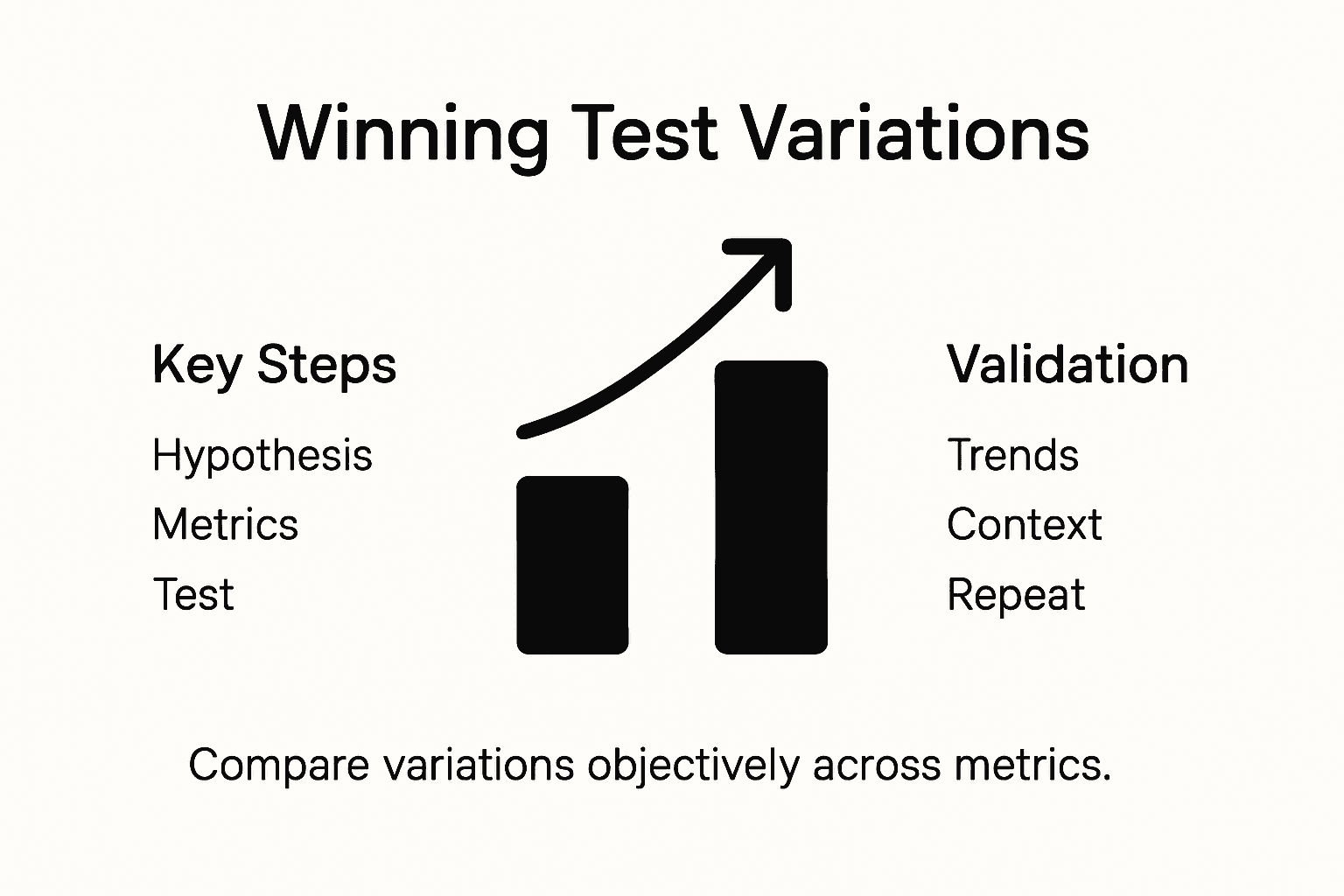
Statistical hypothesis testing techniques are crucial for objectively evaluating test results and distinguishing genuine performance differences from random fluctuations. Begin by examining your primary metrics with a critical eye toward statistical significance. Look for variations that demonstrate consistent and substantial improvements across multiple key performance indicators. Pay close attention to confidence intervals and effect sizes to understand the practical magnitude of observed differences. A statistically significant result does not automatically translate to a business changing improvement if the effect size is minimal.
When evaluating potential winning variations, consider more than just raw numbers. Analyze the context of your test results including user segments, traffic sources, and potential external influences that might skew your data. Some variations might perform exceptionally well for specific user groups while underperforming for others. This nuanced understanding helps you make more sophisticated implementation decisions that go beyond simple aggregate metrics. Your ultimate objective is to identify variations that not only improve key metrics but also align with broader business strategies and user experience goals.
Pro Tip: Run multiple rounds of validation tests to confirm the consistent performance of your winning variation across different time periods and user segments.
Step 5: Validate Insights Before Implementing Changes
Validating insights from A/B testing is a critical process that transforms raw experimental data into reliable, actionable strategies. Your primary objective is to ensure that the observed improvements are genuine, repeatable, and meaningful across different user contexts before making widespread changes.
Systematic testing methodologies require a comprehensive approach to validating experimental insights. Start by examining your test results through multiple analytical lenses looking beyond surface level metrics to understand the underlying performance drivers. Conduct additional targeted experiments that replicate your initial findings across different user segments, traffic sources, and time periods. Be especially vigilant about potential variations in performance among specific user groups or contextual scenarios that might have been masked in your original test results. Scrutinize not just the statistical significance of your results but also the practical implications and potential side effects of proposed changes.
Beyond statistical validation, consider the broader strategic implications of your test insights. Assess how proposed changes align with your overall business objectives, user experience goals, and long term growth strategies. Sometimes a variation that shows marginal statistical improvement might not warrant implementation if it conflicts with broader organizational priorities. Look for consistent performance patterns that demonstrate robust and reliable improvements rather than relying on isolated data points. Your validation process should function as a rigorous filter that ensures only the most promising and strategically aligned insights progress toward implementation.
Pro Tip: Create a comprehensive validation checklist that includes statistical significance requirements, user segment performance consistency, and strategic alignment criteria before approving any experimental changes.
Unlock Accurate A/B Test Insights with Stellar
Interpreting analytics correctly can be overwhelming when your tracking is complicated and results unclear. If you have faced challenges such as inconsistent data, unclear conversion goals, or difficulty identifying statistically significant winners, you are not alone. This article highlights the importance of precise setup, prioritizing key metrics, and validating insights before implementation — all critical steps to make A/B testing truly effective.
Stellar is designed to solve these common pain points by providing marketers and growth hackers with an easy-to-use, powerful A/B testing tool that ensures accurate tracking and real-time analytics. With our no-code visual editor and advanced goal tracking capabilities, you can effortlessly set up tests that align perfectly with your business objectives. Our lightweight script minimizes website performance impact so you get fast, reliable results that you can trust.
Don’t let confusing data hold back your growth. Experience the fastest and simplest way to interpret your testing data accurately and identify winning variations that truly move the needle. Visit Stellar to start streamlining your A/B testing today and turn insights into immediate action.
Frequently Asked Questions
How do I set up analytics tracking for A/B tests?
To set up analytics tracking effectively, choose a reliable analytics platform that allows for detailed event tracking. Implement consistent tracking codes and create unique identifiers for each test variation to ensure accurate data collection.
What key performance indicators should I focus on during A/B tests?
Focus on key performance indicators that align with your business objectives, such as click-through rates or conversion rates. Prioritize these metrics to ensure that your A/B tests provide actionable insights that can directly impact your goals.
How can I identify statistically significant results in my A/B tests?
To identify statistically significant results, analyze your primary metrics while considering confidence intervals and effect sizes. Ensure your sample sizes are sufficient to differentiate genuine improvements from random fluctuations within the data.
What should I do if my A/B test results are inconclusive?
If your A/B test results are inconclusive, conduct further analysis by segmenting data based on user demographics or traffic sources. Additionally, run additional controlled experiments to validate or challenge the trends you've observed.
How can I validate insights before making changes based on A/B test results?
Validate insights by replicating your initial findings through targeted experiments across different user segments. Create a validation checklist that assesses statistical significance and aligns proposed changes with your broader business goals.
Recommended
Published: 1/2/2026