
How to run a pricing test for better conversions
TL;DR:
- Running structured pricing tests allows SMBs to gather evidence-driven insights, protect revenue, and identify profitable price points. These experiments involve randomized variants and key metrics like conversion rate, ARPU, and profit per visitor to inform smarter pricing decisions. To succeed, teams need sufficient traffic, flexible tools, and a disciplined approach, avoiding common pitfalls such as testing too many variables or prematurely stopping tests.
Changing your pricing feels like defusing a bomb blindfolded. You nudge a number up by $10, and suddenly your sign-up rate craters. You drop your entry-level plan, and revenue barely moves. For small and medium-sized businesses, every pricing misstep has real consequences, and guessing your way through those decisions is a gamble you can't afford. A structured pricing test changes that completely. It lets you gather real evidence before committing, protect your current revenue, and find the price points that actually grow your business without needing an engineering team to pull it off.
Table of Contents
- What is a pricing test and why does it matter?
- Toolkit for running a pricing test
- Step-by-step: Executing your pricing test
- Avoiding common pricing test pitfalls
- What to measure and how to interpret the results
- A hard-won lesson: When you shouldn't run a pricing test
- Supercharge your pricing tests with user-friendly tools
- Frequently asked questions
Key Takeaways
| Point | Details |
|---|---|
| Test one variable | Changing a single price element at a time gives clear, actionable results. |
| Track the right metrics | Profit per visitor and customer lifetime value give a fuller picture than conversion rate alone. |
| Don’t rush tests | Running your test long enough to reach statistical significance ensures reliable decisions. |
| Avoid testing fatigue | Focus your efforts where testing brings the most insight to prevent wasted time and decision paralysis. |
What is a pricing test and why does it matter?
A pricing test is exactly what it sounds like: a controlled experiment where you show different price points, structures, or packaging to randomized groups of visitors, then measure which version drives better outcomes. As pricing test research explains, these tests involve showing different price points, structures, or packaging to randomized customer segments and measuring impacts on metrics like conversion rate, ARPU, revenue, and profit per visitor.
For SMBs, the stakes are especially high. You don't have the luxury of absorbing months of reduced revenue while you figure out what went wrong. A well-run pricing test gives you a safety net. Instead of rolling out a new price to everyone and hoping it works, you test it on a slice of your traffic first. If it flops, only a fraction of visitors saw it. If it works, you have data to back your decision with confidence.
The outcomes you can measure span several dimensions. The most common include:
- Conversion rate: How many visitors become paying customers
- Average revenue per user (ARPU): What you earn from each customer on average
- Total revenue: The combined income from all customers in the test window
- Profit per visitor: Revenue minus cost, the truest measure of business health
- Customer lifetime value (LTV): How much a customer is worth over time
- Churn rate: How quickly customers cancel after sign-up
| Metric | What you learn | Why it matters |
|---|---|---|
| Conversion rate | Which price removes friction | High conversion doesn't equal high profit |
| ARPU | What your average customer pays | Reveals whether pricing aligns with value |
| Total revenue | Net effect on income | Captures volume and price together |
| Profit per visitor | Real business impact | Accounts for margin, not just revenue |
| LTV | Long-term value of a segment | Critical for subscription businesses |
| Churn rate | How pricing affects retention | Flags if a price creates buyer's remorse |
Understanding these numbers together is how testing pricing strategies becomes a genuine growth lever rather than just an experiment for its own sake. And if you're also thinking about small business marketing strategies more broadly, smart pricing sits at the center of nearly every growth initiative.
Once you understand the risks and rewards, you need to know what goes into a pricing test.
Toolkit for running a pricing test
Before you run a single test, you need the right ingredients. Jumping in without preparation leads to muddied data, short tests, and conclusions you can't act on. Here's what your team needs:
- Sufficient traffic: You need enough visitors to reach statistical significance. Thin traffic means long test times or unreliable results.
- An editable pricing page: You must be able to change what visitors see without a full engineering sprint.
- A reliable analytics setup: Goals, events, or conversion tracking need to be in place before the test starts, not after.
- Defined customer segments: Knowing who you're testing on, new visitors only, a specific plan tier, or a geographic segment, keeps your results clean.
Choosing the right tool for your test matters too. Here's a plain-English comparison of your main options:
| Tool type | Best for | Limitation |
|---|---|---|
| Spreadsheets | Manual cohort tracking over time | No randomization, prone to human error |
| Built-in platform features | Simple price variants on e-commerce platforms | Limited flexibility and reporting depth |
| Dedicated A/B testing tools | Randomized split testing with real-time analytics | Requires setup, but far more reliable |
The methodology you pick shapes your results significantly. According to A/B pricing testing research, key methodologies include cohort-based testing using random assignment, segmented testing by demographics or behavior, sequential testing over time periods, and multivariate approaches for multiple variables. The golden rule across all of them: isolate one variable at a time to avoid confounding your results.
If you're wondering exactly how to test pricing pages without breaking your site or your budget, there are purpose-built approaches that work well for resource-constrained teams. And using segmentation for sales funnels effectively can make your segments sharper and your results far more actionable.
Pro Tip: Run your first pricing test on new visitors only. This avoids confusion for existing customers, keeps your sample clean, and gives you a true look at how your price lands on a fresh audience.
With tools in hand, you're ready to set up the core steps. Here's how to do it efficiently.
Step-by-step: Executing your pricing test
You've mapped the resources. Now let's walk through the simplest, most effective process for getting a clean, trustworthy pricing test off the ground.
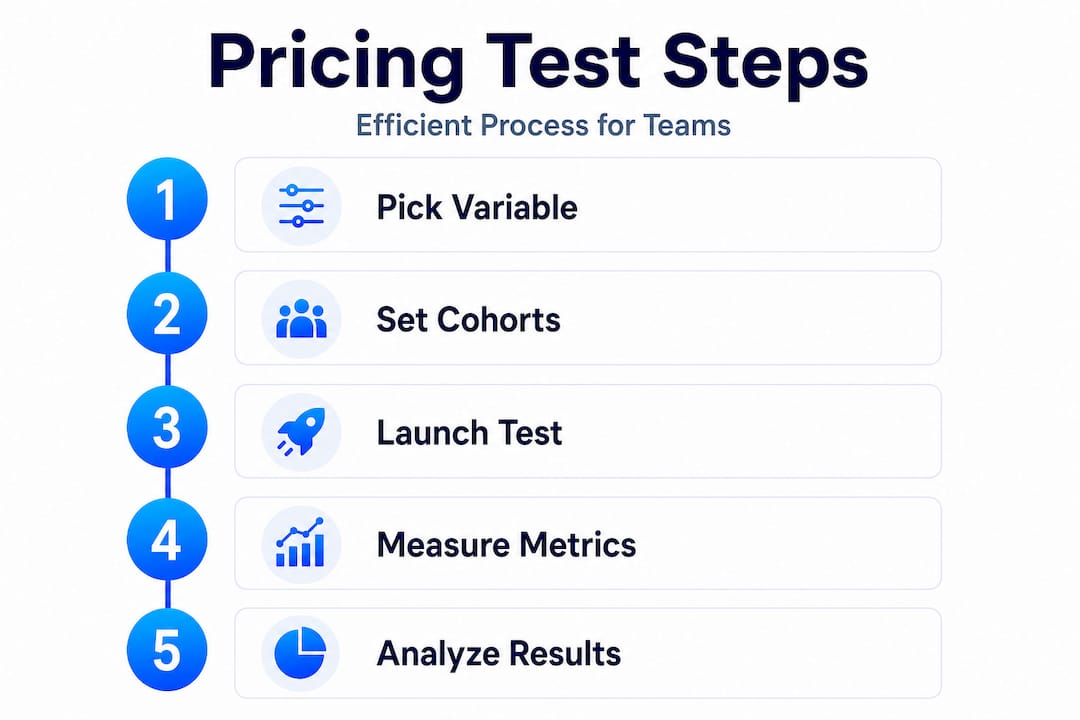
-
Set a clear, singular goal. Decide upfront what success looks like. Is it a higher conversion rate? More revenue per visitor? Better profit margins? Don't try to optimize for all of them at once. Pick one primary metric to guide your decision.
-
Define your variants. Control is your current price. Variant B is your single change, whether that's a different price point, a repackaged tier, or an annual vs. monthly framing. Keep the change focused.
-
Randomize traffic splits. Assign visitors to control or variant randomly and evenly. A 50/50 split works well for most SMBs. Avoid manually deciding who sees which version.
-
Calculate how long to run the test. Use a significance calculator to estimate the duration based on your current traffic and expected change. For most SMBs, that's two to four weeks minimum.
-
Monitor without interfering. Check results periodically, but don't make decisions or stop the test early based on preliminary data. Early results can be wildly misleading.
-
Record everything. Log start date, sample sizes, conversion events, and any external factors like a sale or a traffic spike that could skew results.
-
Analyze and decide. Once you hit statistical significance, compare your primary metric across variants and make a data-backed call.
One finding that surprises many marketers: price increases are neutral or positive in 69% of pricing tests. Lowering prices rarely compensates in volume what you lose in margin. This is a sharp reminder that profit-focused thinking should drive your decisions, not just revenue alone.
If you're weighing A/B against more complex approaches, the multivariate testing guide breaks down exactly when more variables are worth the complexity. For most SMBs, though, classic A/B is faster and more reliable given typical traffic levels. Understanding one-tailed vs two-tailed tests also shapes how you interpret whether your result is genuinely significant.
Pro Tip: If your monthly traffic is under 10,000 visitors, stick with simple A/B. The cleaner the test, the cleaner the insight. Multivariate testing needs much larger samples to reach confidence.
Avoiding common pricing test pitfalls
You're prepared to launch, but staying vigilant prevents wasted effort and misleading results. Pricing tests fail in predictable ways. Here's what to watch for.

Testing too many variables at once. The moment you change the price AND the plan structure AND the button copy, you lose the ability to know what caused any shift in behavior. You end up with a result you can't repeat or learn from.
Cutting tests short. It's tempting to stop the moment you see a positive trend, but early data is noisy. A test that looks like a winner on day three can reverse completely by day 14. Statistical significance isn't optional; it's the point where your result is trustworthy enough to act on.
Ignoring qualitative feedback. Numbers tell you what happened, but not why. Pair your quantitative data with customer surveys, support tickets, or short exit polls. If visitors bounce from your higher-price variant, a quick survey can reveal whether it's a value perception problem, a trust gap, or something else entirely.
Including existing customers. Showing existing customers a different price mid-relationship is risky and likely to create churn and confusion. Keep your test audience to new visitors or prospects only.
Shipping an untested pricing change across your entire audience, even with good intentions, is one of the fastest ways to lose revenue you didn't know you had. One bad rollout can take months to reverse.
As A/B pricing research reinforces, SMBs sometimes skip testing and just ship changes to fix "obvious" problems, which often backfires. The smarter path combines a test-first mindset with client-focused marketing strategies that treat every customer touchpoint as something worth measuring. Tools that help you optimize pricing tests make this mindset practical rather than theoretical.
What to measure and how to interpret the results
Collecting data is only half the battle. Making sense of it closes the feedback loop and turns a test into a real decision.
| Metric | What it means | Why it matters |
|---|---|---|
| Conversion rate | % of visitors who purchase | Tells you if the price removes or creates friction |
| ARPU | Revenue divided by active users | Reveals actual earning per customer |
| Total revenue | All revenue in test window | Captures the combined effect of price and volume |
| LTV | Projected customer value over time | Essential for subscription or repeat-purchase models |
| Churn rate | % who cancel within 30-90 days | Flags post-purchase regret linked to pricing |
| Profit per visitor | Revenue minus cost, per visitor | The single truest measure of pricing success |
Here's a step-by-step process for reviewing your results once the test ends:
- Confirm statistical significance first. Don't skip this. A result with 60% confidence is not a result you should act on.
- Compare your primary metric across all variants. Is the difference meaningful in dollar terms, not just percentage terms?
- Check secondary metrics for contradictions. A higher conversion rate that coincides with higher churn is a trap, not a win.
- Consider profit per visitor above all else. As pricing metrics research shows, optimizing conversion rate alone is a mistake; a higher price may lower conversions but significantly boost revenue. The margin tells the real story.
- Document your findings. Write down what you tested, what you found, and what you decided. Future tests are better for it.
For teams focused on improving outcomes at every stage, optimizing pricing pages for clarity and conversion is a natural follow-on once you've validated your price point through testing. Proven growth strategies consistently show that businesses who use data to inform pricing decisions outperform those who operate on intuition alone.
A hard-won lesson: When you shouldn't run a pricing test
Here's the perspective most pricing test guides won't give you: sometimes the right call is to skip the test entirely.
This isn't an argument against testing. Testing is almost always better than guessing. But for SMBs with limited traffic, limited engineering support, and finite team bandwidth, the cost of a test isn't zero. Every test takes time to set up, monitor, and analyze. That time has real opportunity cost.
There are situations where a test isn't the right tool. If your pricing is wildly out of step with your market, a 5% increase vs. a 10% increase test won't tell you much. Fix the obvious problem first, then test around the edges. If your traffic is so low that a test would take six months to reach significance, the market may shift faster than your results arrive. If your product is still finding product-market fit, your pricing instability is a symptom, not the root problem.
There's also the underappreciated danger of decision paralysis from over-testing. Marketing teams who run test after test without ever committing to a direction can develop a kind of data dependency where no result ever feels conclusive enough to act on. At some point, good judgment informed by reasonable data is more valuable than perfect data that never arrives.
Think about testing frequency strategy carefully. The best teams test regularly but purposefully. They know when a test will generate actionable insight and when it's just adding noise to a decision they already know how to make. If you already know a price is too low because customers tell you so repeatedly and they convert at nearly 100%, raise the price. You don't need a test to validate common sense.
Supercharge your pricing tests with user-friendly tools
Running pricing tests well takes a clear process, the right metrics, and tools that don't slow you down or require a developer every time you want to try something new.
Stellar is built precisely for marketing teams like yours. With a no-code visual editor, a 5.4KB script that won't hurt your page speed, and real-time analytics that make interpreting results simple, you can run clean, effective A/B tests on your pricing page without filing a single engineering ticket. The platform supports advanced goal tracking so you measure the metrics that matter, not just clicks. Whether you're on the free plan for under 25,000 monthly tracked users or scaling up, Stellar keeps experimentation fast, focused, and frustration-free. Start testing smarter today at gostellar.app.
Frequently asked questions
How long should a pricing test run for reliable results?
A pricing test should run until you reach statistical significance, which typically takes two to four weeks for small businesses. Tests cut short before that point produce unreliable results that can lead to costly missteps.
What's better for SMBs: A/B testing or multivariate testing?
A/B testing is almost always the better starting point for SMBs because it requires less traffic and is easier to interpret. As pricing test research confirms, traditional A/B is simpler and faster for lower-traffic businesses, while multivariate is better suited for high-traffic situations with complex interactions.
Which pricing metrics matter most for SMBs?
Profit per visitor, total revenue, and customer lifetime value are the most important metrics to track. Focusing on conversion rate alone can be misleading because a higher price may reduce conversions while still increasing overall profit.
Should I include existing customers in a pricing test?
No. Existing customers should be excluded from pricing tests to avoid confusion, backlash, and churn. Avoiding existing customers in tests prevents bias and protects relationships you've already built.
Recommended
Published: 5/3/2026