
How to Validate Marketing Ideas for Effective A/B Testing
Over 60 percent of American e-commerce marketers struggle to validate A/B test results without technical help. When conversion rates drive every decision, even small mistakes in goal setting or data tracking can cost real revenue. This quick-start guide breaks down practical steps for defining measurable goals, launching precise tests, and using visual, no-code tools so you can make confident decisions that deliver results faster.
Table of Contents
- Step 1: Define Measurable Goals For Marketing Ideas
- Step 2: Set Up Targeted A/B Tests Efficiently
- Step 3: Implement Visual Changes With No-Code Tools
- Step 4: Monitor Real-Time Analytics For Quick Feedback
- Step 5: Optimize Based On Goal-Driven Test Outcomes
Quick Summary
| Key Point | Explanation |
|---|---|
| 1. Set SMART marketing goals | Define Specific, Measurable, Achievable, Relevant, and Time-bound objectives to guide your A/B testing strategy effectively. |
| 2. Isolate one variable in tests | Focus on altering a single element, like headline or button color, to accurately assess its impact on user behavior. |
| 3. Utilize no-code tools for flexibility | Employ no-code platforms to swiftly implement design changes without needing extensive technical knowledge, enabling faster iterations. |
| 4. Monitor analytics in real time | Use real-time feedback to make prompt adjustments to your experiments based on user engagement and performance metrics. |
| 5. Analyze results to optimize strategies | Evaluate test outcomes against your initial goals to derive actionable insights for future marketing campaigns. |
Step 1: Define measurable goals for marketing ideas
Successful A/B testing begins with crystal clear, well defined marketing goals that provide a roadmap for your experimentation strategy. Defining precise marketing objectives allows you to track performance systematically and make data driven decisions.
To create effective marketing goals, leverage the SMART framework: Specific, Measurable, Achievable, Relevant, and Time bound. Instead of vague objectives like "increase website traffic," craft goals that specify exact metrics. For example, "Increase organic website traffic by 25% within the next quarter" provides a concrete target. Break down your primary objective into granular, trackable components that align with specific stages of your marketing funnel.
When establishing your goals, consider multiple dimensions like conversion rates, click through rates, engagement metrics, and revenue impact. Align each goal with key performance indicators that directly reflect business outcomes. Choose metrics that are not just quantifiable but also meaningful to your specific marketing strategy.
Here's a quick comparison of common metrics used in A/B testing and their business significance:
| Metric | What It Measures | Typical Use Case | Business Impact |
|---|---|---|---|
| Conversion Rate | Percentage of visitors who take a desired action | Form submissions, purchases | Tracks ROI and marketing success |
| Click-Through Rate (CTR) | Ratio of clicks on a specific link or ad | Email campaigns, button tests | Measures engagement effectiveness |
| Bounce Rate | Percent of users leaving after one page | Landing page performance | Signals relevance and user satisfaction |
| Engagement Time | Average time spent on page or site | Content quality tests | Indicates content interest level |
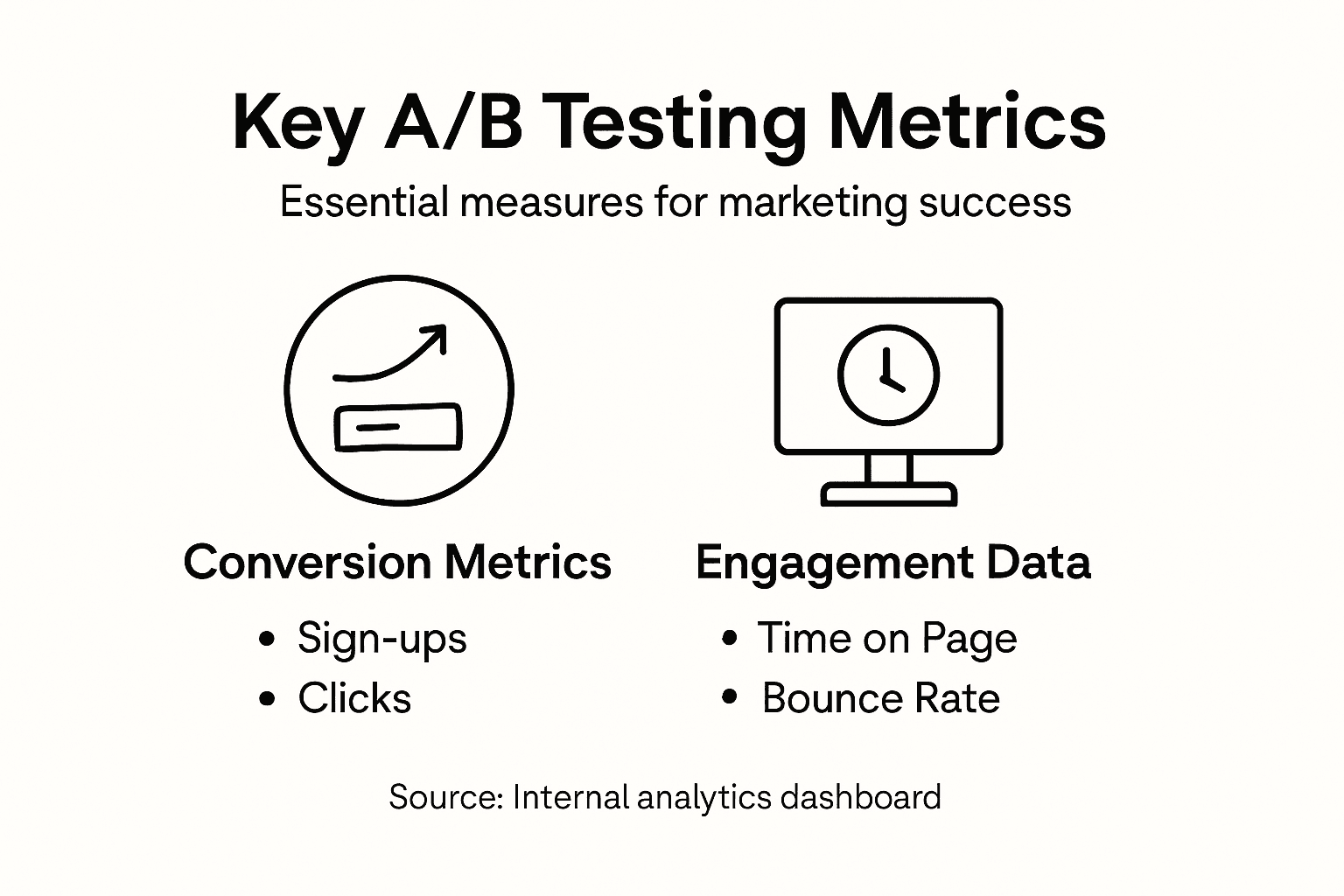
Pro tip: Start with 2-3 focused goals rather than attempting to measure everything simultaneously, which can dilute your testing effectiveness and create analysis paralysis.
Step 2: Set up targeted A/B tests efficiently
Designing effective A/B testing experiments requires a strategic approach that minimizes variables and maximizes actionable insights. Your testing setup should focus on isolating specific elements that can meaningfully impact your marketing performance while ensuring statistical reliability.
Start by identifying a single, clear hypothesis for your test. Select one primary variable to modify such as headline text, call to action button color, or image placement. Segment your audience carefully to ensure you have a representative sample that reflects your target demographic. Determine the sample size needed to achieve statistically significant results before launching your experiment.

Prepare your test variants with precise tracking mechanisms in place. Ensure both versions A and B are identical except for the specific element you are testing. Set up conversion tracking that captures relevant metrics like click through rates, engagement time, or purchase completions. Monitor the test closely and resist the temptation to end it prematurely before collecting sufficient data.
Pro tip: Use a sample size calculator to determine the minimum number of participants required for statistically valid results before launching your A/B test.
Step 3: Implement visual changes with no-code tools
No-code platforms enable rapid marketing experimentation by removing technical barriers that traditionally slow down website modifications. These intuitive tools allow marketers to make visual changes quickly without requiring extensive coding knowledge or developer intervention.
Begin by selecting a no-code visual editor that integrates seamlessly with your existing website platform. Look for tools offering drag-and-drop interfaces that allow you to modify elements like headlines, images, button colors, and layout configurations with simple point-and-click actions. Preview both test variations side by side to ensure design consistency and alignment with your original hypothesis.
Focus on creating clean, purposeful variations that isolate specific design elements. Ensure each version maintains your brand's core visual identity while introducing targeted modifications. Verify that tracking scripts and conversion goals are properly configured before launching your experiment. Document each change meticulously to understand which specific visual modifications drive meaningful performance improvements.
Pro tip: Always create a backup of your original page design before implementing no-code tool modifications to maintain a reliable reference point.
This summary outlines how no-code tools differ from traditional web editing for marketing experiments:
| Approach | Required Skills | Speed of Changes | Experiment Flexibility |
|---|---|---|---|
| No-Code Tools | Basic marketing knowledge | Minutes to hours | High, rapid iteration |
| Traditional Coding | HTML/CSS/JS expertise | Days to weeks | Moderate, developer dependent |
Step 4: Monitor real-time analytics for quick feedback
AI-driven feedback systems provide immediate marketing insights that transform how marketers understand and optimize their A/B testing experiments. Real-time analytics offer a window into user behaviors, allowing you to make swift data-driven decisions without waiting for lengthy reporting cycles.
Set up your analytics dashboard to track key performance indicators relevant to your specific test hypothesis. Focus on metrics like conversion rates, bounce rates, engagement time, and click-through percentages. Configure custom alerts that notify you instantly when significant statistical variations emerge between your test variants. Pay close attention to segment-specific performance to understand how different user groups interact with your variations.
Develop a systematic approach to interpreting analytics data. Look beyond surface-level numbers and investigate the underlying patterns driving user behavior. Identify not just which variant performs better, but understand why certain design elements trigger different user responses. Be prepared to pause or adjust your experiment if early data suggests a clear performance disparity that could impact your marketing objectives.
Pro tip: Schedule short daily review sessions to monitor test analytics, preventing decision fatigue while maintaining consistent experiment oversight.
Step 5: Optimize based on goal-driven test outcomes
Goal-setting methodologies enable strategic marketing optimization by transforming raw test data into actionable insights that drive meaningful business improvements. Your optimization process should focus on translating experimental results into concrete strategies that align with your original marketing objectives.
Start by critically analyzing your test results against the initial SMART goals you established. Identify which variant performed most effectively across key performance indicators. Examine not just the winning version, but the underlying user behaviors and interactions that contributed to its success. Look for patterns in user engagement, conversion rates, and segment specific responses that reveal deeper insights about your target audience.
Implement a systematic approach to applying your findings. If a particular variant outperformed others, document the specific design elements or messaging strategies that drove its success. Develop a process for incrementally rolling out winning variations across your marketing channels. Be prepared to conduct follow up tests that further refine and validate your insights, creating a continuous improvement cycle that keeps your marketing strategies adaptive and effective.
Pro tip: Create a standardized test results template that captures key learnings, allowing you to build an institutional knowledge base of what works for your specific audience.
Accelerate Your A/B Testing Success with Stellar
The article highlights common challenges marketers face when validating marketing ideas such as defining measurable goals, setting up targeted tests, and implementing no-code visual changes efficiently. If you want to avoid analysis paralysis and endless waiting for data processing, you need a tool designed to deliver fast, actionable insights paired with user-friendly features. With Stellar's advanced goal tracking and real-time analytics, you can precisely measure conversion rates and engagement metrics that matter most to your business.
Our platform's no-code visual editor lets you create clean, purposeful A/B test variants in minutes without technical delays. Designed specifically for marketers and growth hackers at small to medium-sized businesses, Stellar removes the complexity so you can focus on what drives results. Don’t let slow or complicated tools hold you back from optimizing your marketing — discover how fast and intuitive A/B testing can transform your campaigns today.
Advanced Goal Tracking for SMART Objectives
Explore Stellar Now
Ready to validate your marketing ideas with confidence and speed Start your free trial at https://gostellar.app and experience the fastest lightweight A/B testing tool engineered for real results.
Frequently Asked Questions
How can I set measurable goals for my A/B testing?
To set measurable goals for your A/B testing, use the SMART framework: Specific, Measurable, Achievable, Relevant, and Time-bound. For example, instead of saying "increase website traffic," state a clear goal like "increase organic website traffic by 25% within the next quarter."
What elements should I focus on when designing A/B tests?
Focus on a single, clear hypothesis and modify one primary variable at a time, such as the headline text or button color. This targeted approach allows you to isolate the effect of the change and understand its impact on user behavior.
How can I monitor real-time analytics during A/B testing?
Set up your analytics dashboard to track key performance indicators that are relevant to your goals. Incorporate custom alerts to notify you of significant changes so you can make data-driven adjustments quickly throughout the testing period.
What should I do after analyzing the results of my A/B tests?
Critically assess your test results against your original SMART goals and identify the most effective variant. Document the insights gained and implement the successful changes across your marketing channels to optimize future performance.
How do no-code tools enhance the A/B testing process?
No-code tools allow marketers to make visual changes quickly without needing extensive coding knowledge. Choose a no-code visual editor to modify elements like headlines and button colors easily, speeding up your experimentation process and allowing for rapid iterations.
Recommended
Published: 1/12/2026