
Improving SaaS Conversions: A Step-by-Step Guide
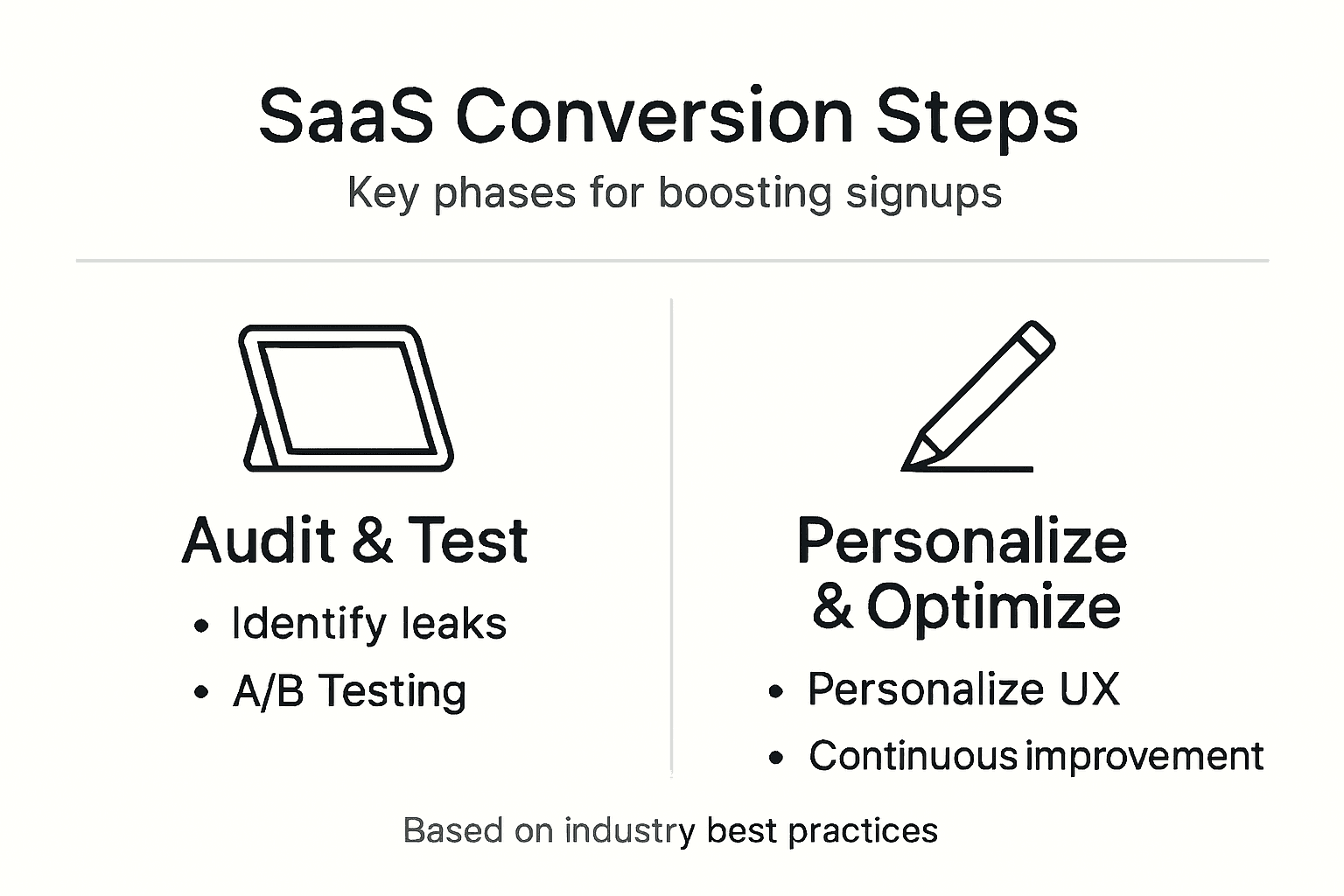
Every Digital marketer knows the frustration of seeing visitors leave before becoming paying customers. Mapping your conversion paths lets you pinpoint where prospects drop off and which journeys actually result in revenue. By auditing your funnel from awareness through retention, you unlock conversion path analysis that reveals hidden friction points and opportunities. This guide walks you through efficient A/B testing, practical personalization, and continuous optimization—giving you actionable steps to boost conversions without needing deep technical skills.
Table of Contents
- Step 1: Audit Current Conversion Paths
- Step 2: Implement Targeted A/B Tests
- Step 3: Personalize User Experiences
- Step 4: Analyze Results and Optimize Continuously
Quick Summary
| Key Point | Explanation |
|---|---|
| 1. Map Your Entire Funnel | Visualizing the customer journey helps identify where drop-offs occur, enabling targeted optimization efforts for increased conversions. |
| 2. Run Targeted A/B Tests | Focus tests on specific bottlenecks, controlling variables to make data-driven decisions for effective conversion improvements. |
| 3. Personalize User Experiences | Tailor messaging and content based on user behavior and demographics to enhance engagement and boost conversion rates. |
| 4. Analyze Results Thoroughly | Evaluate test outcomes for statistical significance and impact to inform future optimization and measure ROI effectively. |
| 5. Maintain Continuous Testing | Establish an ongoing testing cadence to iteratively improve conversions, leveraging lessons learned from previous tests. |
Step 1: Audit Current Conversion Paths
Your SaaS conversion paths are where customers live or die. Before you optimize anything, you need to see exactly where visitors are dropping off and which routes actually lead to paying users.
Start by mapping your entire customer journey. Most SaaS companies think they understand their funnel, but they actually don't. You need to trace the step-by-step path from first website visitor through signup, trial activation, and paid conversion. Conversion path analysis in SaaS reveals which sequences drive the most conversions and where friction points hide.
Here's what your audit should cover:
- Awareness stage: How do people first discover you? What pages do they land on?
- Acquisition stage: Which signup flows work best? Are you losing people at email confirmation?
- Activation stage: What does "activated" mean for your product? When do trial users first get value?
- Retention and revenue stages: Which users upgrade? What separates free users from paying customers?
Next, align your team on definitions. This matters more than you think. Your marketing team might define a "signup" as someone who enters their email. Your product team might not count them as activated until they complete onboarding. Your sales team has another definition entirely. These misalignments kill optimization efforts before they start.
Pull your conversion data from Google Analytics or your product analytics tool. Look for assisted conversions reports to understand which combinations of pages and events lead to conversions. Don't just look at final touchpoints. Some of your best optimization opportunities live in the middle of the journey where visitors wander.
Map your entire funnel first. You can't optimize what you don't measure.
Identify where the biggest drop-offs occur. If 100 visitors land on your homepage but only 10 enter the trial, that's your priority. Calculate drop-off rates at each stage so you can rank them by impact.

Pro tip: Create a simple spreadsheet documenting each stage, the number of users at that stage, the drop-off rate, and your hypotheses about why people leave. This becomes your optimization roadmap for the next steps.
Here's a summary of each SaaS conversion funnel stage and the primary metric to track:
| Funnel Stage | Primary Success Metric | Typical Drop-Off Reason |
|---|---|---|
| Awareness | Website visits | Low brand visibility |
| Acquisition | Signups | Complex signup process |
| Activation | Trial activations | Unclear onboarding or value |
| Retention/Revenue | Paid conversions/upgrades | Weak ongoing engagement |
Step 2: Implement Targeted A/B Tests
Now that you know where your conversion leaks are, it's time to run experiments that actually fix them. Targeted A/B tests are your weapon for making data-driven decisions rather than guessing what might work.
Start by choosing one specific conversion bottleneck to test first. Don't try to fix everything simultaneously. If your biggest drop-off happens between signup and first login, that's your test. Data-driven decision making in product optimization requires focusing your experiments where they'll move the needle most.
Create a clear hypothesis before you build anything. Write it down. "Changing the CTA button from blue to red will increase signups by 15 percent" is a real hypothesis. "Making the button better" is not. Your hypothesis guides which variation to build and how to measure success.
Your test needs three core elements:
- Control version: Your current experience (the baseline)
- Variation: The single change you're testing (one variable only)
- Success metric: How you'll measure if it worked (signups, time to activation, paid conversions)
Set your test duration and sample size before launching. A test needs enough traffic to reach statistical significance. Running a test for three days and calling it done leads to false conclusions. Aim for at least one full week of data, longer if your conversion rates are low.
Split your traffic evenly between control and variation. Send 50 percent of visitors to each experience. Uneven splits create misleading results. Use a testing platform that handles traffic allocation automatically so human error doesn't corrupt your data.
Monitor your results daily but don't declare a winner until you hit your target sample size. This is critical. Many marketers peek at results on day three and stop early. You'll make wrong decisions. Let the experiment run its full course.
Run experiments on the biggest friction points first. Quick wins compound into serious conversion gains.
Document everything as you go. Record your hypothesis, the change you made, when it ran, sample size, and results. This becomes your optimization history and prevents you from testing the same thing twice.

Pro tip: Run multiple tests in parallel on different pages or flows to accelerate learning. Just ensure you're not testing the same users twice, which can skew results and waste traffic on conflicting experiments.
Use this A/B testing roadmap to guide your optimization process:
| Step | Key Action | Business Benefit |
|---|---|---|
| Identify bottleneck | Focus on highest drop-off stage | Maximizes impact |
| Define hypothesis | Write specific change to test | Ensures measurable outcomes |
| Run test | Allocate traffic, track metrics | Achieves reliable results |
| Analyze results | Check significance and learnings | Informs next tests |
Step 3: Personalize User Experiences
Personalization is no longer a nice-to-have feature. Users expect experiences tailored to their needs, and when you deliver that, conversions jump. This step teaches you how to start personalizing without overwhelming your team.
Begin with the data you already have. You don't need advanced AI to personalize. User behavior signals are sitting in your analytics right now. Which pages do they visit? How long do they stay? What industry are they from? Use this information to show different messaging to different visitor segments.
Start with three basic personalization layers:
- Industry or company size: Show SaaS solutions to tech companies and enterprise messaging to large corporations
- Page behavior: If someone spent three minutes on your pricing page, show them ROI calculators or case studies
- Traffic source: Visitors from paid ads might see different headlines than those from organic search
Create buyer persona variations of your key pages. If you have five target personas, build five versions of your landing page (or use dynamic content blocks to swap sections). Each version speaks directly to what that audience cares about. A startup wants speed and affordability. An enterprise wants security and compliance.
AI-powered personalization and machine learning algorithms can adapt experiences in real-time, but start simple. You can implement basic rules without any AI. If a user is from an industry you track, show industry-specific features. If they clicked pricing first, emphasize transparency.
Test your personalization variations just like you tested button colors. Set one variation as control and measure conversion impact. You're looking for whether each persona converts at different rates with personalized messaging.
Personalized experiences don't have to be complex. Show the right message to the right person, and conversions improve.
Track which personalized experiences work best. Document which audience segments respond to which messaging, offers, and page layouts. This becomes your playbook for scaling what works.
Pro tip: Start personalization on your highest-traffic pages first. You'll see results faster and need smaller sample sizes to reach statistical significance, letting you iterate quicker and prove ROI to stakeholders.
Step 4: Analyze Results and Optimize Continuously
Your test has run its course. Now comes the part that separates winners from everyone else: actually analyzing what happened and acting on it. One test won't transform your conversions. A system of continuous testing will.
Start by checking whether your results reached statistical significance. This is non-negotiable. A 5 percent lift means nothing if your sample size was tiny. You need enough traffic and time for the results to be reliable. Most testing platforms show you a confidence level automatically. Wait until you hit at least 95 percent confidence.
Look at three key metrics for every test:
- Primary metric: Did your chosen success metric improve? By how much?
- Secondary metrics: Did anything else change? Did you improve signups but hurt time to activation?
- Segment performance: Did the variation work equally well for all audience types or just some?
Calculate the actual impact. If your test increased conversions by 8 percent and you get 1,000 signups monthly, that's 80 additional signups per month. Over a year, that's 960 extra customers. This is how you show ROI to leadership.
Continuous optimization uses data-driven insights to refine your entire user journey. One winning test becomes your new baseline. Then you test the next bottleneck. This iterative approach compounds over time, turning small gains into massive conversion improvements.
Document your learnings before moving on. Record what you tested, the results, and what you learned. Build a shared repository so your entire team knows what's already been tested and won't repeat experiments.
If your test won: Implement it permanently and start testing the next friction point immediately.
If your test lost: Don't get discouraged. Failed tests teach you something about your audience. Move forward and test something different.
Continuous testing beats occasional big experiments. Small, consistent wins compound into serious growth.
Schedule your next test before you wrap up the current one. Momentum matters. Teams that maintain testing cadence see faster conversion improvements than those who test sporadically.
Pro tip: Track your cumulative lift across all tests. A 5 percent gain here, 8 percent there, and 12 percent elsewhere adds up to 25 percent total improvement. Show this compound growth to stakeholders to build support for continued testing investment.
Boost Your SaaS Conversion Rates with Stellar's Streamlined A/B Testing
Improving SaaS conversions requires clear insights into your funnel and focused experimentation on critical drop-off points. This guide highlights challenges like identifying bottlenecks between signup and activation and personalizing user experiences to increase paid conversions. If you want to go beyond basic testing and embrace precise, data-driven optimization without the complexity or performance drag, Stellar delivers exactly that.
Stellar is designed for marketers and growth hackers who need a fast and lightweight A/B testing tool with a no-code visual editor, dynamic keyword insertion, and advanced goal tracking. With just a 5.4KB script size, it preserves your website’s speed while providing real-time analytics that empower you to run meaningful experiments across each conversion funnel stage.
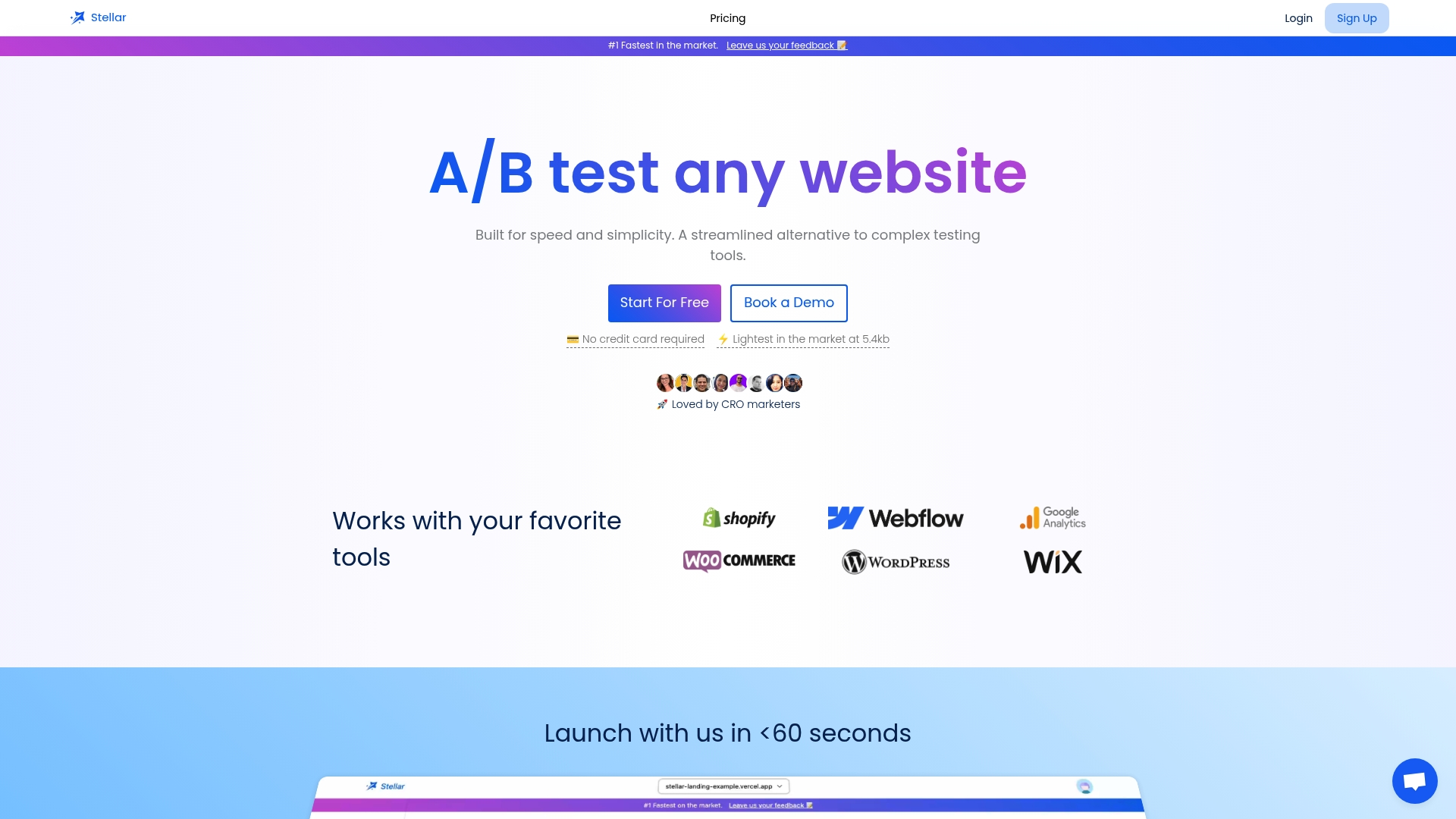
Ready to uncover your hidden conversion leaks and personalize experiences that truly convert? Experience the fastest experimentation toolkit built for small to medium-sized businesses today. Visit Stellar's homepage to start your free plan and transform your test results into lasting growth. Start optimizing smarter now with Stellar’s A/B Testing Tool and elevate your SaaS funnels with our Visual Editor that makes complex personalization easy and effective.
Frequently Asked Questions
How can I audit my current SaaS conversion paths?
Start by mapping your entire customer journey from the first website visit through signup to paid conversion. Analyze metrics at each stage to identify where visitors drop off and focus on optimizing those areas for improvement.
What are the most effective ways to implement A/B testing for SaaS conversions?
Run targeted A/B tests by identifying one specific bottleneck at a time and comparing it against a control version. Ensure you document your hypothesis and analyze results for statistical significance to make informed decisions.
How can I personalize user experiences to improve conversions?
Utilize data on user behavior, such as industry and page visits, to tailor messaging and content accordingly. Start with basic personalization on your highest-traffic pages to see significant results quickly.
What key metrics should I focus on during testing and optimization?
Track primary metrics related to your conversion goals, along with secondary metrics to see if changes affect other aspects of user experience. Continuously analyze segment performance to identify what works best for different audiences.
How often should I run tests to improve my SaaS conversions?
Maintain a consistent testing cadence by scheduling your next test before completing the current one. Frequent small tests lead to faster improvements and can accumulate significant gains over time.
What should I do if my A/B test results are inconclusive?
If your test didn't reach statistical significance or failed to improve metrics, don't be discouraged. Learn from the results, revise your approach, and plan to test a different aspect of your conversion path next.
Recommended
- Conversion Funnels: Boosting SaaS Growth With Data
- UX and Conversion Links: Powering SaaS Growth
- Proven Steps to Improve Conversions on Your Site
- How to Increase Conversions: 7 Proven Strategies for Success
- Why SaaS Solutions Drive Smarter Operations
- Step by Step Business Launch: Guide to Starting Strong
Published: 2/27/2026