
Improving UX with Experimentation: Data-Driven Wins
Most American small and medium enterprises miss out on meaningful conversion growth by neglecting structured UX experimentation. With over 68 percent of product managers admitting they rely on intuition instead of data, digital marketers risk disappointing users and missing key opportunities. Discover how no-code A/B testing challenges common myths and empowers teams to measure and improve every user interaction with precision.
Table of Contents
- Defining UX Experimentation And Common Myths
- Types Of Experimentation For UX Optimization
- How A/B Testing Enhances User Experience
- Critical Success Metrics And Result Analysis
- Avoiding Pitfalls And Maximizing Test Impact
Key Takeaways
| Point | Details |
|---|---|
| UX Research is Essential | UX experimentation is critical for creating user-centric products and cannot be overlooked. |
| Continuous Feedback is Key | Regular, structured research is necessary to obtain ongoing user insights that drive design improvements. |
| A/B Testing Drives Improvement | A/B testing allows teams to make data-driven design decisions, enhancing user experience incrementally. |
| Define Clear Metrics | Selecting appropriate metrics ensures that research findings are actionable and aligned with business goals. |
Defining UX Experimentation and Common Myths
User Experience (UX) experimentation represents a systematic approach to understanding and improving how users interact with digital products. While many professionals mistakenly view UX research as optional, it's a critical process for designing intuitive, user-centric experiences. Evolving definitions of UX demonstrate the complexity of measuring human interaction with digital interfaces.
The fundamental goal of UX experimentation is to evaluate design decisions through empirical evidence rather than subjective assumptions. This involves collecting quantitative and qualitative data about user behaviors, preferences, and pain points. Contrary to common myths, UX research is not just about conducting occasional user interviews, but a continuous process of observation, testing, and iterative design refinement.
Most UX experimentation myths stem from misunderstandings about its scope and methodology. Some product managers believe talking directly to users eliminates the need for structured research. However, comprehensive UX frameworks reveal that user experience encompasses multiple dimensions, including ergonomic, cognitive, and emotional interactions that cannot be fully understood through casual conversations.
Here's a summary of common UX experimentation myths versus reality:
| Myth | Reality | Practical Impact |
|---|---|---|
| UX research is optional | UX is critical for product success | Skipping UX can cause user frustration |
| User interviews alone are enough | Continuous, structured research is required | Ongoing user feedback produces better designs |
| Casual conversations reveal all user needs | UX includes deeper cognitive and emotional insights | Structured frameworks uncover hidden pain points |
To effectively conduct UX experimentation, teams must embrace a multidimensional approach that combines quantitative metrics with qualitative insights. This means using tools like user testing, heatmaps, session recordings, and structured surveys to build a comprehensive understanding of user experience.

Pro Tip: Start your UX experimentation by creating a hypothesis-driven research plan that clearly defines measurable objectives and potential user interaction scenarios.
Types of Experimentation for UX Optimization
UX optimization involves a diverse range of experimentation methods designed to uncover insights about user behavior and interaction patterns. UX research methods span from rigorous academic controlled trials to rapid industry usability tests, each serving unique research objectives and providing distinct perspectives on user experience.
The primary types of UX experimentation can be categorized into four main approaches: qualitative, quantitative, generative, and evaluative methods. Qualitative methods like user interviews and contextual observations help researchers understand deeper motivations and emotional responses. Quantitative techniques such as A/B testing and user surveys provide statistically significant data about user preferences and behavior patterns. Generative research focuses on discovering new insights and opportunities, while evaluative research assesses the effectiveness of existing designs and interfaces.
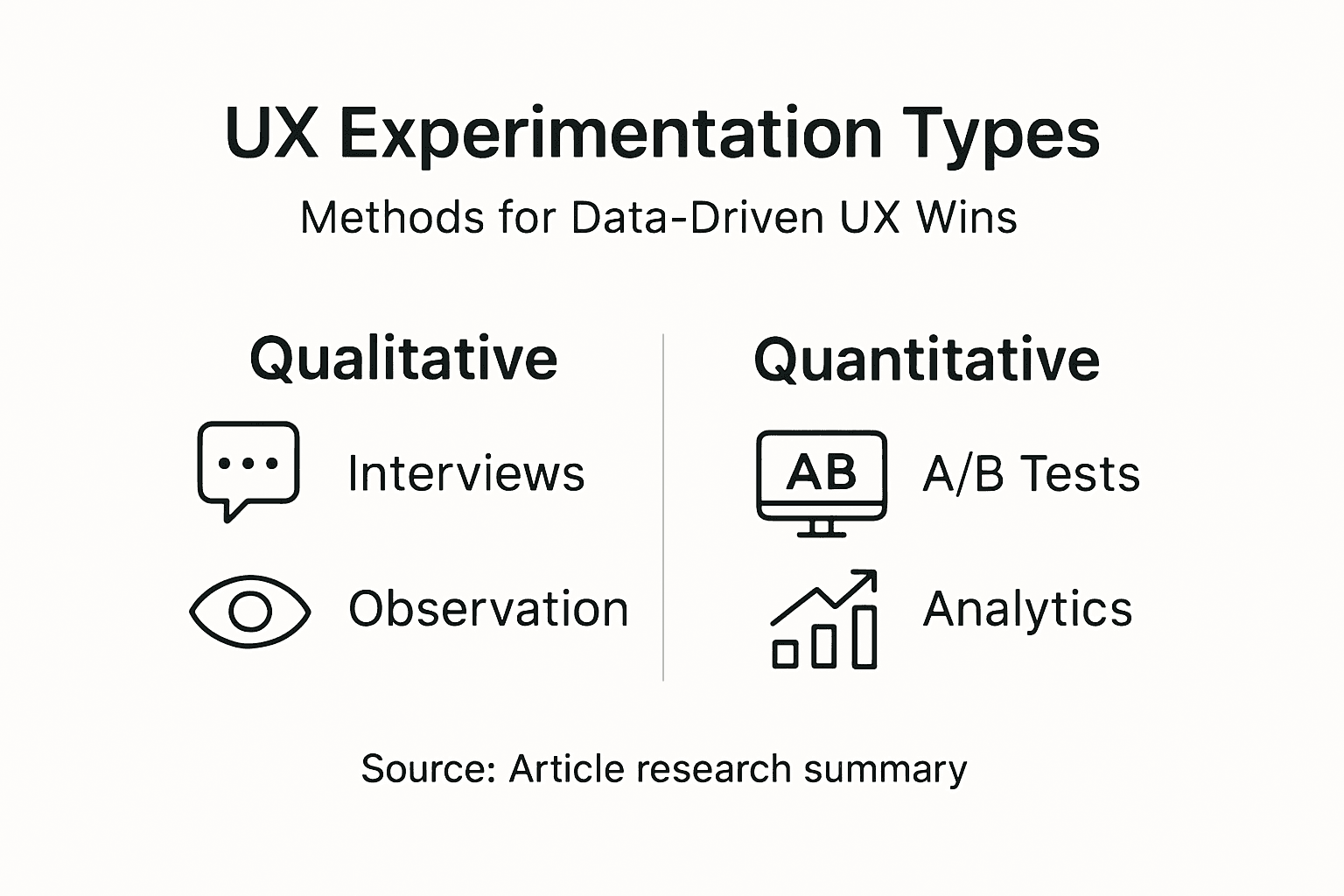
Here is a comparison of qualitative and quantitative UX research approaches:
| Approach | Data Collected | Ideal Use Case | Limitations |
|---|---|---|---|
| Qualitative | Observations, interviews, emotion | Discover motivations and pain points | Subjective and hard to scale |
| Quantitative | Metrics, surveys, conversion rates | Measure behaviors and trends | May miss context and nuance |
Specific experimental techniques include usability testing, where participants complete predefined tasks while researchers observe interactions, heuristic evaluations that assess interfaces against established design principles, and remote unmoderated testing that captures user behavior across diverse scenarios. Comprehensive UX research strategies recommend combining multiple methods to create a holistic understanding of user experience, ensuring that insights are both deep and broadly applicable.
Successful UX experimentation requires careful method selection based on project goals, available resources, and specific research questions. Researchers must balance academic rigor with practical constraints, choosing approaches that provide meaningful insights without overwhelming project timelines or budgets.
Pro Tip: Always triangulate your UX research by using at least two different experimental methods to validate and enrich your findings.
How A/B Testing Enhances User Experience
A/B testing represents a powerful methodology for systematically improving user experience by comparing alternative design approaches. Critical UX evaluation techniques enable product teams to replace subjective design decisions with data-driven insights, transforming how interfaces are developed and optimized.

The fundamental process involves presenting two distinct design variants to different user groups and measuring their performance across key metrics such as conversion rates, engagement times, and user satisfaction. By randomly distributing users between Version A and Version B, researchers can statistically determine which design elements create more positive interactions. Rigorous testing methodologies help teams understand not just what users prefer, but why specific design choices generate better outcomes.
Successful A/B testing requires careful planning and precise execution. Researchers must identify clear objectives, isolate specific variables for testing, and ensure sufficient sample sizes to generate meaningful results. Common areas of investigation include button placement, color schemes, headline text, navigation structures, and interactive elements. By systematically experimenting with these design components, teams can incrementally improve user interfaces, reducing friction and enhancing overall user experience.
Beyond immediate design improvements, A/B testing cultivates a culture of continuous learning and data-driven decision making. Teams gain deeper insights into user behavior, challenge existing assumptions, and develop more intuitive interfaces through empirical evidence rather than guesswork.
Pro Tip: Always establish a clear hypothesis and predetermined success metrics before launching your A/B test to ensure objective and meaningful results.
Critical Success Metrics and Result Analysis
User experience research demands comprehensive and nuanced measurement strategies that go beyond simple surface-level metrics. Multi-dimensional success frameworks emphasize the critical importance of selecting metrics that capture both quantitative performance and qualitative user sentiment across multiple dimensions.
The most effective UX result analysis incorporates a balanced approach of quantitative and qualitative metrics. Key performance indicators typically include task success rate, error rate, time on task, user satisfaction scores, and Net Promoter Score (NPS). Comprehensive UX measurement approaches recommend evaluating outcomes at user, business, and organizational levels to ensure holistic understanding of experimental results.
Successful metrics selection requires careful consideration of research objectives and contextual factors. Researchers must design measurement strategies that align with specific product goals, user needs, and organizational priorities. This involves identifying precise, measurable indicators that provide actionable insights, such as conversion rates, engagement duration, user retention, and specific interaction patterns that reveal deeper user experience nuances.
Beyond raw data collection, effective result analysis demands sophisticated interpretation that contextualizes quantitative findings with qualitative insights. This means moving beyond simple numerical comparisons to understand the underlying reasons for user behavior, exploring not just what happened, but why specific design variations generate more positive user interactions.
Pro Tip: Develop a standardized metrics framework before launching your experiment to ensure consistent, comparable, and meaningful data collection across different research initiatives.
Avoiding Pitfalls and Maximizing Test Impact
UX experimentation requires strategic planning and meticulous execution to generate meaningful insights. Common research mistakes often stem from inadequate preparation, unclear objectives, and poor participant selection, which can dramatically undermine the validity and usefulness of experimental results.
One of the most critical challenges in UX testing involves creating unbiased, representative research environments. This means developing realistic test scenarios, recruiting participants who genuinely reflect target user demographics, and designing neutral, non-leading research protocols. Usability testing strategies emphasize the importance of carefully crafted test tasks that reveal authentic user behaviors without introducing artificial constraints or researcher biases.
Successful UX experiments demand cross-functional collaboration and clear communication. Researchers must proactively engage stakeholders, align experimental objectives with broader business goals, and establish robust mechanisms for sharing and implementing findings. This involves creating comprehensive research documentation, developing actionable recommendations, and building organizational buy-in through transparent, data-driven storytelling.
Maximizing test impact requires a holistic approach that goes beyond isolated experiments. Teams should view UX research as a continuous improvement cycle, where each test builds upon previous insights, incrementally refining understanding of user needs, behaviors, and preferences. By maintaining rigorous methodological standards and cultivating a culture of curiosity and evidence-based decision making, organizations can transform experimental data into meaningful product enhancements.
Pro Tip: Create a standardized research template that captures consistent metadata across all experiments, enabling easier comparison and longitudinal analysis of UX insights.
Unlock Data-Driven UX Improvements with Stellar A/B Testing
The article highlights the challenge of turning UX experimentation insights into effective design decisions without compromising website performance or overcomplicating workflows. If you want to move beyond myths and harness structured, continuous user research with precise metrics and rapid iteration then Stellar offers the solution tailor-made for marketers, growth hackers, and product managers. Key pain points such as the need for lightweight tools that minimize site impact and provide real-time analytics are addressed with Stellar's 5.4KB script and advanced goal tracking.
Start harnessing the power of your UX experimentation with Stellar's no-code visual editor and dynamic keyword insertion, enabling seamless, hypothesis-driven A/B testing that fits perfectly with the comprehensive methodologies discussed in the article. Explore how Stellar streamlines A/B testing so you can focus on uncovering meaningful user insights and optimizing experiences quickly and confidently.

Ready to leverage data-driven wins and elevate your product's user experience? Visit Stellar's homepage to get started with a free plan designed for small to medium businesses and turn your UX experimentation into measurable success today.
Frequently Asked Questions
What is UX experimentation?
UX experimentation is a systematic approach to evaluate and improve how users interact with digital products. It involves collecting both quantitative and qualitative data to understand user behaviors, preferences, and pain points.
Why is UX research essential for product success?
UX research is critical for product success because it informs design decisions based on empirical evidence rather than assumptions. Skipping UX can lead to user frustration and decreased engagement.
How does A/B testing improve user experience?
A/B testing improves user experience by comparing different design variants and measuring their performance across key metrics. This data-driven approach allows teams to identify which design elements lead to better user interactions.
What are some common methods of UX experimentation?
Common methods of UX experimentation include usability testing, A/B testing, heatmaps, user surveys, and heuristic evaluations. These methods help researchers gather insights into user behavior and optimize interfaces.
Recommended
Published: 1/8/2026