
Store Owners: Boost Ecommerce Sales in 30–90 Days With Fast A/B Tests
Fix conversion leaks and retention before you spend another dollar on new traffic. That means auditing checkout and page speed, then running prioritized A/B tests on your product pages and cart, while lifecycle email flows catch the customers you already paid to acquire. Most stores have more upside sitting in their existing traffic than in their next ad campaign. Pick one or two experiments from your checkout or speed audit and launch them within 30 days, using conversion rate optimization tips to guide your testing approach.
TL;DR:
- Improvement in mobile load speed by 0.1 seconds can lead to an 8% increase in conversions and a 9.2% rise in mobile revenue.
- Fixing cart abandonment rates, reducing unnecessary checkout fields, and showing full costs upfront can directly address over half of the main checkout drop-offs.
- Prioritizing product page value proposition and optimizing mobile images can yield quick revenue gains with minimal effort.
- Focusing on conversion and retention metrics, such as repeat purchase rate and cohort lifetime value, provides a clearer measure of growth than traffic alone.
- Running rapid, no-code split tests on checkout and product pages helps identify effective changes without extensive developer involvement.
Table of Contents
- What Drives Ecommerce Sales? The Metrics to Diagnose First
- Conversion Optimization: Product Pages, Checkout, Mobile UX, and Speed
- Acquisition Tactics That Scale Revenue Without Killing Margin
- Retention and Lifecycle Marketing: Email, Flows, and Loyalty
- Increase Average Order Value Without Eroding Margin
- How to Test, Measure, and Scale Your Wins
- Your 30, 60, and 90-Day Growth Audit and Action Plan
- What Actually Moves the Needle (and What Doesn't)
- Run Faster Experiments Without Waiting on a Developer
- Sources
- FAQ
What Drives Ecommerce Sales? The Metrics to Diagnose First
Revenue breaks down into one simple equation: traffic times conversion rate times average order value times repeat purchase rate. Most store owners obsess over traffic and ignore the other three variables, which is backward, since conversion and retention fixes usually cost less and pay off faster than new campaigns.
Before spending on acquisition, run a customer acquisition cost to lifetime value comparison (CAC:LTV) alongside your contribution margin. If a channel's CAC is climbing faster than the LTV it generates, scaling that channel just accelerates losses. This filter matters more than most dashboards suggest, because a channel can look profitable on a blended return on ad spend while quietly losing money on true incremental orders.
Start with four diagnostics, broken out by channel and device rather than as one blended number:
- Conversion rate by traffic source and by mobile versus desktop
- Checkout abandonment rate, segmented by step
- Average order value by customer segment and acquisition channel
- Return and refund rate by product category
U.S. Census Bureau data shows ecommerce continues to grow as a share of total retail, with mobile commerce taking an increasing slice of that growth. This shift alone justifies treating mobile diagnostics as a separate line item, not an afterthought buried inside your overall conversion rate.
Conversion Optimization: Product Pages, Checkout, Mobile UX, and Speed
Three areas typically produce the fastest revenue lift: product detail pages, checkout, and mobile speed. Fix them in that rough order of effort versus payoff.
1. Product pages. Lead with the value proposition above the fold, not a generic description. Optimize your primary image for the platform it will actually be viewed on, since a hero shot that looks sharp on desktop often gets cropped or slow-loading on mobile. Add size guides or configurators for any product where fit or specification creates hesitation, and test your call-to-action copy and placement rather than assuming "Add to Cart" is final.
2. Checkout. This is where Gostellar's guide to checkout optimization digs deeper, but the core fixes are consistent across most stores. Show the full order total, including shipping and tax, before the final step. Offer guest checkout as the default path, not an easy-to-miss link. And cut form fields aggressively: Baymard's usability benchmark found the average US checkout displays 23.48 form elements, while a well-designed flow needs roughly 12. Every field beyond that is friction with no offsetting benefit.
Baymard's abandonment research breaks out why shoppers actually leave: 39% cite unexpected extra costs, 21% cite slow delivery estimates, 19% cite forced account creation, and 18% say checkout simply felt too complicated. None of those are traffic problems. They're fixable UX problems sitting inside stores that are already spending to bring shoppers to the door.
Statistic Callout: A 0.1 second improvement in mobile load speed correlates with an 8% increase in retail conversions and a 9.2% lift in mobile spending, based on Google's analysis across 37 brands and 30 million sessions.
3. Mobile speed. Set a hard performance budget for your homepage, PDP, and checkout, then hold every new script or widget accountable to it. Defer noncritical scripts, compress images and video, and audit third-party tags that quietly compete for the same load-time budget. Payment options matter here too: offer the wallets and installment methods your target market actually prefers, and never surprise a shopper with a fee they didn't see coming at step one.
Pro Tip: Segment your abandonment data by device and payment method before you fix anything. A single broken mobile field can hide inside a perfectly acceptable blended conversion rate, and you'll waste weeks fixing the wrong page.

Acquisition Tactics That Scale Revenue Without Killing Margin
Acquisition only pays off when it's measured against the right filter. Before scaling any paid channel, run the CAC:LTV comparison from earlier and decide honestly whether that channel deserves more budget or whether the money is better spent fixing conversion.
Paid social and search still work, but the mistake most teams make is judging creative purely on last-click conversion. Test creative and audiences in small, controlled cells, then track downstream metrics like AOV and 90-day retention for each cohort. A campaign that brings in cheap, one-time buyers can look great on a dashboard while quietly dragging down your average customer value.
For organic growth:
- Prioritize product and category pages with clear buying intent over top-of-funnel blog content alone
- Fix technical performance issues (Core Web Vitals, mobile load time) since they compound with both search rankings and conversion rate
- Treat internal linking and structured product data as ongoing maintenance, not a one-time project
- Measure organic traffic quality by conversion rate per landing page, not just session volume
Marketplaces and social commerce channels (Amazon, Instagram Shopping, TikTok Shop) deserve a specific caveat: treat them as incremental revenue, not a replacement for your own store's traffic. Track their fees, return rates, and true contribution margin separately, since a channel that looks like free growth can quietly erode profitability once marketplace commissions and higher return rates get factored in. Gostellar's conversion rate guide covers how to structure these channel comparisons without letting vanity metrics drive the decision.
Retention and Lifecycle Marketing: Email, Flows, and Loyalty
Retention is usually the cheapest revenue lever available, because you already paid to acquire that customer once. Shopify's ecommerce marketing guidance recommends five lifecycle flows as the foundation:
- Welcome series for new subscribers, introducing your value proposition and bestsellers
- Cart and browse recovery, triggered within hours of abandonment
- Post-purchase cross-sell, timed to when the customer is most likely to need a complementary product
- Review requests, sent after expected delivery, not immediately at checkout
- Win-back sequences for customers who haven't purchased in a defined window
Segmentation is what separates flows that convert from flows that get ignored. Segment by product purchased, by recency/frequency/value (RFM) tier, and by behavior, since a browser who's never bought behaves nothing like a repeat customer. Blasting your entire list with the same 20%-off email trains everyone to wait for a discount, which quietly erodes both margin and brand perception over time.
Measure lifecycle success against repeat purchase rate and cohort LTV, not just email open rates. On loyalty programs, membership models (paid access to perks) tend to protect margin better than points-based systems, but points programs often drive more frequent, lower-value purchases. Choose based on your margin structure, not on what a competitor is running.
Increase Average Order Value Without Eroding Margin
Sitewide discounts are the laziest AOV lever and usually the most expensive one. Bundles and kits protect margin far better, since you control the bundled price relative to individual item cost rather than giving away a flat percentage on everything.
A few tactics consistently outperform blanket discounting:
- Display your free-shipping threshold visibly in the cart and on product pages, not buried in a shipping policy link
- Use cart-bound cross-sell offers ("add this for $12 more") rather than sitewide promotions, and measure the incremental margin they actually generate
- Test price anchoring, showing a higher reference price next to your actual price, instead of defaulting to percentage-off messaging
- Offer tiered bundle pricing ("buy 2, save 15%") so the discount scales with basket size rather than applying uniformly
The common thread: every AOV tactic here should be measured against margin, not just top-line revenue. A promotion that lifts AOV by 10% while cutting margin by 15% isn't a win.
How to Test, Measure, and Scale Your Wins
A test only tells you something useful when it starts with a clear hypothesis. Write yours with a specific expected outcome: "Showing shipping cost on the product page will reduce checkout abandonment by X% without lowering AOV." Name a guardrail metric alongside your primary one, since a checkout change that lifts conversion but tanks AOV isn't actually a win.
- Calculate sample size before launching, and run the test to statistical confidence rather than stopping early because the early numbers look good. Run mobile and desktop as separate tests when device behavior differs meaningfully, which it usually does on checkout flows.
- Prioritize using ICE (impact, confidence, effort). Checkout and PDP experiments almost always score highest, since they sit closest to the transaction and touch every visitor who reaches that step.
- Validate the win beyond the test window. After a test concludes, check its effect on page speed, downstream retention, and revenue per session before rolling it out to 100% of traffic.
Pro Tip: A no-code visual editor cuts the biggest bottleneck in this process, which is waiting on developer time to build and ship a variant. The faster you can launch a test, the more of them you can run in a quarter, and volume of testing correlates directly with how fast you find real wins.
Gostellar's guide to ecommerce website testing walks through experiment design in more detail, including how to structure guardrail metrics for checkout tests specifically.
Your 30, 60, and 90-Day Growth Audit and Action Plan
Start with an audit, not a wish list. Review traffic quality by channel, conversion rate by device, checkout abandonment by step, returning customer rate, AOV by segment, and any operational bottleneck (fulfillment delays, stockouts) quietly suppressing sales.
From there, sequence the work:
- Days 1 to 30: Fix guest checkout, surface shipping costs early, compress your heaviest images, and launch one checkout A/B test
- Days 30 to 60: Roll out winning experiments to full traffic, deploy your core lifecycle email flows, and refine PDP elements based on early test data
- Days 60 to 90: Test pricing structure and pilot one new market or channel expansion
- Ongoing: Weekly experiment status updates, monthly KPI review against the traffic times conversion times AOV times repeat rate framework
Shopify's ecommerce growth guide frames this sequencing the same way: conversion and retention fixes first, because they're faster to implement and compound with every acquisition dollar you spend afterward. Gostellar's revenue framework covers how to prioritize CRO and AOV work specifically when you want to grow revenue without growing your ad budget.
What Actually Moves the Needle (and What Doesn't)
Most stores chase acquisition first because it feels like growth. It rarely is. A checkout leaking 20% of ready-to-buy customers, or a mobile page loading two seconds slower than it should, will quietly cancel out whatever a new campaign brings in.
Discount-led growth is the other trap. It lifts AOV or conversion in the short term, then trains customers to wait for the next sale, which erodes both margin and the repeat purchase rate you were trying to build. The stores that compound fastest treat every test as a documented experiment, win or lose, and build a record of what actually worked for their specific audience rather than copying a tactic that worked for someone else's store.
— Juan
Run Faster Experiments Without Waiting on a Developer
Every fix in this article, from checkout form reduction to PDP messaging, only pays off once you've validated it against your own traffic. That's where most teams stall out: not on ideas, but on the weeks it takes to brief a developer, build a variant, and wait for results. The platform runs on a lightweight script, enabling tests to launch through a no-code visual editor without adding load time to the pages you just spent effort speeding up.
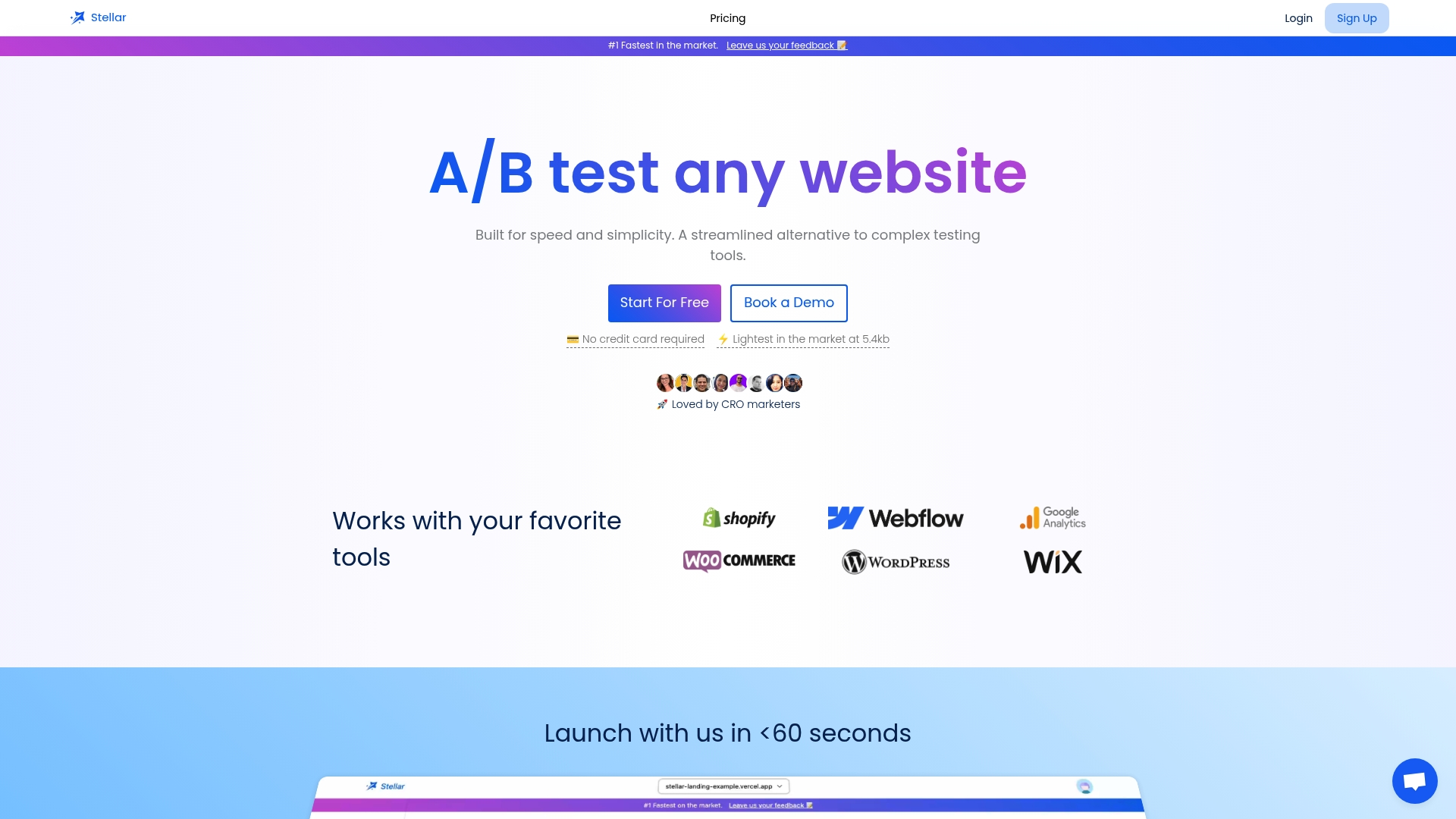
That speed matters most on checkout and PDP experiments, the exact tests this article recommends running first: write the hypothesis, launch the variant same-day, and read results in a real-time dashboard instead of waiting on a weekly report. Stores under 25,000 monthly tracked users can start on a free Sandbox plan, with paid tiers unlocking higher traffic limits and advanced goal tracking as testing volume grows. Check current plans and start a test on Gostellar to see how quickly a checkout or speed experiment can go live.
Sources
Baymard's checkout research and usability benchmark remain the deepest public data sets on cart abandonment causes and form design. Think With Google's speed studies quantify exactly how load time translates into lost conversions. Shopify's ecommerce marketing guide offers a practical lifecycle marketing framework worth revisiting each quarter.
- Ecommerce checkout usability report and benchmark (Baymard)
- Milliseconds make millions (Think With Google)
- Ecommerce marketing (Shopify)
FAQ
How does ecommerce increase sales most reliably?
The most reliable path combines conversion fixes (checkout, speed, PDPs), retention through lifecycle email, and AOV tactics like bundling, before scaling paid acquisition. Baymard's research shows checkout friction alone accounts for a large share of lost revenue that's fixable without any new ad spend.
Where are ecommerce sales growing fastest?
Mobile commerce is the fastest-growing segment of overall ecommerce, according to U.S. Census Bureau retail data, which is why mobile speed and mobile-specific checkout testing deserve dedicated attention rather than being folded into general site metrics.
How can ecommerce increase a business's revenue fastest?
Revenue grows fastest when you fix the highest-friction points in your existing traffic before spending more to acquire new visitors. A checkout audit, a mobile speed budget, and one or two lifecycle email flows typically produce faster, cheaper gains than a new acquisition channel.
How do I increase retention on my ecommerce store?
Deploy the core lifecycle flows: welcome series, cart recovery, post-purchase cross-sell, review requests, and win-back sequences, segmented by recency, frequency, and value rather than blasted to your whole list. Measure success by repeat purchase rate and cohort lifetime value, not open rates alone.
What's the fastest way to start testing checkout changes?
Audit your checkout for extra fields and hidden costs first, since those two issues drive the majority of avoidable abandonment. A no-code testing tool like Gostellar lets you launch a checkout variant without a developer, which shortens the time between diagnosing a problem and measuring whether the fix actually worked.
Recommended
Published: 9/22/2026