
350–1,000 Conversions: How SMBs Decide When to A/B Test
A/B testing is worth running when you can push roughly 350 to 1,000 conversions through each variant in a reasonable window. If your traffic won't get you there, formal split testing will waste time and mislead you more than it helps. Ship the change instead, or use faster qualitative signals. The rest of this guide breaks down exactly how to tell which camp you're in, and what to do next, either way.
TL;DR:
- A/B testing provides reliable results only when each variant receives at least 350 to 1,000 conversions, making it impractical for low-traffic sites to wait for significance.
- For low-traffic situations, adaptive allocation or qualitative research methods like user interviews and heatmaps deliver faster insights than fixed-horizon A/B tests.
- Common testing mistakes include peeking early, underpowered hypotheses, and ignoring seasonality, all of which can lead to false positives and unreliable outcomes.
- Small teams should focus on reversible, low-stakes changes with strong qualitative evidence and reserve formal A/B tests for high-impact, hard-to-reverse decisions.
- Automated, no-code testing platforms with lightweight scripts enable SMBs to run experiments without developers, provided the traffic volume justifies the sample size.
Table of Contents
- What Is A/B Testing, and How Is It Different From Other Experiment Types?
- Is A/B Testing Worth It for Your Business? A Quick Framework
- How to Design an A/B Test That Actually Holds Up
- What Should You Do Instead When Traffic Is Too Low?
- What A/B Testing Mistakes Cost You the Most?
- Your Quick-Start Checklist for Running a First Experiment
- Why Conviction and Testing Aren't Actually in Conflict
- Ready to Run Your First Test With Gostellar?
- Sources
- FAQ
What Is A/B Testing, and How Is It Different From Other Experiment Types?
A/B testing (also called split testing) splits your traffic between two versions of a page, email, or flow, usually a control and one variant, and measures which one performs better against a specific goal. That's the whole idea. One headline against another. One checkout button color against another. One subject line against another.
It's often confused with multivariate testing, which changes several elements at once and measures interactions between them, like testing headline and image together. Multivariate testing needs far more traffic to reach significance, which makes it a poor fit for most SMBs. Continuous optimization and bandit algorithms are a third category entirely: instead of splitting traffic 50/50 for a fixed period, they shift traffic toward the better-performing variant as data comes in.
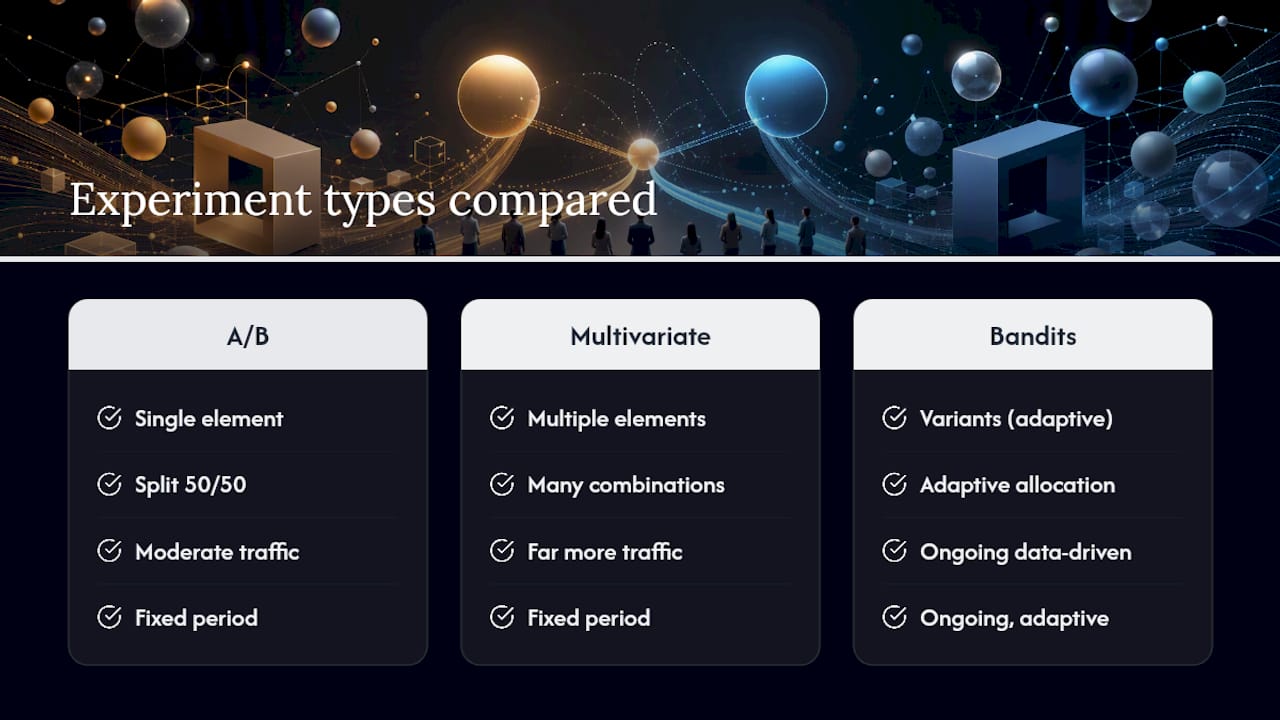
Marketing teams typically run A/B tests on email subject lines, landing page headlines and hero images, product page layouts, and checkout flows. Anywhere a single, isolated change can move a single, measurable number is fair game.
Is A/B Testing Worth It for Your Business? A Quick Framework
The honest answer depends on two things: how much traffic hits the page you want to test, and how much is riding on the outcome. Shopify's A/B testing guide recommends running tests long enough to cover a full business cycle and reaching a sample large enough that statistical significance, typically a 95% confidence threshold, means something.
As a working rule, aim for around 350 conversions per variant if you just need a directional read, and 1,000 or more per variant before you trust the result enough to roll it out permanently. Below that, noise swamps signal. FastStrat's research on small-business testing points out that most SMBs simply don't have the traffic to hit these numbers on a fixed timeline, which is exactly why so many small-team tests produce contradictory or inconclusive results.
Here's a simple checklist to decide test versus ship:
- Ship it if the change is reversible, low-risk, and backed by strong qualitative evidence, like five separate user interviews saying the same thing.
- Test it if the change is high-impact (pricing, checkout flow, core value proposition) and you have enough traffic to reach a real sample size within a few weeks.
- Test it if the change is hard to reverse, like a redesign or a new pricing tier, where a wrong guess is expensive.
- Skip testing entirely if your traffic can't clear 350 conversions per variant in a month. Use the alternatives below instead.
If you land in "test it," treat the design of that test as seriously as the decision to run one.
How to Design an A/B Test That Actually Holds Up
A test is only as good as its hypothesis. A weak hypothesis like "let's try a different color" produces weak, unreliable data.
Pick one primary metric before launch, and treat everything else as secondary; for practical guidance, see our conversion rate optimization tips to design effective tests. For ecommerce, revenue per visitor (RPV) often matters more than conversion rate alone, since a test can lift conversions while quietly lowering average order value.
Here's the practical sequence:
- Write the hypothesis with a metric, a direction, and a reason.
- Estimate your minimum detectable effect (MDE), the smallest lift worth caring about, and size your sample against it.
- Set your sample size and duration up front, and don't touch them mid-test.
- Run a full business cycle, at least one full week, ideally two, to smooth out day-of-week effects.
- Analyze once, at the pre-set endpoint, not every morning over coffee.
DRIP's experiment database found that only 36.3% of ecommerce tests produce a statistically significant winner, with a median test length of 42 days and a median conversion uplift of just 1.88% when tests do win. Those aren't discouraging numbers, they're realistic ones, and they should shape how much certainty you expect from any single test.
Pro Tip: Run an A/A test once a quarter, splitting traffic between two identical pages. If it shows a "winner," your tracking or sample size math has a problem worth fixing before you trust any real test.
What Should You Do Instead When Traffic Is Too Low?
Fixed-horizon A/B tests need a set sample size decided in advance, and low-traffic sites rarely gather one fast enough to matter. Eevy's research on low-traffic testing makes the case for adaptive allocation, better known as multi-armed bandit testing, which shifts traffic toward the winning variant continuously instead of waiting for a fixed endpoint. You learn faster and expose fewer visitors to the losing option, though you sacrifice some of the statistical cleanliness of a traditional test.
Qualitative methods fill the gap even better for very early-stage sites:
- Five-second tests reveal whether visitors understand your offer at a glance.
- Session recordings show exactly where people hesitate or abandon a flow.
- User interviews, even five of them, often surface the same friction point that a hundred data points would take weeks to confirm.
- Heatmaps flag which parts of a page get ignored entirely.
The practical sequence for a low-traffic team: validate with qualitative research first, ship the reversible fixes that research clearly supports, then graduate to formal tests once traffic and stakes justify the wait.
What A/B Testing Mistakes Cost You the Most?
Most bad test results trace back to a handful of repeat offenders:
- Peeking early and stopping when you like the number. Checking results daily and stopping the moment a variant looks ahead inflates false positives dramatically, which is why FastStrat recommends pre-registering your sample size before launch and sticking to it.
- Underpowered tests with weak hypotheses. Testing button shades because someone had a hunch wastes your traffic budget on a change too small to matter.
- Letting seasonality or a promotion bleed into the window. A Black Friday sale in the middle of your test window will hand you a "winner" that has nothing to do with your actual change.
- Overtesting trivial changes while ignoring direct customer feedback that already answered the question for free.
Pro Tip: Before launching any test, write down the exact date and sample size you'll stop at. Tape it somewhere visible. That single habit fixes most peeking problems on its own.
Your Quick-Start Checklist for Running a First Experiment
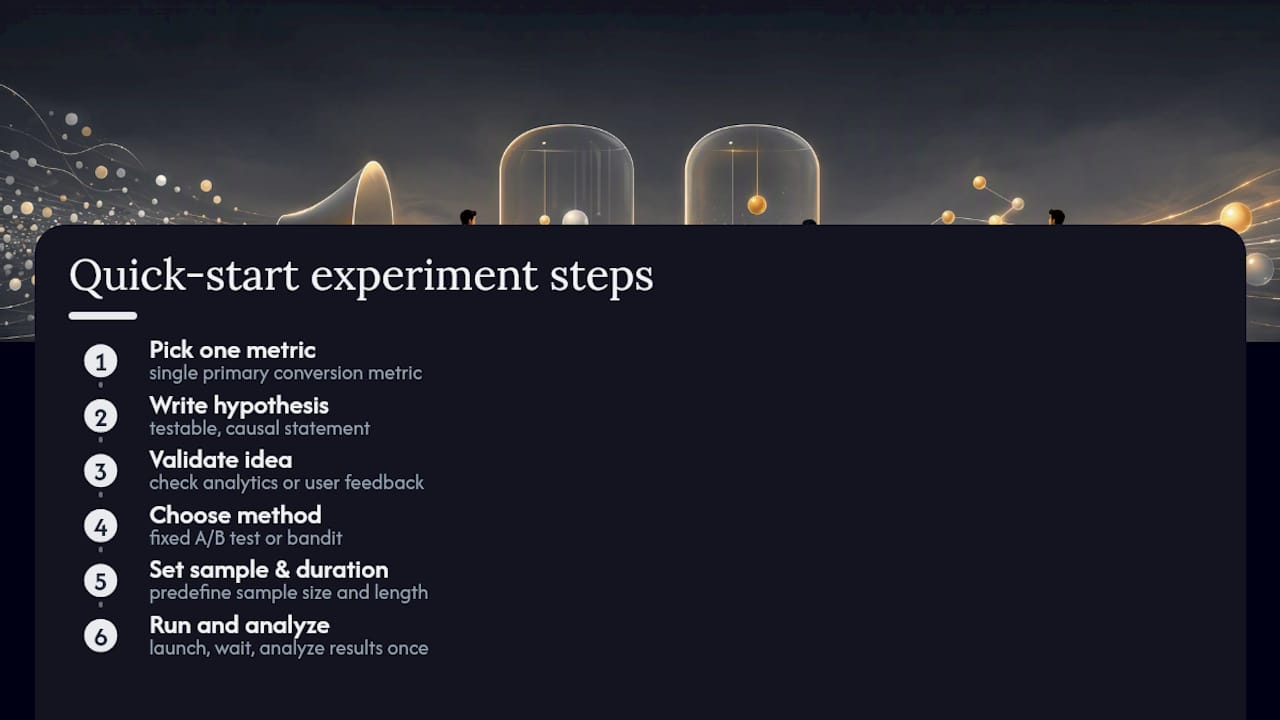
Getting from idea to reliable result comes down to six steps: pick one metric, write a testable hypothesis, validate it against existing analytics or user feedback, choose your method (fixed test or bandit), set your sample size and duration before launch, then run it and analyze once at the end. Starting with a landing page headline test is usually the fastest way to see the whole process work end to end.
Implementation details matter more than teams expect. A heavy testing script slows page load, which can quietly tank the exact conversion rate you're trying to improve. The platform runs on a lightweight script, pairs with a no-code visual editor for setup, and includes dynamic keyword insertion and goal tracking, with a free plan available for businesses below a certain usage threshold. For more test ideas once you've got the basics running, this list of high-impact landing page tests is a solid next stop.
Why Conviction and Testing Aren't Actually in Conflict
Small teams don't need to choose between moving fast and testing rigorously. Ship the reversible, low-stakes calls on conviction. Save formal tests for the changes where being wrong is expensive, and let your testing discipline grow as your traffic does.
— Juan
Ready to Run Your First Test With Gostellar?
Most SMB teams lose weeks to testing tools that slow down their site or require a developer just to launch a variant. The platform reduces friction with a lightweight script, a no-code visual editor for building variants, and goal tracking that shows results in real time rather than delayed exports. If your monthly tracked users are below a certain threshold, a free plan is available to help get your first experiments running.
Start with something small and reversible, like a headline or CTA test, and let the data confirm what your gut is already telling you. Create your free Gostellar account and launch your first test today.
Sources
- How to run A/B tests that move the needle | Shopify
- A/B Testing Statistics 2026: Win Rates, Uplift & ROI Benchmarks | DRIP
- A/B Testing for Small Business: When It Is Worth It | FastStrat
FAQ
What sample size do I need for a valid A/B test?
Aim for at least 350 conversions per variant for a directional signal, and 1,000 or more per variant before treating a result as reliable enough to roll out permanently.
Is A/B testing worth it for a low-traffic website?
Not usually in its fixed-horizon form. Adaptive allocation, bandit approaches, or qualitative methods like session recordings and user interviews typically produce faster, more trustworthy signals when traffic is thin.
How long should an A/B test run?
Run it for at least one full business cycle, ideally two weeks, and set the sample size and stop date before launch rather than checking results daily and stopping early.
What's the difference between A/B testing and multivariate testing?
A/B testing compares two full versions of one page or element, while multivariate testing changes several elements at once and measures how they interact, which requires much more traffic to reach significance.
Can I run A/B tests without a developer?
Yes. Platforms like Gostellar use a no-code visual editor, so marketers can build and launch variants themselves without pulling engineering time.
Recommended
Published: 9/10/2026