
7 Key Performance Indicators 2025 for A/B Testing Success
Running A/B tests without a clear strategy often leaves you wondering why your results don’t translate into real business growth. Testing random elements or broad user groups can waste precious time and resources, delivering inconsistent or confusing outcomes. If you want real improvements, you need a smarter, more focused approach that digs beneath the surface to find what truly influences user behavior.
By applying key methods like audience segmentation, real-time goal tracking, and targeted metric analysis, you can turn scattered experiments into a powerful engine for growth. Every technique in this guide is chosen for its ability to help you optimize every critical step, from reducing bounce rates to unlocking deeper insights about your users. You’re about to discover actionable strategies that reveal exactly what’s working and what needs to change—giving you the tools to move from guesswork to reliable, data-driven wins.
Table of Contents
- Conversion Rate Optimization For Targeted Experiments
- Lift Metric Analysis To Measure Impact
- User Segmentation For Deeper Insights
- Goal Completion Tracking In Real Time
- Engagement Rate Monitoring Across Variants
- Bounce Rate Reduction Strategies
- Personalized Landing Page Performance KPIs
Quick Summary
| Takeaway | Explanation |
|---|---|
| 1. Focus on Targeted Experiments | Tailor A/B tests to user segments to enhance ROI by aligning tests with specific user behaviors and needs. |
| 2. Calculate Lift Accurately | Use lift to measure conversion improvement percentage; ensure statistical significance before applying changes broadly. |
| 3. Segment for Deeper Insights | Analyze user behavior across segments to identify unique responses, allowing for tailored optimization strategies. |
| 4. Track Goals in Real Time | Monitor A/B test outcomes instantly to make agile decisions and maximize successful variation implementation. |
| 5. Optimize Engagement Metrics | Measure user interaction alongside conversions to ensure changes foster deeper connections and long-term value. |
1. Conversion Rate Optimization for Targeted Experiments
Conversion Rate Optimization for targeted experiments means focusing your A/B tests on specific user segments and tailoring variations to match their behaviors and needs. Instead of running broad tests that apply to everyone, you zero in on the audiences that matter most to your business goals. This approach dramatically improves both the efficiency of your experiments and the return on investment you get from them.
The power of targeted CRO lies in precision. When you segment your audience and deploy experiments designed for specific groups, you're not wasting resources testing generic changes that might work for some users but fail for others. Research shows that advanced methods include using segmentation, personalization, and behavioral analytics to optimize results while minimizing resource expenditure. For example, if you're an e-commerce business, your mobile users might respond differently to checkout changes than desktop users. Your cart abandoners might need different messaging than first-time visitors. By running targeted experiments, you discover these nuances and act on them. This granular approach means your test results actually translate into real revenue improvements, not just vanity metrics.
Implementing targeted CRO requires you to think differently about your experiments. Start by identifying your highest-impact user segments using your analytics data. Which groups generate the most revenue? Which have the highest abandonment rates? Which are easiest to convert? Once you've pinpointed these segments, design your A/B test variations specifically for them. Test different call-to-action wording for new users versus returning customers. Try different value propositions for users arriving from paid ads versus organic search. Document what works for each segment, then scale those wins. The beauty of this approach is that quantitative data analysis and iterative testing reveal exactly where your biggest opportunities lie, turning your experiments into a continuous feedback loop that compounds over time.
Pro tip: Start with your lowest-converting segments first, not your best performers. A small improvement in converting high-traffic, low-conversion groups often delivers faster ROI than optimizing segments that already perform well.
2. Lift Metric Analysis to Measure Impact
Lift is the percentage increase in your conversion rate that results directly from your A/B test variant compared to your control. If your baseline converts at 2 percent and your test variation converts at 2.4 percent, you have achieved a 20 percent lift. This single metric cuts through the noise and shows you exactly how much better your experiment performed, making it one of the most valuable KPIs for evaluating whether your tests actually moved the needle.
Why does lift matter so much? Because it answers the question every marketer cares about: Did this change work? Raw conversion numbers don't tell the full story. One hundred conversions might sound great, but if that's only a 0.5 percent improvement over your control, it probably isn't statistically significant. Lift gives you the relative impact, which is what determines whether you should roll out a winning variation to your entire audience. Understanding conversion metric benchmarks helps you contextualize your lift results within your industry and competitive landscape. A 15 percent lift might be exceptional for one business but underwhelming for another, depending on your current performance baseline and market conditions.
To use lift effectively, you need to calculate it correctly and understand the statistical confidence behind it. The basic formula is simple: (Variant Conversion Rate minus Control Conversion Rate) divided by Control Conversion Rate, then multiplied by 100 to get a percentage. But the real power comes from knowing whether your lift is statistically significant or just random variation. Run your tests long enough to gather sufficient data, ideally reaching at least 100 conversions in each variation. Track lift alongside your sample size and confidence interval. A 25 percent lift with 95 percent statistical confidence means you can confidently roll it out. That same 25 percent lift with only 50 percent confidence means you need more data before making decisions. Many growth hackers at small to medium businesses jump to conclusions too quickly. Patience with your data prevents costly mistakes that waste resources on changes that don't actually improve results.
Pro tip: Always report lift as a percentage increase, not absolute percentage point change, since it reveals the true magnitude of improvement and makes it easier to compare performance across different experiments and time periods.
3. User Segmentation for Deeper Insights
User segmentation splits your audience into smaller groups based on demographics, behavior, location, or purchase history so you can understand how different types of users respond to your experiments. Instead of treating all visitors the same, you recognize that a first-time visitor behaves completely differently than someone who has purchased five times from you. By analyzing performance across these distinct segments, you uncover insights that blanket A/B tests simply cannot reveal.
The real value of segmentation lies in discovering heterogeneous responses. Different user groups often react completely differently to the same change. A discount offer might drive conversions for price-sensitive visitors but alienate your premium customers who value exclusivity. Longer form content might engage your professional audience while driving away casual browsers. When you identify performance variations across different user groups, you stop making one-size-fits-all decisions and start tailoring interventions that actually match what each segment needs. This is where personalization becomes powerful. Your test might show a 5 percent overall lift, but when you segment the data, you discover that mobile users experienced 18 percent lift while desktop users saw only 2 percent lift. That insight changes everything about how you allocate your optimization efforts moving forward.
Implementing segmentation requires you to think strategically about which segments matter most to your business goals. Start with behavioral segments: new users versus returning users, free plan users versus paying customers, high engagement versus low engagement. Then layer in demographic or source data if you have it. Mobile versus desktop is almost always worthwhile. When you run your A/B tests, make sure your testing platform captures these segment identifiers so you can slice the data afterward. Look for segments where the winning variation performed exceptionally well and segments where it underperformed. Run follow-up tests specifically targeting underperforming segments with variations designed for them. This iterative approach compounds your learnings and prevents you from making changes that work for most people but harm a valuable minority segment.
Pro tip: Create a minimum sample size threshold for each segment before trusting the results, typically at least 50 conversions per segment, to avoid making decisions based on noise rather than real patterns.
4. Goal Completion Tracking in Real Time
Real-time goal completion tracking means monitoring your A/B test performance as it happens, not waiting days or weeks for data to accumulate. You set predefined business goals like email signups, demo requests, or product purchases, then watch your dashboard update continuously to show which test variation is driving more conversions toward those goals. This instant visibility transforms how quickly you can make decisions and capitalize on winning changes.
The power of real-time tracking lies in speed and alignment. Traditional testing approaches leave you blind for days while data collects. By the time you have enough information to act, your opportunity window may have closed or market conditions shifted. Real-time dashboards eliminate this lag. When you see one variation significantly outperforming another after just a few hundred conversions, you can pause the underperforming variation and redirect traffic to the winner, maximizing your test returns. Beyond just faster decisions, real-time goal tracking helps teams stay aligned with their targets and adjust strategies promptly. Everyone on your marketing team, product team, and leadership sees the same numbers at the same time, preventing arguments about what the data actually showed. Your sales team understands why you are making a change because they watched it improve lead quality in real time. This transparency builds trust and momentum around your experimentation culture.
Implementing effective real-time tracking requires clarity about which goals matter most. Don't track everything. Pick three to five key goals that directly connect to your revenue or core business metrics. For an e-commerce site, this might be add-to-cart actions, completed purchases, and email newsletter signups. For a SaaS company, it could be free trial signups, demo requests, and account activations. Set up your testing platform to capture these events and feed them into a dashboard you check regularly. Configure alerts so you get notified when a variation reaches statistical significance or when performance drops suddenly. The key is building a feedback loop where you are constantly monitoring, learning, and iterating. Weekly A/B test reviews become daily reviews when you have real-time data available. This accelerates your learning velocity and compounds your competitive advantages over time.
Pro tip: Monitor your goal completion rate alongside raw conversion count, as a variation might increase traffic but decrease the quality of conversions, ultimately harming your bottom line if you only watch numbers.
5. Engagement Rate Monitoring Across Variants
Engagement rate monitoring tracks how actively users interact with each version of your A/B test, measuring clicks, time spent on page, scroll depth, video plays, and other behavioral signals. While conversion is your ultimate goal, engagement tells you whether users are actually connecting with your content and finding value in it. Two variations might have similar conversion rates, but one could have dramatically higher engagement, indicating it creates a better user experience that will pay dividends in retention and lifetime value.
Why does engagement matter alongside conversions? Because it reveals the full story of what your test variants are doing. A landing page variation might drive more immediate conversions by using aggressive language, but if users spend 30 seconds on the page and never return, you have won a battle while losing the war. Conversely, another variation might have slightly lower immediate conversions but users spend 5 minutes engaging with your content, asking questions in the chat, watching your product video, and viewing multiple pages. That second variation is building a relationship. When you monitor interaction levels across different test versions, you stop optimizing solely for one-time transactions and start optimizing for user satisfaction and long-term value. This nuanced approach prevents you from implementing changes that feel like hollow wins.
To implement effective engagement monitoring, identify the specific engagement metrics that matter for your business. For a blog or content site, measure time on page and pages per session. For a SaaS platform, track feature adoption and action frequency. For an e-commerce site, monitor product page views and wish list additions. Set up your testing platform to capture these events alongside your conversion goals. Create dashboards that show engagement metrics side by side with your conversion rates so you can see the full picture. When analyzing test results, flag any variations that increase conversions but decrease engagement, or vice versa. These contradictions deserve investigation. Maybe the high-conversion variant is attracting the wrong audience. Maybe the high-engagement variant just needs a better call-to-action button. The goal is continuous refinement where iterative improvement enables you to enhance digital touchpoints across all dimensions of user experience.
Pro tip: Calculate engagement as a ratio to conversions rather than in isolation, so a variation driving 1000 conversions with 50000 total interactions is directly comparable to a variation with 800 conversions and 30000 interactions.
6. Bounce Rate Reduction Strategies
Bounce rate measures the percentage of visitors who leave your page without taking any action or visiting another page. A high bounce rate signals that your page is failing to engage visitors or meet their expectations. When you run A/B tests focused on reducing bounce rates, you're addressing a fundamental problem that affects everything downstream from visitor engagement to conversions. Even small improvements in bounce rate compound into significant revenue gains because you're keeping more people in your funnel.
The key to effective bounce rate reduction is understanding why people are leaving. Visitors bounce because your page loads slowly, the content doesn't match what they expected from the ad or search result, the design looks unprofessional, or your call-to-action is unclear. Research shows that bounce rate reductions are linked to improved test variant performance and better customer retention. This means every bounce rate improvement you achieve through testing directly correlates with better business outcomes. The challenge is identifying which elements are actually causing bounces in your specific situation. You might assume it's the headline, but testing reveals it's actually the loading speed or lack of social proof. This is why segmentation matters so much for bounce rate optimization. Mobile visitors bounce differently than desktop visitors. Visitors from paid ads have different expectations than organic search visitors. By testing variations targeted at high-bounce segments, you can make dramatic improvements rather than marginal tweaks.
Implementing effective bounce rate reduction strategies requires you to test specific friction points. Start by testing your page headline against alternatives that better match visitor intent. Test different value propositions and social proof elements. Most importantly, test landing page speed improvements because slow-loading pages are one of the biggest bounce drivers. Each test should measure not just conversions but specifically bounce rate as a primary metric. When you find a winning variation that reduces bounces while maintaining or improving conversion rate, that's gold. You have created a page that both attracts and converts. Document which elements made the difference so you can apply those learnings to your other landing pages. This systematic approach turns bounce rate from a depressing metric into an opportunity for continuous improvement.
Pro tip: Test one variable at a time to reduce bounce rate, starting with the element most visitors encounter first, since early friction points have the biggest impact on whether visitors stay or leave.
7. Personalized Landing Page Performance KPIs
Personalized landing pages deliver different content, offers, and messaging to different visitor segments based on their characteristics, behavior, or source. Measuring the performance of these personalized experiences requires a different set of KPIs than generic landing pages because you need to track how well each variation resonates with its specific audience segment. Rather than one conversion rate for everyone, you monitor conversion rates for each personalized experience, allowing you to understand which messages work best for which audiences.
The power of personalized landing page KPIs lies in their ability to reveal what actually drives results for each segment. A generic landing page might show a 3 percent conversion rate, masking the fact that new users convert at 1 percent while returning customers convert at 8 percent. When you measure personalized landing pages, you discover these hidden patterns and can optimize each experience independently. The key performance indicators for personalized landing pages include conversion rates, engagement levels, and bounce rates segmented by user demographics and behavior. This segmented approach means you stop making one-size-fits-all optimizations and start making targeted improvements that maximize results for each audience group. Someone arriving from a social media ad needs different messaging than someone arriving from a Google search. Someone on mobile needs a different layout than someone on desktop. By tracking these KPIs separately, you ensure your personalizations are actually working and not just adding complexity.
Implementing effective personalized landing page KPIs requires you to establish clear baseline metrics for each segment before you start testing. Document the current conversion rate, bounce rate, and average session duration for each major visitor segment. Then create personalized variations and measure whether they improve those metrics compared to the baseline. When testing effective landing page designs that drive conversions, remember that success looks different across segments. A variation that increases conversion by 12 percent for enterprise prospects but decreases it by 5 percent for small business prospects is not a winner. You need to report results by segment so leadership understands the nuanced impact of your personalizations. Over time, build a playbook of winning elements for each segment. You'll discover that certain headlines, images, or offers consistently outperform for specific audiences. This accumulated knowledge becomes your competitive advantage because you're continuously optimizing based on real behavior rather than guesses.
Pro tip: Calculate lift within each segment rather than overall lift, so you can identify which personalization variations are truly effective for their intended audience and avoid diluting results across groups.
Below is a comprehensive table summarizing the main concepts, strategies, and insights discussed in the article about Conversion Rate Optimization (CRO) and related metrics.
| Concept/Strategy | Description | Benefits |
|---|---|---|
| Targeted Conversion Rate Optimization | Focuses on segment-specific A/B testing based on user behaviors and needs to enhance experiment efficiency and outcomes. | Tailored approaches drive relevant optimizations, leading to effective resource usage and improved ROI. |
| Lift Metric Analysis | Evaluates the percentage improvement in conversion rates achieved by a test variant over the control group. | Offers a clear measure of experiment success, aiding decision-making for rollout adoption. |
| User Segmentation Insights | Analyzes performance differences among user groups based on demographics, behavior, and preferences. | Unveils hidden trends, enabling targeted improvements for varied audience needs. |
| Real-Time Goal Tracking | Enables immediate observation of A/B test performance against predefined objectives for on-the-spot adjustments. | Provides fast, actionable data for optimizing test strategies promptly, ensuring alignment with business goals. |
| Engagement Rate Monitoring | Evaluates user interactions with test variants, focusing on metrics like time spent, click-through rates, and page interactions. | Facilitates comprehensive understanding of user experiences, leading to better long-term user engagement. |
| Bounce Rate Reduction Strategies | Identifies and mitigates elements causing high visitor drop rates during the initial page interaction. | Improves overall visitor retention, directly enhancing subsequent user engagement and conversions. |
| Personalized Landing Page KPIs | Measures metrics for customized pages tailored to specific audience segments, revealing individual responsiveness. | Enhances the insights into particular user groups, promoting efficient, personalized user experiences. |
Unlock Your A/B Testing Potential with Stellar
The article highlights key challenges such as targeted experiments, real-time goal tracking, and personalized landing page KPIs that marketers and growth hackers face in optimizing conversion rates and engagement. You need a solution that simplifies these complex concepts while giving you actionable insights and confidence to make fast data-driven decisions. If you struggle with slowing down your site or complicated platforms that demand technical skills, you are not alone. Effectively reducing bounce rates, monitoring lift metrics, and leveraging user segmentation without headache is crucial for small to medium-sized businesses aiming for rapid growth.
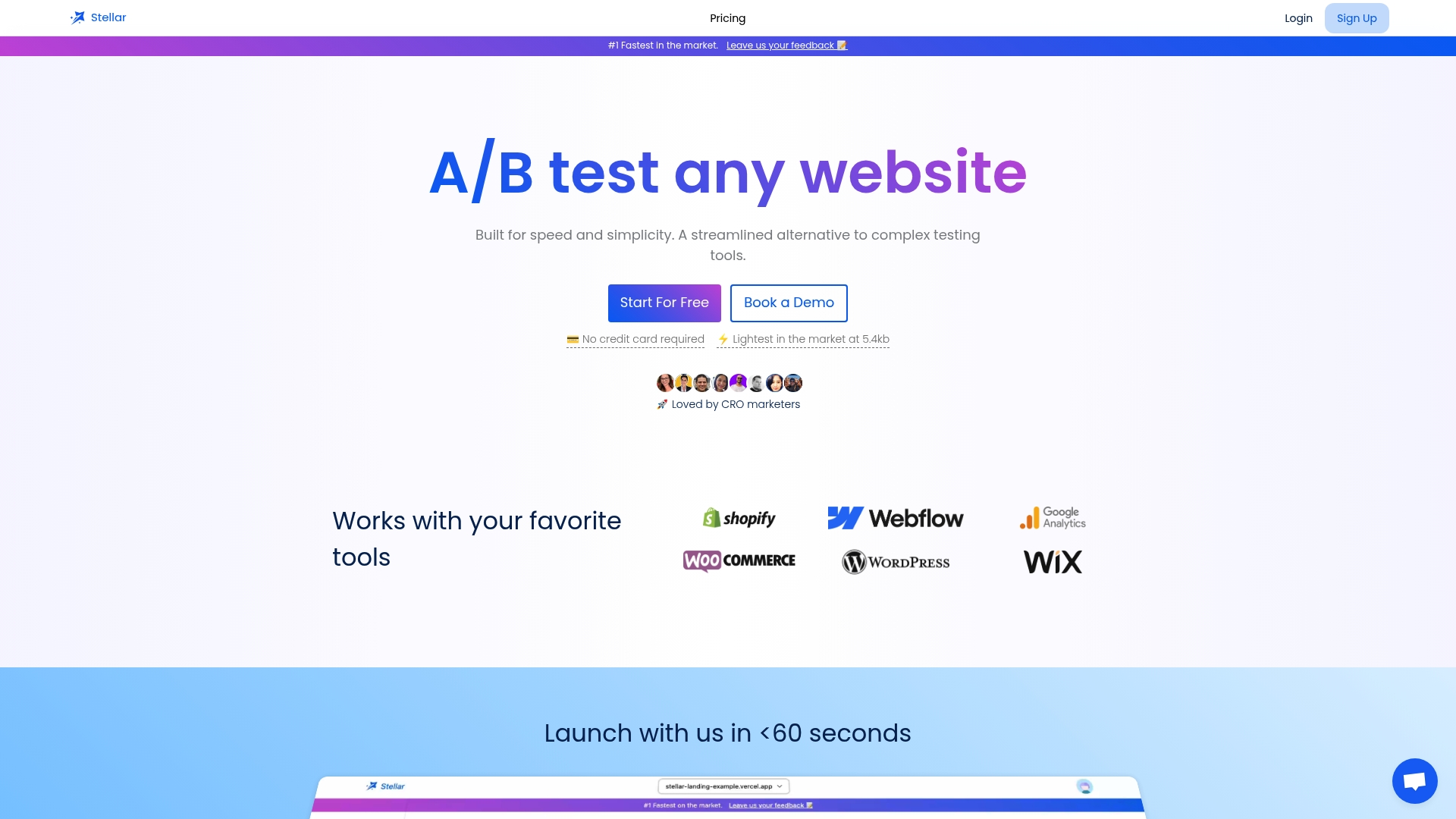
Discover how Stellar, the fastest A/B testing platform, empowers you with a lightweight script, a no-code visual editor, and advanced goal tracking designed precisely for marketers like you. Experience dynamic keyword insertion that makes personalization effortless and real-time analytics for instant feedback on your experiments. Start optimizing your campaigns today and see measurable uplifts across your targeted segments. Take control of your A/B testing success now by visiting our landing page to claim your free plan and begin turning KPIs into real growth.
Frequently Asked Questions
What are the key performance indicators to focus on for A/B testing in 2025?
The key performance indicators for A/B testing in 2025 include lift metrics, engagement rates, bounce rates, and personalized landing page performance. Monitor these indicators to understand how different segments respond to your tests and to continuously improve results.
How can I measure lift in my A/B testing?
Lift can be measured by calculating the percentage increase in conversion rate between your test variant and the control. Use the formula: (Variant Conversion Rate - Control Conversion Rate) / Control Conversion Rate x 100 to quantify the impact of your changes.
What should I do if my A/B test results show significant bounce rates?
If you see high bounce rates, investigate factors such as page loading speed, content relevancy, and design quality. Optimize these elements, focusing on those that are most likely to resonate with your target audience to reduce bounce rates effectively.
How can I effectively segment users for A/B testing?
To segment users effectively, analyze demographics, behavior, and engagement levels to create meaningful groups. Start by identifying high-impact segments that could benefit from tailored messaging or content changes in your tests.
Why is real-time goal tracking important during A/B testing?
Real-time goal tracking allows you to monitor your A/B test performance as it happens, enabling quicker decisions based on data. Set up a dashboard to view conversion rates continuously and adjust strategies promptly based on initial results.
How can I improve engagement rates alongside conversion rates in A/B testing?
To improve engagement rates, focus on the quality of your content and user experience. Measure user interactions like time spent on the page and adjust your A/B test variations to prioritize user satisfaction, potentially increasing both engagement and conversions.
Recommended
Published: 1/25/2026