
Marketing Funnel Optimization for Higher Conversions
Every growth-focused team knows the sting of a marketing funnel that leaks potential customers at critical steps. Uncovering these silent bottlenecks with smart analytics is a game changer for small businesses aiming to optimize conversion rates. With a combination of advanced funnel analysis, measurable KPIs, and methodical A/B testing, you can target and fix friction points using data-driven strategies that work. Efficient A/B testing for funnel optimization will help you prioritize impactful changes and refine your approach, moving more visitors smoothly toward conversion.
Table of Contents
- Step 1: Identify Funnel Bottlenecks Using Analytics
- Step 2: Set Measurable Goals With Advanced Tracking
- Step 3: Implement A/B Tests For Critical Funnel Stages
- Step 4: Personalize Landing Pages With Dynamic Keywords
- Step 5: Analyze Real-Time Results And Refine Strategies
Quick Summary
| Key Message | Explanation |
|---|---|
| 1. Identify Funnel Bottlenecks | Analyze user journey data to find where users drop off, focusing optimization efforts on major bottlenecks for maximum impact. |
| 2. Set Measurable Goals | Define success for each funnel stage and establish specific, trackable goals to guide your conversion optimization strategy. |
| 3. Implement A/B Testing | Run systematic A/B tests at critical stages of your funnel to validate assumptions and identify what enhances conversions. |
| 4. Personalize Landing Pages | Use dynamic keyword insertion to tailor landing page content to match search intent, improving user experience and conversion rates. |
| 5. Analyze Real-Time Results | Monitor metrics in real-time to quickly identify and address any drop in performance, refining strategies based on data insights. |
Step 1: Identify funnel bottlenecks using analytics
Funnel bottlenecks are the silent revenue killers in your conversion path. They're the steps where users stop moving forward, creating friction that prevents them from completing your desired action. By identifying these specific problem areas, you can focus your optimization efforts where they'll have the biggest impact on your bottom line.
Start by examining your complete user journey data. Look at each stage of your funnel and calculate the drop-off rate between consecutive steps. If your funnel goes from landing page to product page to checkout to confirmation, measure how many users move from landing to product, then product to checkout, and so on. The stage with the largest percentage drop is typically your primary bottleneck. Use funnel event analysis methods to pinpoint exactly where users abandon their journey.
Dig deeper by segmenting your audience. A bottleneck affecting 30% of mobile users might not appear significant when averaged across all traffic, but it's actually a critical issue for that segment. Break down your funnel data by device type, traffic source, geographic location, and user type. You'll often discover that certain groups experience dramatically different drop-off rates at specific steps. A mobile user might struggle with your checkout form while desktop users breeze through it.
Then examine user behavior patterns around the bottleneck point. Did users spend an unusual amount of time on that page before leaving? Did they interact with certain elements more than others? These behavioral signals reveal whether the problem is confusion, technical issues, or simply lack of motivation. Use session recordings or heat mapping data to watch what users actually do versus what you expected them to do.
Combine quantitative metrics with qualitative insights. Your analytics show you where users drop off, but customer feedback explains why. Review support tickets, chat transcripts, and survey responses related to that funnel stage. You'll often find that users tell you exactly what's blocking them.
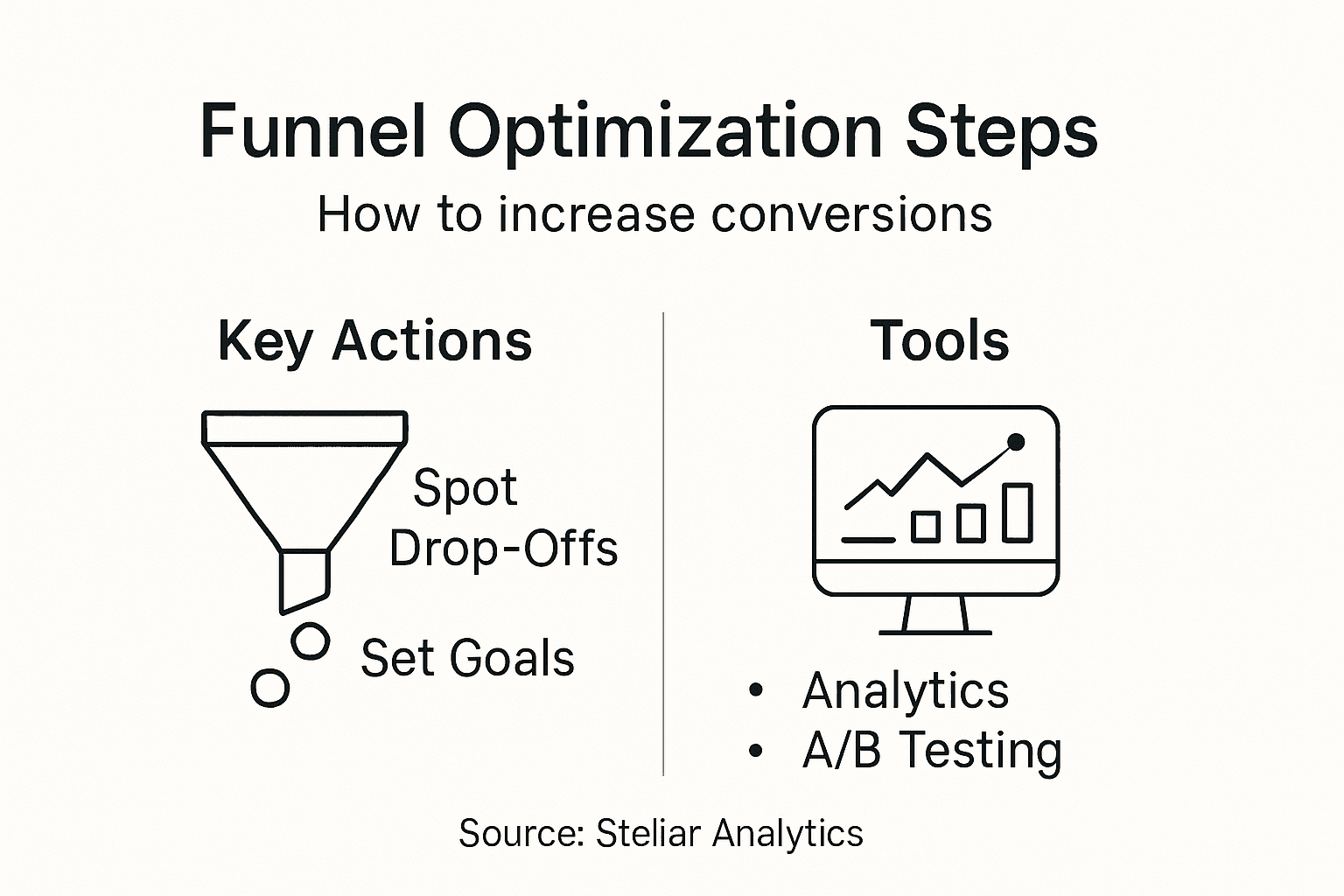
Here's a comparison of common funnel bottleneck signals and the analytics tools best suited to identify them:
| Bottleneck Signal | Sample Metric or Pattern | Best Analytics Tool |
|---|---|---|
| High drop-off at a step | Drop-off rate % | Funnel Analysis |
| Long dwell time, no action | Average time on page spikes | Session Recordings |
| Unexpected exit behavior | Exit rate, rage clicks | Heat Mapping/Click Tracking |
| Segment-specific drop-off | Mobile vs desktop comparison | Segmentation Reports |
| User confusion/frustration | Repeated actions, navigation loops | Session Replay |
Pro tip: Set up custom events for each micro-conversion within your bottleneck stage to pinpoint the exact field, button, or section causing friction, rather than relying on broad page-level metrics.
Step 2: Set measurable goals with advanced tracking
Measurable goals transform your funnel optimization from guesswork into data-driven strategy. Without clear targets, you're flying blind, unable to know whether your changes are actually moving the needle. This step gets you anchored to specific, trackable outcomes that matter to your business.
Start by defining what success looks like at each funnel stage. Success at the awareness stage might be traffic volume or page views. At consideration, it could be engagement metrics like time on page or video completion rates. At the decision stage, you're focused on actual conversions. These marketing KPIs linked to funnel stages give you a clear picture of performance across your entire customer journey. Break down your overarching goal into smaller, stage-specific targets that are realistic for your business and traffic volume.
Next, connect these goals to your tracking infrastructure. Set up conversion tracking for each objective so your analytics tool captures when users complete that action. If your goal is 200 monthly checkouts, your tracking needs to fire every single time someone completes checkout. If it's 50 demo requests, you need to track every demo button click and form submission. The precision here matters tremendously. A loose implementation means you're working with incomplete data.

Establish baseline metrics before you start optimizing. Run your funnel for one full week without changes and document where users currently stand at each stage. This baseline becomes your control group for all future tests. When you make a change and see a 15% increase in conversions, that 15% is only meaningful because you know what the baseline was.
Then assign ownership and review cadence. Who checks these metrics weekly? How often do you review progress against goals? Set a specific day and time for this review so it actually happens. These goals only drive change if someone is actively monitoring them and adjusting your strategy based on what the data reveals.
The table below summarizes key tracking goals for each funnel stage and useful metrics to benchmark success:
| Funnel Stage | Primary Goal | Key Metric Example | Micro-Conversion to Track |
|---|---|---|---|
| Awareness | Brand exposure | Unique visitors | Newsletter signup |
| Consideration | Audience engagement | Time on page, video views | Wishlist add, product compare |
| Decision | Conversion | Purchases, signups | Pricing page viewed |
Pro tip: Track micro-conversions like newsletter signups, wishlist adds, and pricing page visits alongside main conversions to identify early-stage momentum shifts before they impact your bottom-line conversion rates.
Step 3: Implement A/B tests for critical funnel stages
A/B testing transforms your funnel optimization from assumptions into hard evidence. You stop guessing what works and start knowing what actually converts. This step shows you how to run methodical experiments at the stages where they'll have the biggest impact on your bottom line.
Begin by selecting your test variable carefully. The stages with highest drop-off rates are your priority because improvements there affect more users. If your landing page loses 40% of visitors immediately, test that first. Successful experiments focus on one variable at a time. Test your headline in isolation, then your call-to-action button color separately, not both simultaneously. This lets you pinpoint exactly what caused the change in conversions.
Set up your experiment using a framework for A/B testing at critical funnel stages that includes audience segmentation and clear success metrics. Divide your traffic randomly between version A (control) and version B (variant). Random assignment matters because it prevents bias. A user who arrives at 3 PM shouldn't always see the same version as someone arriving at 9 AM. Your testing tool should handle this automatically, ensuring each version gets a fair comparison.
Run your test long enough to gather statistical significance. If you stop after two days because one version looks good, you're likely dealing with random variation, not a real difference. Most experiments need at least one week and ideally 100 to 200 conversions per variation to show meaningful results. Document exactly what you changed and why you thought it might improve conversions.
Once your test concludes, implement the winner and move to the next variable. Not every test produces a winner. Sometimes version A performs slightly better, sometimes version B. Either way, you've learned something valuable about your audience. Keep testing different stages methodically, building momentum through small, validated improvements.
Pro tip: Run your most critical tests during your peak traffic periods to gather statistical significance faster, then validate winners during slower periods before full deployment.
Step 4: Personalize landing pages with dynamic keywords
Personalization at scale used to require building dozens of landing page variations. Dynamic keyword insertion changes that equation entirely. You can now show each visitor content that matches their exact search intent, dramatically improving relevance and conversions without the complexity.
Understand how dynamic keyword insertion works first. When someone searches for "blue running shoes" and clicks your ad, a code snippet automatically inserts that exact phrase into your landing page headline. The visitor sees "Buy Blue Running Shoes Now" instead of a generic "Shop Our Athletic Footwear" message. This relevance triggers psychological alignment. The user thinks you're reading their mind because your page speaks directly to what they searched for.
Set up your keyword insertion variables systematically. Identify the search terms driving traffic to your funnel and group them by intent and category. Create insertion placeholders in your headline, subheading, and primary call-to-action button. If someone searches for "affordable running shoes," your page shows one message. If they search for "premium athletic footwear," they see something completely different. The backend system matches visitor search queries to your keyword groups and populates the page accordingly.
Apply dynamic keyword insertion to personalize user experience and match landing page content to search intent. This strategy reduces bounce rates because visitors immediately see content relevant to their original search. They don't waste time questioning whether they landed on the right page. The relevance feels intentional and earned. Conversion rates improve because the cognitive friction disappears.
Test different keyword groupings and messaging combinations to see which produce the highest conversions. Some keywords cluster together naturally around price sensitivity, others around product features, still others around brand reputation. Your messaging should reflect the underlying motivation behind each group. Visitors searching for budget options need different reassurance than those seeking premium quality.
Monitor performance by keyword group to identify which search intent segments convert best. This reveals where your product delivers the most value and which audiences appreciate your offering most. Use this insight to inform your paid search bidding strategy and content focus.
Pro tip: Create fallback default copy for keywords with insufficient search volume to prevent blank placeholders, and always ensure your fallback message aligns with your broadest audience segment.
Step 5: Analyze real-time results and refine strategies
Real-time analytics separate successful marketers from those stuck guessing. When you can see conversion data as it happens, you spot problems and opportunities within hours, not weeks. This step shows you how to build a monitoring rhythm that keeps your funnel optimized continuously.
Set up a real-time dashboard that displays your core metrics in one place. Your conversion rate, traffic volume, bounce rate by page, and revenue per visitor should all be visible at a glance. The dashboard needs to update frequently enough to catch patterns but not so frequently that you obsess over random fluctuations. Most teams check their metrics during peak traffic hours and once more at day's end. Don't refresh every five minutes, as that leads to false conclusions from incomplete data.
Monitor for unexpected shifts in performance. If your checkout conversion rate suddenly drops 8% compared to yesterday, something changed. It might be a technical issue, a traffic source quality shift, or seasonal variation. Use real-time analytics to identify bottlenecks quickly and investigate the cause before more traffic hits the problem. The sooner you spot friction, the sooner you can remove it.
Create a simple testing calendar that documents what you changed and when you changed it. When conversion rates shift, you need to know whether a specific test caused it or whether external factors are at play. Without this context, you're just watching numbers fluctuate randomly. Include the hypothesis, the change, the date, and preliminary results. This becomes your playbook for what works with your audience.
Refine your strategies based on what the data reveals. If certain traffic sources convert at twice the rate of others, bid more on the high performers and pause the low performers. If mobile users bounce at a specific step, test a mobile-optimized version there. If visitors from a particular geographic region have different behavior patterns, segment your testing accordingly. Real-time data tells you exactly where to focus next.
Pro tip: Set conversion rate alerts that notify you immediately if performance drops below your baseline by more than 5%, allowing you to investigate and respond quickly before losing significant revenue.
Unlock Higher Conversions with Precision A/B Testing and Real-Time Insights
Struggling with funnel bottlenecks and unclear performance metrics? The article highlights the challenge of identifying exact drop-off points and setting measurable funnel goals for smarter marketing decisions. Pain points like complex A/B testing setups and slow data feedback hinder timely funnel optimizations. With Stellar, marketers gain access to the fastest A/B Testing Tool that simplifies experimentation through a no-code visual editor and delivers real-time analytics for continuous improvement. Dynamic keyword insertion personalizes landing pages automatically matching your visitor's intent, reducing friction and boosting conversions.
Say goodbye to guesswork and guess delays. Stellar helps you pinpoint bottlenecks, track advanced goals, and run statistically significant tests with ease. Its lightweight 5.4KB script ensures minimal impact on your website speed while maximizing user experience. Whether you manage traffic in the thousands or tens of thousands, Stellar offers flexible pricing tiers tailored to your needs including a free plan for smaller businesses.
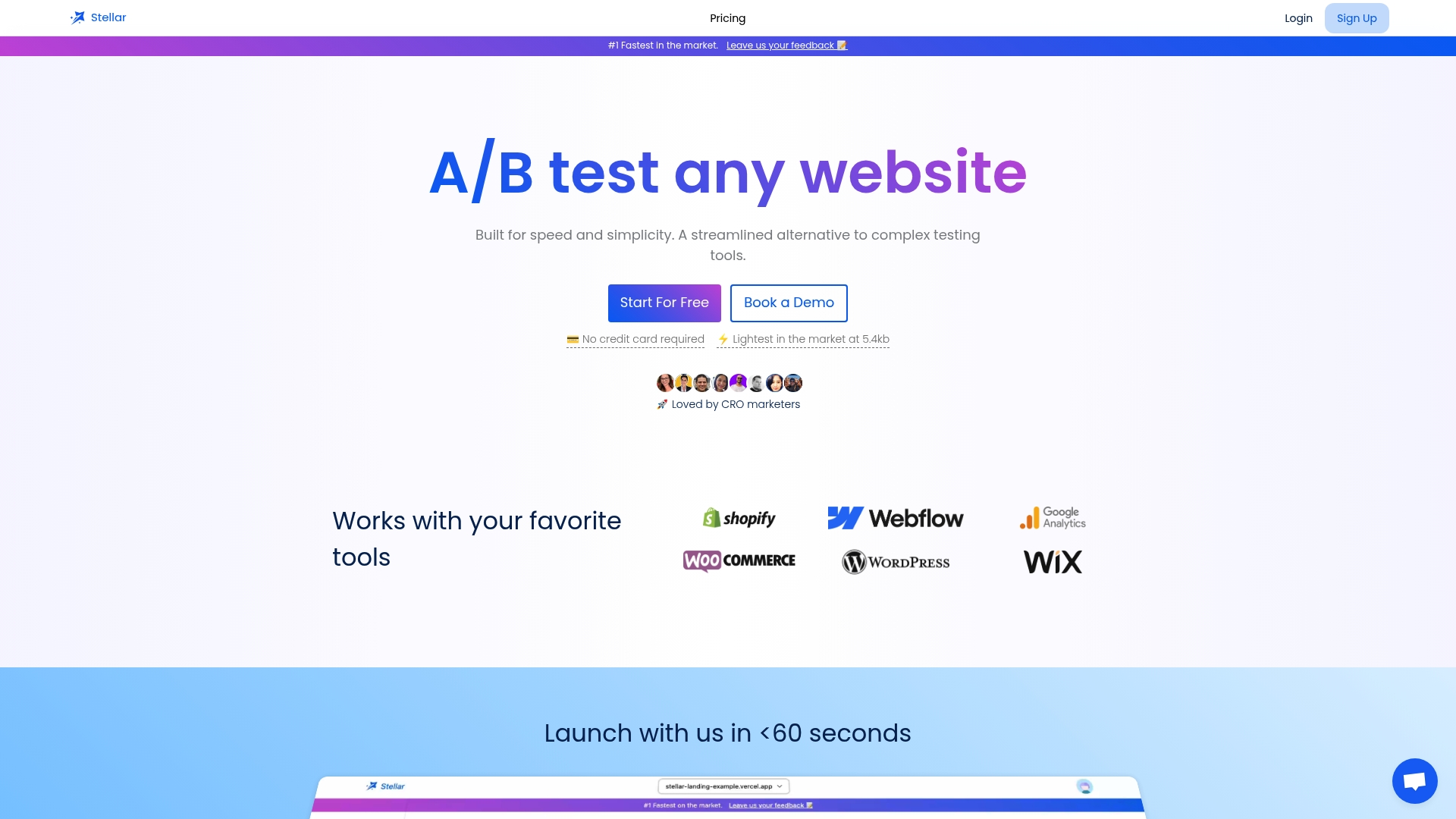
Ready to transform your marketing funnel into a conversion powerhouse? Visit Stellar's landing page now to start your free trial and experience fast, data-driven growth without any technical hassle.
Frequently Asked Questions
How can I identify bottlenecks in my marketing funnel?
Identifying bottlenecks involves analyzing user journey data to pinpoint where drop-offs occur. Start by calculating the drop-off rate between each funnel stage and focus on the steps with the highest percentage decline to target your optimization efforts.
What measurable goals should I set for funnel optimization?
Set specific, trackable goals for each stage of your funnel, such as increasing unique visitors at the awareness stage or boosting purchases at the decision stage. Aim for realistic targets based on your current traffic volume to monitor progress effectively.
How do I conduct A/B tests to improve conversions?
Conduct A/B tests by selecting one funnel stage with the highest drop-off rates and testing one variable at a time, such as headlines or call-to-action buttons. Run your experiment for at least one week to gather sufficient data before making any decisions based on results.
What is dynamic keyword insertion, and how can it help my conversions?
Dynamic keyword insertion allows you to tailor landing page content to match the search terms users enter, making pages more relevant and improving conversions. Implement this by creating keyword placeholders in your headlines and calls to action that align with user intent.
How can I use real-time analytics to enhance my funnel strategy?
Real-time analytics enable you to monitor key metrics and spot significant changes quickly. Create a dashboard to track your conversion rate, traffic volume, and bounce rate, and set alerts for sudden drops to respond proactively to any issues.
Recommended
Published: 1/27/2026