
Master conversion testing: boost website performance by 18%
Running A/B tests sounds simple, but 80-90% of experiments fail to produce actionable insights. Most SMB marketers struggle with low traffic volumes, premature result checking, and unclear hypotheses that waste time and budget. This guide cuts through the confusion by showing you exactly how to run conversion tests that drive real business impact. You'll learn when to use traditional A/B testing versus multi-armed bandit methods, how to avoid common pitfalls, and which high-impact elements to test first for measurable conversion gains.
Table of Contents
- Key takeaways
- Understanding conversion testing basics
- Common challenges and pitfalls for SMB conversion testing
- Innovations and alternatives: Multi-armed bandit testing for SMBs
- Applying conversion testing effectively: strategies for SMB marketers
- Take your conversion testing to the next level with Stellar
- Frequently asked questions
Key Takeaways
| Point | Details |
|---|---|
| Sample size planning | Calculate required sample size based on the baseline conversion rate and the minimum detectable effect to ensure tests have enough statistical power. |
| Early peeking bias | Peeking at results before reaching significance inflates false positives and leads to misinformed decisions. |
| Bandit testing option | Multi armed bandit approaches can provide faster insights for SMBs with limited traffic by adapting to results during the test. |
| Focus on high impact pages | Prioritize testing on high impact pages and elements to maximize conversion gains rather than testing many changes at once. |
| Continuous testing and segmentation | Ongoing testing with segment analysis reveals patterns that support long term conversion improvements. |
Understanding conversion testing basics
Conversion testing is the practice of splitting traffic 50/50 between control and variant to measure which version drives more desired actions. You change one element, run the test until reaching 95% confidence and 80% power, then implement the winner. This scientific approach removes guesswork from optimization decisions.
Before launching any test, calculate your required sample size based on baseline conversion rate and minimum detectable effect. A site converting at 2% needs roughly 15,000 visitors per variant to detect a 20% relative improvement. Changing one element per test prevents confounding variables that make results impossible to interpret.
Understanding core terminology helps you communicate with stakeholders and evaluate test validity:
- Baseline conversion rate: Your current performance before testing
- Minimum detectable effect: Smallest improvement worth detecting
- Statistical significance: Probability results aren't due to chance (typically 95%)
- Statistical power: Probability of detecting a real effect when it exists (typically 80%)
- Control group: Original version (A) shown to half your traffic
- Variant group: Modified version (B) with your proposed change
Hypothesis testing follows a structured process. Start by observing user behavior through analytics or heatmaps. Form a specific hypothesis like "Changing the CTA button from blue to orange will increase clicks by 15% because orange creates higher contrast." Define your success metric, calculate sample size, then run the test without interruption until reaching your predetermined thresholds.
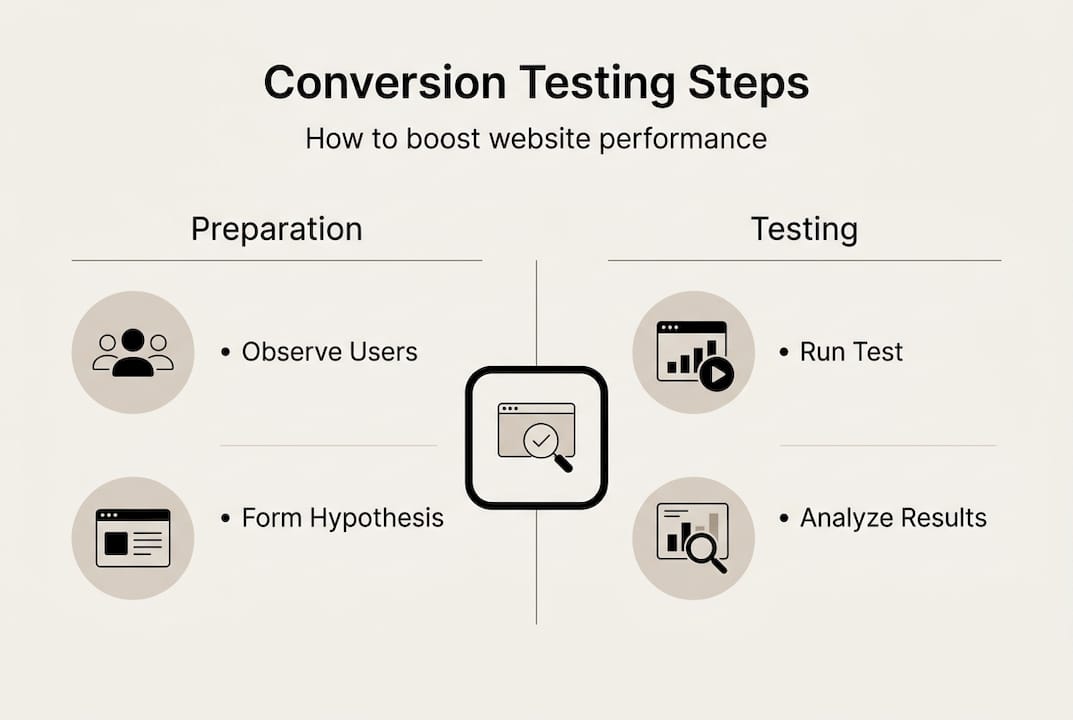
The steps to improve conversions begin with identifying friction points in your funnel. Testing multiple changes simultaneously creates statistical noise that obscures which element drove results. If you test headline, image, and CTA together, a positive result tells you nothing about which change worked. This wastes your next test cycle because you can't build on specific insights.
Pro Tip: Use a step-by-step A/B testing guide to create a testing checklist that prevents skipping critical setup steps like defining types of conversion objectives before launching.
Common challenges and pitfalls for SMB conversion testing
Low website traffic creates the biggest barrier for SMB marketers attempting conversion testing. A site with 5,000 monthly visitors can't reliably test improvements under 50% because the sample size falls short of statistical requirements. You'll wait months for conclusive results or make decisions on insufficient data.

Peeking at results before reaching significance is the most common cause of false positives. Early in a test, random variation creates apparent winners that disappear as more data arrives. Checking daily and stopping when you see a positive result inflates your false positive rate from 5% to over 30%. This leads to implementing changes that actually hurt conversions.
Testing multiple elements simultaneously produces confounded results that provide zero learning value. Changing headline, hero image, and form fields together means a conversion lift could come from any combination of changes. Your next test starts from scratch instead of building on validated insights. The 80-90% test failure rate among companies stems largely from this mistake.
Ignoring segment differences masks important patterns in your data. Mobile users might respond positively to a change while desktop users respond negatively, creating a flat overall result. Without segmentation analysis, you miss opportunities to optimize experiences for different user groups.
Stopping tests early because results look promising or disappointing undermines the entire scientific process. You must precommit to your sample size and significance thresholds before starting. Changing the rules mid-test to match your preferred outcome destroys statistical validity and turns testing into confirmation bias.
External factors like seasonality, marketing campaigns, or site outages can skew test results if ignored. Running a test during Black Friday produces different behavior than testing in January. Note external events in your test log and consider extending tests that overlap with unusual traffic patterns.
Pro Tip: Create a pre-test checklist covering hypothesis, success metrics, sample size calculation, segment plan, and external factor review. Don't launch until every item is complete. This prevents the most common mistakes that waste testing budgets. Review choosing conversion actions and testing website call to actions to select the right metrics before starting.
Innovations and alternatives: Multi-armed bandit testing for SMBs
Traditional A/B testing provides statistical rigor but demands high traffic volumes and long test durations that many SMBs can't sustain. You split traffic evenly between variants for weeks, potentially sending half your visitors to an inferior experience while gathering data. This approach works for high-traffic sites but creates opportunity costs for smaller businesses.
Multi-armed bandit testing dynamically allocates more traffic to better-performing variants as the test runs. Instead of maintaining a 50/50 split, the algorithm gradually shifts traffic toward winners while continuing to explore other options. MAB requires about 7x less traffic to detect a 10% conversion lift compared to traditional A/B testing.
The traffic efficiency comes from reducing exposure to losing variants. Traditional A/B testing sends 50% of traffic to each variant regardless of performance until the test concludes. MAB starts with equal distribution but quickly reduces traffic to poor performers, minimizing conversion losses during the test period. For SMBs with limited traffic, this means reaching optimization decisions weeks or months faster.
MAB testing shines when evaluating more than three variants simultaneously. Testing five different headlines with traditional A/B testing requires splitting traffic five ways, dramatically extending test duration. MAB handles multiple variants efficiently by focusing traffic on top performers while maintaining exploration of alternatives.
For two or three variants, traditional A/B testing often remains preferable. The statistical precision of A/B tests provides clearer insights into secondary metrics and segment behavior. MAB optimizes for the primary conversion goal but offers less visibility into why variants perform differently or how specific user segments respond.
| Testing method | Speed to decision | Traffic required | Statistical precision | Best for |
|---|---|---|---|---|
| Traditional A/B | Slower (weeks) | High (15k+ per variant) | High confidence intervals | 2-3 variants, deep analysis |
| Multi-armed bandit | Faster (days) | Low (2k+ total) | Moderate on secondary metrics | 4+ variants, quick wins |
Implementing MAB requires platforms that support dynamic traffic allocation algorithms. Most basic A/B testing tools lack this capability, so evaluate whether your testing platform offers MAB before planning tests around this method. The reduced sample size requirements make MAB particularly valuable for testing best A/B test ideas on pages with modest traffic.
Pro Tip: Use MAB for testing creative elements like headlines, images, or CTA button variations where you have many options and want quick directional results. Reserve traditional A/B testing for fundamental changes like pricing, form length, or checkout flow where you need precise impact measurement. Check out multi-armed bandit testing explained for implementation details.
Applying conversion testing effectively: strategies for SMB marketers
Start with free or low-cost tools that accommodate modest traffic volumes instead of enterprise platforms built for high-traffic sites. Google Optimize, Microsoft Clarity, and Hotjar provide essential testing and analysis capabilities without monthly fees that strain SMB budgets. These tools integrate with Google Analytics for measurement and offer visual editors that eliminate coding requirements.
Prioritize testing on product detail and checkout pages where visitor intent is highest and conversion improvements directly impact revenue. Use the PIE framework (Potential, Importance, Ease) to score test ideas. High-impact pages and elements like add-to-cart buttons, shipping cost displays, and trust badges consistently deliver measurable lifts.
Focus initial tests on micro-conversions rather than final purchase actions. Testing CTA clicks, email signups, or add-to-cart actions requires less traffic to reach significance than testing completed purchases. These micro-conversions serve as leading indicators of purchase behavior while providing faster test results with smaller sample sizes.
Implement a continuous testing program running 1-2 experiments monthly rather than sporadic testing bursts. Structured programs lift conversions 18% over six months by compounding small wins and building organizational knowledge. Log every test with hypothesis, results, and insights in a shared document that prevents retesting failed ideas.
Perform pre-test power analysis to calculate required sample size before launching. A power calculator takes your baseline conversion rate, minimum detectable effect, significance level, and power threshold to output visitor requirements. Running tests without adequate sample size wastes time and produces unreliable results that lead to poor decisions.
Segment conversion data by device type, traffic source, and user behavior to uncover patterns masked in aggregate results. Mobile users often respond differently than desktop visitors, and paid traffic behaves differently than organic visitors. Segment analysis reveals optimization opportunities that blanket changes miss.
Follow these steps for effective test execution:
- Identify friction points using analytics, heatmaps, and user recordings
- Form specific hypothesis with predicted impact and reasoning
- Calculate required sample size based on baseline metrics
- Set up test in your platform with proper goal tracking
- Run test without interruption until reaching significance thresholds
- Analyze results including segment breakdowns
- Document learnings and implement winner
- Plan next test building on validated insights
Pro Tip: Resist the urge to test everything simultaneously. Focus on the single highest-impact change based on your PIE scoring. Testing too many elements dilutes your learning and extends time to meaningful results. Review increase conversions proven strategies, A/B testing ideas for landing pages, and optimize call-to-action buttons for prioritized test ideas. See conversion rate increase tips for additional tactical guidance.
Take your conversion testing to the next level with Stellar
Running effective conversion tests requires the right platform that balances power with simplicity. Stellar provides SMB marketers with a lightweight A/B testing tool that won't slow down your site while delivering the analytics you need to make confident optimization decisions.
Our visual editor eliminates coding requirements, letting you create test variants in minutes rather than days. Dynamic keyword insertion personalizes landing pages for different traffic sources, while advanced goal tracking measures micro and macro conversions across your funnel. The platform supports both traditional A/B testing and multi-armed bandit methods, giving you flexibility to match testing approach to traffic volume.
With real-time analytics and segment analysis built in, you can monitor test performance and dive into device, source, and behavior breakdowns without switching tools. Plans start with a free tier for sites under 25,000 monthly tracked users, making sophisticated testing accessible regardless of budget. Explore Stellar's optimization tools and review our conversion improvement strategies to start driving measurable growth today.
Frequently asked questions
What is conversion testing and how does it differ from general A/B testing?
Conversion testing is A/B testing specifically focused on increasing the percentage of visitors who complete desired actions like purchases, signups, or downloads. While general A/B testing might measure engagement metrics like time on page or scroll depth, conversion testing targets measurable business outcomes. The methodology is identical, but the goal orientation toward revenue-driving actions makes conversion testing more directly tied to business growth.
How can SMBs handle low traffic volumes in conversion testing?
SMBs should use multi-armed bandit testing for creative elements, which requires roughly 7x less traffic than traditional A/B testing to reach optimization decisions. Prioritize testing on high-intent pages like product detail and checkout where conversion rates are higher, reducing sample size requirements. Focus on micro-conversions like CTA clicks or add-to-cart actions that occur more frequently than final purchases, enabling faster test completion with limited traffic.
What are common mistakes to avoid in conversion testing?
Never peek at results before reaching your predetermined sample size and significance thresholds, as this inflates false positive rates above 30%. Test only one element at a time to avoid confounded results that provide no learning value. Always predefine your minimum detectable effect and run tests to completion rather than stopping early when results look favorable. Segment your data by device and traffic source to catch performance differences that aggregate results mask.
Which tools are best for SMB conversion testing?
Google Optimize, Microsoft Clarity, and Hotjar offer free or low-cost testing and analysis capabilities ideal for SMBs with modest traffic volumes. These platforms integrate seamlessly with Google Analytics 4 for enhanced measurement and provide visual editors that eliminate coding requirements. For teams ready to invest in dedicated testing platforms, look for tools supporting both traditional A/B and multi-armed bandit methods with built-in segment analysis and real-time reporting.
Recommended
Published: 3/21/2026