
Master website checking site tools for A/B testing success
Most marketers believe A/B testing requires technical expertise, lengthy setup times, and enterprise budgets. This misconception keeps countless small to medium-sized businesses from optimizing their conversion rates. Website checking sites have transformed this landscape by offering no-code solutions that split traffic randomly, track conversions in real time, and deliver statistically significant results within days. You'll discover how these tools work, compare pricing models suited for SMB budgets, navigate advanced statistical nuances like Bayesian methods and privacy compliance, and apply practical frameworks to run high-impact experiments that boost your marketing performance.
Table of Contents
- Key takeaways
- Understanding how website checking sites power no-code A/B testing
- Pricing models and tool options for SMB marketers
- Common challenges and advanced nuances in A/B testing
- Applying website checking sites to optimize your marketing efforts
- Explore no-code A/B testing solutions with Stellar
- Frequently asked questions
Key Takeaways
| Point | Details |
|---|---|
| No code testing | No coding is required to run experiments, as website checking tools handle traffic split, real time tracking, and statistical significance. |
| SMB friendly pricing | Flat rate pricing from 119 to 599 per month makes A/B testing affordable for midsize businesses compared with enterprise options. |
| Bayesian statistics | Bayesian statistics enable declaring significance with smaller samples. |
| Cookieless tracking | Cookieless privacy first tracking helps maintain GDPR compliance while preserving measurement accuracy. |
| Fifty fifty splits | Starting with 50/50 traffic splits for the first three experiments builds baseline confidence before tackling more complex ratios. |
Understanding how website checking sites power no-code A/B testing
Website checking sites operate on four fundamental pillars that make experimentation accessible to non-technical marketers. Random traffic splitting directs visitors to control or variant pages based on predetermined ratios, ensuring unbiased distribution. Real-time conversion tracking monitors specific actions like button clicks, form submissions, or purchase completions as they occur. Statistical significance calculations determine when enough data exists to declare a winner confidently. Privacy-first implementations use cookieless tracking methods that comply with GDPR and other regulations while maintaining measurement accuracy.
Traffic split ratios vary based on your risk tolerance and hypothesis confidence. Conservative tests use 90/10 splits to limit potential negative impact from unsuccessful variants. Balanced 50/50 distributions accelerate learning by exposing equal visitor volumes to each experience. Most platforms default to even splits because they reach statistical significance faster with moderate traffic levels. You'll typically need 3-7 days to gather sufficient data, though high-traffic sites may conclude tests within 24-48 hours.
The visual editor component eliminates coding requirements entirely. You point, click, and modify page elements like headlines, images, button colors, or entire layout sections. Changes apply instantly to the variant group while the control group sees the original version. This approach works brilliantly for surface-level UI modifications but struggles with complex logic changes or backend functionality adjustments.
Integration capabilities extend your testing power significantly. Most tools connect seamlessly with Google Analytics 4, allowing you to cross-reference experiment data with your existing analytics setup. Custom event tracking lets you measure nuanced behaviors beyond basic conversions. Some platforms offer steps to improve conversions by automatically suggesting high-impact test variations based on industry benchmarks and your site's historical performance patterns.
Pro Tip: Start with 50/50 traffic splits for your first three experiments to build baseline confidence in your testing infrastructure and statistical interpretation skills before attempting more complex ratio configurations.
Pricing models and tool options for SMB marketers
Pricing for SMB-focused tools ranges from €119 to €599 monthly with flat-rate structures, contrasting dramatically with enterprise platforms charging $36,000 or more annually. This cost difference stems from feature complexity, support levels, and target market positioning. Flat-rate pricing provides budget predictability as your traffic grows, while enterprise tools often meter costs based on monthly visitors or experiments run.

| Tool | Monthly Cost | Best For | Key Limitation |
|---|---|---|---|
| Varify | €119-€249 | Budget-conscious startups | Limited simultaneous tests |
| Tiny A/B | €199-€399 | Mid-sized marketing teams | Basic analytics integration |
| Humblytics | €299-€599 | Privacy-focused businesses | Fewer visual editor features |
| Stellar | Free-€299 | Performance-sensitive sites | Traffic tier restrictions |
Free trials eliminate financial risk during your evaluation phase. Most platforms offer 14-30 day trial periods with full feature access, letting you validate tool fit before committing budget. Pay attention to trial limitations like maximum experiments or visitor caps that might prevent realistic testing scenarios. Some providers extend trials for businesses demonstrating serious evaluation intent.
Scalability considerations matter more than initial pricing for growing businesses. Examine how costs increase as you add team members, run concurrent experiments, or exceed traffic thresholds. Tools with generous free tiers for low-traffic sites provide excellent entry points. Stellar offers free access for businesses tracking under 25,000 monthly users, making it ideal for no code marketing solutions during early growth phases.
No-code visual editors trade customization depth for implementation speed. You gain the ability to launch tests in minutes without developer involvement. However, you sacrifice control over complex scenarios like personalized pricing displays, multi-step funnel modifications, or backend logic changes. Code-based feature flag tools like GrowthBook excel at these advanced use cases but require engineering resources.
Consider total cost of ownership beyond subscription fees. Factor in time savings from reduced developer dependency, opportunity cost of delayed experiments, and potential revenue gains from faster optimization cycles. A tool costing $400 monthly that enables weekly experiments delivers better ROI than a $150 solution requiring two weeks per test due to technical bottlenecks.
Pro Tip: Calculate your cost per experiment by dividing monthly subscription fees by realistic test volume to identify which pricing tier delivers optimal value as your experimentation program matures.
Common challenges and advanced nuances in A/B testing
Statistical methodology becomes critical when traffic volumes limit traditional frequentist approaches. Bayesian statistics provide reliable results with smaller sample sizes by incorporating prior knowledge and updating probability distributions as data accumulates. This method suits SMBs with 5,000-15,000 monthly visitors who can't wait months for frequentist significance. However, Bayesian approaches require careful prior selection to avoid biasing results toward expected outcomes.
Peeking at results before reaching predetermined sample sizes inflates false positive rates dramatically. Each time you check interim results and consider stopping, you introduce multiple comparison errors that corrupt statistical validity. The temptation grows strong when early data trends positive, but premature declarations waste the entire experiment. Set your sample size target upfront based on minimum detectable effect calculations and resist checking until you hit that threshold.
A/A tests validate your experimentation infrastructure by splitting traffic between two identical experiences. Ideally, you see no statistically significant differences in conversion rates. Detecting differences indicates technical problems like:
- Improper randomization creating biased traffic allocation
- Tracking errors causing inconsistent conversion measurement
- Browser compatibility issues affecting specific visitor segments
- Caching problems serving stale content to variant groups
Anti-flicker techniques prevent the jarring visual transition when variant content loads after the original page. Users briefly see the control experience before JavaScript executes and swaps in variant elements. This flash of original content contaminates your data because visitors react to both versions. Modern tools inject CSS that hides page content until variant selection completes, eliminating this data quality issue at the cost of slightly delayed page rendering.
Multiple simultaneous experiments require statistical corrections to maintain overall error rates. Running five tests concurrently at 95% confidence each creates a 23% chance of at least one false positive across the portfolio. Bonferroni corrections adjust individual test thresholds to preserve family-wise error rates, though they reduce statistical power. Balance your need for rapid learning against the risk of acting on spurious results.
Privacy regulations fundamentally reshape tracking approaches. GDPR mandates explicit consent before setting cookies, but consent banners reduce trackable traffic by 30-40%. Cookieless tracking methods use server-side session identifiers or first-party storage to maintain visitor continuity without third-party cookies. These approaches satisfy regulatory requirements while preserving measurement accuracy. Explore privacy in web analytics to understand implementation options and compliance trade-offs.
Avoid common ab testing mistakes by documenting your hypothesis, success metrics, and minimum detectable effect before launching experiments. This discipline prevents post-hoc rationalization and ensures you measure what matters rather than cherry-picking favorable metrics after data collection.
Pro Tip: Run your first A/A test for one full week to establish baseline conversion rate variance and validate that your tool correctly implements random assignment before investing in actual experiments.
Applying website checking sites to optimize your marketing efforts
Successful experimentation follows a structured process that maximizes learning while minimizing wasted effort. Start by identifying conversion bottlenecks through analytics review and user feedback. Prioritize tests based on potential impact, implementation ease, and strategic importance. This framework ensures you tackle high-value opportunities first rather than optimizing trivial page elements.
- Define your hypothesis with specific, measurable predictions about how changes will affect user behavior and conversion rates.
- Select your primary conversion metric and secondary indicators that provide context about user experience quality.
- Calculate required sample size based on baseline conversion rate, minimum detectable effect, and desired statistical power.
- Build your variant using the visual editor, ensuring changes align precisely with your hypothesis.
- Launch the experiment and resist checking results until reaching your predetermined sample size threshold.
- Analyze outcomes using both statistical significance and practical business impact criteria.
- Document learnings and plan follow-up experiments to compound insights over time.
Effective test variations focus on elements that directly influence decision-making. Best ab test ideas include call-to-action button copy changes, value proposition headline rewrites, social proof placement adjustments, form field reductions, and pricing display modifications. Avoid testing multiple changes simultaneously unless you're deliberately running multivariate experiments with sufficient traffic to detect interaction effects.
Balance test duration against traffic volume to achieve statistical confidence without unnecessary delays. Sites with 50,000 monthly visitors can often conclude tests in 3-5 days. Lower-traffic sites need 2-3 weeks for reliable results. Extending tests beyond necessary durations wastes time and delays subsequent learning cycles. Cutting tests short produces unreliable conclusions that guide poor decisions.
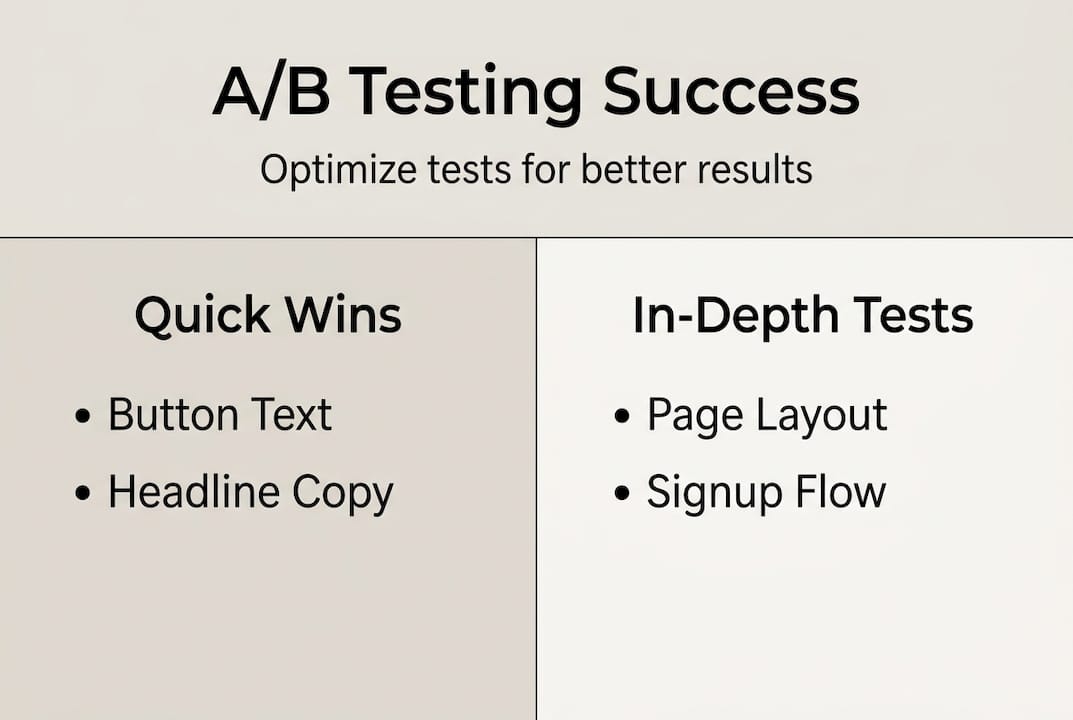
Result interpretation requires examining both statistical and practical significance. A variant showing 2% conversion rate improvement with p-value under 0.05 achieves statistical significance. However, if implementation requires substantial ongoing resources, the practical business impact may not justify adoption. Consider confidence intervals, not just point estimates, to understand the range of plausible true effects.
| Approach | Speed | Flexibility | Customization | Best Use Case |
|---|---|---|---|---|
| No-code visual editor | Very fast (minutes) | High for UI changes | Limited to front-end | CTA, headline, layout tests |
| Code-based feature flags | Moderate (hours-days) | Very high | Complete control | Pricing, logic, algorithm tests |
| Open-source platforms | Slow (days-weeks) | Moderate | Maximum | Custom enterprise needs |
Choose conversion actions that align with business objectives rather than vanity metrics. Form submissions matter more than page views for lead generation businesses. Add-to-cart rates predict revenue better than session duration for e-commerce sites. Ensure your tracking captures the specific user actions that drive business value.
Analyzing test results extends beyond declaring winners and losers. Segment results by traffic source, device type, or user cohort to identify where variants perform differently. A change that improves mobile conversions while harming desktop performance requires nuanced implementation rather than blanket adoption. These insights inform future test hypotheses and deepen your understanding of user behavior patterns.
Pro Tip: Avoid over-optimization by limiting AI-generated variant suggestions to 2-3 options per test, ensuring each variation tests a distinct hypothesis rather than minor permutations that dilute statistical power.
Explore no-code A/B testing solutions with Stellar
You've learned how website checking sites democratize experimentation through no-code interfaces, real-time tracking, and SMB-friendly pricing. Stellar embodies these principles with a lightweight 5.4KB script that won't slow your site while delivering enterprise-grade testing capabilities. The visual editor lets you modify any page element in minutes, while advanced goal tracking measures the conversions that matter most to your business.
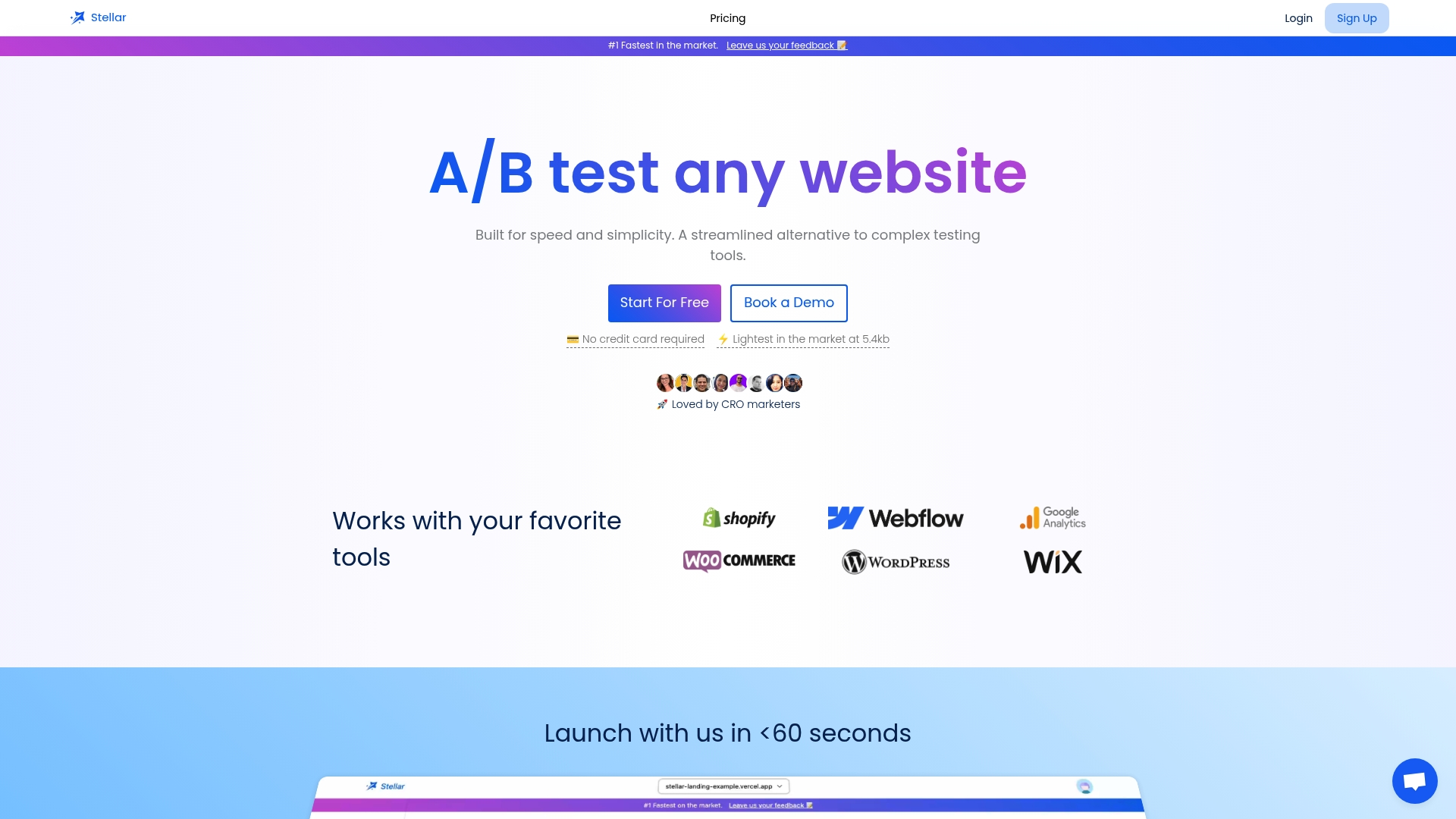
Flat-rate pricing scales naturally as your traffic grows, eliminating surprise costs that plague metered platforms. Integration with existing analytics tools preserves your current measurement infrastructure while adding experimentation power. Privacy-first architecture ensures GDPR compliance without sacrificing data quality. Whether you're running your first A/B test or optimizing an established program, Stellar provides the speed and simplicity that modern marketers demand.
Frequently asked questions
What is a website checking site and how does it differ from traditional A/B testing tools?
Website checking sites are platforms enabling marketers to run A/B tests without coding by automatically splitting traffic and tracking conversions in real time. They differ from traditional tools through faster setup processes, intuitive visual editors that eliminate developer dependency, and pricing structures designed for SMB budgets rather than enterprise contracts. These platforms prioritize ease of use and rapid experimentation over the deep customization options that traditional tools provide.
How do no-code website checking sites ensure test accuracy and privacy compliance?
Modern testing platforms use Bayesian statistics to deliver reliable results even with limited traffic volumes, while anti-flicker techniques prevent visual glitches that contaminate data. A/A tests validate proper implementation before running actual experiments. Cookieless tracking methods using server-side session management satisfy GDPR requirements without sacrificing measurement accuracy, and many tools offer built-in consent management integration. Learn more about privacy in web analytics to understand compliance options.
What are the best practices for choosing conversion actions when using website checking sites?
Focus on high-impact actions like form submissions, button clicks, and purchase completions that directly align with business revenue or lead generation goals. Ensure your chosen actions connect clearly to your test hypothesis and represent genuine user intent rather than passive engagement metrics. Use precise, measurable definitions for each conversion to maintain data consistency across experiments. Explore choosing conversion actions for detailed selection frameworks.
Can no-code tools handle complex experiments compared to code-based platforms?
No-code visual editors excel at rapid UI modifications like CTA button changes, headline rewrites, and layout adjustments that don't require backend logic alterations. Code-based feature flag platforms like GrowthBook become necessary for complex scenarios involving pricing algorithms, personalized recommendations, or multi-step funnel logic changes. Match your tool capabilities to experiment complexity by using no-code solutions for front-end tests and no code marketing solutions while reserving code-based tools for backend experimentation needs.
Recommended
Published: 3/23/2026