
6 Essential Tips to Maximize Web Testing Services
Launching an E-commerce website is an exciting step, but hidden bugs and technical hiccups can sabotage your progress before customers even arrive. If you want your site to win customer trust and drive sales, you need more than luck—you need a proven approach to testing and optimization. Every overlooked problem puts your reputation and revenue at risk.
This guide delivers actionable steps to turn chaotic trial-and-error into a focused system. You will learn exactly how to select targeted web testing services, set clear goals, and use the smartest tools available. Expect practical ideas you can implement today to resolve issues and fine-tune your site for growth.
Get ready to discover solutions that will help you catch errors early, personalize your user experience, and act on real data as it happens. With these hands-on strategies, you will understand how to make your E-commerce site reliable, user-friendly, and conversion-ready.
Table of Contents
- 1. Choose The Right Web Testing Service For Your Business
- 2. Set Clear Goals Before Starting Your Web Tests
- 3. Use No-Code Editors For Fast Experiment Setup
- 4. Leverage Dynamic Keyword Insertion For Personalization
- 5. Monitor Real-Time Analytics For Actionable Insights
- 6. Iterate And Optimize Based On Test Results
Quick Summary
| Takeaway | Explanation |
|---|---|
| 1. Choose a Testing Service with Business Alignment | Ensure your testing service aligns with your specific business goals to identify critical issues and enhance user experiences effectively. |
| 2. Set SMART Goals for Testing | Define Specific, Measurable, Achievable, Relevant, and Time-bound goals to focus your testing efforts and measure business impact accurately. |
| 3. Leverage No-Code Tools for Quick Setup | Use no-code editors to expedite test creation, allowing marketers to deploy experiments significantly faster without coding challenges. |
| 4. Implement Dynamic Keyword Insertion | Personalize content using dynamic keyword insertion for tailored messaging that enhances relevance and boosts conversion rates. |
| 5. Monitor Analytics in Real Time | Real-time analytics provide timely insights into test performance, enabling quick adjustments to optimize ongoing experiments effectively. |
1. Choose the Right Web Testing Service for Your Business
Selecting the right web testing service is one of the most consequential decisions you'll make for your e-commerce platform. The wrong choice can leave bugs undetected, performance issues unresolved, and conversion opportunities missed. But picking the right one transforms how confidently you deploy changes and optimize user experiences.
Web testing services examine your website's functionality, reliability, and performance to ensure everything works correctly for your visitors. They catch problems before customers do. However, not all testing services are created equal, and your choice should align with your specific business needs and goals.
Why This Matters
Your testing service acts as a quality gatekeeper. When you rush to market without proper testing, you risk reputation damage, lost sales, and frustrated customers. A good testing partner helps you identify and fix issues early, protecting both your brand and your bottom line.
Key Factors to Evaluate
When comparing web testing services, focus on these critical dimensions:
- Clear alignment with your business goals - Know what you want to test and measure before selecting a service
- Risk-based testing approach - Prioritize tests that address your highest-risk areas and most critical user journeys
- Browser and device coverage - Ensure the service tests across the devices and browsers your actual customers use
- Testing methodology - Look for services offering both manual and automated testing capabilities
- Flexibility and customization - The service should adapt to your specific industry and technical requirements
- Budget compliance - Choose testing depth that meets your timelines without unnecessary extra costs
Your testing service should understand your industry specifics and offer flexibility in how and what gets tested, ensuring you catch real problems that impact your customers.
The Right Fit for Your Business
Start by clarifying what success looks like for you. Are you focused on conversion rate optimization, performance, user experience, or security? Website testing services vary in their strengths, and matching your priorities with the service's expertise matters significantly.
Consider whether you need ongoing testing or project-based support. Small to medium-sized e-commerce businesses often benefit from services that offer both manual testing and automated solutions, allowing you to balance speed with thoroughness.
Experience matters. Look for services that have worked with businesses similar to yours and understand your technical stack. A partner familiar with e-commerce platforms, third-party integrations, and performance optimization will deliver more relevant insights.
Pro tip: Start by testing the testing service itself with a small, non-critical project. This lets you evaluate their process, communication, and report quality before committing to larger initiatives.
2. Set Clear Goals Before Starting Your Web Tests
Vague testing efforts lead to vague results. Without clear goals, you're essentially running experiments in the dark, hoping something useful emerges. But when you define your testing objectives upfront, everything becomes sharper—your focus, your data, your decisions.
Before you launch a single test, you need to know exactly what you're testing and why. Clear goals provide direction, motivation, and a measurable way to evaluate whether your testing actually moved the needle for your business.
Why Goals Matter in Web Testing
Goals transform testing from a scattered activity into a purposeful strategy. They help you decide which tests matter most, allocate resources efficiently, and measure whether you're actually achieving business results. Without them, you waste time on tests that don't drive outcomes.
Clear objectives also keep your team aligned. Everyone understands what success looks like, reducing confusion and debate about which tests to prioritize next.
The SMART Framework for Testing Goals
Effective goals follow the SMART approach, which ensures your objectives are grounded in reality and measurable:
- Specific - Define exactly what you're testing and what change you expect
- Measurable - Choose metrics you can actually track and quantify
- Achievable - Set realistic targets based on your current performance
- Relevant - Align tests with your larger business objectives
- Time-bound - Establish a clear timeline for testing and decision-making
Well-defined testing goals keep your team focused and ensure every experiment contributes to your business objectives, not just your curiosity.
Turning Business Objectives into Testing Goals
Start with your overarching business goal. Maybe you want to increase revenue by 25% this quarter, reduce cart abandonment, or improve customer retention. Now break that down into specific, testable hypotheses.
If your goal is improving checkout conversion, you might test different button colors, form field requirements, trust signals, or payment options. Each test should connect directly back to that conversion objective.
Setting conversion goals for A/B testing requires you to identify which metrics matter most. Are you optimizing for click-through rate, completion rate, or customer lifetime value?
Prioritizing Your Testing Goals
You can't test everything at once. Break your larger goals into smaller, manageable tasks and prioritize based on impact and effort. Focus first on the tests most likely to move your key metrics.
Create a testing roadmap with deadlines. This keeps your testing efforts accountable and prevents endless experimentation without decisions. Set a schedule for reviewing results and adjusting your approach based on what you learn.
Pro tip: Document your goals in writing before any test launches, including the metric you'll measure and the threshold for success—this prevents post-hoc goal-moving and keeps results honest.
3. Use No-Code Editors for Fast Experiment Setup
Time is your scarcest resource as a marketer. Every day spent building experiments manually is a day lost to testing and optimization. No-code editors eliminate that friction, letting you design and launch tests in hours instead of weeks.
No-code means you can focus on strategy instead of syntax. You don't need developers waiting in the queue or technical knowledge you don't possess. You just drag, drop, and deploy.
Why Speed Matters in Testing
Fast experiment setup means you can iterate faster and respond to market changes quickly. When you can launch a test in an afternoon, you're not constrained by development backlogs or technical bottlenecks. Your testing velocity directly impacts how many experiments you run in a quarter, which directly impacts learning and growth.
The longer your setup time, the higher your mental barrier to testing. No-code removes that barrier, making testing feel accessible and routine.
How No-Code Editors Work
No-code experimentation tools allow you to create experiments visually without writing a single line of code. You point and click to select page elements, make changes, set targeting rules, and configure goals. Everything happens through an intuitive interface designed for marketers, not programmers.
The best no-code platforms handle the complexity behind the scenes. You don't need to understand how randomization works or worry about technical implementation details. The platform manages all that for you.
What You Can Test Without Code
No-code doesn't mean limited. You can test:
- Headlines, copy, and button text
- Images, colors, and layouts
- Form fields and checkout flows
- Navigation elements and menus
- Call-to-action placement and design
- Page elements and content blocks
- Personalization based on visitor attributes
Most changes marketers actually want to test fall into these categories anyway. The 80/20 principle applies here—no-code tools handle 80% of testing needs with 100% less friction.
No-code editors democratize testing. They put experimentation power directly in your hands, freeing you from developer dependencies and technical delays.
The Real Speed Advantage
Consider your typical workflow. With code-based testing, you submit a request, wait for development resources, describe your test, review code, deploy, and finally launch. That's days or weeks.
With no-code, you open the editor, make your changes, set your targeting and goals, and hit launch. That's hours. You're not waiting for anyone. You're not describing your vision to someone else and hoping they understand. You're building it yourself.
This speed compounds over time. If you run twice as many tests, you learn twice as fast. You discover winning variations that competitors haven't found yet.
Pro tip: Start with simple tests in your no-code editor to build confidence, then gradually tackle more complex variations—this accelerates your learning curve and proves ROI to stakeholders faster.
4. Leverage Dynamic Keyword Insertion for Personalization
One-size-fits-all messaging doesn't work anymore. Your customers search for different things, arrive from different sources, and respond to different language. Dynamic keyword insertion lets you automatically tailor your content to match what each visitor actually wants.
Instead of showing the same headline to everyone, dynamic keyword insertion adapts your message in real time based on user behavior or search context. It's personalization at scale without the manual work.
What Is Dynamic Keyword Insertion?
Dynamic keyword insertion automatically inserts relevant keywords into your landing pages and ads based on factors like user search history, recent search trends, or specific visitor attributes. When a user arrives from a search for "blue running shoes," your page headline can automatically reference blue running shoes instead of generic "athletic footwear."
This creates immediate relevance. Visitors see language that matches their intent, making your page feel like it was built specifically for them.
Why Personalization Boosts Conversions
When content matches visitor intent, engagement skyrockets. Personalizing website content for higher conversions demonstrates that users are more likely to convert when they see messaging tailored to their needs.
Personalization also reduces friction. Instead of making visitors translate generic copy into their own context, you do that work for them. They immediately understand relevance and feel understood.
How to Implement Dynamic Keyword Insertion
Start by identifying your key variables—the user attributes that most influence their decision-making. Consider these common factors:
- Search keywords or search terms
- Geographic location
- Device type or browser
- Traffic source or referrer
- Visitor segment or customer type
- Time of day or season
- Recent browsing behavior
Once you've identified your variables, create multiple content variations. Your testing platform automatically serves the right variation to the right visitor based on those attributes.
Dynamic keyword insertion transforms generic landing pages into personalized experiences that feel custom-built for each visitor, dramatically improving relevance and conversion probability.
Practical Examples for E-Commerce
Here's how this works in real scenarios:
If a visitor searches "waterproof winter boots," your page headline shifts from "Shop Our Boots" to "Premium Waterproof Winter Boots."
If a visitor lands from a mobile device, your form might reduce fields from ten to three, matching mobile user expectations.
If a visitor is a repeat customer, your messaging highlights loyalty rewards instead of first-time discounts.
Each variation feels purposeful and relevant, encouraging visitors to take action rather than bounce.
The Testing Advantage
Dynamic keyword insertion also accelerates testing. Instead of running separate tests for each keyword or segment, you run one test with personalization logic built in. You learn faster what messaging resonates with which audiences.
Pro tip: Start with your highest-traffic keywords or segments when implementing dynamic keyword insertion, ensuring maximum impact from your personalization efforts from day one.
5. Monitor Real-Time Analytics for Actionable Insights
Waiting for yesterday's data to make today's decisions is a losing strategy. Real-time analytics show you what's happening right now, letting you spot problems instantly and capitalize on opportunities before they vanish. This speed transforms testing from a retrospective activity into a live optimization tool.
When you monitor your tests as they run, you can spot unexpected issues, validate assumptions faster, and make smarter decisions about when to stop or accelerate a test.
Why Real-Time Data Matters
Your tests generate continuous streams of data every second. Real-time analytics capture this data immediately, showing you exactly what's working and what isn't without delays. By the time traditional daily reports arrive, you've already missed hours of actionable intelligence.
Real-time visibility also reduces risk. If a test is hurting your conversion rate, you need to know instantly, not tomorrow morning.
What Real-Time Analytics Actually Measure
Real-time analytics in marketing reveal patterns across multiple dimensions simultaneously. You're not just seeing which variation won, but understanding who responded to it, when they engaged, and whether they converted.
Key metrics to monitor include conversion rate, click-through rate, bounce rate, revenue per session, and goal completion rate. Real-time dashboards display these metrics updated continuously as new data arrives.
The Information You Need Right Now
Effective real-time analytics dashboards should show you:
- Conversion metrics - Current conversion rate for each test variation
- Traffic flow - How many visitors are seeing each variation
- Engagement signals - Click, scroll, and interaction patterns
- Performance alerts - Automatic warnings when metrics drop below expectations
- Visitor segments - Performance breakdowns by device, location, or traffic source
- Revenue impact - Real-time impact on actual business outcomes
This gives you complete visibility into test performance as it happens, not after the fact.
Real-time analytics transform testing from a weekend report into a living dashboard that guides decisions throughout the day. You respond to data while it's still hot.
Acting on Real-Time Insights
Saw a conversion spike at 2 PM on mobile? Real-time data lets you investigate why immediately. Is it a specific page element, traffic source, or user segment? You can drill deeper instantly instead of waiting for engineers to pull reports.
Spotted a technical error affecting conversion? Real-time alerts let you pause the test and fix the problem before losing more conversions.
Notice one variation dramatically outperforming others? Real-time data lets you make the call to accelerate traffic to the winner earlier than planned.
Pro tip: Set up automated alerts for your key metrics so you're notified immediately if conversion drops below your baseline, allowing you to investigate and act within minutes instead of hours.
6. Iterate and Optimize Based on Test Results
One test doesn't make a strategy. The real power of web testing comes from treating it as a continuous cycle where you learn from each experiment, refine your approach, and run the next test smarter than the last. This iterative process compounds over time, turning small improvements into significant competitive advantages.
Every test result is a data point that informs your next move. The businesses that win aren't the ones with the best single test, but the ones who master the art of iterating constantly.
The Iterative Testing Cycle
Testing isn't a one-and-done activity. It's a structured cycle of observation, analysis, and refinement. You run a test, analyze results, formulate hypotheses about what worked and why, implement changes based on those insights, and repeat.
This cyclical approach mirrors scientific methodology. You're building knowledge systematically rather than chasing random ideas.
Analyzing Results Strategically
How to analyze test results for decision-making involves more than just looking at winning variations. You need to understand the underlying reasons why certain changes worked.
Ask yourself these questions after each test:
- Which variation performed best and by how much?
- Was the winner statistically significant?
- Did all visitor segments respond the same way?
- What pattern or principle does this result reveal?
- How can I apply this learning to other pages?
- What's the next logical hypothesis to test?
This deeper analysis prevents you from making reactive decisions based on noise.
Iteration transforms individual test results into cumulative learning. Each test builds on the last, creating a knowledge base that guides smarter future experiments.
From Results to Action
Once you've analyzed results, your next step is deciding what to implement. Not every winning variation deserves immediate rollout. Consider factors like:
- Statistical confidence level (typically 95% minimum)
- Business impact and revenue potential
- Technical feasibility and maintenance burden
- Alignment with brand guidelines
- Applicability to other areas of your site
Winning variations that passed statistical rigor should be implemented immediately. Implement them widely, not just on the test page, if the principle applies elsewhere.
Building Your Testing Roadmap
Iterative testing requires planning. Document what you learned from each test and how it shapes future priorities. Over time, patterns emerge revealing your site's biggest conversion opportunities.
Don't test in isolation. Let results from one test inform your next hypothesis. If you discovered that trust signals boost conversion on product pages, test them on category pages next. If reducing form fields increased submissions in one funnel, try it elsewhere.
This systematic approach multiplies your learning velocity. After running ten connected tests, you understand your customers far better than someone running ten random experiments.
Pro tip: Document test hypotheses, results, and learnings in a shared repository so your entire team can reference past findings and avoid retesting hypotheses or rediscovering the same insights.
Below is a comprehensive table summarizing the key strategies and considerations for web testing services as detailed in the article.
| Category | Explanation | Importance |
|---|---|---|
| Choosing Service | Select a web testing service aligned with business needs and goals. | Ensures optimal performance and reliability of the website. |
| Evaluating Factors | Assess flexibility, budget compliance, testing methodologies, and browser/device coverage. | These factors guarantee testing effectiveness and alignment with target audiences’ experiences. |
| Defining Clear Goals | Use the SMART framework to create actionable testing objectives. | Clear goals provide measurable benchmarks and focus testing strategies effectively. |
| Leveraging Tools | Utilize no-code editors for rapid experiment setups and dynamic keyword insertion for personalization. | Streamlines the testing process and enhances relevance to visitor queries, boosting customer engagement. |
| Monitoring Analytics | Analyze real-time data to obtain actionable insights. | Facilitates timely adjustments during testing and supports informed decisions for optimization. |
| Iterative Optimization | Continuously iterate tests and refine strategies based on results. | Promotes sustained improvements and deepens understanding of user preferences and behaviors. |
Maximize Your Web Testing Success with Stellar's Powerful Solutions
Struggling to implement effective web testing that truly drives growth and conversion? The article "6 Essential Tips to Maximize Web Testing Services" highlights key challenges like setting clear goals, speeding up experiment setup, and leveraging real-time analytics to make smarter decisions. Many marketers and growth hackers face these hurdles daily without access to tools that simplify or accelerate the process.
Stellar is built precisely to tackle these pain points by offering a lightweight A/B Testing Tool with a no-code visual editor for rapid test creation. Our platform supports dynamic keyword insertion for personalized content that boosts visitor relevance while providing advanced goal tracking and real-time data to act decisively.
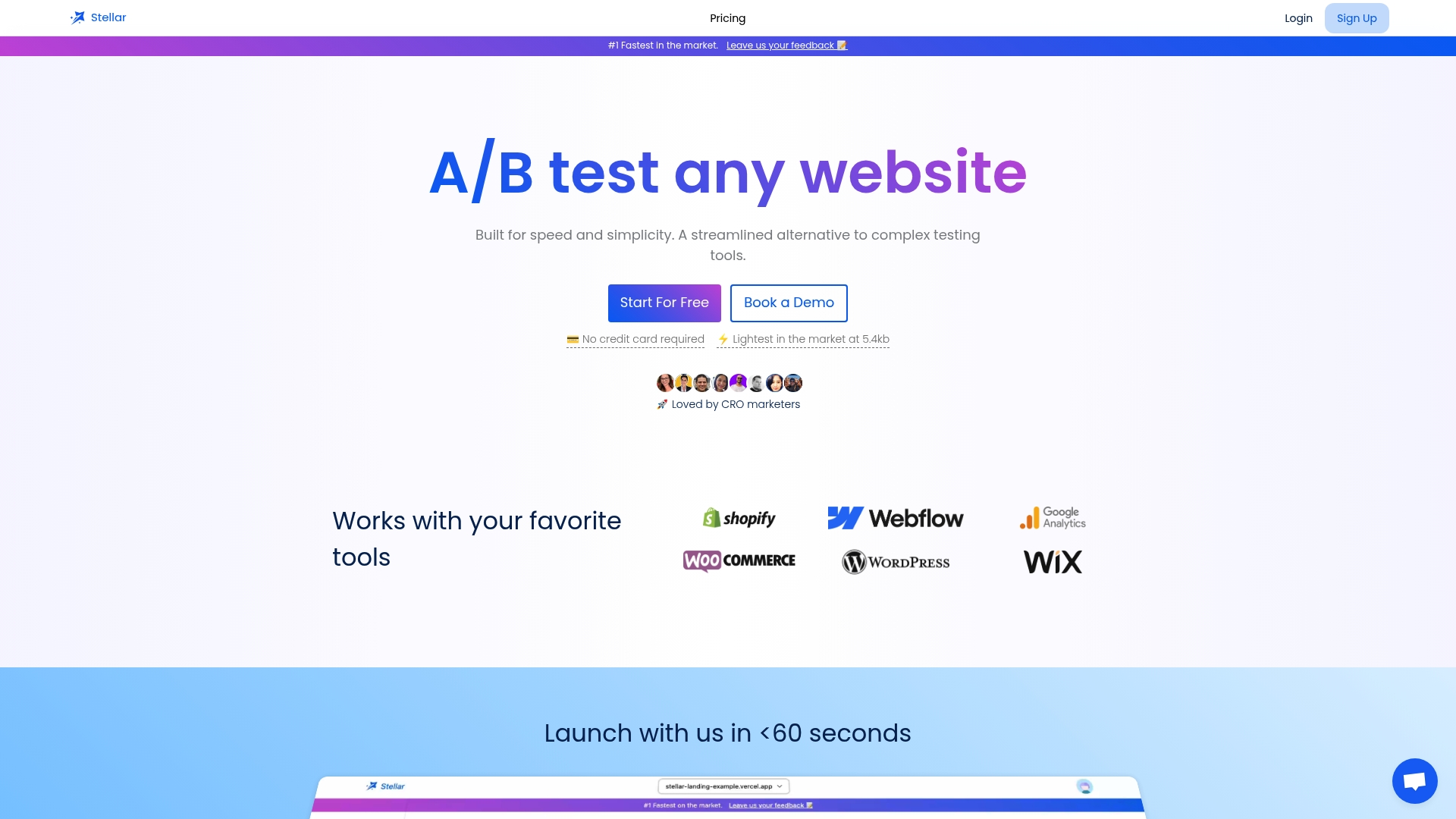
Elevate your testing strategy today with Stellar’s intuitive platform designed for small to medium-sized businesses. Experience faster setup, smarter personalizations, and actionable insights without depending on technical resources. Start optimizing your website the right way by visiting Stellar. Take control of your experiments now and unlock continuous growth that outperforms your competition.
Frequently Asked Questions
How do I choose the right web testing service for my business?
Selecting the right web testing service involves aligning the service's capabilities with your specific business goals, such as performance or user experience. Begin by identifying your key priorities and requirements, then compare services based on their expertise in those areas.
What are some important goals to set before starting web tests?
Before launching web tests, set clear and measurable goals using the SMART criteria: Specific, Measurable, Achievable, Relevant, and Time-bound. Clearly defined objectives help prioritize tests and evaluate their effectiveness in contributing to your business outcomes.
How can I set up tests quickly without coding skills?
Utilize no-code editors to create and launch web tests quickly without needing programming knowledge. With these tools, you can easily drag and drop elements to design experiments, potentially reducing setup time from weeks to just hours.
What is dynamic keyword insertion, and how can it improve my website's conversions?
Dynamic keyword insertion automatically tailors on-page content based on visitor attributes and search behavior, making your messaging more relevant. Implement this technique by identifying key visitor variables and creating multiple content variations to boost your conversion rates.
How can I effectively monitor test results in real time?
Implement real-time analytics to track key metrics like conversion rates and engagement as your tests run. Set up dashboards to display this data continuously, enabling you to make informed decisions and identify issues immediately, reducing risk in your testing process.
What is the best practice for iterating on web test results?
Approach web testing as a continuous cycle of learnings and iterations. After each test, analyze the results to formulate hypotheses for future tests, documenting insights along the way to build a knowledge base that can inform and improve subsequent experiments.
Recommended
- 8 Essential Elements to Test on Websites for Growth
- Web Based Testing Strategies for CRO and Growth Teams 2025
- 6 Essential Tips for Mastering SEO Split Testing
- The Sub-6KB Testing Revolution: Why Size Matters for CRO
- 7 Website User Experience Tips Every Business Should Know|BM
- A Guide to Flawless Website Quality Assurance Testing | Trackingplan
Published: 2/24/2026