
Key Metrics to Monitor AB Tests for Accurate Results
Over 80 percent of american businesses use A/B testing to improve online performance, yet only a fraction maximize its full potential. Defining clear objectives and using accurate metrics are the building blocks for experiments that actually drive results. If you want to turn raw data into real growth, mastering each stage from goal setting to statistical analysis will help you unlock deeper insights and more reliable wins.
Table of Contents
- Step 1: Define Clear Objectives And Metrics For Your AB Tests
- Step 2: Integrate Real-Time Tracking Tools For Accurate Monitoring
- Step 3: Assess Conversion Rates And User Engagement Metrics
- Step 4: Analyze Statistical Significance And Reliability Of Results
- Step 5: Validate Findings And Implement Winning Variations
Quick Summary
| Key Insight | Explanation |
|---|---|
| 1. Define clear objectives and metrics | Establish precise business goals and metrics to guide A/B testing effectively. Focus on specific, quantifiable measurements linked to objectives. |
| 2. Implement real-time tracking tools | Use robust tracking solutions to capture performance data instantly, allowing for agile decisions and minimizing biases. |
| 3. Assess conversion rates thoroughly | Evaluate conversion and engagement metrics critically, considering both quantitative and qualitative data for meaningful insights. |
| 4. Analyze statistical significance accurately | Determine if results are meaningful or random by focusing on confidence intervals and effect sizes for informed decisions. |
| 5. Validate findings before implementation | Conduct thorough analysis of test results and implement changes gradually, monitoring their impact on performance metrics closely. |
Step 1: Define clear objectives and metrics for your AB tests
Successful A/B testing begins with crystal clear objectives and precisely defined metrics that will guide your entire experimentation process. Your goal is to create a strategic measurement framework that transforms raw data into meaningful insights about user behavior and conversion potential.
To establish robust testing objectives, start by identifying your specific business goals. Are you aiming to increase conversion rates on a landing page, reduce cart abandonment, or improve email signup rates? Each objective demands unique metrics that directly correlate with your desired outcome. Research indicates that successful A/B testing environments require meticulously accounting for variables like seasonal trends and special events that could influence test results.
When defining metrics, focus on quantifiable and actionable measurements. Common key performance indicators might include click through rates, time spent on page, bounce rates, or actual conversion percentages. Ensure your chosen metrics are directly linked to your primary objective and can provide statistically significant insights. Pro tip: Select no more than 2-3 core metrics to prevent data complexity and maintain test clarity. Your metrics should be specific, measurable, achievable, relevant, and time bound.

Step 2: Integrate real-time tracking tools for accurate monitoring
Real-time tracking is the heartbeat of effective A/B testing, enabling you to capture instantaneous performance data and make informed decisions quickly. By implementing robust monitoring tools, you can track experiment progress with precision and minimize potential biases that could skew your results.
When integrating tracking tools, focus on solutions that provide real-time analytics with continuous monitoring capabilities. Research reveals that traditional fixed-horizon statistical methods often fall short in modern experimentation environments, as they do not permit ongoing experiment evaluation. Your tracking approach should allow for sequential monitoring that can dynamically adjust as new data emerges.
Key considerations for real-time tool integration include selecting platforms that offer comprehensive data visualization, immediate statistical significance calculations, and the ability to track multiple metrics simultaneously. Implement tools that can detect potential anomalies or significant variations instantly, allowing you to pause or modify experiments if unexpected patterns emerge. Pro tip: Choose tracking solutions that support data-dependent stopping mechanisms, which help prevent statistical errors and ensure more reliable experimental outcomes. By maintaining a vigilant, adaptive monitoring strategy, you transform raw data into actionable insights that drive meaningful business improvements.
Step 3: Assess conversion rates and user engagement metrics
Assessing conversion rates and user engagement metrics is the critical process of transforming raw experimental data into meaningful insights that drive strategic business decisions. Your goal is to translate numerical data into actionable understanding of how users interact with your digital experience.
To effectively analyze these metrics, start by identifying the core conversion indicators most relevant to your specific business objectives. Interpreting conversion metrics requires a nuanced approach that goes beyond surface level numbers. Focus on key performance indicators like click through rates, signup completions, purchase conversions, and time spent on page. Pay close attention to segmentation differences that might reveal deeper behavioral patterns across various user groups or traffic sources.
When evaluating user engagement, consider both quantitative and qualitative measurements. Quantitative metrics might include bounce rates, pages per session, and average session duration. Qualitative insights could come from user feedback, heatmap analysis, and scroll depth tracking. Pro tip: Don't just collect metrics implement a systematic method of comparing them against your baseline performance and identifying statistically significant variations. By maintaining a holistic view of your conversion and engagement data, you can make informed decisions that incrementally improve user experience and drive meaningful business growth.
Step 4: Analyze statistical significance and reliability of results
Analyzing statistical significance transforms your A/B test data from raw numbers into actionable insights that can confidently guide business decisions. Your primary objective is to determine whether the observed differences between test variations are meaningful or merely the result of random chance.
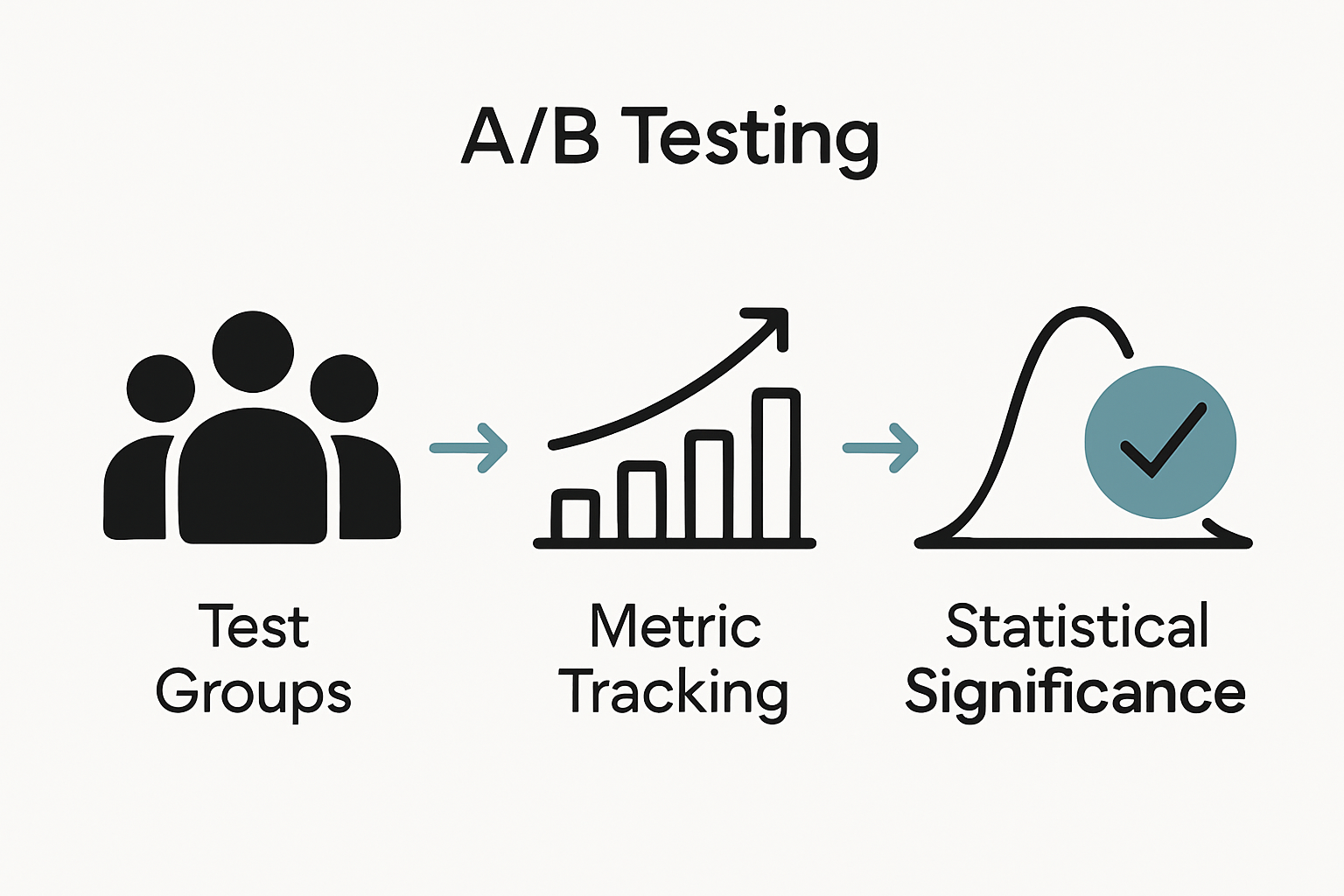
Hypothesis testing in AB experiments has become a standard scientific approach for product development, enabling teams to control risks associated with potentially incorrect decisions. When evaluating statistical significance, focus on multiple metrics that serve different purposes such as establishing success evidence, preventing performance regressions, and verifying overall test validity. Pay close attention to your confidence intervals, p values, and effect sizes to ensure robust analysis.
Complex experimental environments require nuanced statistical approaches. Pro tip: Be cautious of oversimplified analysis methods that assume perfect observability. Research indicates that many experimental settings involve time dependent treatments that don't conform to traditional statistical assumptions. Use advanced statistical techniques that can handle complex, sequential data scenarios. Implement rigorous statistical controls, consider potential confounding variables, and maintain a critical perspective that goes beyond surface level numerical comparisons. By adopting a comprehensive and methodical approach to statistical analysis, you can extract reliable insights that drive meaningful product improvements.
Step 5: Validate findings and implement winning variations
Validating A/B test findings is a critical process that transforms experimental data into strategic business improvements. Your goal is to confidently determine which variation delivers superior performance and understand the underlying reasons for its success.
To ensure comprehensive validation, analyze potential A/B testing mistakes that could compromise your results. This requires a systematic approach that goes beyond surface level statistical significance. Consider factors like statistical power, sample size, and potential external influences that might skew your interpretation. Strategic leadership team collaboration plays a crucial role in aligning test results with broader business objectives and ensuring that implementation decisions are grounded in a holistic understanding of organizational goals.
When implementing winning variations, adopt a phased rollout strategy that minimizes potential risks. Start with a controlled implementation that allows continuous monitoring of performance metrics. Pro tip: Document the specific changes introduced, track their impact comprehensively, and be prepared to make incremental adjustments. By maintaining a rigorous and methodical approach to validation and implementation, you transform A/B testing from a mere experimental process into a powerful mechanism for continuous business optimization.
Unlock Precise A/B Test Metrics with Stellar for Smarter Decisions
Measuring the right key performance indicators and ensuring real-time analytics can feel overwhelming when your current tools lack clarity or speed. This article highlights the challenge of interpreting essential metrics like conversion rates and statistical significance, which marketers face daily. If you want to feel confident about eliminating guesswork and gaining actionable insights from your experiments, a streamlined solution is crucial.
Experience effortless metric tracking and reliable results with Stellar’s fast and user-friendly A/B Testing Tool.

Take control of your testing process today by leveraging a lightweight platform combining advanced goal tracking and real-time analytics. Visit Stellar now and discover how our no-code visual editor and dynamic keyword features transform how small to medium-sized businesses optimize their digital strategies. Don’t let complex data hold you back when precise metrics are just a click away.
Frequently Asked Questions
What key metrics should I monitor during A/B tests?
Focus on key performance indicators such as conversion rates, click-through rates, and bounce rates. Track no more than 2-3 core metrics to keep data manageable and insights clear.
How can I ensure the statistical significance of my A/B test results?
To determine statistical significance, analyze metrics like p-values and confidence intervals. Aim for a confidence level of at least 95% to confidently validate your findings.
What is the best way to track user engagement during A/B testing?
Utilize both quantitative metrics like pages per session and qualitative insights from user feedback. This combination helps you understand not only how many users are engaging but also why they interact the way they do.
How often should I evaluate the performance metrics from my A/B tests?
Regularly assess your performance metrics throughout the experiment—ideally every few days. This consistent evaluation helps identify trends and anomalies early, allowing for timely adjustments.
How can I take action based on the results of my A/B tests?
Once you identify a winning variation, implement it in a phased rollout. Continuously monitor its impact on your key metrics, and be ready to make incremental changes as needed to optimize performance.
Published: 12/1/2025