
One sided vs two sided test: choose best for A/B success
Choosing between a one-sided and two-sided statistical test can make or break your A/B testing strategy. Many marketers struggle with this decision, unsure whether to focus on detecting improvements or protect against potential harm to their conversion rates. The wrong choice can lead to wasted traffic, missed insights, or costly mistakes that damage campaign performance. This article provides a practical framework to evaluate both approaches, helping you select the test type that aligns with your traffic volume, risk tolerance, and optimization goals.
Table of Contents
- Key takeaways
- How to evaluate test choice: your selection criteria
- Understanding one-sided tests: advantages and risks
- Understanding two-sided tests: comprehensive but demanding
- One sided vs two sided tests: a head-to-head comparison
- Optimize your A/B testing with Go Stellar
- FAQ
Key Takeaways
| Point | Details |
|---|---|
| One sided power | One sided tests concentrate power in the expected direction, enabling faster conclusions with smaller samples when you are confident about the outcome. |
| Two sided safety | Two sided tests protect against harms by detecting movements in either direction, reducing the risk of overlooking negative effects. |
| Traffic efficiency | For the same sample size, one sided tests offer about 1.4 times more power and can reach significance with less traffic, accelerating decisions for campaigns with limited visitors. |
| Sample size savings | One sided tests require roughly 20 to 30 percent fewer samples to achieve the same power, shortening testing windows and speeding iterations. |
How to evaluate test choice: your selection criteria
Selecting the right statistical test requires evaluating five critical factors that directly impact your campaign outcomes. Start by assessing your certainty about the expected direction of change. If you're confident your variant will improve conversions and have no reason to expect harm, a one-sided test concentrates statistical power where you need it. However, uncertainty about outcomes demands the safety net of a two-sided approach.
Risk tolerance forms your second decision point. Consider what happens if your variant actually decreases conversions but you're only testing for increases. A one-sided test would miss this harmful effect entirely, potentially costing revenue while you continue running a losing variant. Two-sided tests protect against this scenario by detecting movement in either direction, making them essential when interpreting statistical significance for changes that could impact revenue.
Your available traffic volume directly influences test feasibility. One-sided tests boost power approximately 1.4 times compared to two-sided tests for the same sample size, meaning you can reach conclusions faster with less traffic. For SMBs with limited monthly visitors, this efficiency advantage can be the difference between actionable insights and inconclusive results.
Statistical power and sample size requirements create practical constraints. One-sided tests need roughly 20-30% fewer samples to achieve the same power level as two-sided tests. This translates to shorter testing windows and faster iteration cycles, critical advantages for growth teams operating under tight timelines.
Finally, consider your analytical framework. Confidence intervals provide nuance beyond simple p-values, showing the range and magnitude of effects. Two-sided tests align naturally with confidence interval interpretation, since a CI that excludes zero indicates significance in the appropriate direction. This complementary relationship helps you understand not just whether an effect exists, but how large and reliable it is.
Key evaluation criteria:
- Directional certainty: Do you know which way the effect should go?
- Risk assessment: Can you afford to miss negative impacts?
- Traffic constraints: How quickly do you need results?
- Power requirements: What sample size can you realistically achieve?
- Analysis approach: Are you using confidence intervals alongside p-values?
Understanding one-sided tests: advantages and risks
One-sided tests focus exclusively on detecting an effect in a single specified direction, placing the entire rejection region in one tail of the distribution. For marketers testing a new landing page variant expected to increase conversions, this approach concentrates all statistical power on detecting that improvement. The alpha level of 0.05 sits entirely in the upper tail, making it easier to reject the null hypothesis when your variant performs better.
The power advantage delivers tangible benefits for resource-constrained teams. By focusing on one direction, you gain approximately 40% more statistical power compared to splitting alpha across both tails. This translates directly to smaller required sample sizes, often reducing your needed traffic by 20-30%. For an SMB running 10,000 monthly visitors, this efficiency can mean reaching significance in two weeks instead of three.
However, this efficiency comes with a critical blind spot. If your variant actually decreases conversions, a one-sided test designed to detect increases will fail to flag this problem. You'll see a non-significant result and might conclude the variant had no effect, when in reality it's actively harming performance. This risk is particularly dangerous for changes to checkout flows, pricing displays, or other high-impact elements where negative effects directly cost revenue.
One-sided tests shine in specific scenarios common to SMB marketing. When you're testing proven tactics like adding social proof elements, optimizing call-to-action button colors based on established principles, or implementing best practices from your one-tailed vs two-tailed tests guide, the direction of expected improvement is clear. Low-traffic situations where reaching statistical significance challenges your timeline also favor this approach.
When one-sided tests work best:
- Testing established best practices with predictable outcomes
- Low-traffic campaigns where sample size is severely limited
- Incremental optimizations to proven elements
- Situations where negative effects are theoretically impossible
- Follow-up tests validating previous findings
Pro Tip: Document your directional hypothesis before collecting any data. This pre-specification prevents the temptation to switch from two-sided to one-sided testing after seeing your results, a form of p-hacking that inflates false positive rates and undermines the validity of your findings.
Understanding two-sided tests: comprehensive but demanding
Two-sided tests split the alpha level across both tails of the distribution, allocating 0.025 to each direction when using the standard 0.05 significance threshold. This approach detects whether your variant differs from the control in either direction, making no assumptions about which way the effect will go. For marketers testing major redesigns or untested concepts, this balanced perspective provides essential safety.
The ability to catch harmful effects makes two-sided testing the conservative choice for high-stakes experiments. When you're modifying checkout processes, changing pricing structures, or overhauling navigation systems, the potential for decreased conversions is real. Two-sided tests detect these drops alongside improvements, ensuring you don't inadvertently roll out changes that damage performance. This aligns with how most AB testing significance calculations work in practice.
The sample size requirement represents the main tradeoff. Splitting alpha across both tails reduces power for detecting effects in either specific direction, typically requiring 20-30% more samples to achieve the same statistical power as a one-sided test. For a test targeting 80% power to detect a 15% relative improvement, you might need 8,000 visitors per variant with a two-sided test versus 6,000 with a one-sided approach.

Two-sided tests integrate seamlessly with confidence interval frameworks, the preferred interpretation method for sophisticated marketers. When your 95% confidence interval for the conversion rate difference excludes zero, you have significance. The interval's bounds also communicate effect magnitude and precision, providing richer insights than a simple p-value. This dual benefit makes two-sided testing the default choice for teams emphasizing rigorous statistical practice.
Testing duration extends when sample requirements increase, but this delay often proves worthwhile. An extra week of testing beats the risk of missing a 10% conversion rate drop that costs thousands in lost revenue. For established businesses with steady traffic, the sample size premium is manageable and buys valuable protection against costly mistakes.
Two-sided test advantages:
- Detects both positive and negative effects without bias
- Prevents missing harmful conversion decreases
- Aligns naturally with confidence interval interpretation
- Reduces risk of p-hacking through directional switching
- Standard practice in most professional testing platforms
One sided vs two sided tests: a head-to-head comparison
The power differential between test types creates measurable efficiency gains. One-sided tests deliver approximately 1.4 times the statistical power of two-sided tests for the same sample size and effect size. In practical terms, if you need 5,000 visitors per variant to detect a 20% relative lift with a two-sided test at 80% power, a one-sided test achieves the same power with roughly 3,600 visitors per variant.
Sample size formulas quantify this advantage. For a two-sided test, the required sample per variant is n = 2(z_alpha/2 + z_beta)^2 * p(1-p) / delta^2, where z_alpha/2 = 1.96 for alpha = 0.05. The one-sided equivalent uses z_alpha = 1.645, reducing the numerator and thus the required n by about 25-30% depending on baseline conversion rate and minimum detectable effect.
Platform defaults reveal industry consensus on best practices. Most professional A/B testing tools, including Statsig and Adobe Target, default to two-sided tests. This reflects the statistical community's preference for the safer, more conservative approach that protects against unexpected negative effects. However, platforms typically allow switching to one-sided tests when you have strong directional hypotheses and understand the risks.
Sequential testing considerations favor pre-specifying your test direction. If you're using methods that allow peeking at results before reaching your planned sample size, switching from two-sided to one-sided after seeing data trends constitutes p-hacking. This inflates your false positive rate well above the nominal 5% level, producing unreliable results that lead to poor decisions.
The risk-reward calculus depends on your specific situation. Low-traffic SMBs testing minor optimizations with clear expected directions benefit from one-sided efficiency. High-traffic enterprises testing major changes should default to two-sided tests unless they have compelling reasons and accept the blind spot risk. Your understanding of statistical power helps you make this tradeoff intelligently.
| Comparison factor | One-sided test | Two-sided test |
|---|---|---|
| Statistical power | ~1.4x higher for specified direction | Baseline power level |
| Sample size | 25-30% smaller required sample | Larger sample needed |
| Testing speed | Faster results, shorter duration | Longer testing period |
| Risk detection | Misses effects in opposite direction | Catches effects both ways |
| Platform default | Rarely the default setting | Standard default choice |
| P-hacking risk | Higher if switched post-data | Lower with pre-specification |
| Best traffic level | Low to medium (under 50K/month) | Medium to high traffic |
| Confidence intervals | Less natural alignment | Natural alignment |
Pro Tip: Calculate required sample sizes for both test types before launching your experiment. If the two-sided requirement exceeds your realistic traffic by more than 50%, consider whether a one-sided test with clear directional justification makes sense, or if you should test a larger effect size that's detectable with your available sample.
Optimize your A/B testing with Go Stellar
Implementing the right statistical approach requires a platform that supports your methodology without adding complexity. Go Stellar gives you the flexibility to choose one-sided or two-sided tests based on your specific campaign needs, while its lightweight 5.4KB script ensures your testing infrastructure never slows down the user experience you're trying to optimize.
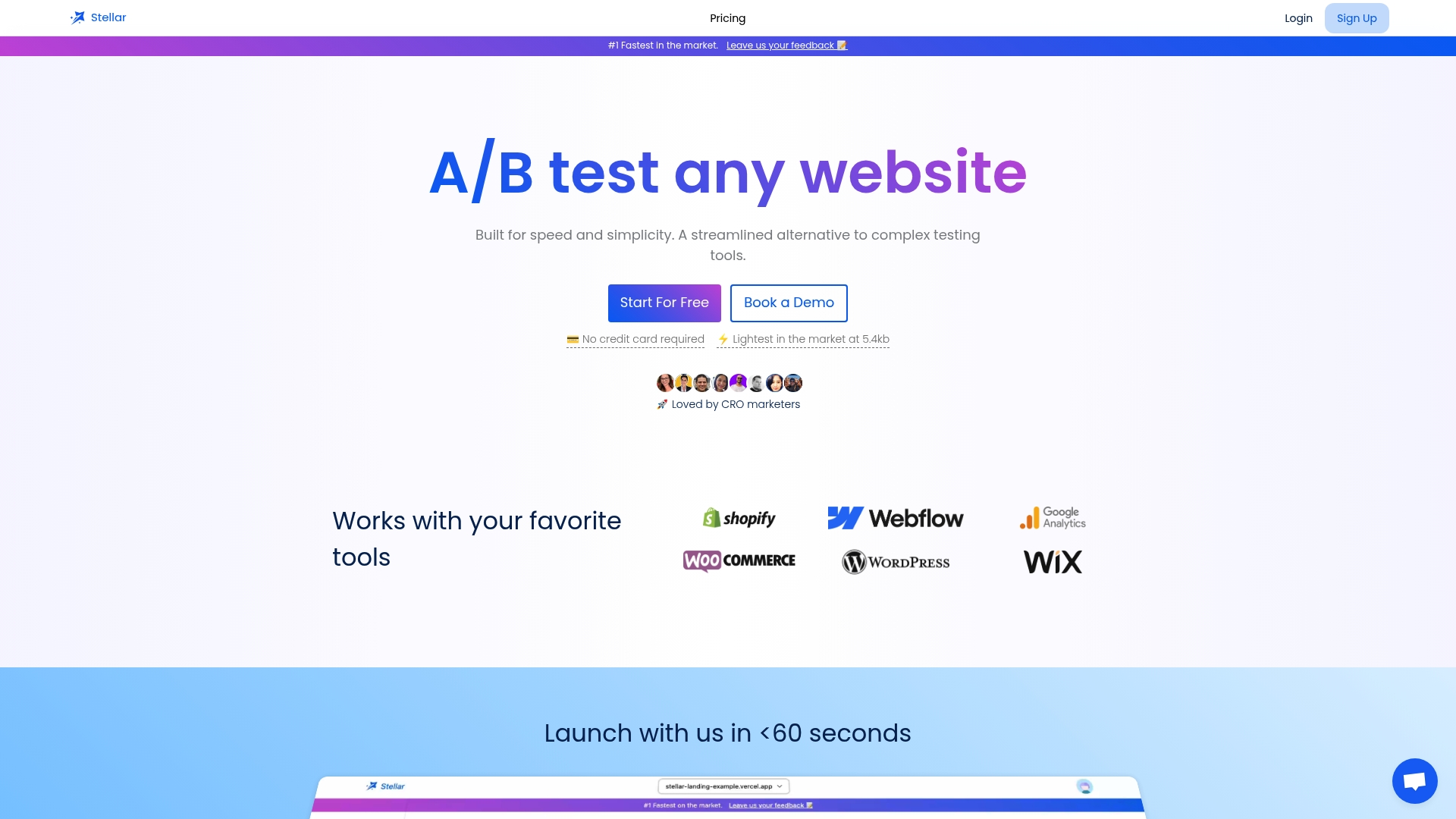
The platform's real-time analytics help you interpret results correctly, whether you're tracking significance with confidence intervals or monitoring p-values across your testing duration. For SMB marketers managing multiple experiments simultaneously, the visual editor and advanced goal tracking let you set up tests quickly and focus on strategic decisions rather than technical implementation. With pricing tiers starting at a free plan for under 25,000 monthly tracked users, you can apply the statistical rigor discussed in this article without stretching your testing budget.
FAQ
What is the main benefit of a one-sided test?
One-sided tests concentrate statistical power in a single direction, enabling you to detect effects faster with smaller sample sizes. This makes them ideal for low-traffic campaigns where reaching significance with a two-sided test would take prohibitively long. The approximately 25-30% reduction in required samples translates directly to shorter testing windows and quicker optimization cycles.
When should I always use a two-sided test?
Use two-sided tests whenever you're uncertain about the direction of effect or testing changes that could potentially harm conversions. Major redesigns, pricing changes, checkout flow modifications, and any high-stakes experiments warrant the safety of detecting effects in both directions. The sample size premium is worth paying when the cost of missing a negative effect exceeds the value of faster results.
Can using a one-sided test cause missing important data?
Yes, one-sided tests create a critical blind spot by only examining one tail of the distribution. If your variant actually decreases conversions but you're testing for increases, the one-sided test will return a non-significant result rather than flagging the problem. You might conclude the change had no effect and leave it running, continuing to lose conversions without realizing the harm.
How do sample size requirements differ between the tests?
One-sided tests typically require 25-30% fewer samples than two-sided tests to achieve the same statistical power. For example, detecting a 15% relative lift at 80% power might need 6,000 visitors per variant with a one-sided test versus 8,000 with a two-sided test. This difference compounds when traffic is limited, potentially making certain effect sizes detectable only with the one-sided approach.
Recommended
- A/B Testing Explained: Best Practices and Examples
- One-Tailed vs. Two-Tailed Tests: Choosing the Right Approach for Your A/B Tests
- Einseitige vs. Zweiseitige Tests: Der richtige Ansatz für Ihre A/B-Tests
- Pruebas Unilaterales vs Bilaterales en A/B Testing: Eligiendo el Enfoque Correcto
- What is A/B testing in ads: boost performance by 40%
Published: 3/26/2026