
Optimizely A/B testing: No-code experimentation for marketers
Most marketers know A/B testing drives better decisions, but getting a test live without a developer can feel impossible. Waiting weeks for engineering support kills momentum and buries potential wins. No-code A/B testing through platforms like Optimizely changes that equation entirely, letting you build, launch, and analyze experiments visually. This article walks you through how to evaluate A/B testing platforms, how Optimizely's workflow actually operates, what advanced statistical methods like CUPED mean for your results, and when a simpler alternative might serve your team better.
Table of Contents
- How to evaluate A/B testing platforms for marketers
- Optimizely A/B testing essentials: Features and workflow
- Advanced Optimizely methodologies: Variance reduction, multivariate, and personalization
- Real results: Benchmarks and what winning tests have in common
- When is Optimizely the best fit? Platform comparison and cost realities
- Level up your experimentation with practical tools
- Frequently asked questions
Key Takeaways
| Point | Details |
|---|---|
| No-code empowers marketers | Optimizely lets growth teams run A/B tests visually and quickly, skipping the need for developer support. |
| Advanced statistics drive faster wins | CUPED and delta methods mean smaller sample sizes and more reliable results for your campaigns. |
| Benchmarks reveal what works | Personalized and multivariate experiments outperform basics, and focus beats test volume. |
| Choose tools based on needs | Optimizely excels at complexity, but other platforms may suit SMBs wanting speed and simplicity. |
How to evaluate A/B testing platforms for marketers
Choosing the right A/B testing platform is not just about features. It is about how fast you can move from hypothesis to data without getting blocked. The wrong tool creates bottlenecks. The right one removes them.
Here is what to prioritize when evaluating your options:
- Visual editor quality: Can you point, click, and edit directly on your site? No-code testing benefits are only real if the editor is genuinely intuitive.
- AI assistance: Does the platform help you generate variants or surface test ideas automatically?
- Sample size guidance: Good platforms tell you how many visitors you need before your results are statistically valid.
- Multi-page and funnel support: Single-page tests miss conversion leaks that happen across multiple steps.
- Integration ease: Your testing tool should connect to your analytics stack without custom engineering work.
- Built-in reporting: You should not need a data analyst to read your results.
- Traffic allocation controls: Flexible splits (not just 50/50) let you protect revenue while testing bold changes.
The biggest pitfall most SMB marketers fall into is choosing a tool that looks simple but hides complexity in its reporting or requires developer involvement to push variants live. Watch for that gap between the demo and the reality. Also, common A/B testing pitfalls like peeking at results too early or running too many simultaneous tests can invalidate your data regardless of which platform you use.
Pro Tip: Always ask vendors how their platform prevents p-hacking. P-hacking means stopping a test the moment results look favorable, which produces false positives. Platforms with sequential testing or fixed-horizon guardrails protect you from this mistake.
Optimizely A/B testing essentials: Features and workflow
Optimizely's Web Experimentation product is built around the idea that marketers should own the testing process end to end. The visual editor lets you directly modify headlines, images, CTAs, and layouts on your live site without touching a line of code. Templates accelerate setup for common test types like hero section variants or form redesigns.
Here is the standard experiment workflow inside Optimizely:
- Define your hypothesis and select the page or element you want to test.
- Build variants using the visual editor or AI-assisted suggestions from Opal, Optimizely's built-in AI.
- Set traffic allocation, typically a 50/50 split between control and variant.
- Assign metrics, choosing primary goals like clicks or purchases and secondary metrics for context.
- Launch the experiment via Optimizely's SDK, which buckets visitors into groups automatically.
- Monitor results in the real-time dashboard and wait for statistical significance before calling a winner.
Opal is worth highlighting separately. It analyzes your existing content and past experiment data to suggest high-potential variants, which means you spend less time guessing and more time running tests that actually have a shot at winning. For tips on Optimizely success, leaning into Opal's suggestions early in your program pays off fast.
"Focus on 10 great tests over 200 mediocre ones. With Opal and visual workflows, you launch what matters."
If you are managing A/B testing without dev support, Optimizely's codeless setup is one of the strongest options available. Marketers can create tests visually, use templates, and edit content directly, with no engineering ticket required.

Advanced Optimizely methodologies: Variance reduction, multivariate, and personalization
Once you move past basic A/B tests, Optimizely's statistical toolkit becomes a real competitive advantage. Two methods stand out: CUPED and the delta method.
CUPED (Controlled-experiment Using Pre-Experiment Data) is a variance reduction technique. In plain terms, it uses data from before your experiment started to filter out noise in your results. The practical impact is significant: CUPED cuts required sample sizes by up to 41 to 50 percent, meaning you reach reliable conclusions faster without needing more traffic.
Here is a concrete example of what that means statistically. A test that might show a p-value of 0.09 (not significant) without variance reduction can drop to 0.03 (significant) after CUPED is applied. That is the difference between shelving a winning idea and shipping it.
The delta method handles a different problem: calculating the right sample size when you are measuring relative lift rather than absolute change. Optimizely supports multivariate and personalized tests using this approach, which makes your pre-test planning more accurate.
| Test type | Relative win rate | Sample size impact |
|---|---|---|
| Standard A/B | Baseline | Standard |
| Multivariate | 1.5x higher | Larger per variant |
| Personalization | Highest | Segment-dependent |
| A/B with CUPED | Baseline | Up to 50% smaller |
For teams looking to improve conversions with A/B tests, multivariate tests are especially powerful when you want to understand how multiple page elements interact, not just which headline wins. Pair that with email A/B testing best practices and you have a full-funnel optimization strategy.
Real results: Benchmarks and what winning tests have in common
Data from 127,000+ experiments gives us a realistic picture of what A/B testing actually delivers. The overall win rate on the primary metric sits at 12 percent. That sounds modest, but it compounds fast when you run tests consistently.
Industry-level win rates vary:
- Food and Beverage: 17%
- Financial Services: 15%
- Retail/eCommerce: ~12%
- Media and Publishing: ~10%
Multivariate tests are 1.5 times more likely to produce a winner than standard A/B tests. Personalization experiments and significant UX overhauls consistently outperform minor copy tweaks. The lesson: test things that actually matter to users, not just button colors.
One concern that often comes up is whether real-world A/B testing is corrupted by p-hacking. An analysis of 2,270 ecommerce A/B tests found no evidence of systematic p-hacking, which means the industry's results are more trustworthy than skeptics assume.
Pro Tip: The top-performing experimentation teams run 200 or more tests per year, but volume alone is not the goal. They prioritize test quality, focusing on experiments tied to real user pain points and meaningful business metrics. Avoid A/B testing pitfalls by building a structured hypothesis backlog rather than testing randomly.
If you want to benchmark your own program, look at conversion optimization tools that give you speed and accuracy without sacrificing statistical rigor.
When is Optimizely the best fit? Platform comparison and cost realities
Optimizely is genuinely powerful, but it is not the right fit for every SMB. Understanding where it excels and where it creates friction helps you make a smarter investment decision.
| Feature | Optimizely | VWO |
|---|---|---|
| Visual editor | Strong, AI-assisted | Strong, simpler UI |
| Pricing | Higher, enterprise-leaning | More SMB-friendly |
| Statistical methods | CUPED, delta method, sequential | Standard frequentist |
| Personalization | Built-in, advanced | Available, less robust |
| Learning curve | Steeper | Gentler |
| Integrations | Extensive | Good |
Optimizely is more robust but pricier than rivals like VWO, which tends to appeal more to cost-conscious SMBs. That gap matters when you are working with a lean budget and need results fast.
Choose Optimizely when:
- You need advanced statistical methods like CUPED for faster, more reliable results.
- Your team runs personalization campaigns alongside standard A/B tests.
- You want AI-assisted variant generation through Opal.
- You are scaling an experimentation program and need enterprise-grade infrastructure.
Consider alternatives when:
- Your monthly testing budget is tight and you need a free or low-cost entry point.
- Your team is new to A/B testing and needs a gentler learning curve.
- You only run simple, single-page tests without complex metrics.
- Developer resources are limited and you need the fastest possible setup.
For SMBs focused on conversion improvement steps without a large budget, lighter tools with no-code editors and real-time analytics can deliver strong results at a fraction of the cost.
Level up your experimentation with practical tools
If this article has made one thing clear, it is that the barrier to effective A/B testing is lower than ever. You do not need a developer, a statistician, or an enterprise contract to run experiments that move the needle. You need the right platform, a clear hypothesis, and the discipline to let data guide your decisions.
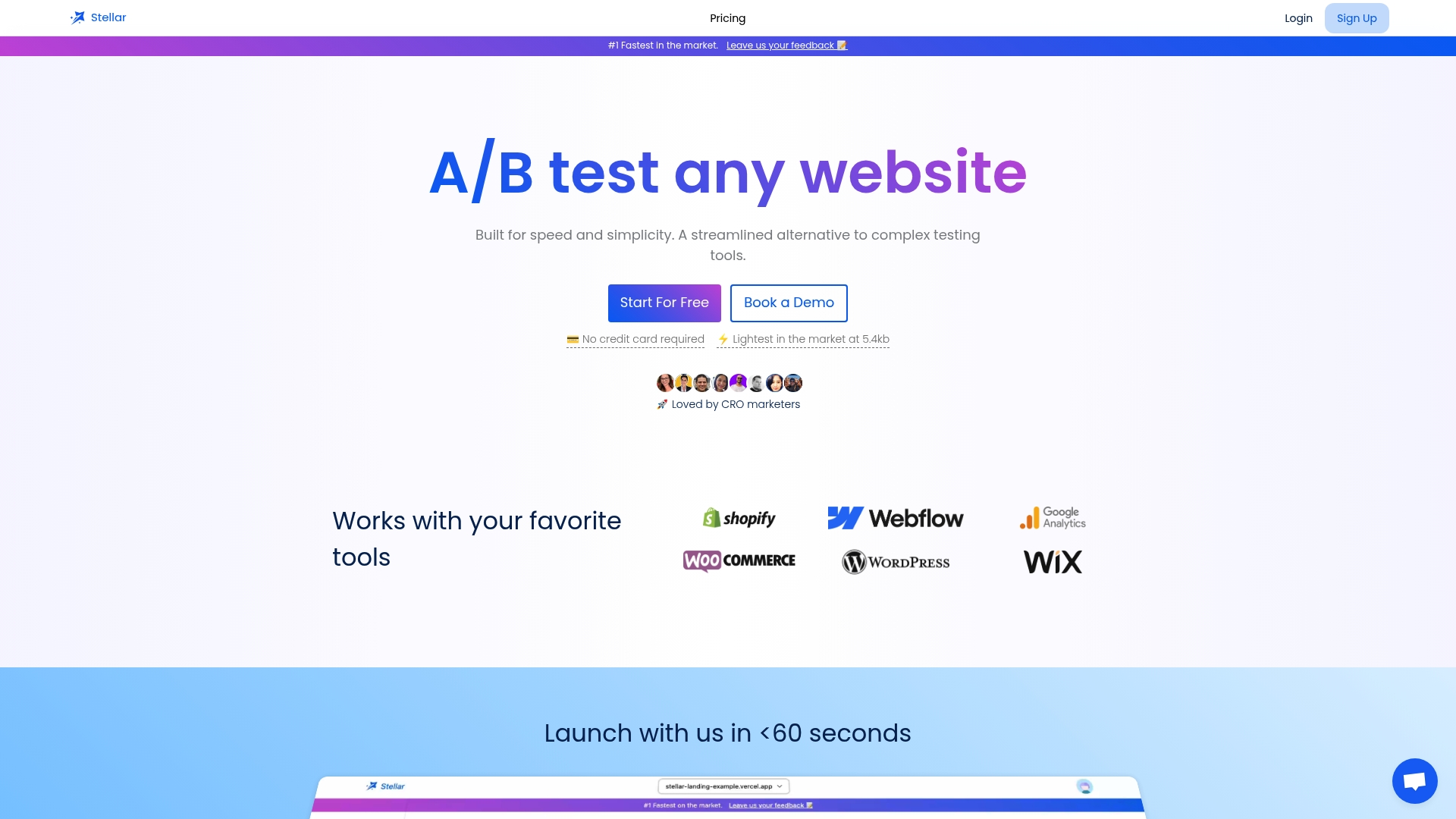
Stellar is built exactly for marketers and growth hackers who want to move fast without technical overhead. With a 5.4KB script that barely touches your page speed, a no-code visual editor, dynamic keyword insertion, and real-time analytics, it gives SMBs the experimentation power of enterprise tools at a price that makes sense. Explore conversion strategies that pair perfectly with Stellar's testing capabilities, and start your free plan today at gostellar.app.
Frequently asked questions
What is Optimizely's no-code A/B testing and how does it work?
Optimizely's visual editor lets marketers build and launch experiments by clicking directly on their site, using templates and AI suggestions, with no programming required. You set up variants, assign metrics, and monitor results entirely through the platform's interface.
How do advanced methodologies like CUPED help A/B testing results?
CUPED reduces required sample sizes by up to 41 to 50 percent by filtering pre-experiment noise from your data, which means you reach statistically valid conclusions faster. It is especially valuable for teams with moderate traffic who cannot afford to wait months for results.
What are win rates and success rates for Optimizely A/B tests?
Across 127,000+ experiments, the overall win rate on the primary metric is 12 percent, with multivariate and personalized tests consistently outperforming standard A/B splits. Industry win rates range from around 10 percent in media to 17 percent in food and beverage.
Is Optimizely suitable for small businesses or startups?
Optimizely offers powerful features for SMBs that need advanced statistics and personalization, but its cost and complexity can be a barrier for teams with tight budgets or limited testing experience. Simpler, lower-cost tools may be a smarter starting point.
Does industry A/B testing suffer from p-hacking?
An analysis of 2,270 ecommerce tests found no systematic evidence of p-hacking, meaning real-world A/B testing results are generally statistically sound. Using platforms with built-in significance guardrails adds another layer of protection.
Recommended
Published: 3/28/2026