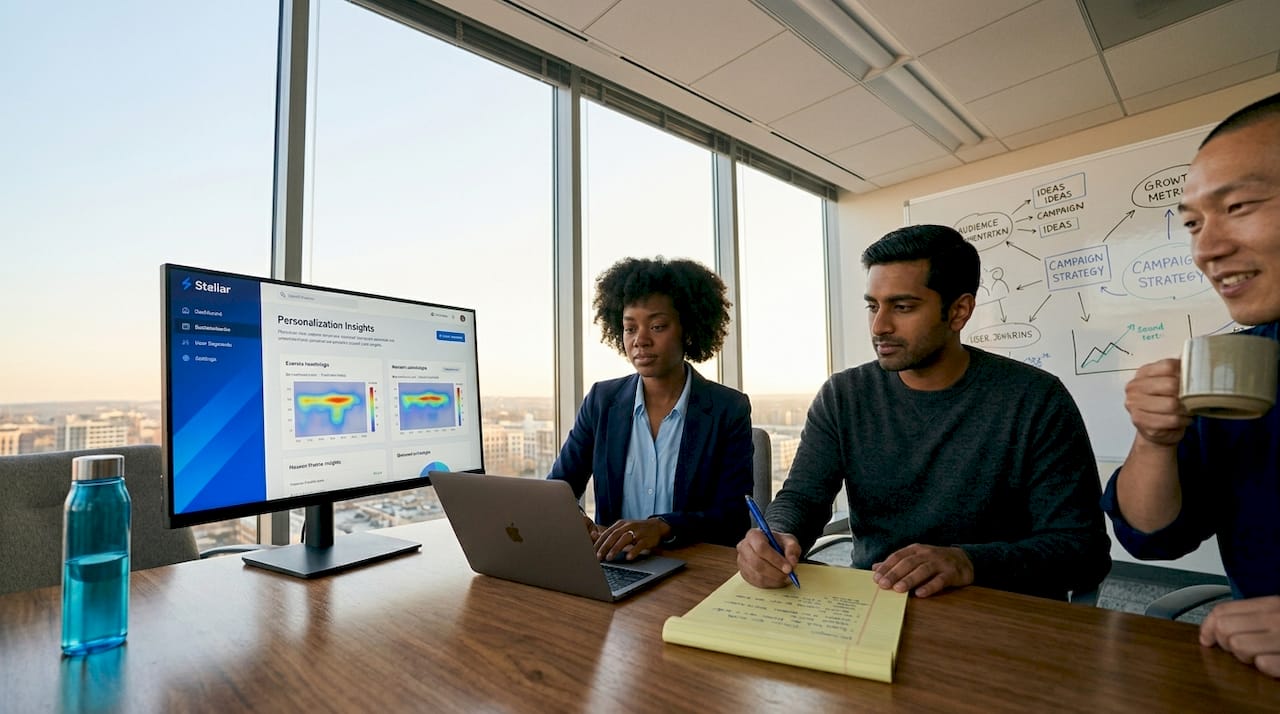
Optimizely Personalization: Strategies That Drive Results
TL;DR:
- Most marketers wrongly assume Optimizely personalization is only for large teams with extensive data science resources.
- However, it offers scalable, sophisticated tools accessible to any marketing team willing to implement systematized strategies.
Most marketers assume Optimizely personalization is reserved for enterprise teams with dedicated data scientists and months of setup time. That assumption is costing them conversions. Optimizely's personalization platform gives you the tools to deliver tailored content delivery at scale, without requiring a PhD in data engineering. From behavioral triggers to AI-driven audience segments, the platform puts genuinely sophisticated personalized marketing techniques within reach of any marketing team willing to think systematically. This guide breaks down exactly how to use it.
Table of Contents
- Key takeaways
- Optimizely personalization: core concepts you need to know
- Building a data-driven personalization strategy
- Optimizing engagement and conversions with tailored content
- Advanced personalization techniques and integrations
- My honest take on getting personalization right
- Take your personalization strategy further
- FAQ
Key takeaways
| Point | Details |
|---|---|
| Start with audience segments | Define clear behavioral and demographic segments before building any personalized experience. |
| Unify your customer data | Break down data silos so Optimizely can build accurate, real-time profiles that reflect actual user behavior. |
| Test every personalization | Run controlled experiments on personalized content, not just generic A/B tests, to measure true lift. |
| Layer AI on top of rules | Use Optimizely's AI features to scale personalization beyond what manual rules can handle alone. |
| Respect privacy from day one | Build compliance into your data collection process rather than retrofitting it after launch. |
Optimizely personalization: core concepts you need to know
Optimizely's personalization engine works by connecting visitor data to content variations in real time. When a user lands on your site, Optimizely evaluates them against defined audience criteria and serves the experience most likely to resonate. That sounds simple. The actual power comes from how deeply you can define those criteria.
The platform operates around four core building blocks:
- Segments and audiences: Groups of visitors defined by attributes like location, device type, referral source, purchase history, or on-site behavior. Segments can be static or dynamic, updating as user behavior changes.
- Triggers: Events or conditions that activate a personalized experience. A trigger might be a user visiting a pricing page twice in one session, or arriving from a specific paid search campaign.
- Content variations: The actual experiences delivered to each segment. This includes headlines, hero images, CTAs, product recommendations, or entire page layouts.
- Experimentation layer: Optimizely's A/B and multivariate testing tools sit directly alongside personalization, so you can measure whether a personalized experience actually outperforms the default. Learn more about Optimizely experimentation and how it supports continuous improvement.
What sets Optimizely apart from simpler website personalization tools is its behavior tracking depth. The platform captures real-time signals like scroll depth, click patterns, and session frequency, and feeds those signals into audience definitions. Dynamic segmentation based on real-time behavior improves targeting precision and increases user satisfaction in ways that static segments simply cannot match.
Optimizely also integrates AI through its Opal orchestration layer, which moves beyond rule-based personalization into predictive modeling. Instead of you manually defining every segment, Opal identifies patterns across your user base and surfaces optimization opportunities you might never have thought to look for.
Building a data-driven personalization strategy
Good personalization lives or dies on data quality. You can have the most sophisticated segmentation logic in the world. If the underlying data is incomplete, stale, or fragmented across systems, your personalized experiences will feel generic at best and off-putting at worst.
Here is how to build a strategy that actually holds up:
- Audit your current data sources. Map out where customer data lives today. CRM, email platform, ad accounts, website analytics, and any CDP you use. Identify gaps and redundancies before you connect anything to Optimizely.
- Build unified customer profiles. Overcoming data silos is a prerequisite for delivering consistent personalized experiences. Connect your data sources so Optimizely sees a complete picture of each user, not isolated fragments.
- Define your segments with purpose. Resist the urge to create dozens of micro-segments on day one. Start with three to five high-value audience groups based on behavioral signals like purchase intent, content engagement, or lifecycle stage.
- Map content to each segment. For each audience, identify the message or experience most likely to move them forward. A first-time visitor from paid search needs different messaging than a returning customer who has browsed your enterprise pricing page three times.
- Connect experimentation to personalization. Every personalized experience should be treated as a hypothesis. Run it as a controlled test against your default experience, track statistical significance, and iterate based on what the data tells you.
Pro Tip: Before building your first personalized campaign, spend one week reviewing session recordings and heatmaps for your top three traffic segments. The behavioral patterns you spot will give you sharper hypotheses than any persona document ever will.
One underrated challenge is recency. A user who bought last week behaves differently than the same user six months later. Build your audience definitions to account for time-decay. A segment labeled "high purchase intent" should automatically expire visitors who have not shown that behavior in the last 14 to 30 days, depending on your sales cycle.

AI and machine learning make it practical to scale personalization without manually managing every rule and segment update. Once your data foundation is solid, letting Optimizely's models learn and adjust continuously is far more sustainable than trying to anticipate every scenario yourself. For a deeper look at how this connects to broader conversion work, the personalizing for higher conversions guide is worth your time.
Optimizing engagement and conversions with tailored content
Data and segments are your inputs. The output is an experience that makes visitors feel seen and understood. Here is where personalization strategies translate into measurable results.
The most reliable conversion lifts come from aligning content to user lifecycle stage. A visitor reading a comparison blog post is not ready for a demo request. Serve them a relevant case study or a free trial offer with low commitment. A returning user who has already watched a product demo should see a direct CTA with a clear next step. Personalized offers based on unified customer data consistently outperform generic messaging in both engagement and conversion metrics.
| Content type | Best use case | Personalization trigger |
|---|---|---|
| Hero headline | First impression for new visitors | Traffic source or campaign UTM |
| Product recommendations | Returning visitors with browsing history | Previous page views or purchases |
| CTA copy | Mid-funnel users showing high intent | Multiple visits to pricing or feature pages |
| Social proof | Visitors from specific industries | Firmographic data from CRM or IP lookup |
| Exit intent offers | Visitors about to leave without converting | Scroll depth and time-on-page thresholds |
Testing personalized experiences requires a different mindset than standard A/B testing for marketers. You are not just comparing two headlines. You are validating whether a specific audience segment actually responds better to a tailored experience than to your generic default. Set up holdout groups for each segment so you always have a clean baseline to measure against.
Measurement is where many teams stumble. Continuous testing and performance tracking are not optional post-launch tasks. Build a review cadence into your workflow, weekly for active campaigns, monthly for evergreen personalization rules. Pay close attention to metrics beyond click-through rate: session depth, return visit rate, and downstream conversion steps tell a more complete story.
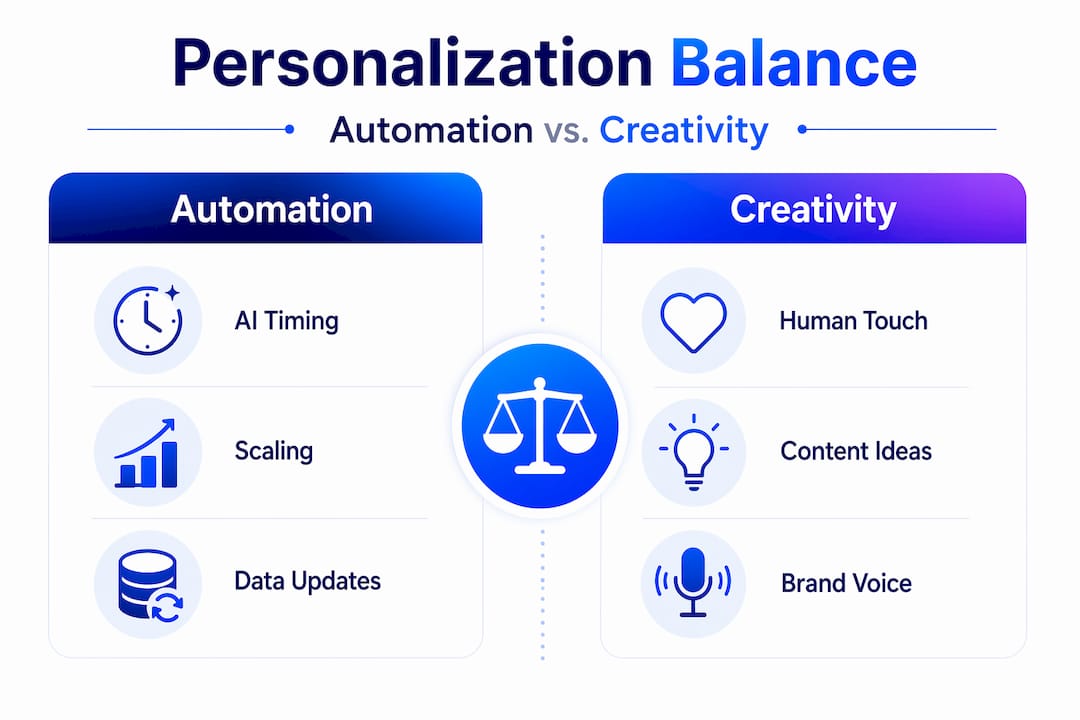
The balance between automation and human creativity matters more than most platforms will admit. AI can optimize timing and delivery, but the message itself still needs a human perspective. The landing page personalization techniques that consistently perform best combine algorithmically optimized delivery with copy and design that feels genuinely written for the reader.
Advanced personalization techniques and integrations
Once your foundational strategy is running, there are several higher-order capabilities worth building toward.
Optimizely Opal is the platform's AI orchestration layer. It moves beyond reactive personalization, where you serve content based on what a user just did, into predictive personalization, where you anticipate what they are likely to do next. Opal analyzes behavioral patterns across your entire user base and can surface recommendations about which segments to prioritize and which content variations to test.
Integrations dramatically expand what is possible. Connecting Optimizely to your CRM unlocks firmographic and lifecycle data that enriches your audience definitions. Connecting to a customer data platform gives you cross-channel behavioral signals that site-only tracking would miss. Integrating CRM, CDPs, and marketing platforms is what separates surface-level personalization from experiences that feel genuinely relevant across every touchpoint.
| Integration type | What it unlocks | Example use case |
|---|---|---|
| CRM | Account and lifecycle data | Personalize by customer tier or renewal date |
| CDP | Cross-channel behavioral profiles | Unify web, email, and app behavior |
| Ad platforms | Campaign and audience data | Match landing page content to ad creative |
| Email marketing | Email engagement history | Tailor site experience based on email clicks |
For omnichannel personalization, the standard is high. Real-time data integration across channels is what makes the experience feel consistent rather than fragmented. If a user clicks an email about a product feature, the website experience they land on should reflect that interest immediately, not after a 24-hour sync delay.
Privacy compliance is non-negotiable. Balancing personalization with data privacy means building consent management into your data collection from the start, not bolting it on later. Know which data points require explicit opt-in in your jurisdiction and configure Optimizely's tracking accordingly. Personalization built on consented, first-party data is also more reliable because users who opt in tend to provide higher-quality behavioral signals.
Pro Tip: When scaling personalization across multiple market segments, resist the instinct to build a separate strategy for each one. Instead, build a modular content system where core components like headlines, proof points, and CTAs can be swapped independently. This cuts production time significantly while still delivering relevant experiences.
As your business grows, the architecture of your personalization program matters as much as the campaigns themselves. Omnichannel personalization requires unified customer data and a technology stack that can share information in real time. Plan that architecture early, because retrofitting it after you have 50 active personalization rules is genuinely painful.
My honest take on getting personalization right
I have worked with enough marketing teams to see the same pattern repeat. The ambition is there. The platform is bought. Three months later, the only live personalization rule is a welcome banner for first-time visitors, and nobody is sure if it is actually working.
The gap is almost never about the tool. It is about the absence of a deliberate process. Teams skip the data audit. They build audiences based on assumptions rather than behavior. They launch personalized experiences and then never check whether those experiences are actually moving the metrics they care about. Measuring performance and iterating regularly is what separates teams that grow with personalization from teams that stall after the initial setup.
The thing I find most underestimated is data hygiene. Garbage data produces confident-sounding personalized experiences that are actually irrelevant. I have seen "personalized" product recommendations go wrong because historical purchase data was not cleaned before being fed into the segmentation engine. The result was returning customers being recommended products they already owned. Not a great look.
My honest advice: start smaller than you think you should. One well-tested, well-measured personalized experience for your highest-value segment will teach you more than ten half-built campaigns spread across every audience you can imagine. Build the muscle before you scale the volume. And always run a holdout group so you know, with data, that your personalization is actually working.
— Juan
Take your personalization strategy further
You have the framework. Now you need the right tools to test, iterate, and confirm that your personalization efforts are actually producing lift. Gostellar is built for exactly that. With a no-code visual editor, real-time analytics, and a 5.4KB script that will not slow your pages down, it gives you the experimentation layer your personalization strategy needs without requiring a developer for every change.
Whether you are running your first behavioral segment test or validating a full omnichannel personalization workflow, Gostellar gives you clean data and fast results. Explore how personalized content drives results and then put that into practice with Gostellar's A/B testing platform built for marketers who move fast.
FAQ
What is Optimizely personalization?
Optimizely personalization is a set of platform features that lets marketers serve different content, layouts, and experiences to different visitor segments based on behavioral, demographic, and contextual data. It works alongside Optimizely's experimentation tools to test and validate personalized experiences.
How does Optimizely use AI for personalization?
Optimizely's Opal layer applies AI and machine learning to identify behavioral patterns and predict user needs, moving beyond manual rule-based segmentation. This allows marketers to scale personalization efforts while maintaining relevance across large, diverse audiences.
What data do you need to start with Optimizely personalization?
You need at minimum a reliable source of behavioral data from your website, such as pages visited, session frequency, and traffic source. Connecting a CRM or CDP expands what you can personalize significantly, but basic behavioral segmentation is a practical starting point for most teams.
How do you measure whether personalization is working?
Set up holdout groups for each personalized experience so you have a control group to measure against. Track not just click-through rates but downstream metrics like session depth, return visits, and conversion rate on key goals to get a full picture of impact.
What are common mistakes in personalization strategy?
The most common mistakes are skipping the data audit before setup, building too many segments too quickly, and failing to run controlled tests on personalized experiences. Treating personalization as a set-and-forget tactic rather than a continuous testing program also consistently limits results.
Recommended
Published: 5/22/2026