
Optimizing mobile checkout for higher conversions in 2026
Mobile shoppers abandon carts at alarming rates, often exceeding 85%, costing ecommerce businesses billions in lost revenue annually. The culprit? Poorly optimized mobile checkout experiences that frustrate users with complex forms, slow loading times, and limited payment options. While mobile conversion rates hover around 1.5-2.2%, roughly half of desktop performance, this gap represents massive untapped potential. This guide walks you through proven strategies to transform your mobile checkout into a conversion machine, covering everything from foundational analytics setup to advanced optimization tactics that deliver measurable results.
Table of Contents
- Understanding The Mobile Checkout Problem: Challenges And Data
- Preparing For Optimization: Essential Prerequisites
- Executing Mobile Checkout Improvements: Practical Strategies
- Verifying And Refining Your Mobile Checkout Optimization
- Optimize Your Mobile Checkout With Stellar App
- Frequently Asked Questions About Mobile Checkout Optimization
Key takeaways
| Point | Details |
|---|---|
| Mobile conversion gap | Mobile checkout converts at roughly half the rate of desktop, with abandonment exceeding 85%. |
| Friction reduction | Eliminating extra costs, forced accounts, and complex forms directly increases completion rates. |
| Speed and wallets | Fast loading times and mobile payment options like Apple Pay boost conversions by 10-18%. |
| Testing matters | Continuous A/B testing and real user monitoring ensure sustained improvement over time. |
Understanding the mobile checkout problem: challenges and data
Before diving into solutions, you need to grasp the scale of the mobile checkout challenge facing ecommerce businesses today. Mobile conversion rates average 1.5-2.2%, significantly trailing desktop's 3.36%. This performance gap isn't just a minor inconvenience. It represents millions in potential revenue slipping through your fingers every month.
The situation gets worse when you examine cart abandonment. Mobile cart abandonment exceeds 85%, outpacing desktop rates by a substantial margin. Think about that for a moment: more than eight out of every ten mobile shoppers who add items to their cart never complete the purchase. That's not a conversion problem. That's a conversion crisis.
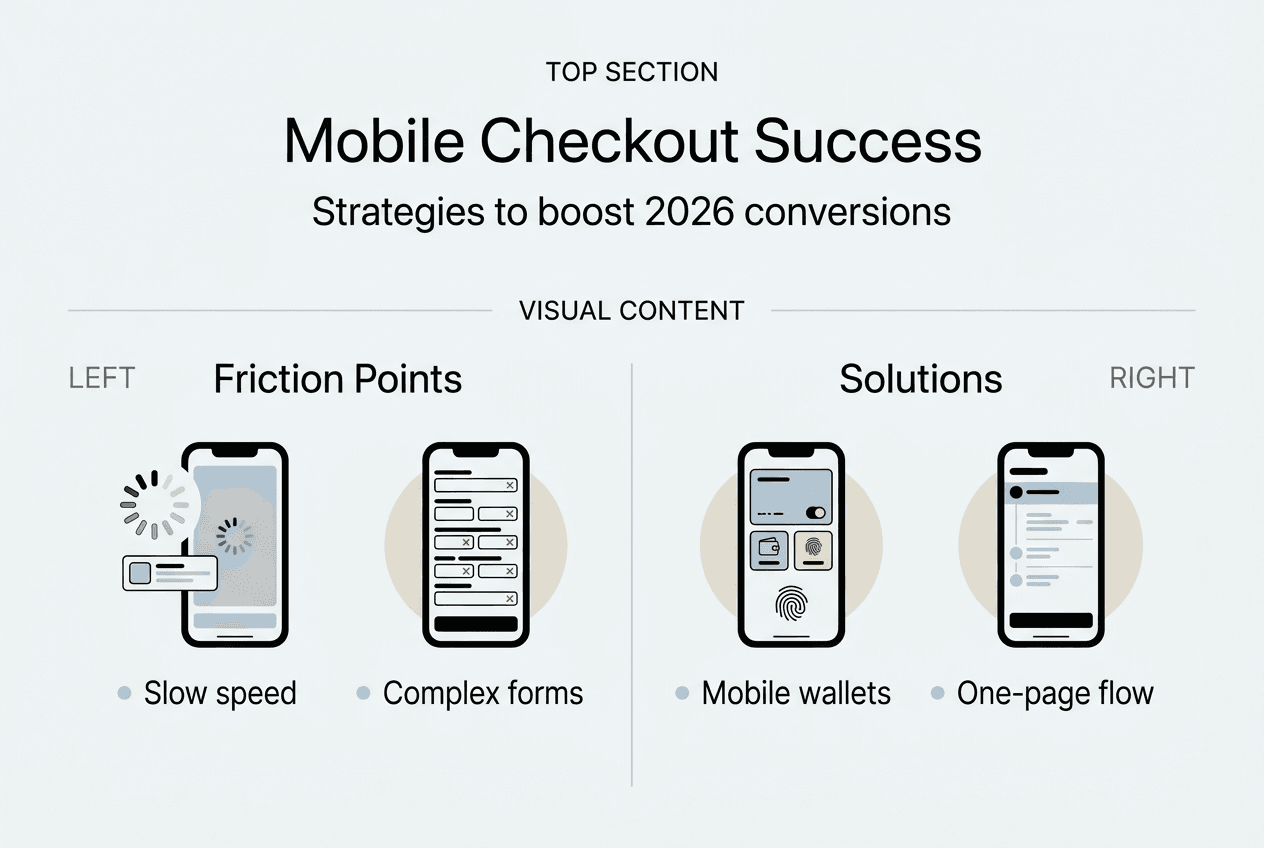
What drives these staggering abandonment rates? Research identifies several key friction points:
- Unexpected extra costs appearing at checkout
- Forced account creation blocking quick purchases
- Complex, lengthy forms requiring excessive typing on small screens
- Slow page load times testing user patience
- Limited payment options failing to match user preferences
Understanding these barriers is your first step toward meaningful improvement. Each friction point represents an opportunity to reclaim lost conversions. When you tackle the right problems with targeted solutions, you can dramatically shift those numbers in your favor. The mobile conversion optimization strategies that work best address multiple friction points simultaneously, creating compound improvements rather than isolated gains.
Here's how the mobile checkout landscape breaks down:
| Metric | Mobile | Desktop |
|---|---|---|
| Average conversion rate | 1.5-2.2% | 3.36% |
| Cart abandonment rate | 85-85.65% | 69-73% |
| Primary friction point | Complex forms | Shipping costs |
Preparing for optimization: essential prerequisites
Jumping straight into checkout redesigns without proper groundwork wastes time and money. You need foundational elements in place before optimization tactics can deliver their full potential. Start by understanding your specific user behaviors rather than relying on industry averages alone.
Analyze which devices your mobile shoppers use most frequently. Are they primarily on iOS or Android? What screen sizes dominate your traffic? What network conditions do they face? These details shape which optimizations will matter most. A checkout experience perfect for iPhone users on 5G might fail miserably for Android users on spotty connections.

Set up robust analytics tracking focused specifically on your mobile checkout funnel. Google Analytics 4 offers powerful mobile-specific reporting, but only if configured correctly. Track every step: cart view, checkout initiation, payment information entry, and purchase completion. Identify exactly where users drop off. You can't fix what you can't measure.
Prepare your technical infrastructure for the improvements ahead:
- Implement guest checkout capabilities to bypass forced account creation
- Integrate mobile wallet APIs for Apple Pay and Google Pay
- Set up a content delivery network to accelerate page loads globally
- Consider progressive web app architecture for app-like experiences
- Establish A/B testing capabilities to validate changes scientifically
Pro Tip: Before making any checkout changes, document your current baseline metrics in detail. Record conversion rates, average completion time, and abandonment rates at each step. This baseline becomes your measuring stick for improvement and helps you prove ROI to stakeholders.
The ecommerce website testing strategies you implement now determine how quickly you can iterate later. Organizations that invest in proper testing infrastructure move faster and make better decisions. Those that skip this step end up guessing, which rarely ends well.
Don't overlook payment infrastructure. Digital payment trends in 2026 show mobile wallets continuing their rapid growth. Getting Apple Pay and Google Pay integration ready now positions you to capitalize on user preferences immediately. These aren't nice-to-have features anymore. They're table stakes for competitive mobile checkout.
Executing mobile checkout improvements: practical strategies
With preparation complete, you're ready to implement changes that directly impact conversion rates. These aren't theoretical improvements. They're battle-tested tactics backed by data from thousands of ecommerce sites.
Start with form simplification. Reducing form fields from 15-23 to 9-14 lifts completion rates by 20-35%. Every field you eliminate removes friction and saves precious seconds on mobile keyboards. Ask yourself: do you really need a separate billing address if it matches shipping? Does the middle name field add value worth the conversion cost?
Here's your execution roadmap:
- Enable guest checkout as the default option, making account creation optional after purchase
- Integrate mobile wallet payments to offer 10-18% conversion uplift from Apple Pay and Google Pay
- Implement autofill and address validation to minimize typing and errors
- Design tap targets at minimum 44x44 pixels to prevent frustrating mis-taps
- Make primary call-to-action buttons sticky, keeping them visible as users scroll
The checkout format debate deserves special attention. One-page checkout outperforms multi-step by 21.8% for simple mobile orders. However, complex purchases with multiple customization options may benefit from progressive disclosure across steps. Test both formats with your specific product mix and audience.
Pro Tip: When implementing mobile wallets, place them prominently above traditional payment fields. Users who prefer Apple Pay or Google Pay want to spot these options immediately. Burying them below credit card forms defeats their speed advantage.
Consider this comparison of checkout approaches:
| Approach | Best for | Conversion impact | Implementation effort |
|---|---|---|---|
| One-page checkout | Simple products, few options | +21.8% vs multi-step | Medium |
| Multi-step checkout | Complex products, customization | Better for cognitive load | High |
| Guest checkout | All scenarios | Reduces 25% of abandonment | Low |
| Mobile wallets | Repeat customers | +10-18% conversion | Medium |
Speed optimization deserves equal priority with UX improvements. Mobile users expect instant responses. Every 100 milliseconds of delay costs conversions. Implement lazy loading for images, minimize JavaScript execution, and leverage browser caching aggressively. Your checkout page should load in under two seconds on 4G connections.
The mobile conversion strategies that work best combine multiple improvements rather than relying on single silver bullets. Stack form simplification with mobile wallets and speed optimization. These changes reinforce each other, creating compound effects that single optimizations never achieve alone.
Verifying and refining your mobile checkout optimization
Implementing improvements is only half the battle. Verification ensures your changes actually work as intended and identifies opportunities for further refinement. Without rigorous testing, you're flying blind, hoping your intuition matches user behavior.
A/B testing provides the scientific foundation for optimization decisions. Test one variable at a time to isolate impact clearly. Run tests on button copy, form layouts, payment method ordering, and checkout flow variations. Real user monitoring and A/B micro-tests reveal insights that analytics alone miss.
Focus your performance monitoring on metrics that directly correlate with conversions:
- Largest Contentful Paint under 2.5 seconds
- First Input Delay below 100 milliseconds
- Cumulative Layout Shift under 0.1
- Time to interactive under 3 seconds
These Core Web Vitals aren't just Google ranking factors. They're user experience indicators that predict conversion success. LCP under 2.5s and 100ms faster load time corresponds to 1% conversion lift. Small improvements compound over time.
Your testing roadmap should follow this sequence:
- Establish statistical significance thresholds before starting tests to avoid premature conclusions
- Run tests for full business cycles to account for weekly patterns and seasonal variations
- Segment results by device type, traffic source, and user type to uncover hidden insights
- Document learnings systematically to build institutional knowledge over time
Quantitative data tells you what happens, but qualitative feedback reveals why. Implement session recording to watch real users navigate your checkout. You'll spot usability issues that metrics never surface. See where users hesitate, what confuses them, and where they abandon.
Gather direct user feedback through post-purchase surveys and exit intent popups. Ask abandoners specifically what prevented completion. Their answers often surprise you, revealing friction points you never considered. One retailer discovered users abandoned because the checkout button color matched error messages, creating subconscious anxiety.
"Continuous iteration based on real user data, not assumptions, separates high-performing checkouts from mediocre ones. Test everything, believe nothing until data confirms it."
The testing checkout forms process never truly ends. Markets evolve, user expectations shift, and new technologies emerge. Organizations that treat optimization as ongoing practice rather than one-time projects consistently outperform competitors who set and forget their checkouts.
Monitor your improvements over extended periods. Initial conversion lifts sometimes fade as novelty wears off or as you exhaust the segment most responsive to changes. Sustainable optimization requires constant vigilance and willingness to challenge previous wins when data suggests better approaches exist.
Optimize your mobile checkout with Stellar app
Transforming your mobile checkout from conversion killer to revenue driver requires the right tools alongside the right strategies. Stellar gives you the A/B testing platform specifically built for ecommerce teams who need to move fast without sacrificing performance.

Our lightweight 5.4KB script ensures your optimization efforts never slow down the checkout experience you're working so hard to improve. The visual editor lets you test form layouts, button placements, and checkout flows without waiting on developers. Track mobile-specific goals with advanced analytics that show exactly which variations drive conversions.
Whether you're testing guest checkout implementation, mobile wallet integration, or form field reduction, Stellar provides the experimentation infrastructure to validate changes scientifically. Start with our free plan for sites under 25,000 monthly users, then scale as your optimization program matures and delivers results.
Frequently asked questions about mobile checkout optimization
How much does checkout simplification actually improve conversion rates?
Reducing form fields from 15-23 to 9-14 fields typically lifts completion rates by 20-35%, with the exact impact varying based on your product complexity and audience. The key is eliminating truly unnecessary fields rather than arbitrarily cutting to hit a number. Test systematically to find your optimal balance between information gathering and conversion friction.
Why does guest checkout matter so much for mobile users?
Forced account creation causes approximately 25% of cart abandonment on mobile devices. Users on small screens with limited patience want to complete purchases quickly, not manage another password. Offering guest checkout with optional post-purchase account creation captures these conversions while still building your customer database over time.
What performance metrics are most critical for mobile checkout success?
Largest Contentful Paint under 2.5 seconds is the single most important metric, as it directly correlates with conversion rates. Every 100ms improvement in load time corresponds to roughly 1% conversion lift. Focus on LCP first, then optimize First Input Delay and Cumulative Layout Shift to ensure smooth, responsive interactions throughout the checkout process.
Should I use one-page or multi-step checkout for mobile?
One-page checkout outperforms multi-step by 21.8% for simple products with few options or customizations. However, complex purchases with extensive configuration may benefit from multi-step approaches that reduce cognitive load. Test both formats with your specific product mix, as the optimal choice depends heavily on your unique context and user behavior patterns.
How quickly can I expect to see results from mobile checkout optimization?
Initial improvements often appear within days of implementing changes like guest checkout or mobile wallets, assuming sufficient traffic for statistical significance. However, sustainable optimization requires 4-6 weeks of testing to account for weekly patterns and seasonal variations. Plan for continuous iteration rather than expecting single changes to permanently solve conversion challenges.
Recommended
- Mobile Conversion Optimization Strategies for 2025: Boost Sales Fast
- Optimizing Mobile Landing Pages: Proven Strategies for 2025
- How to test checkout forms for higher conversion in 2026
- Ecommerce Website Testing: Optimize Conversions for 2025 Success
- Conversieoptimalisatie: meer leads en verkopen uit je website halen - ZazouTotaal webdesign en online marketing Helmond
Published: 3/18/2026