
Run efficient multi-variant A/B tests: step-by-step guide
TL;DR:
- Proper setup and clear hypotheses are essential for meaningful multi-variant A/B testing outcomes.
- Changing only one variable per variant and ensuring sufficient sample size prevents inconclusive results.
- Most failures stem from poor hypothesis focus, improper traffic split, or stopping tests early.
You launch a test with three or four page variants, wait two weeks, and end up staring at data that tells you nothing useful. Sound familiar? Multi-variant A/B testing is one of the most powerful tools in a marketer's toolkit, but it's also one of the easiest to get wrong. Too many variants, too little traffic, or a vague hypothesis can turn a promising experiment into a waste of time and budget. This guide gives you a clear, practical blueprint for running multi-variant tests that actually produce actionable results, without needing a data science degree to pull it off.
Table of Contents
- What you need before launching a multi-variant A/B test
- Step-by-step: How to set up and run multi-variant A/B tests
- Common mistakes and how to avoid them
- Analyzing results and making decisions
- What most marketers get wrong (and how to actually win with multi-variant A/B testing)
- Run smarter A/B tests with the right tools
- Frequently asked questions
Key Takeaways
| Point | Details |
|---|---|
| Prepare thoroughly | Define your hypothesis, pick strong variants, and ensure enough traffic for meaningful data. |
| Use the right approach | Choose between A/B or multivariate methods based on your site's volume and goals. |
| Avoid common errors | Only test one change per variant and meet minimum sample size to avoid inconclusive results. |
| Analyze for impact | Interpret results statistically and combine with user insights to make confident decisions. |
What you need before launching a multi-variant A/B test
After understanding why disorganized variant testing leads to confusion, let's build the right foundation for success.
Before you touch a single landing page or write a line of code, preparation is everything. The most common reason multi-variant tests fail is not a bad idea. It's a weak setup. You need to know exactly what you're trying to improve and why, before you create a single variant.
Start with a sharp hypothesis. A good hypothesis follows a simple structure: "If we change X, then Y will improve, because Z." For example: "If we change the CTA button color from gray to green, then click-through rate will increase, because green signals action and creates contrast." Vague goals like "let's see what works better" produce vague results. Following A/B testing best practices from the start saves you from restarting tests that should have worked.
Isolate one variable per variant. This is the rule most teams break. If Variant B has a new headline AND a new image AND a different button, you won't know which change drove the result. Each variant should change exactly one element from the control. That's how you get clean, interpretable data.
Calculate your required sample size before you start. This is non-negotiable. Multi-variant test steps require a minimum of 100 to 300 conversions per variant to reach statistical significance at 95% confidence (p < 0.05). If you have three variants plus a control, that's at least 400 to 1,200 total conversions needed. Use a free sample size calculator (tools like Evan Miller's or AB Tasty's calculator work well) to plug in your current conversion rate and the minimum detectable effect you care about.
Preparation checklist before you launch:
- Clear, specific hypothesis with one measurable outcome
- One variable changed per variant
- Sample size calculated based on current traffic and conversion rate
- Traffic randomization confirmed (equal split across all variants)
- Test duration estimated at a minimum of one full week
- Tracking and goal events verified in your analytics platform
- Baseline conversion rate documented for comparison
Traffic split matters more than most teams realize. Randomized, equal traffic distribution across all variants is critical. If your tool front-loads traffic to certain variants or doesn't randomize properly, your results will be skewed from day one. Understanding what A/B testing in marketing actually requires at a technical level helps you ask the right questions of your testing platform before you commit to a setup.
| Preparation step | Why it matters | Common mistake |
|---|---|---|
| Define hypothesis | Gives your test a measurable goal | Testing without a clear expected outcome |
| Isolate one variable | Ensures clean, readable results | Changing multiple elements per variant |
| Calculate sample size | Prevents underpowered tests | Stopping early when numbers look good |
| Randomize traffic | Eliminates selection bias | Sending new vs. returning users to different variants |
| Set test duration | Captures weekly behavior cycles | Running tests for only 2-3 days |
Pro Tip: Always run your test for at least one full business week, even if you hit your sample size target faster. Weekly patterns in user behavior (weekday vs. weekend traffic) can significantly skew your results if you stop too soon.
Step-by-step: How to set up and run multi-variant A/B tests
Once you're equipped with the right tools and data, you can begin the actual setup. Here's how to do it right.
Setting up a multi-variant test is a sequential process. Skipping steps or reordering them is where most teams introduce errors that invalidate their results.
Step 1: Define your goal and hypothesis. Write it down formally. What page, what element, what metric, and what expected direction of change. This document becomes your test brief.

Step 2: Decide between A/B testing and multivariate testing (MVT). These are not the same thing. A/B testing with multiple variants means you test several versions of one element against a control, one change per variant. MVT tests combinations of multiple elements simultaneously (headline + image + button, for example). Choosing test variants correctly depends on your traffic volume and the complexity of what you want to learn. As a rule, avoid MVT under 100k unique visitors per month. Below that threshold, you simply won't collect enough data per combination to reach significance.
Step 3: Build your variants. Create each variant with exactly one change from the control. Use a visual editor if you don't have developer resources. Document every change in a shared log so your team knows exactly what each variant contains.
Step 4: Set up randomized traffic splitting. Your testing platform should handle this automatically, but verify it. Each variant, including the control, should receive an equal percentage of traffic. For four variants, that's 25% each.
Step 5: Configure your goal tracking. Define the primary conversion event (button click, form submission, purchase) and any secondary metrics you want to monitor (time on page, scroll depth). Secondary metrics help you understand why a variant won or lost, not just whether it did.
Step 6: Run the test for the full planned duration. Do not stop early because one variant looks like it's winning. Statistical significance at 95% (p < 0.05) requires the full sample. Peeking at results and stopping early is one of the most common causes of false positives in A/B testing.
Step 7: Analyze results and decide on next steps. More on this in the analysis section below.
| Method | Best for | Traffic requirement | Complexity |
|---|---|---|---|
| A/B (2 variants) | Single element, clear hypothesis | Low to medium | Simple |
| A/B (3-4 variants) | Testing multiple options for one element | Medium | Moderate |
| Multivariate (MVT) | Testing element combinations | High (100k+ uniques/month) | Complex |
Pro Tip: If you're using a multivariate testing approach and your traffic is borderline, consider a Bayesian statistical model instead of a frequentist one. Bayesian methods are better suited to smaller sample sizes and give you probability-based results rather than binary pass/fail significance scores.
Common mistakes and how to avoid them
Understanding how to execute each phase is crucial, but avoiding the typical setbacks will double the value of your efforts.
Even well-prepared teams make predictable mistakes in multi-variant testing. Knowing what they are in advance is the fastest way to improve your success rate.
The biggest mistakes in multi-variant A/B testing:
- Changing more than one variable per variant. This is the most frequent error and completely undermines your ability to draw conclusions. If two things change, you can't attribute results to either one with confidence.
- Stopping the test too early. A variant that looks like a winner after three days may not hold up over a full week. Novelty effects, weekend traffic patterns, and random variance all distort early results.
- Ignoring sample size requirements. Running a test with 30 conversions per variant and calling a winner is not A/B testing. It's guessing with extra steps.
- Skipping the power calculation. Statistical power (usually set at 80%) tells you the probability your test will detect a real effect if one exists. Without it, you're flying blind on whether your test design can actually answer your question.
- Conflating A/B testing with MVT when traffic is too low. 70 to 80% of A/B tests are inconclusive or fail outright. Trying to run an MVT on a site with 20,000 monthly visitors is a near-guaranteed path to that failure category.
- Not using qualitative data alongside quantitative results. Numbers tell you what happened. Heatmaps, session recordings, and user surveys tell you why. Using heatmaps alongside A/B tests gives you the context to build better hypotheses for your next test.
- Not accounting for interaction effects in MVT. In multivariate testing, two elements that each perform well individually can actually hurt conversion when combined. This is called an interaction effect, and it's a real risk in complex MVT setups.
"The real problem isn't that A/B testing doesn't work. It's that most teams test the wrong things with the wrong setup and then wonder why the results don't hold up after rollout." Following A/B test best practices isn't about following a checklist. It's about building a testing culture that values rigor over speed.
Pro Tip: Before you run any test, write down what result would cause you to act on the data. If Variant B beats control by 5%, will you roll it out? What if it's only 2%? Deciding your action threshold in advance prevents you from moving the goalposts after you see the numbers.
Analyzing results and making decisions
Avoiding mistakes isn't the end. Progress depends on interpreting your findings and knowing exactly how to act on them.
Analysis is where multi-variant testing gets interesting, and where a lot of teams still stumble. Having data is not the same as having insight. Here's how to read your results and make confident decisions.
Step 1: Check statistical significance first. Your primary filter is whether each variant reached 95% confidence (p < 0.05). This means there's less than a 5% chance the observed difference is due to random variation. If a variant hasn't hit this threshold, you don't have a result yet. You have noise.
Step 2: Look at confidence intervals, not just point estimates. A conversion rate of 4.2% vs. 3.8% sounds meaningful, but if the confidence intervals overlap significantly, the difference may not be real. Your testing tool should display confidence intervals. Use them.
Step 3: Compare all variants against the control, not against each other. The control is your baseline. Each variant wins or loses relative to that baseline. Comparing Variant B to Variant C directly introduces multiple comparison problems that inflate false positive rates.
Step 4: Review secondary metrics for context. If Variant B increased button clicks but also increased bounce rate, that's a mixed signal. Statistical significance at 95% on your primary metric is necessary but not sufficient for a confident rollout decision. Secondary metrics tell the fuller story.
Step 5: Decide what to do next. You have three options after a test concludes. Roll out the winning variant, run a follow-up test to explore why a variant won (or lost), or archive the test and move on to a higher-priority hypothesis. For advanced A/B strategies, the most valuable outcome of any test is often the next question it generates, not just the answer it provides.
Key stat: Bayesian methods suit smaller samples better than traditional frequentist approaches, making them a smarter choice for SMBs that can't wait months to accumulate data.
One practical habit that separates strong testing programs from weak ones: document every test result, including the inconclusive ones. Patterns across failed tests often reveal systemic issues with your hypotheses or your audience segmentation that no single test would surface on its own.
What most marketers get wrong (and how to actually win with multi-variant A/B testing)
With a clear process for analysis and execution, let's step back and confront some hard truths about multi-variant testing.
Here's the uncomfortable reality: most A/B testing programs are not actually testing. They're running experiments with a veneer of rigor while making the same structural mistakes repeatedly. 70 to 80% of A/B tests are inconclusive or fail to produce a clear winner. That's not a tool problem. That's a thinking problem.
The most common culprit is the hypothesis. Teams test button colors and font sizes because they're easy to change, not because there's a strong behavioral reason to believe those changes will move the needle. Real testing leverage comes from understanding why users aren't converting in the first place. That means talking to customers, reviewing session recordings, and reading support tickets before you ever open your testing tool.
More variants do not mean more learning. In fact, the opposite is often true. Adding a fourth or fifth variant dilutes your traffic across more buckets, extends your test duration, and increases the risk of inconclusive results. The teams that win consistently with multi-variant testing are the ones who ask sharper questions, not the ones who run more simultaneous experiments.
The other underrated factor is validating test ideas before you build them. A quick user survey or five-second test can tell you whether your proposed variant even resonates with real users, before you invest in building and running a full experiment. That kind of qualitative pre-validation dramatically improves your hit rate on tests that actually produce meaningful lifts.
The teams that get multi-variant testing right treat it as a learning system, not a conversion rate optimization shortcut. Each test, whether it wins or loses, feeds better hypotheses into the next cycle. That compounding effect is where the real growth comes from.
Run smarter A/B tests with the right tools
If you're ready to eliminate guesswork in your testing, here's how our platform can help.
Running multi-variant tests manually, or with a bloated enterprise tool that slows your site down, creates friction that kills momentum. Stellar is built specifically for marketers and product managers at small to medium-sized businesses who need fast, reliable experimentation without the overhead.
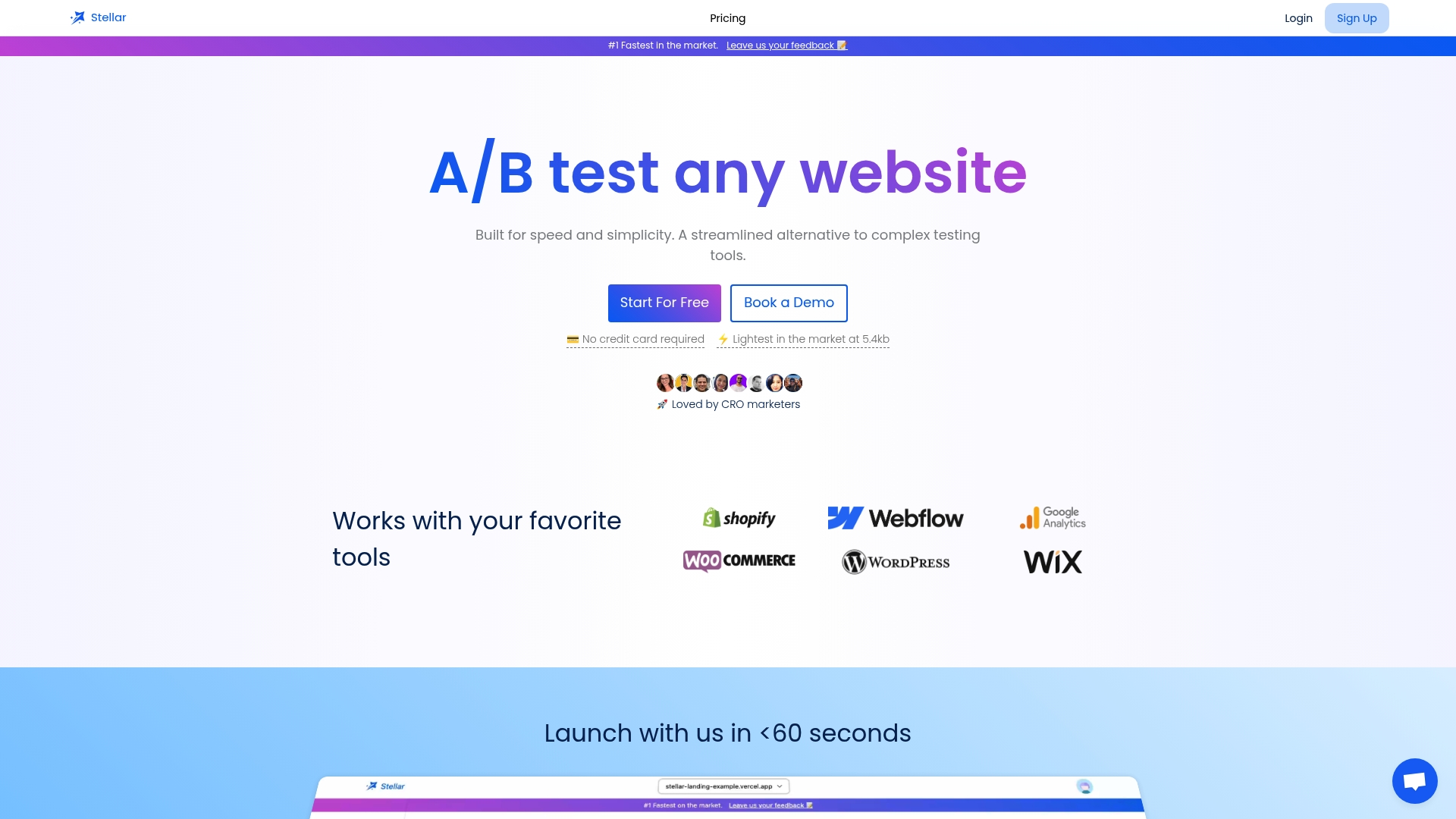
Run multi-variant tests with Stellar using a no-code visual editor that lets you build and launch variants in minutes, not days. At just 5.4KB, the Stellar script won't hurt your page speed or your SEO. Real-time analytics and advanced goal tracking give you the conversion data you need to make confident decisions quickly. Whether you're on the free plan (up to 25,000 monthly tracked users) or scaling up, Stellar removes the technical barriers so you can focus on what actually matters: running better experiments and growing faster.
Frequently asked questions
How many variants should I test at once?
You should limit your test to only as many variants as your traffic and sample size can support. For most small to medium business sites, that means 2 to 4 variants, since each variant requires a minimum of 100 to 300 conversions to reach statistical significance.
Can I use A/B testing with multiple variants on low-traffic sites?
Traditional A/B testing (two variants) works at lower traffic volumes, but multi-variant and MVT tests need significantly more data, ideally over 100,000 unique visitors per month, to produce reliable results across all variant combinations.
How long should multi-variant experiments run?
Tests should run for at least one full week and continue until you've collected the required sample size per variant. Stopping tests early before hitting your sample size target is one of the leading causes of false positives in A/B testing.
What if my test results are inconclusive?
Review your original hypothesis for clarity, verify that you collected enough data per variant, and consider simplifying your test design. Most inconclusive tests trace back to weak hypotheses or underpowered test setups rather than a fundamental problem with the idea being tested.
Recommended
Published: 4/30/2026