
Segmentation for Personalization: Boosting A/B Test Success
Nearly 90 percent of American online shoppers say personalized experiences influence their purchase decisions. For digital marketers in e-commerce, segmentation forms the backbone of personalization strategy, helping carve out groups that truly reflect customer motivations. Understanding how to define and implement targeted segments empowers businesses to maximize efficient A/B testing, discover impactful personalization tactics, and drive stronger conversion rates with confidence.
Table of Contents
- Defining Segmentation For Personalization Goals
- Segmentation Types Used In A/B Testing
- Key Data Sources And Collection Methods
- Implementing Segmentation For Dynamic Personalization
- Common Pitfalls And Optimizing Segmentation Strategies
Key Takeaways
| Point | Details |
|---|---|
| Personalization Requires Strategic Segmentation | Effective personalization in digital marketing depends on a well-defined segmentation strategy that categorizes customers based on behavioral, demographic, and psychological attributes. |
| Advanced Techniques Enhance Insights | Utilizing methods like clustering and machine learning allows marketers to optimize user segments and improve personalization efforts significantly. |
| Continuous Optimization is Key | Dynamic segmentation practices require ongoing data analysis and adjustments to keep personalization relevant and effective for changing user behaviors. |
| Avoid Common Pitfalls | Marketers should be cautious of over-segmentation and data quality issues to prevent ineffective targeting and enhance A/B testing results. |
Defining Segmentation for Personalization Goals
Personalization in digital marketing requires a strategic approach to understanding and dividing customer groups. Segmentation represents the foundational process of categorizing users based on specific characteristics, enabling targeted experiences that resonate with individual preferences. Strategic customer segmentation methods have evolved from broad, generic targeting to precise, data-driven approaches that address unique user motivations.
Effective segmentation goes beyond simple demographic groupings. Modern approaches integrate multiple data dimensions, including behavioral patterns, transactional histories, engagement levels, and psychological attributes. By analyzing these complex factors, marketers can create nuanced segments that reveal deeper insights into customer needs. Research demonstrates that personalization strategies centered on individual differences can dramatically improve user engagement and conversion rates.
The primary goals of segmentation for personalization include:
- Identifying distinct user groups with similar characteristics
- Understanding unique motivational drivers for each segment
- Creating targeted experiences that speak directly to specific user needs
- Developing more precise A/B testing hypotheses
- Improving overall conversion and engagement metrics
Pro tip: Start by creating 3-5 initial segments based on your most significant user characteristics, then refine and test these segments iteratively to uncover the most meaningful personalization opportunities.
Segmentation Types Used in A/B Testing
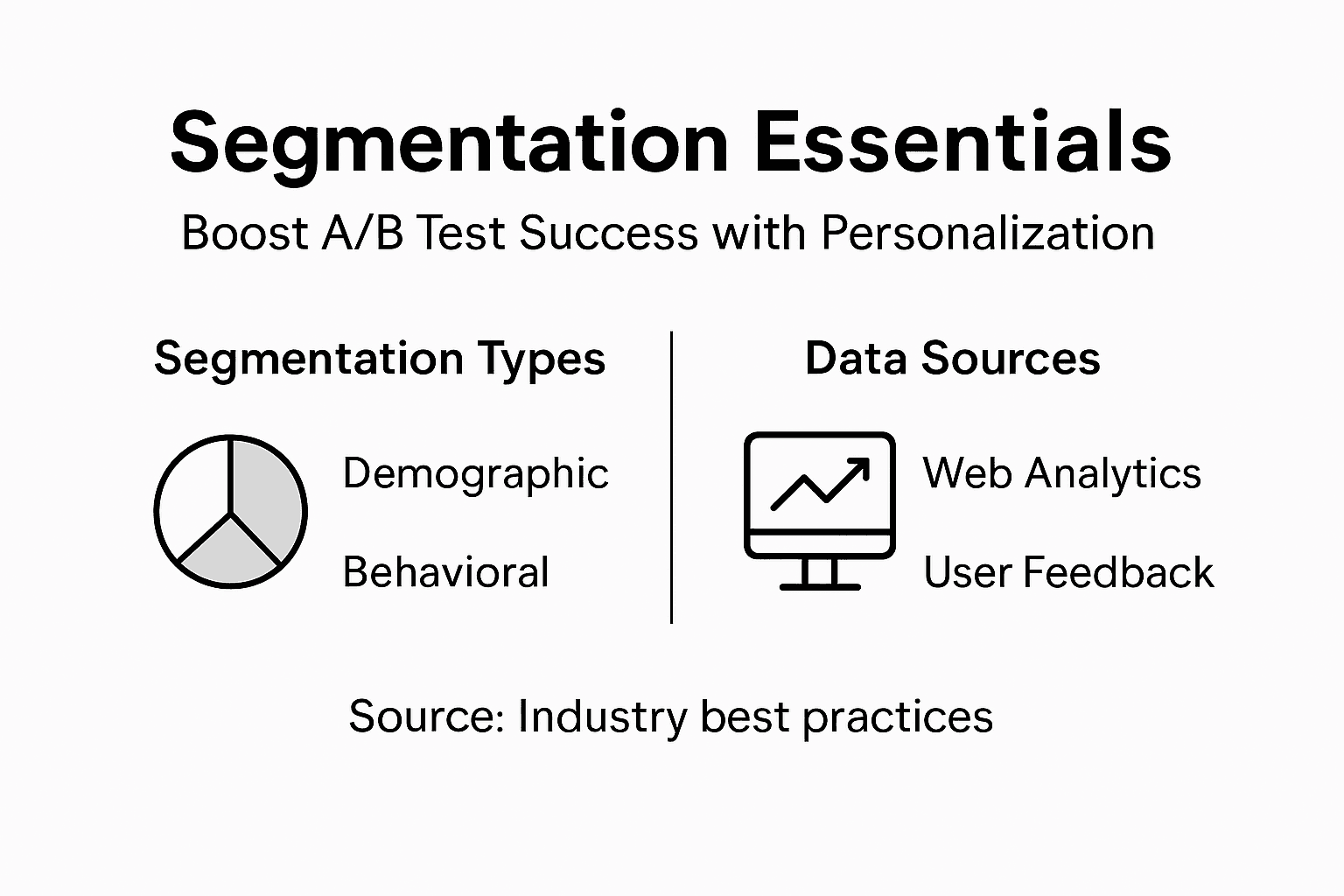
A/B testing relies on sophisticated segmentation approaches that enable marketers to divide audiences into meaningful groups for targeted experimentation. Clustering techniques like k-means play a crucial role in creating precise user segments that reveal nuanced insights into customer behavior and preferences.
Four primary segmentation types dominate A/B testing strategies:
- Demographic Segmentation: Divides users by objective characteristics such as:
- Age
- Gender
- Income level
- Education
- Geographic location
- Behavioral Segmentation: Focuses on user actions and interactions:
- Purchase history
- Website engagement
- Product usage patterns
- Frequency of interactions
- Customer loyalty levels
- Psychographic Segmentation: Explores psychological attributes:
- Personal values
- Lifestyle choices
- Interests and hobbies
- Personality traits
- Motivational drivers
- Technographic Segmentation: Analyzes technological characteristics:
- Device type
- Browser preferences
- Operating system
- Connection speed
- Digital literacy
Advanced segmentation techniques now leverage AI-powered algorithms that dynamically refine segments in real-time, enabling more precise and adaptive personalization strategies.

Here's how different segmentation types compare in terms of data complexity and personalization impact:
| Segmentation Type | Data Complexity | Personalization Impact |
|---|---|---|
| Demographic | Low | Basic content tailoring |
| Behavioral | Medium | Relevant offer suggestions |
| Psychographic | High | Deep emotional engagement |
| Technographic | Medium | Optimized device experiences |
Pro tip: Combine multiple segmentation types to create comprehensive, multi-dimensional user profiles that provide deeper insights and more targeted A/B testing opportunities.
Key Data Sources and Collection Methods
Data-driven customer segmentation requires a comprehensive approach to gathering and analyzing multiple data streams. Modern marketers leverage diverse sources to create robust user profiles that enable precise personalization and effective A/B testing strategies.
Key data sources for segmentation can be categorized into several primary types:
- First-Party Data Sources:
- Website analytics
- User account information
- Purchase history
- Customer support interactions
- Email engagement metrics
- Mobile app usage data
- Behavioral Data Collection:
- Click-through rates
- Session duration
- Navigation paths
- Content consumption patterns
- Conversion funnel interactions
- Repeat visit frequencies
- Transactional Data:
- Product preferences
- Average order value
- Purchase frequency
- Payment methods
- Seasonal buying patterns
- Discount response rates
- Technological Tracking:
- Device types
- Browser information
- Geographic location
- Network connection types
- Operating system details
- Screen resolution
Personalization industry reports highlight the critical importance of combining multiple data types while maintaining strict privacy standards. Advanced analytics platforms now enable real-time data integration and dynamic segmentation, allowing marketers to create increasingly precise user profiles.

Pro tip: Implement a robust consent management system that transparently communicates data collection practices and provides users with clear opt-in/opt-out mechanisms to build trust while gathering segmentation insights.
Implementing Segmentation for Dynamic Personalization
Machine learning approaches have revolutionized how marketers create and manage dynamic user segments. Modern personalization strategies require continuous adaptation, moving beyond static categorizations to responsive, real-time user profiling that evolves with each interaction.
The implementation process for dynamic segmentation involves several critical stages:
- Data Collection and Integration:
- Aggregate data from multiple sources
- Establish unified data pipelines
- Ensure real-time data synchronization
- Validate data quality and consistency
- Create comprehensive user profiles
- Algorithmic Segmentation:
- Utilize machine learning clustering techniques
- Apply predictive analytics models
- Develop adaptive segmentation rules
- Create dynamic segment boundaries
- Implement continuous learning mechanisms
- Personalization Activation:
- Map segments to tailored content variations
- Design responsive A/B test variants
- Configure automated personalization rules
- Establish trigger-based content delivery
- Monitor segment performance metrics
- Continuous Optimization:
- Track segment performance
- Recalibrate segmentation algorithms
- Identify emerging user behavior patterns
- Adjust personalization strategies
- Eliminate underperforming segments
Business intelligence architectures now support sophisticated, fluid segmentation that responds instantly to changing user characteristics, enabling marketers to deliver increasingly precise personalized experiences.
This table summarizes key actions and expected outcomes at each stage of dynamic segmentation implementation:
| Implementation Stage | Key Action | Expected Outcome |
|---|---|---|
| Data Collection | Aggregate multi-source data | Unified, accurate user profiles |
| Algorithmic Segmentation | Apply machine learning models | Adaptive, evolving user groups |
| Personalization Activation | Deliver tailored experiences | Increased engagement rates |
| Continuous Optimization | Refine segments and strategies | Sustained performance growth |
Pro tip: Implement a robust feedback loop that continuously validates and refines your segmentation model, ensuring your personalization strategies remain agile and responsive to evolving user behaviors.
Common Pitfalls and Optimizing Segmentation Strategies
Segmentation strategy challenges can significantly undermine A/B testing effectiveness. Digital marketers frequently encounter complex obstacles that prevent them from creating meaningful, actionable user segments that drive genuine personalization and conversion improvements.
Key pitfalls in segmentation strategies include:
- Over-Segmentation:
- Creating too many narrow segments
- Reducing statistical significance
- Fragmenting audience insights
- Increasing complexity
- Diminishing practical usability
- Data Quality Issues:
- Incomplete user profiles
- Inconsistent data collection
- Outdated information
- Lack of data validation
- Unreliable tracking mechanisms
- Misaligned Targeting:
- Ignoring business objectives
- Disconnecting segments from goals
- Failing to understand user motivations
- Applying generic segmentation approaches
- Neglecting contextual nuances
- Analytical Limitations:
- Insufficient statistical methods
- Overlooking segment interactions
- Rigid segmentation models
- Poor feature selection
- Limited validation techniques
Personalization optimization strategies emphasize the critical importance of continuous evaluation and iterative refinement. Successful segmentation requires a dynamic approach that balances granularity, relevance, and actionable insights while maintaining robust validation processes.
Pro tip: Regularly audit your segmentation strategy by comparing segment performance against core business objectives, and be prepared to merge, split, or eliminate segments that do not demonstrably contribute to meaningful conversion improvements.
Unlock Precision Segmentation and Personalization with Stellar
Struggling to implement effective segmentation for your A/B tests that truly boost your conversion rates The article "Segmentation for Personalization" highlights how balancing multi-dimensional user profiles and avoiding over-segmentation are key challenges marketers face. It also emphasizes the need for dynamic, real-time personalization driven by data and machine learning to engage users uniquely and increase their loyalty.
Stellar is designed specifically to tackle these challenges head-on. With the fastest and lightest A/B testing tool in the market featuring a simple no-code visual editor and advanced goal tracking you can create and test targeted user segments effortlessly. Seamlessly integrate behavioral and demographic data into your experiments and dynamically personalize your landing pages with features like dynamic keyword insertion. This precision enables you to deliver tailored experiences without the complexity or performance drag typical of other platforms.
Take control of your personalization goals today with Stellar’s A/B Testing Tool.
Don’t let fragmented data or overcomplicated setups hold your campaigns back. Start using Stellar now to unlock real-time analytics and responsive segmentation that scales with your business. Get started fast and see how your tailored strategies translate into higher engagement and conversions.
Frequently Asked Questions
What is segmentation in digital marketing?
Segmentation in digital marketing is the process of categorizing users based on specific characteristics such as demographics, behavior, and psychographics. This allows marketers to create targeted experiences that resonate with individual preferences.
How does segmentation improve A/B testing results?
Segmentation enhances A/B testing by dividing audiences into meaningful groups, enabling targeted experimentation tailored to specific user motivations, leading to improved engagement and conversion rates.
What types of segmentation are commonly used in A/B testing?
Common types of segmentation in A/B testing include demographic, behavioral, psychographic, and technographic segmentation. Each type focuses on different data dimensions to create nuanced user segments.
What are some common mistakes in segmentation strategies?
Common mistakes include over-segmentation, data quality issues, misaligned targeting with business objectives, and analytical limitations that hinder effective user segmentation and personalization.
Recommended
- Segmentation in A/B Testing: Complete Guide
- 7 Smart Strategies for Segmenting Test Audiences Effectively
- User Segmentation in Testing: Driving Smarter Decisions
- Segmenting Visitors for Tests: Step-by-Step Strategy Guide
- Top 5 automatisierungstools für unternehmen – Expert Comparison 2026 - EcomTask
- Business Systems Optimization Guide for Leaders: Achieve Automated Growth
Published: 1/14/2026