
SEO A/B testing strategies that drive real SMB growth
TL;DR:
- SEO A/B testing isolates specific on-page changes to measure their impact on search rankings and traffic.
- Tests should run for 4 to 8 weeks to account for slow search engine indexation and ranking adjustments.
- Proper setup and safeguards prevent risks like cloaking, duplicate content, and indexing errors that can harm rankings.
Separating genuine SEO gains from random fluctuations is one of the hardest challenges digital marketers face. Search engines don't respond to changes the way a landing page does, and for SMBs without a dedicated SEO team, every misstep costs time and organic visibility. SEO A/B testing gives you a structured, evidence-based way to measure what actually moves the needle in search. This article walks you through what it is, how to run it safely, how long to wait for results, and which safeguards protect your site from penalties.
Table of Contents
- What is SEO A/B testing and why does it matter?
- How to set up your first SEO A/B test: Step-by-step
- How long should you run an SEO A/B test?
- Critical risks: How to avoid hurting your site
- Key tools and best practices for A/B testing SEO
- The real ROI of SEO A/B testing: What most marketers get wrong
- Start smarter SEO A/B testing with the right tools
- Frequently asked questions
Key Takeaways
| Point | Details |
|---|---|
| Isolate single variables | For the most meaningful results, change only one SEO factor per test at a time. |
| Allow for longer test periods | SEO test results often require 4–8 weeks, unlike short CRO tests. |
| Avoid SEO implementation risks | Be vigilant against duplicate content, cloaking, and improper canonicalization that can harm rankings. |
| Use tools with SMB safeguards | Choose platforms that automate variant cleanup and prevent harmful SEO errors for small teams. |
| Strong hypotheses matter most | Effective testing comes from smart, focused experiments—not complicated platforms. |
What is SEO A/B testing and why does it matter?
SEO A/B testing is not the same as the conversion rate optimization (CRO) split tests you may already run on landing pages. Understanding that distinction is the foundation of everything else in this article.
In a standard CRO test, you split live users between two versions of a page and measure which one converts better. The feedback loop is fast, often days. SEO A/B testing works differently. You divide a group of similar pages into a control cohort and a variant cohort, apply a single change to the variant group, and then measure how organic rankings, click-through rates, and search traffic shift over time. As SEO A/B testing research confirms, this control/variant cohort structure is what isolates SEO impact from other variables.
"SEO A/B testing compares control and variant page cohorts to isolate SEO impact, making it possible to attribute ranking changes to a specific on-page modification."
Why does this matter for SMB marketers specifically? Because your resources are finite. You cannot afford to roll out a site-wide title tag change, wait three months, and then discover it hurt rankings. Testing on a subset of pages first gives you proof before you commit.
Here are the core benefits that make SEO A/B testing worth the effort:
- Objectivity. You stop guessing whether a change helped. Data tells you.
- Incremental improvement. Small, validated wins compound into significant organic growth over a year.
- Resource efficiency. You test on a controlled subset before investing in a full rollout.
- Reduced risk. A failed test on 20 pages is recoverable. A failed rollout across 500 pages is not.
If you are still building your foundation, it helps to revisit what A/B testing in digital marketing looks like across channels before narrowing to the SEO context. The core logic is the same, but the mechanics and timelines are very different.
One more thing worth noting: SEO A/B testing is not just for enterprise teams with dedicated data scientists. With the right setup, SMB marketers running lean operations can run valid tests and act on results confidently.
How to set up your first SEO A/B test: Step-by-step
Once you understand what SEO A/B testing is, the next step is mastering its real-world setup. The process is more structured than a typical CRO test, but it is not complicated once you know the sequence.
Follow these steps to run a clean, valid SEO A/B test:
- Select your target pages. Choose a group of structurally similar pages, such as product category pages or blog posts in the same topic cluster. You need enough pages to form two statistically comparable cohorts, typically at least 20 to 30 per group.
- Choose a single SEO variable. This is the most critical rule. As single-variable testing guidelines confirm, tests must isolate one SEO change at a time. Good candidates include title tag structure, meta description length, H1 phrasing, internal link density, or schema markup.
- Split pages into control and variant buckets. Assign pages randomly or by alternating pattern to avoid selection bias. Your control group stays unchanged. Your variant group receives the modification.
- Measure your baseline. Before making any change, record current organic impressions, clicks, and average position for both cohorts using Google Search Console. This baseline is your reference point.
- Execute the change. Apply your single modification to the variant cohort only. Document the exact date and what was changed.
- Track results consistently. Check Search Console weekly, but resist drawing conclusions too early. SEO signals are slow.
- Analyze and decide. After your observation window closes, compare the variant cohort's performance to the control. If the variant shows a statistically meaningful lift, roll out the change. If not, revert and form a new hypothesis.
Pro Tip: Always ensure that Googlebot sees exactly what users see. If your testing setup serves different content to crawlers than to visitors, you risk a cloaking violation, which can result in a manual penalty from Google.
For deeper guidance on building out your testing framework, explore SEO test strategies and SEO split testing tips to see how other SMB marketers structure their experiments.
How long should you run an SEO A/B test?
Timing is a huge concern. SEO does not move at the speed of CRO, and rushing to conclusions is one of the most common mistakes SMB marketers make.
The reason SEO tests take longer comes down to how search engines process changes. After you modify a page, Googlebot needs to recrawl it, reindex it, and then factor the change into its ranking signals. That process alone can take days to weeks. Then you need enough post-change data to distinguish a real trend from normal organic fluctuation. SEO test signals take multiple weeks, often 4 to 8 weeks, to fully materialize.

Here is a direct comparison to help you plan:
| Test type | Typical duration | Primary metric | Signal speed |
|---|---|---|---|
| CRO A/B test | 1 to 2 weeks | Conversion rate | Fast (user behavior) |
| SEO A/B test | 4 to 8 weeks | Organic clicks/rank | Slow (crawl and index cycle) |
| SEO test on low-traffic pages | 10 to 16 weeks | Impressions/position | Very slow (limited data) |
Plan for a minimum of 4 to 8 weeks of observation before drawing any conclusions from an SEO A/B test.
Low-traffic pages complicate things further. If your variant pages receive fewer than 500 organic visits per month, you may need to extend the test window significantly to accumulate enough data. Trying to read results too early on low-volume pages almost always leads to false conclusions.
A few practical tips for managing your test timeline:
- Set a calendar reminder for your minimum observation date so you are not tempted to check early.
- Monitor for major algorithm updates during the test window. A Google core update mid-test can contaminate your results, and you may need to restart.
- Use SEO test duration data from similar industries to set realistic expectations before you begin.
When your observation window closes, compare cohort performance clearly and document your findings regardless of outcome. Both positive and negative results are valuable inputs for your next hypothesis.
Critical risks: How to avoid hurting your site
While timelines are important, safeguards are critical to avoid undoing your hard work. SEO A/B testing done poorly can actually damage your rankings, and the risks are specific enough that every SMB marketer should know them by name.
The main risks to watch for include:
- Cloaking. Serving different content to Googlebot than to users is a direct violation of Google's guidelines.
- Duplicate content. Creating separate URLs for variant pages without proper canonical tags signals confusing or redundant content to search engines.
- Canonical conflicts. Incorrect canonical tags on variant pages can cause Google to index the wrong version or split ranking signals.
- Redirect errors. Improper redirects during or after a test can strip link equity or send crawlers into loops.
- Indexation errors. Accidentally allowing variant pages to be indexed creates competing versions of the same content.
As split testing risks research shows, poorly implemented tests can create cloaking, duplicate content, and indexing issues that take months to recover from. The good news is that all of these risks are preventable with the right setup.
| What can go wrong | How to prevent it |
|---|---|
| Cloaking violation | Ensure test variants are visible to both users and crawlers |
| Duplicate content | Add canonical tags pointing to the original URL on all variants |
| Canonical conflict | Audit canonical tags before and after launching the test |
| Redirect errors | Use 302 (temporary) redirects during tests, never 301s |
| Accidental indexation | Block variant URLs with noindex tags or robots.txt during testing |
Following best practices means sticking to main URLs, avoiding cloaking, and cleaning up variants quickly after your test concludes.
Pro Tip: As soon as your test ends, remove or redirect variant pages immediately. Leaving test variants live, even for a few extra weeks, increases the chance of duplicate content issues accumulating in Google's index.
For more on protecting your site while testing, see SEO testing solutions, SEO safety tips, and A/B testing best practices for a fuller picture of how to build a safe testing workflow.
Key tools and best practices for A/B testing SEO
With risks and setup covered, let's look at specific tools and strategies to make your SEO A/B testing efficient, especially for smaller teams without dedicated technical resources.
When evaluating any SEO A/B testing tool, prioritize these features:
- No-code or low-code setup. If implementing a test requires a developer every time, your testing velocity drops to near zero.
- Automatic canonical tag management. The tool should handle duplicate content prevention without manual intervention.
- Google Search Console integration. Direct data pull from GSC eliminates manual data collection and reduces reporting errors.
- Variant cleanup automation. After a test ends, the platform should remove or redirect variants automatically.
- Clear statistical reporting. Results should be presented in plain language, not just raw numbers that require interpretation.
Beyond tool selection, your day-to-day practices matter just as much. Single-variable testing discipline means SMBs should always test one SEO variable at a time, avoid duplicate URLs, and follow cleanup procedures consistently.
Here are the best practices that separate high-performing SMB testing programs from disorganized ones:
- Document every change. Keep a shared log of what was tested, when, on which pages, and what the result was. This becomes your institutional knowledge over time.
- Monitor Google Search Console throughout. Watch for unexpected drops in impressions or crawl errors during the test window. These are early warning signs.
- Run a post-test debrief. Even a 15-minute team review after each test helps you refine your next hypothesis and avoid repeating mistakes.
- Iterate based on findings. A confirmed win should be rolled out site-wide quickly. A loss should inform your next test, not discourage you from testing.
For practical inspiration, A/B testing examples show how marketers in similar industries structure their experiments and what kinds of changes tend to produce the strongest organic lifts. Combining that with SEO testing strategies gives you a repeatable system rather than a one-off experiment.
The real ROI of SEO A/B testing: What most marketers get wrong
Here is the uncomfortable truth most articles skip: the majority of SEO A/B tests that fail do not fail because of the tool or the timeline. They fail because the hypothesis was vague or the variable was not truly isolated.
Marketers often launch tests with goals like "improve rankings" without specifying which pages, which keyword intent, or which single element they are changing. That is not a hypothesis. That is a wish. Smart testing strategies start with a specific, falsifiable statement: "Changing the title tag on our product category pages to lead with the primary keyword will increase organic click-through rate by at least 10% over six weeks."
The other trap is "test everything at once" syndrome. SMB teams under pressure to show results often bundle multiple changes into a single test. When results come back positive, they cannot identify which change drove the lift. When results are negative, they cannot diagnose the problem. Single-variable discipline feels slow, but it builds a body of knowledge that compounds.
One more reframe worth sitting with: a losing variant is not a failed test. It is data. Knowing that a longer meta description did not improve click-through rates on your category pages is just as valuable as knowing that it did. The real ROI of SEO A/B testing is not just the wins you implement. It is the accumulated understanding of what your specific audience responds to in search results.
Start smarter SEO A/B testing with the right tools
Ready to apply these insights? It is much easier when your platform handles the technical complexity so you can focus on the strategy.
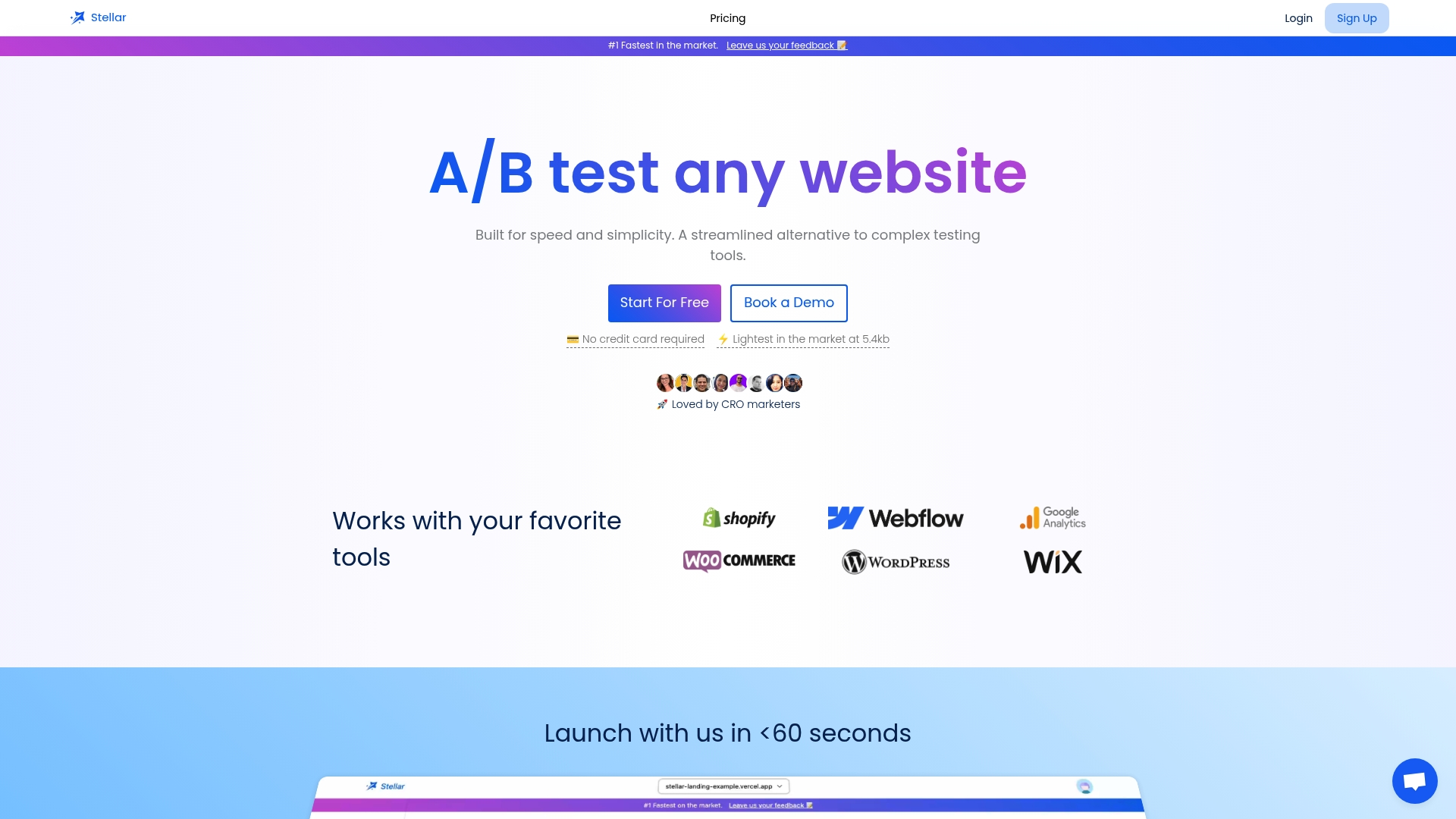
GoStellar is built for exactly this kind of work. It is a lightweight, no-code A/B testing platform designed for SMB marketers who need fast setup, clean data, and reliable results without pulling in a developer for every test. With real-time analytics, automatic goal tracking, and a visual editor that requires zero coding, you can launch your first SEO test in minutes. Explore SEO split testing essentials to see how GoStellar fits into your testing workflow and start running experiments that actually move your organic rankings.
Frequently asked questions
How is SEO A/B testing different from CRO A/B testing?
SEO A/B tests measure search rankings and organic traffic, while CRO tests focus on user actions like sign-ups or purchases. As organic metric measurement research confirms, SEO testing uses organic metrics instead of conversion rates to evaluate impact.
What is the biggest risk when running SEO A/B tests?
Incorrect setup can cause duplicate content or cloaking problems that directly harm search rankings. Split testing dangers include duplicate content, canonical problems, and cloaking violations that can trigger Google penalties.
How long do I need to run an SEO A/B test for trustworthy results?
You should plan for a minimum of 4 to 8 weeks, as SEO changes take longer to show results than CRO tests. Most SEO tests require this extended window due to organic signal delays from crawling and indexation cycles.
What is the safest way to structure an SEO A/B test for SMBs?
Focus on one change per test, use main page URLs, and clean up all variants after the test ends. Isolating one change and removing variants promptly after tests significantly reduces the risk of penalties or ranking drops.
Recommended
Published: 4/27/2026