
6 Essential Tips for Mastering SEO Split Testing
Getting real improvements in your SEO can feel confusing when you rely solely on guesswork and vague metrics. Many marketers struggle to understand which page changes actually drive organic growth and what truly impacts search engine rankings. You need a clear, evidence-driven approach that shows the difference between what works and what just looks good on paper. This list brings you actionable strategies designed to help you run SEO split tests that measure genuine ranking gains, organic clicks, and conversions. You'll learn how to pick the right pages, set meaningful goals, and use tools that make testing fast and effective. Get ready to discover practical techniques and critical insights that turn raw SEO data into proven results for your site.
Table of Contents
- Understand The Basics Of SEO Split Testing
- Choose The Right Pages For Split Testing
- Set Clear Goals And Success Metrics
- Use No-Code Tools For Quick Implementation
- Leverage Dynamic Keyword Insertion
- Analyze Results To Drive Continuous Improvement
Quick Summary
| Takeaway | Explanation |
|---|---|
| 1. Use SEO Split Testing Effectively | Measure ranking and organic performance changes with distinct URLs for accurate insights. |
| 2. Choose High-Traffic, Similar Pages | Select pages that see sufficient traffic and share structure for valid testing outcomes. |
| 3. Set Clear Testing Goals | Define specific, measurable objectives to track success and avoid misinterpretation of results. |
| 4. Implement No-Code for Speed | Utilize no-code tools to launch tests quickly without technical dependencies, increasing testing velocity. |
| 5. Analyze Results Thoroughly | Evaluate data with a focus on business outcomes to inform future SEO strategies and improvements. |
1. Understand the Basics of SEO Split Testing
SEO split testing is fundamentally different from standard A/B testing. Instead of serving different versions to visitors on the same URL, you show separate page versions to search engines via distinct URLs and measure how rankings, organic traffic, and conversions respond.
This distinction matters because search engines need time to crawl, index, and evaluate your variations before you'll see meaningful ranking changes. You're not testing user behavior in isolation—you're testing how search engines perceive and rank your content changes.
SEO split testing measures actual ranking and organic performance changes across different page versions, providing data that directly impacts your search visibility.
Here's what makes SEO split testing valuable for your business:
- Controlled experiments: Changes are isolated to specific pages, making cause-and-effect relationships clear
- Measurable SEO metrics: Track organic clicks, keyword rankings, and crawl health improvements
- Real ranking data: You capture how Google actually treats your variations, not assumptions
- Lower risk testing: Variants don't compete for the same organic traffic slot during the test period
When you implement SEO split testing strategies, you'll work with key technical components that control how search engines see your test.
You'll use subfolders or subdomains to host variant pages, keeping them separate from the original. Canonical tags tell search engines which version is authoritative, protecting your SEO equity. After testing concludes, server-side redirects consolidate traffic back to your winning version without losing ranking signals.
Choosing the right metrics determines whether your test actually answers your questions. Focus on measurable outcomes like organic clicks from search results, changes in keyword rankings for target terms, and improvements in crawl efficiency.
The fundamental goal is simple: you're gathering evidence about what changes actually improve your search performance, not guessing based on user behavior alone.
Pro tip: Start with pages that already rank for your target keywords but underperform in click-through rates—these offer the fastest path to measurable ranking improvements and clearer test results.
2. Choose the Right Pages for Split Testing
Not every page on your website deserves a split test. Choosing the right candidates determines whether your experiment will generate actionable data or waste your time waiting for results that never reach statistical significance.
The best pages for SEO split testing share two critical characteristics: sufficient organic traffic and similarity in structure or content type. Pages with minimal traffic won't generate enough data to show meaningful ranking changes, while pages with wildly different purposes will confuse your results.
Grouping similar pages and testing on high-traffic candidates ensures your results are statistically valid and directly applicable to your business goals.
When selecting pages, focus on these categories first:
- High-traffic blog posts: Posts already attracting organic visitors become ideal test beds for content changes
- Product or feature landing pages: Pages designed to convert visitors create direct ROI potential
- Category or collection pages: These typically handle significant search volume and affect multiple product visibility
- Conversion-critical pages: Pages tied directly to your business goals amplify the impact of ranking improvements
Grouping pages by similar templates or content types matters more than you might think. When you test pages with matching structures, you eliminate variables caused by different layouts or user intents. A blog post template should be tested against other blog posts, not against product pages.
Pages targeting different user intents will skew your results because ranking changes affect each intent differently. Someone searching for "how to fix a leaky faucet" behaves differently than someone searching "buy kitchen faucet online." Testing both simultaneously confuses cause-and-effect relationships.
Prioritize pages where you can measure impact clearly. Focus on pages that rank for keywords with clear business value and where organic improvements directly connect to conversions or engagement metrics you actually track.
Start by auditing your top 50 organic traffic sources. Identify clusters of similar pages that consistently rank and receive clicks. These clusters become your testing candidates.
Pro tip: Group your highest-traffic pages by template type, then select the single largest group to test first—this maximizes statistical power while keeping your testing scope manageable.
3. Set Clear Goals and Success Metrics
Vague goals kill split tests before they start. You need specific, measurable objectives defined before you launch any experiment, so you know exactly what success looks like and when you've achieved it.
Without clear goals, you'll face a common trap: watching data roll in and deciding what matters after the fact. This leads to cherry-picked results and wasted time on changes that don't actually move your business forward.
Define your primary goal and success threshold upfront, then measure consistently throughout your test to avoid misinterpreting results.
Your primary goals typically fall into these categories:
- Organic traffic increases: More clicks from search results to your pages
- Keyword ranking improvements: Better positions for your target search terms
- Conversion rate gains: Higher percentage of organic visitors completing desired actions
- Click-through rate growth: More people clicking your listing in search results
Each goal requires different metrics to track. When you're aiming to boost conversions, setting conversion goals for your tests helps you measure actual business impact rather than vanity metrics.
Beyond primary goals, capture secondary metrics that provide context. Track engagement signals like time on page and bounce rates. Monitor technical health metrics such as crawl errors and page speed to ensure your changes don't accidentally harm SEO performance elsewhere.
Before your test launches, establish baseline data by measuring your current performance across all chosen metrics. This gives you a reference point to compare against variant performance during the experiment.
Define your experiment duration and success thresholds upfront too. Decide how long you'll run the test and what percentage improvement qualifies as meaningful. Running tests too short leads to unreliable data. Running them indefinitely wastes resources on tests you've already learned from.
Document everything. Write down your hypothesis, primary metrics, secondary metrics, baseline numbers, and success criteria in a shared document your team can reference throughout the test period.
Pro tip: Set your success threshold at a minimum 5-10% improvement for practical business impact—smaller gains often disappear when you account for natural fluctuations in organic traffic.
4. Use No-Code Tools for Quick Implementation
Traditional SEO split testing required developer time, complex configurations, and weeks of setup work. No-code tools flip this entirely, letting you launch tests in hours instead of weeks without touching a single line of code.
This matters because speed directly impacts your competitive advantage. The faster you test, the faster you learn what actually improves your rankings and conversions. Your development team can focus on building while marketers own the experimentation process.
No-code platforms eliminate technical barriers, allowing marketers to implement and monitor SEO tests independently while reducing development resource bottlenecks.
Here's what no-code tools handle for you:
- Visual variant creation: Build test versions by editing page elements directly in a visual editor
- Automatic traffic allocation: The tool splits traffic between control and variant pages without manual configuration
- Real-time data collection: Performance metrics flow automatically into your dashboard as the test runs
- Result interpretation: Built-in analytics help you understand whether your variant won or lost
Without no-code capabilities, you'd be writing code, configuring servers, and waiting for engineering cycles. Understanding no-code experimentation tools shows how these platforms dramatically accelerate your testing velocity.
The practical impact is significant. You can test headline changes, content restructuring, or meta description variations without any technical dependencies. A marketer can set up a complete test in 15 minutes rather than submitting a ticket and waiting two weeks.
No-code tools also provide visual monitoring dashboards that let you watch test performance in real time. You see daily results, conversion metrics, and ranking changes as they happen, rather than manually aggregating data from multiple sources.
This reduces the chance of human error in data analysis. The platform automatically tracks your control and variant performance, eliminating confusion about which version is performing better.
Your team moves faster because there's no back-and-forth with developers. No miscommunications about requirements. No delays waiting for someone else's capacity. You own the full testing cycle from hypothesis to implementation to results analysis.
Pro tip: Start your first test with a simple, high-impact change like improving title tags or reordering content sections—these are quick wins that no-code tools can deploy instantly.
5. Leverage Dynamic Keyword Insertion
Dynamic keyword insertion automatically customizes your page content to match what searchers are actually looking for. Instead of manually creating multiple static page versions, the system inserts relevant keywords dynamically during your test, matching searcher intent with precision.
This technique transforms SEO testing from a slow, manual process into a scalable, data-driven operation. You test keyword relevance impact without creating dozens of different page variants.
Dynamic keyword insertion lets you test how keyword relevance affects rankings and click-through rates while maintaining strict test variable control.
Here's how it works in practice:
When someone searches for "blue running shoes," your page title automatically becomes "Blue Running Shoes" or similar variation. Someone searching "affordable running footwear" sees different keyword emphasis in your title and meta description. The content adapts to match searcher intent while keeping everything else constant.
This matters because keyword relevance directly impacts both rankings and clicks. When your page title matches exactly what someone searched, they're more likely to click. Search engines reward this relevance with better rankings too.
Manually creating static variations would be impractical. Dynamic keyword insertion in SEO split testing allows you to test multiple keyword variations simultaneously without creating separate pages for each one.
You can test dynamic insertion in several places:
- Title tags: Primary keyword appears dynamically based on search query
- Meta descriptions: Matches searcher intent with keyword-relevant summary text
- Page headings: H1 tags adapt to reinforce keyword relevance
- Body content: Key paragraphs emphasize relevant keyword variations naturally
The data reveals which keyword approach resonates most. Does exact matching outperform semantic variations? Are longer-tail keywords more effective? Your tests answer these questions with actual performance data.
This approach maintains strict variable control because only the keyword elements change. Everything else stays identical, so you know keyword relevance is driving your results, not other page factors.
You'll need a platform supporting dynamic insertion to implement this effectively. The tool handles all the customization automatically based on search queries, eliminating manual setup complexity.
Pro tip: Start by testing dynamic insertion on your highest-traffic keyword clusters—focus on keywords where you rank positions 2-5 and need to improve click-through rates.
6. Analyze Results to Drive Continuous Improvement
Your test data only matters if you actually analyze it. Proper result analysis transforms raw numbers into actionable insights that drive real improvements across your entire website. Without this step, you're just collecting data that sits unused.
Analysis requires patience and statistical thinking. Don't celebrate or panic after a few days of data. Wait until your test has sufficient traffic and time to produce reliable conclusions.
Careful statistical evaluation of your test results against the control group reveals winning variations that you can confidently implement site-wide.
Start by examining your primary metrics against their baseline performance. Compare your variant traffic, rankings, and conversions directly to the control group numbers you collected before testing began.
Look for these key indicators:
- Statistical significance: Did improvements occur by chance or represent real performance gains?
- Effect size: How much better is your variant actually performing in practical terms?
- Directional clarity: Does your data clearly show a winner or remain ambiguous?
- Secondary metric impact: Did your variant improve primary goals without harming engagement or technical health?
When analyzing test results effectively, focus on the metrics that connect to business outcomes. A 2% ranking improvement means nothing if it doesn't translate to more organic clicks or conversions.
Avoid common analysis mistakes. Don't stop tests early because initial results look good. Don't cherry-pick metrics that support your preferred outcome. Don't ignore secondary metrics that reveal hidden problems.
Document your findings clearly. Write down what won, by how much, and why you think it worked. This builds institutional knowledge that compounds over time.
Implement winning variations broadly. Once your test confirms an improvement, roll that change out to all eligible pages with similar characteristics. This multiplies your gains across your entire site.
Then plan your next test. Winning variations often suggest new hypotheses worth testing. Strong results create momentum that builds a culture of continuous experimentation.
This iterative approach adapts your SEO strategy over time as search engine algorithms evolve and user behavior shifts. One test informs the next, creating compound improvements that accumulate into significant competitive advantage.
Pro tip: Always test a new variation before rolling winners site-wide—confirm the result holds across different traffic patterns, seasons, and page contexts.
Below is a comprehensive table summarizing the foundational concepts and actionable strategies for implementing and analyzing SEO split testing as discussed in the article.
| Key Component | Description | Benefits and Strategies |
|---|---|---|
| SEO Split Testing Basics | Testing involves serving unique page versions to search engines via distinct URLs, measuring ranking, traffic, and conversions. | Enables controlled experiments with measurable SEO metrics, ensuring lower-risk testing and real ranking data. |
| Choosing Pages for Testing | Focus on pages with significant organic traffic and similar structure/content type for meaningful results. | Prioritize high-traffic blogs, product pages, category pages, and conversion-critical pages to maximize impact. |
| Setting Goals and Success Metrics | Define clear, measurable objectives like traffic increases, ranking improvements, or conversion growth. | Establish baseline data and success thresholds to measure reliable outcomes effectively. |
| Leveraging No-Code Tools | Utilize platforms enabling visual editing, automated traffic allocation, and real-time analysis. | Reduces dependency on developers and speeds up the implementation of SEO tests profoundly. |
| Dynamic Keyword Insertion | Adjust page elements like titles and meta descriptions dynamically based on search query relevance. | Enhances ranking and click-through rates through improved keyword relevance matching. |
| Analyzing Test Results | Evaluate outcomes with statistical significance, effect size, and clear data interpretation. | Ensures actionable insights for continuous improvement and compound SEO gains. |
Accelerate Your SEO Split Testing Success with Stellar
Mastering SEO split testing means overcoming challenges like slow implementation, unclear metrics, and technical bottlenecks. The article highlights critical pain points such as the need for no-code visual editors, dynamic keyword insertion, and advanced tracking to confidently identify winning SEO strategies.
Stellar offers a perfect solution to these challenges. Our platform is built for marketers and growth hackers who want to launch controlled, data-driven experiments without waiting weeks on developer resources. With a lightweight script that preserves site speed, you gain real-time analytics, dynamic keyword insertion for highly personalized landing pages, and effortless advanced goal tracking to measure what truly matters.
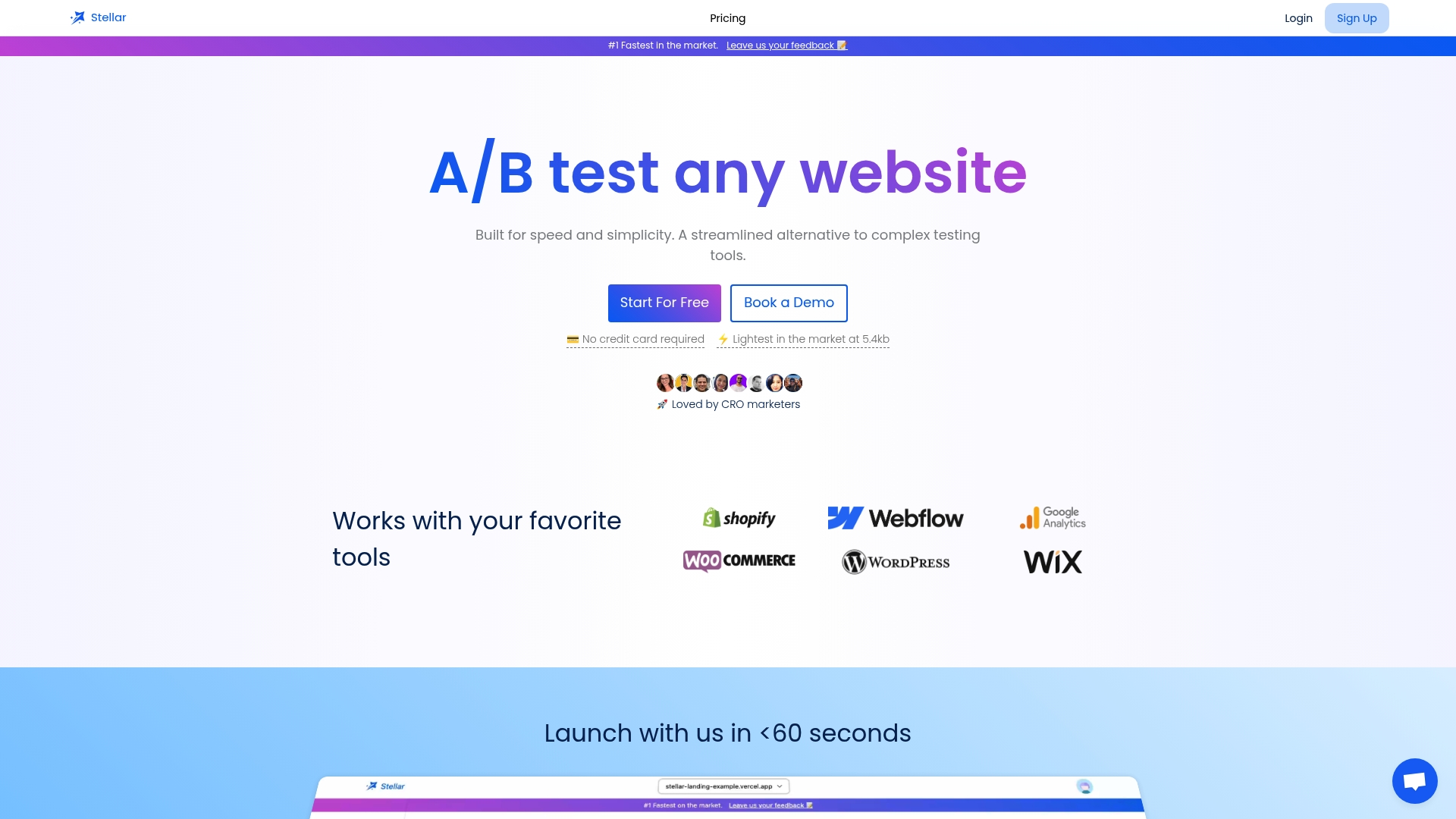
Ready to stop guessing and start knowing what moves the needle for your organic traffic and conversions Just visit Stellar’s landing page to try the fastest no-code SEO split testing tool designed specifically for small to medium-sized businesses. Empower your team with the insights to win today and see why marketers trust Stellar to streamline their SEO A/B test strategies.
Frequently Asked Questions
What is SEO split testing and how is it different from A/B testing?
SEO split testing involves serving different versions of a webpage to search engines using separate URLs to measure ranking and organic traffic effects. This distinguishes it from traditional A/B testing, which compares user behavior on the same URL. Start by implementing SEO split testing on pages that already rank.
How do I choose the right pages for SEO split testing?
Select pages that generate sufficient organic traffic and have a similar structure or content type for valid results. Start with high-traffic blog posts, landing pages, or critical conversion pages to gather actionable data more efficiently. Focus on clusters of pages that rank for relevant keywords.
What goals should I set for my SEO split testing?
Define specific, measurable goals such as increases in organic traffic, keyword ranking improvements, or conversion rate gains before launching your test. For practicality, aim for at least a 5-10% improvement as your success threshold, ensuring you track these outcomes closely throughout the testing period.
How can I implement SEO split testing without technical knowledge?
Utilize no-code tools that allow you to create and manage tests without coding skills. These tools enable you to set up visual variants and monitor performance quickly, often within hours. Start with simple changes, like modifying title tags or content order.
What should I analyze after completing an SEO split test?
Analyze your primary metrics—such as traffic and conversions—against baseline performance to determine if your test variant performed better than the control. Focus on statistical significance and ensure your results reflect real performance gains before implementing changes site-wide.
Can dynamic keyword insertion improve my SEO split testing results?
Yes, dynamic keyword insertion can enhance SEO split testing by automatically customizing page content to align with searcher intent, helping improve rankings and click-through rates. Start experimenting with dynamic insertion on your highest-traffic keyword clusters to see significant impacts on performance.
Recommended
- 7 Split Tests That Can Double Your Conversion Rate
- Performance-First Split Testing: Why Every Millisecond Matters
- Website Split Testing Guide 2025: Boosting CRO and Conversions
- 7 Key SEO Trends in 2025 for Higher Conversion Rates
- 7 Simple SEO Strategies for Beginners to Boost Sales | Ibrandmedia
- Advanced SEO Techniques for Growing Your Business Online|BM
Published: 2/22/2026