
SEO Testing Methods That Drive Real Results in 2026
TL;DR:
- SEO testing transforms optimization efforts from guesses into data-driven strategies by systematically measuring website changes' impact on search performance. It involves methods like split testing, A/B testing, and manual audits, emphasizing proper hypothesis formulation, reliable data collection, and alignment with AI-driven search priorities. Continuous, well-documented testing enhances SEO growth, especially when combined with automation tools like Gostellar for streamlined workflows.
SEO testing is the discipline that separates marketers who guess from those who grow. Every time you change a title tag, restructure internal links, or swap a meta description, you're running an experiment. The question is whether you're capturing data or just hoping for the best. Organic search is too competitive and too volatile to leave optimization decisions to intuition alone. This guide breaks down the exact SEO testing methods digital marketers and SEO specialists use to validate changes, build traffic, and make every iteration count.
Table of Contents
- Key Takeaways
- 1. What is SEO testing and why it matters
- 2. Key criteria for choosing an SEO testing method
- 3. Top SEO testing methods explained
- 4. Comparing SEO testing methods side by side
- 5. Tactical best practices for running SEO tests
- My honest take on SEO testing in 2026
- How Gostellar accelerates your SEO testing workflows
- FAQ
Key Takeaways
| Point | Details |
|---|---|
| Define your hypothesis first | Every SEO test needs a specific, measurable prediction before you touch a single element. |
| Match method to scope | Split testing suits large sites; manual audits work best for targeted technical diagnostics. |
| Staging benchmarks can mislead | Always benchmark speed and crawlability against production, not your staging environment. |
| CI/CD integration catches issues early | Automated SEO audits during deployment stop critical errors before they reach users. |
| AI search shifts testing priorities | AEO readiness now requires testing structured data and content hierarchy, not just rankings. |
1. What is SEO testing and why it matters
SEO testing is the practice of systematically changing website elements, measuring the impact on search engine performance, and drawing conclusions based on data rather than assumption. It covers everything from swapping title tags on product pages to validating how Googlebot renders your JavaScript components.
Without a formal testing process, you cannot distinguish between a traffic increase caused by your optimization and one caused by a seasonal trend or an algorithm shift. That ambiguity kills confidence and wastes budget. A structured search engine optimization test removes that ambiguity.
2. Key criteria for choosing an SEO testing method
Not every testing method works for every site. Before you pick an approach, evaluate it against these core criteria.
Technical feasibility comes first. Your testing setup needs to accurately simulate how search engines crawl and render your pages. Client-side rendering can hide meta tags from crawlers on the initial pass, which means a test run without server-side rendering checks will give you false confidence. Always confirm your audit tools handle JavaScript rendering correctly.

Data reliability and statistical confidence determine whether your results mean anything. SEO tests require sufficient traffic volume and a long enough test window to produce statistically significant findings. Rushing a test on a low-traffic page produces noise, not insight.
Scope alignment matters more than most marketers acknowledge. Define whether you're testing on-page SEO elements, technical infrastructure, content quality, or user engagement signals. Testing seo optimization effectively requires clear scope so you aren't attributing ranking changes to the wrong variable.
Resource investment vs. expected insight is the honest trade-off. Running multivariate tests demands more traffic, more tooling, and more analysis time than a simple manual audit. Match the complexity of the test to the size of the potential gain.
Pro Tip: Before selecting a method, map your test to a specific KPI. "Improve organic CTR on category pages by 15% in 60 days" is a testable hypothesis. "Do better at SEO" is not.
- Confirm your CMS or framework supports the technical requirements of your chosen test type
- Use Google Search Console as your baseline data source before adding third-party tooling
- Define success metrics before the test starts, not after you see the results
3. Top SEO testing methods explained
SEO split testing
SEO split testing divides similar pages into a control group and a variant group. You change one element on the variant pages, hold everything else constant, and measure ranking and traffic differences over time. It works best on sites with large numbers of similar pages, like e-commerce category pages or large content archives. The types of website testing available to marketers each have distinct use cases, and split testing is uniquely suited to proving causal relationships at scale.
A/B testing for SEO
Standard A/B testing in SEO differs from conversion rate A/B testing. Instead of splitting user traffic, you split page groups. You modify title tags or header structures on Group B and leave Group A untouched. The challenge is statistical significance in SEO A/B testing, because ranking changes take longer to materialize than conversion changes. Plan for test windows of at least four to six weeks.
Multivariate testing
Multivariate testing changes multiple elements simultaneously across multiple page variants. It's powerful for understanding interaction effects, such as how a title tag change combined with a schema markup update performs together. The downside is traffic volume requirements. You need substantially more pageviews to reach statistical confidence when testing multiple variables at once.
Manual SEO audits
Manual audits are the most underused high-impact method in a specialist's toolkit. Experienced SEOs warn against relying solely on expensive platforms, because customized manual checks regularly surface crawl issues that automated dashboards miss entirely. A manual website SEO evaluation gives you context that no crawler report can provide.
Automated crawler validation
Automated tools accelerate pre and post-deployment audits by scanning for broken links, missing titles, and canonical conflicts at scale. They are not a replacement for manual judgment, but they are an indispensable first pass on sites with hundreds or thousands of pages.
Pro Tip: When running any SEO test, crawl your test pages using multiple user agents including Googlebot Smartphone, Googlebot Desktop, and Bingbot. Environment-specific discrepancies between agents reveal technical issues that single-agent crawls will never catch.
4. Comparing SEO testing methods side by side
Use this table to match each method to your project context before committing resources.
| Method | Complexity | Traffic needed | Best for | Speed of results |
|---|---|---|---|---|
| SEO split testing | Medium | High (large page sets) | E-commerce, content farms | 4-8 weeks |
| A/B testing | Medium | Medium | Title tags, meta descriptions | 4-6 weeks |
| Multivariate testing | High | Very high | Interaction effects across elements | 8-16 weeks |
| Manual audit | Low | None required | Technical diagnostics, crawl issues | Days |
| Automated crawler | Low-medium | None required | Scale audits, pre-deployment checks | Hours |
SEO audit benchmarks classify scores of 80% and above as a strong foundation, while anything below 30% signals critical technical issues that need resolution before any split or A/B testing can return clean data. Running traffic tests on a technically broken site produces misleading results.
The honest assessment: manual audits and automated crawlers are fast and cheap, but they cannot prove causation. Split testing and A/B testing prove causation, but they require time and traffic. Most high-performing SEO programs use both in parallel.
5. Tactical best practices for running SEO tests
Getting your testing infrastructure right is just as important as choosing the right method. These practices separate programs that generate real learning from ones that spin their wheels.
Start every test with a documented hypothesis. Write it down: "Changing H1 tags on blog posts from keyword-stuffed phrases to question-based formats will increase average ranking position by 3-5 spots within 45 days." Vague hypotheses produce vague results.
Benchmark against production, not staging. Staging servers typically perform slower than production environments, which means speed test results on staging can seriously underrepresent real-world performance. Always use production benchmarks when evaluating page speed impact.
Integrate SEO audits into your CI/CD pipeline. Automated audits as pre-traffic gates catch SEO issues during the build process, not after a broken deployment reaches Google's crawlers. This single practice prevents more SEO damage than almost any post-launch monitoring tool.
Align your tests with AI-driven search priorities. AEO readiness requires structured data, clear content hierarchy, and snippet formatting. Testing your pages against AI model visibility criteria is quickly becoming as important as traditional rank tracking.
Pro Tip: Page speed scores below 50 require urgent fixes before you run any content or ranking tests. A slow page contaminates every other test variable. Fix performance first, then optimize everything else.
- Isolate one variable per test whenever possible to keep analysis clean
- Set a minimum test duration before reviewing results to avoid calling tests early
- Document every test in a shared log with hypothesis, method, start date, and outcome
- Use SEO and CRO intersections as opportunities to run parallel tests that serve both organic and conversion goals
- Review post-test results at 30 and 90 days, because some ranking effects are delayed
My honest take on SEO testing in 2026
I've watched too many smart marketers build elaborate testing programs and still fail to generate real learning. The problem is almost never the method. It's the mindset.
Most teams treat SEO testing as a project. Something you do once a quarter during an audit cycle. In my experience, the teams that compound their organic growth treat testing as a continuous operating mode, not a scheduled event. Every significant on-page change gets a hypothesis. Every deployment gets a pre-launch crawl check.
The second thing I've learned the hard way: expensive enterprise platforms do not automatically produce better insights. I've seen marketing automation tools catch what pricey SEO suites missed, simply because the analyst running the cheaper tool was asking better questions. The tool serves the thinker, not the other way around.
What I find genuinely concerning right now is how many SEO programs are still optimizing purely for traditional ranking signals while AI answer engines are fundamentally changing what "visibility" means. Testing your structured data, your content hierarchy, and your entity alignment for AI visibility isn't optional anymore. It's the next frontier of SEO performance analysis.
Start small. Run one clean test per month. Document ruthlessly. The compounding effect of 12 clean tests per year beats one massive audit that gathers dust in a shared drive.
— Juan
How Gostellar accelerates your SEO testing workflows
Running rigorous SEO tests becomes significantly easier when your experimentation infrastructure doesn't slow you down.
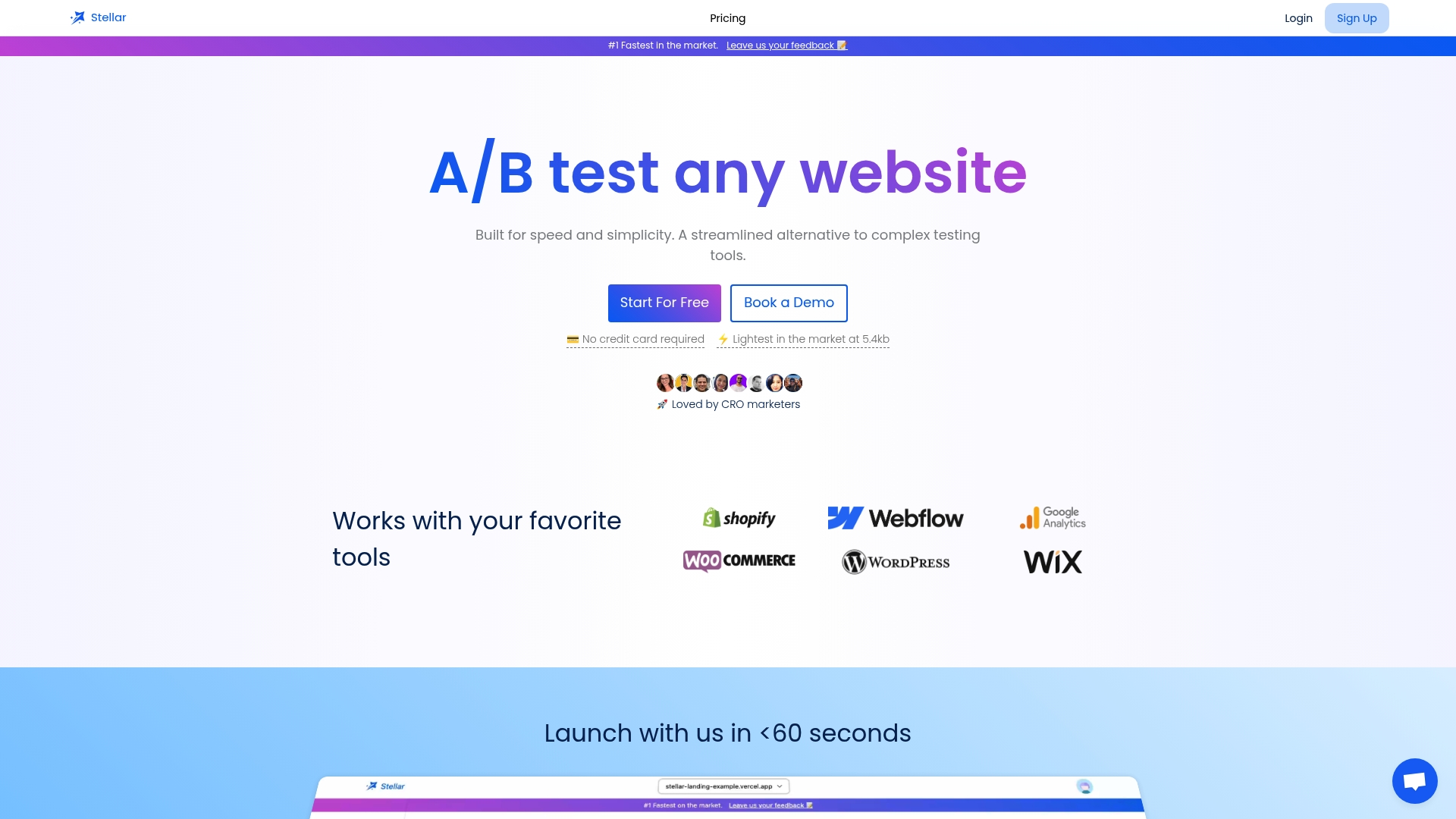
Gostellar is built for exactly this kind of work. Its A/B testing platform loads via a 5.4KB script that won't inflate your page weight or contaminate your speed benchmarks. The no-code visual editor lets you set up title tag and content variants without pulling in a developer. Real-time analytics surface performance shifts as they happen, so you're not waiting weeks to call a test. Dynamic keyword insertion means you can run personalized landing page variants that align with the website SEO performance signals you're actively testing. For SMBs running lean, Gostellar's free plan covers up to 25,000 monthly tracked users.
FAQ
What is SEO testing?
SEO testing is the process of making controlled changes to website elements and measuring their effect on search engine rankings, organic traffic, and crawlability. It turns optimization decisions from guesses into data-backed conclusions.
How do you run a proper SEO A/B test?
Divide similar pages into a control group and a variant group, change one element on the variant group, and measure ranking and traffic differences over a minimum of four to six weeks to reach statistical reliability.
What SEO testing tools should I start with?
Google Search Console is the non-negotiable starting point for any SEO performance analysis. Pair it with an automated crawler for technical audits and a dedicated A/B testing platform like Gostellar for on-page element testing.
How do I test page speed for SEO?
Always benchmark page speed against your live production environment, not staging. Sites with speed scores below 50 need technical fixes before content or ranking tests can return clean data.
How does AI search change SEO testing priorities?
AI-powered answer engines prioritize pages with structured data, clear content hierarchy, and entity-aligned content. Modern SEO testing now needs to include AEO readiness checks alongside traditional ranking and traffic metrics.
Recommended
Published: 5/25/2026