
Social Media A/B Testing: A Beginner's Complete Guide
Social media A/B testing, formally called split testing, is the practice of showing two versions of the same content to separate audience segments to determine which one performs better on a specific metric. You change one variable, measure the outcome, and let the data decide. That's the whole mechanism. What makes it powerful is the discipline behind it: one variable at a time, a predetermined metric, and enough data to trust the result.
Here's what you're typically testing on social media:
- Hook or opening line — the first sentence of a caption or the first three seconds of a video
- Visual format — Reel vs. carousel, lifestyle photo vs. product shot
- Call to action (CTA) — phrasing, placement, directional vs. curiosity-driven
- Caption length — short and punchy vs. long and narrative
- Posting time — same content, different publication window
- Audience targeting — same creative shown to different demographic segments
Paid and organic testing operate differently. Paid platforms like Facebook Ads Manager split audiences algorithmically, producing faster and cleaner data. Organic testing requires posting variants at different times and controlling for external noise manually. Both work, but they demand different levels of patience and rigor.
Why social media A/B testing belongs in every campaign
The core reason to run split tests is simple: gut feel doesn't compound. You might publish a post that performs well, but without a controlled test, you can't isolate why it worked. Was it the hook? The image? The day you posted? A/B testing answers that question with evidence you can actually build on.
The practical benefits stack up fast:
- Data-driven decisions replace assumptions about what your audience prefers
- Engagement rates improve when you systematically identify what hooks your specific followers
- Ad spend efficiency increases because you stop funding content that underperforms
- Audience behavior becomes clearer — the same brand often gets very different responses on Instagram vs. LinkedIn
- Content strategy sharpens over time as each test adds to a library of proven patterns
Testing organic content also tells you what's worth paying to promote. A post that earns strong saves and shares organically is a candidate for paid amplification. Without testing, you're guessing at that call.
What elements are actually worth testing first

Not every variable deserves equal attention. Testing emoji placement before you've tested your hook is like adjusting the font on a billboard before you've written the headline.
Hook and opening line
The hook is the highest-leverage element to test because it determines whether anyone engages further. A stronger first line improves every downstream metric simultaneously: watch time, saves, shares, and click-throughs all follow from whether someone stops scrolling. On video, that window is the first three seconds.
Format
- Reel vs. carousel
- Single image vs. carousel
- Text-only vs. image post
- Short-form video vs. static graphic
Call to action
- Directional CTA ("Save this for later") vs. curiosity-driven ("You'll want to see what happened next")
- CTA placement: end of caption vs. mid-caption
- Link in bio prompt vs. comment-to-get
Caption length
- Short captions (one to three lines) vs. long-form storytelling
- With line breaks vs. dense paragraph format
Posting time
Same content, published at different times, to measure engagement velocity in the first two hours and reach within the first 24 hours.
Audience targeting
This one works differently. You show the same creative to two different audience segments to learn which group responds better, rather than testing two versions of the content itself. Targeting variables include age range, interest category, device type, and retargeted vs. cold audiences.
Testing one variable at a time is non-negotiable. Change the hook AND the visual AND the hashtags in the same test, and you'll never know which change drove the result.
How to plan and run a social media A/B test step by step
1. Write a testable hypothesis
Every test starts with a specific question, not a vague goal. The formula: "If we change [X], then [metric Y] will [increase/decrease] because [reason]." For example: "If we open the caption with a question instead of a statement, the 'more' tap rate will increase because questions create an open loop." That's testable. "Let's try different captions" is not.
Use a hypothesis validation framework to pressure-test your assumptions before you build the test.
2. Choose one high-impact variable
Start at the top of the hierarchy: hook, then format, then CTA, then caption length, then posting time. Beginners often waste early tests on low-leverage variables. Hooks have the highest downstream impact, so test those first.
3. Determine sample size and test duration
Industry standards require high confidence levels, minimum sample sizes, and sufficient test duration to produce reliable results. For organic posts, wait until both variants have reached a sufficiently large number of impressions before comparing. For paid tests, most platforms require a minimum audience size per variant to ensure statistical reliability.
Timing windows vary by platform, generally ranging from a couple of days to one or two weeks after posting to capture sufficient engagement for comparison.
4. Control for external variables
Post both variants in the same week. Avoid holidays, major news events in your industry, and known algorithm update periods. If something significant happens between posting Variant A and Variant B, your results are contaminated.
5. Split your audience
For paid tests, platforms like Facebook Ads Manager handle this automatically. For organic testing, post Variant A and Variant B three to five days apart on the same day of the week to minimize day-of-week effects.
6. Read results by your pre-committed metric
Judge the outcome by the metric you defined in your hypothesis, not by whichever number happens to favor the version you preferred. Pre-committing to the metric removes the temptation to cherry-pick.
7. Apply the learning and build the next test
A winning result goes into your content playbook. The next test picks up where this one left off, moving down the variable hierarchy. That's how single tests turn into accumulated knowledge.
Pro Tip: Never check results mid-test and stop early if one variant looks like it's winning. Peeking at results before the predetermined sample size is reached dramatically inflates false positive rates, meaning you'll "confirm" a winner that isn't actually better.
Best practices and common mistakes to avoid
Best practices
- Test one variable per iteration, always
- Pre-commit to your primary metric before launching
- Set your sample size and test duration before you start, then don't touch them
- Use guardrail metrics alongside your primary metric to make sure an optimization in one area isn't hurting another (e.g., a CTA that drives clicks but tanks saves)
- Segment audiences to prevent the same follower from seeing both variants
- Run tests during typical weeks, not around product launches or seasonal spikes
Common mistakes
- Premature stopping: Ending the test when one variant looks better, before reaching the planned sample size
- Metric switching: Changing your success metric after seeing results because the original metric didn't show what you hoped
- Multiple simultaneous tests: Running two tests on the same audience at the same time creates overlap and corrupts both results
- Ignoring organic testing limits: Organic posts lack algorithmic audience splits, so results carry more noise than paid tests
Audience overlap is one of the most underestimated problems in organic social testing. When the same follower sees both Variant A and Variant B, they may notice the similarity, which affects engagement on both posts and introduces bias into your results.
Platform capabilities and expert tips for the US market
Each platform offers different A/B testing capabilities, and paid tests are generally more automated and statistically cleaner than organic ones. Here's how the major platforms stack up:
- Facebook Ads Manager: The most fully featured option for paid split testing. Use the Experiments tool to build a test from scratch or duplicate an existing campaign and change one variable. Automatic distribution between test groups, with a clear winner declared based on your chosen metric. Also covers Instagram ads. For a deeper walkthrough, the Facebook Ads testing guide covers the full setup process.
- Instagram (organic): No native split-testing tool for organic posts. Post variants three to five days apart on the same weekday and compare using Instagram Insights: reach, engagement rate, save rate, and Reels completion rate across the same time window after posting.
- TikTok Ads Manager: Supports testing of creative, captions, music, and audience targeting. The Smart Creative feature generates multiple variations and automatically optimizes delivery toward the best performer. For organic TikTok, give each variant at least 48–72 hours before comparing, since the algorithm distributes content to small test audiences first.
- LinkedIn Campaign Manager: Well-suited for B2B brands. Test ad copy, headline variations, visuals, and ad formats. LinkedIn content has a 5–7 day engagement window, so wait the full week before reading results.
Pro Tip: For organic testing on any platform, hooks and CTAs are the two variables with the highest impact on bounce behavior and downstream engagement. Start there before testing anything else.
Advanced teams use sequential testing methods, sometimes called always-valid inference, which allow checking results at any point without inflating the false positive rate. These are built into some enterprise-level platforms and address the legitimate need for early stopping when a result is very strong.
Real-world examples of social media A/B tests that worked
Hook format on Instagram Reels. A direct-to-consumer brand tests two versions of the same Reel: Variant A opens with a product close-up and a voiceover stating a feature. Variant B opens with a relatable problem statement before showing the product. After 72 hours, Variant B shows a meaningfully higher completion rate and save rate. The insight: problem-first hooks outperform product-first hooks for this audience. That finding gets applied to the next five Reels.
CTA phrasing on Facebook ads. An e-commerce advertiser tests "Shop Now" against "See How It Works" on the same ad creative. The curiosity-driven CTA drives a higher click-through rate, but "Shop Now" produces more direct purchases. The right winner depends on the campaign goal: traffic vs. conversion. This is exactly why pre-committing to a primary metric matters before the test runs.
Caption length on LinkedIn. A B2B software company tests a three-line post against a 200-word narrative post on the same topic, posted on the same day of the week across two consecutive weeks. The longer post generates more comments and shares; the shorter post gets more profile visits. Both are "wins" depending on the goal. The company now uses long-form for thought leadership posts and short-form for product announcements.
Format test on TikTok. A fitness brand tests a talking-head tutorial against a text-overlay montage for the same workout tip. The montage format earns a higher average watch time and more shares. The brand shifts its organic content mix toward montage-style videos for educational content, reserving talking-head format for community-building posts.
How to turn A/B testing insights into ongoing social media strategy
A single test result is a data point. A library of test results is a content strategy. The goal is to build a system where each test informs the next one, and winning patterns get codified into repeatable formats.

Start by keeping a simple testing log: hypothesis, variable tested, platform, sample size, primary metric result, and the conclusion. After ten tests, patterns emerge. You'll see which hook styles consistently outperform others, which CTA formats drive the metric you care about, and which formats earn the best reach on each platform.
From there, build a content playbook specific to your brand and audience. Generic best practices are a starting point, but your playbook reflects what actually works for your followers. Review and update it quarterly, because audience preferences shift and platform algorithms change.
Integrate test results into your paid strategy as well. Organic testing surfaces creative directions worth scaling. When a format or hook style wins consistently in organic, it's a strong candidate for paid amplification. That connection between organic learning and paid execution is where social media optimization techniques produce compounding returns over time.
Finally, share findings across your team. The marketer running Instagram tests and the one managing LinkedIn campaigns are solving related problems. A shared testing culture, where results get documented and distributed, builds institutional knowledge that outlasts any single campaign.
Try Gostellar for your next A/B test
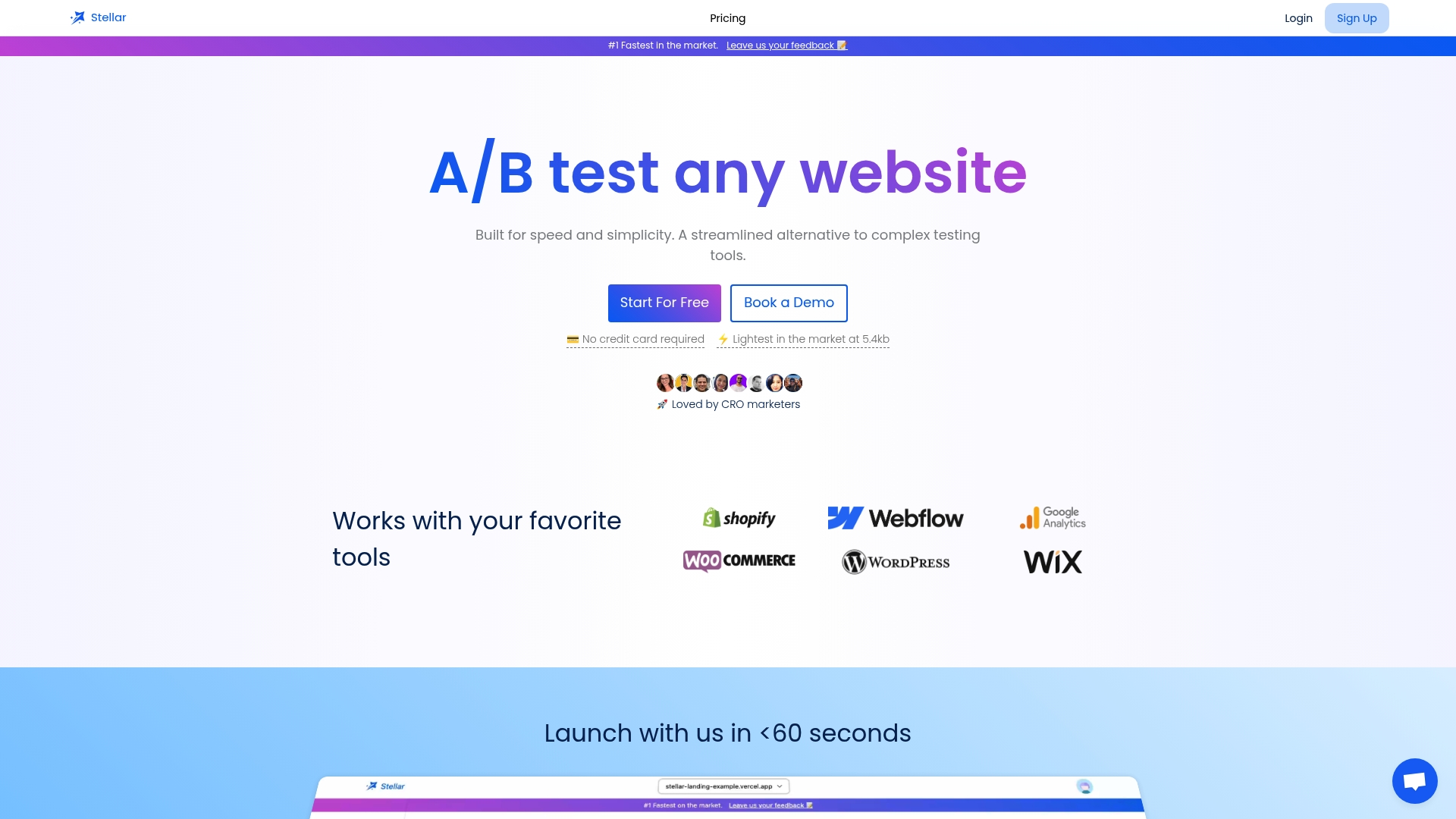
Gostellar is built for marketers who want fast, reliable A/B testing without the technical overhead. The platform runs on a 5.4KB script that won't slow your pages, includes a no-code visual editor for quick setup, and delivers real-time analytics so you can read results as they come in. There's a free plan for sites with under 25,000 monthly tracked users, and paid tiers scale with your traffic. Start testing with Gostellar and turn your next campaign into a learning system.
Key Takeaways
Social media A/B testing produces reliable results only when you isolate one variable, commit to a sample size before launching, and judge outcomes by a pre-defined metric.
| Point | Details |
|---|---|
| Test one variable at a time | Changing multiple elements in a single test makes it impossible to attribute results to a specific change. |
| Hook testing has the highest leverage | The first line of a caption or first three seconds of video impacts every downstream engagement metric. |
| Commit to sample size before launching | Checking results early and stopping when one variant looks better inflates false positive rates. |
| Paid tests outperform organic for precision | Platform tools like Facebook Ads Manager split audiences algorithmically, producing faster and cleaner data than manual organic testing. |
| Build a testing log to compound learning | Documenting each test result turns individual data points into a repeatable content strategy over time. |
Recommended
Published: 7/20/2026