
Launch in Weeks, Scale in 18–24 Months: Ecommerce System for SMBs
A system ecommerce setup is the software stack that lets you sell online: product listings, a shopping cart, payment processing, and the order management behind the scenes. The immediate decision that matters most is deployment model. If you have no developer on staff, a SaaS platform gets you selling in weeks; if you need custom logic or multi-channel scale, open-source or headless architecture earns the extra setup time.
TL;DR:
- SaaS platforms enable quick deployment for small merchants but may limit customization and incur ongoing costs as business complexity grows.
- Open-source solutions offer full control and unlimited flexibility but require substantial developer time for setup and maintenance.
- Headless architectures excel for larger, multi-channel businesses needing custom storefronts and integrated tools, despite a steeper initial investment.
- Key features such as advanced search, flexible checkout, and real-time inventory are crucial only if they directly impact sales or operational efficiency.
- Data portability, transparent pricing, and API accessibility are vital considerations to avoid vendor lock-in and support future growth and innovation.
Table of Contents
- What Does an Ecommerce Platform Actually Do?
- SaaS, Open-Source, or Headless: Which Deployment Model Fits?
- Which Features and Integrations Actually Move the Needle?
- How Do You Actually Choose the Right Platform?
- What Does Migration Actually Cost and Take?
- Which Platform Type Fits Your Business Model?
- Why Lightweight Experimentation Tools Matter in Modern Stacks
- What Trends Should Shape Your Next Platform Decision?
- Add Experimentation to Any Ecommerce System Without Switching Platforms
- Sources
What Does an Ecommerce Platform Actually Do?
Strip away the marketing language and an ecommerce platform boils down to three non-negotiable jobs: letting shoppers find products, letting them collect items in a cart, and processing payment securely. Coursera's breakdown of ecommerce platforms confirms that product search, a shopping cart, and a payment gateway are the baseline requirement for any online transaction. Everything else a vendor advertises, from AI recommendations to loyalty programs, sits on top of that foundation.
That baseline definition matters because vendors use "platform" loosely. Some sell you a closed, all-in-one system. Others sell you a handful of connected services you assemble yourself. Both get called an ecommerce platform, and the difference changes your entire technical roadmap.
Beyond the three basics, a working store needs several subsystems working together:
- Product catalog management — organizing SKUs, variants, categories, and pricing rules across potentially thousands of items.
- Inventory tracking — syncing stock levels across warehouses, physical locations, and sales channels in real time.
- Checkout flow — the pages and logic that walk a shopper from cart to confirmed order without friction or drop-off.
- Order management (OMS) — routing orders for fulfillment, tracking status, and handling returns or exchanges.
- Shipping and tax calculation — computing rates, generating labels, and applying the right tax rules by jurisdiction.
- Analytics and reporting — measuring traffic, conversion, and revenue so you can see what's actually working.
Where this gets confusing for a first-time buyer is scope. A platform like a hosted SaaS suite bundles most of these into one dashboard. A modular or headless setup treats each one as a separate service you connect through APIs. Neither approach is objectively better. The right one depends on how much you want to build versus how much you want to configure, a distinction that drives almost every decision covered in the rest of this guide.
SaaS, Open-Source, or Headless: Which Deployment Model Fits?
The three dominant deployment models for ecommerce systems are SaaS, open-source/self-hosted, and headless/composable, and TechTarget's overview of ecommerce treats these as the standard way the industry categorizes platform architecture. Each one trades speed for control in a different place.
SaaS (software as a service) means the vendor hosts everything: servers, security patches, uptime, updates. You log in, configure your store through a dashboard, and sell. Hosting, PCI compliance infrastructure, and most maintenance are handled for you, which is why SaaS dominates among small merchants who want to launch fast without hiring engineers.
Open-source/self-hosted means you download or fork the platform's code and run it on your own servers or cloud instance. You get full control over functionality, data, and customization, but you also own every patch, security update, and scaling decision. This model suits teams with in-house development capacity or an agency relationship they trust.
Headless/composable decouples the front end (what shoppers see) from the back end (catalog, cart, checkout logic), connecting the two through APIs. Salesforce's guide to ecommerce platforms frames this as the model built for businesses that need to swap in specialized tools, custom storefronts, or multiple sales channels without rebuilding the whole system each time. It's also the direction most enterprise-grade platforms are heading, since it lets teams plug in best-of-breed tools for search, personalization, or experimentation instead of settling for whatever the core platform bundles in.
Here's how the trade-offs typically play out:
- Time to market. SaaS wins decisively here, often letting a merchant launch in days. Open-source and headless setups usually take weeks to months, since someone has to build or configure the front end and connect the services.
- Ongoing maintenance burden. SaaS vendors handle security patches and uptime. Open-source puts that burden on you or your agency. Headless setups fall somewhere in between, since the back-end services are often managed but the front end is yours to maintain.
- Customization ceiling. SaaS platforms cap how far you can push custom logic before you hit template or API limits. Open-source and headless systems have no practical ceiling, only the limits of your development budget.
- Cost structure. SaaS charges predictable subscription fees, sometimes with transaction cuts. Open-source looks free upfront but shifts cost into hosting, development, and maintenance. Headless setups often cost the most initially, since you're paying for both a commerce back end and custom front-end development.
A quick way to sort yourself into a lane: if you're a solo operator or a small team without developer resources, SaaS almost always wins on practicality. If you have a development team and specific customization needs that off-the-shelf themes can't meet, open-source gives you room to build. If you're scaling past a single storefront, selling across multiple regions or channels, or planning to integrate specialized tools like personalization engines and experimentation platforms, headless architecture pays off despite the steeper setup.
Pro Tip: Don't choose a deployment model based on where your business is today. Choose based on where you'll be in 18 to 24 months. A lot of merchants pick SaaS for its speed, hit a customization wall at scale, and end up paying twice: once for the original build, once for the replatform.
Which Features and Integrations Actually Move the Needle?
Feature lists on vendor pricing pages are mostly noise until you connect each item to a business outcome. A checkbox that says "advanced search" or "multi-currency support" only matters if it solves a problem you actually have.
Here's how to read the categories that count:
- Search relevance determines whether shoppers find what they're looking for before they give up and leave. For catalogs over a few hundred SKUs, weak search directly costs you sales.
- Checkout flow design affects cart abandonment more than almost any other single factor. Guest checkout, saved payment methods, and minimal form fields all reduce friction at the exact moment money changes hands.
- Payment gateway options determine which payment methods you can accept and whether you're locked into one processor. More options usually mean better rates through competition.
- Order management (OMS) capability decides how gracefully you handle returns, partial shipments, and backorders once volume grows past what a spreadsheet can track.
- Inventory rules matter most for multi-location or multi-channel sellers who need real-time stock sync to avoid overselling.
- Shipping rule flexibility covers whether you can set zone-based rates, real-time carrier quotes, or free-shipping thresholds without a developer.
- Analytics depth decides whether you can see what's converting or just what's selling, which are different questions.
Integration surface is the second half of the evaluation, and it's where a lot of buyers get burned after the sale. Ask specifically: does the platform expose a documented REST or GraphQL API? Does it support webhooks for real-time events like order creation or inventory changes? Is there an app marketplace, and how many of the apps you'd actually need are free versus paid add-ons? Salesforce's evaluation criteria for ecommerce platforms point specifically to integration ability with CRM, shipping, analytics, and conversion optimization tools as a core scalability factor, not a nice-to-have.
Security and compliance items belong on the same checklist, not a separate one you check later:
- PCI DSS compliance for handling card data, which most SaaS platforms cover for you but self-hosted systems require you to manage directly.
- SSL/TLS encryption on every page that touches customer data, not just checkout.
- Uptime guarantees, usually stated as a service-level agreement, that tell you how much downtime risk you're accepting.
- Fraud prevention tooling, whether built-in or available through a payment processor integration.
A platform that scores well on features but poorly on integrations will eventually force you into workarounds, duct-taped spreadsheets, manual CSV exports, or a developer on retainer just to keep data in sync. The feature list gets you in the door. The integration surface determines whether you're still happy a year later.
How Do You Actually Choose the Right Platform?
Start with five decision axes rather than a feature checklist, because features without context are meaningless. Traffic volume, catalog complexity, whether you sell internationally, how much developer time you have access to, and how aggressively you plan to run marketing campaigns all point toward different platform types.
A merchant with 200 SKUs selling domestically has almost nothing in common with one selling 8,000 SKUs across five countries with local tax rules and currency conversion. The first can run comfortably on a mid-tier SaaS plan. The second needs either an enterprise SaaS tier or a composable setup built for that complexity.
Once you've sized your own situation, run every vendor through the same question set:
- What does the API expose, and is it documented publicly? If you can't read the API docs before signing a contract, that's a warning sign.
- Can you export your full data set, including customer and order history, without a support ticket or fee? Data portability protects you if the relationship goes wrong later.
- What's the actual SLA, in writing, not marketing copy? Uptime guarantees with financial penalties for the vendor mean something. Vague promises don't.
- How is pricing structured? Flat subscription, percentage of gross merchandise value, or a hybrid? GMV-based pricing can quietly become expensive as you grow.
- What do the "essential" apps cost beyond the base plan? Search upgrades, advanced SEO tools, and loyalty programs are often paid add-ons that inflate the real monthly cost well past the sticker price.
That last point connects directly to total cost of ownership, which almost never matches the number on the pricing page. Beyond the subscription, budget for developer hours to build custom integrations, recurring fees for third-party apps covering payments, shipping, and localization, and in some cases fees tied to data export or GMV-based charges. None of these show up until you're already committed, which is exactly why they need to be part of the decision, not a surprise afterward.
Pro Tip: Ask every vendor on your shortlist the same blunt question: "What does a merchant our size typically pay in year one, including apps and integrations, not just the base plan?" Vendors who answer specifically are usually more transparent across the board.
What Does Migration Actually Cost and Take?
Timelines vary enormously by business size, and vendors routinely underquote them. A small merchant with a simple catalog moving between SaaS platforms can realistically complete a migration in two to four weeks. A mid-market retailer with custom integrations, multiple sales channels, and a few thousand SKUs should plan for two to four months. Enterprise replatforms, especially moves into headless or composable architecture, commonly run six months to a year once you account for custom front-end development and integration testing.
A migration checklist that actually prevents disasters looks like this:
- Full data audit of products, customers, orders, and historical records before touching anything.
- Data mapping between old and new field structures, since platforms rarely store the same information the same way.
- URL redirect mapping for every existing product and category page, or you'll lose search rankings overnight.
- QA testing across checkout, payment processing, and shipping calculation before launch, not after.
- Performance testing under realistic traffic load, especially if you're moving ahead of a peak sales season.
The costs that catch people off guard aren't the obvious ones. App subscription fees on the new platform often duplicate what you were already paying on the old one during the overlap period. Developer hours for custom connectors can run well past initial estimates once edge cases surface. And some platforms charge egress or export fees just to get your own data out, a detail worth confirming before you sign anything, not after you've decided to leave. Given that digital buyer counts in the US have climbed steadily for years, the scaling question isn't hypothetical. Plan the migration assuming you'll need more headroom in twelve months than you need today.
Which Platform Type Fits Your Business Model?
Business type predicts platform fit better than almost any other single variable. A single-product shop selling one item with a few variants doesn't need the same infrastructure as a brand managing a growing SKU catalog across three sales channels.
- Small single-product or low-SKU shops do well on entry-level SaaS plans, where speed and simplicity outweigh flexibility every time.
- Scaling direct-to-consumer brands often outgrow entry-level SaaS within a year or two as catalog size, marketing complexity, and integration needs increase, pushing them toward higher SaaS tiers or headless setups.
- B2B sellers typically need custom pricing tiers, quote workflows, and account-based catalogs that most consumer-focused SaaS platforms handle poorly without heavy customization.
- Omnichannel retailers selling across physical stores, marketplaces, and their own site need real-time inventory sync across every channel, which favors platforms with strong API access and OMS integration.
Advanced commerce features are the tipping point that pushes merchants toward more flexible systems. Subscriptions, product bundles, tiered or negotiated pricing, and complex promotional rules all stress-test a platform's underlying architecture. A platform that handles a simple cart beautifully can fall apart the moment you add recurring billing logic on top.
Cross-border sales add another layer entirely. Selling internationally means handling multiple currencies, local tax compliance, and regional payment preferences, and Trade distinguishes cross-border selling and marketplace integrations as separate considerations from a standard single-market storefront. If international or marketplace expansion is on your roadmap even eighteen months out, that capability needs to factor into today's platform decision, not next year's replatform budget.
Why Lightweight Experimentation Tools Matter in Modern Stacks
Whatever platform you choose, the ability to test changes before rolling them out store-wide is what separates merchants who improve steadily from merchants who guess. This is where experimentation tooling fits into the picture, and it fits differently depending on your architecture.
On a monolithic SaaS platform, experimentation tools typically run as a script injected into your storefront, testing headlines, layouts, or offers without touching backend logic. On a headless or composable stack, experimentation can live closer to the API layer, letting you test variations across multiple front ends from one experiment. Saleor's composable architecture is a clear example of how decoupled systems let teams plug in specialized tools like A/B testing without being boxed in by whatever a monolithic vendor bundles natively.
The catch with client-side testing scripts is performance. A bulky script slows page load, and slow pages cost conversions before the experiment even finishes running. This is why script weight is a real evaluation criterion, not a footnote: a lightweight script under 6KB adds negligible load time, while heavier legacy testing scripts can measurably drag page speed on mobile connections.
Wiring an experimentation layer into your ecommerce system correctly requires a few deliberate steps:
- Define event goals tied to actual revenue outcomes, like completed checkout or added-to-cart rate, not vanity metrics like page views.
- Wire analytics consistently using stable identifiers such as customer ID and order ID so results don't drift between sessions.
- Set experiment guardrails that automatically stop a test if a variant is clearly hurting conversion rather than helping it.
- Confirm server-side tracking where possible, since purely client-side tracking can miss conversions blocked by ad blockers or slow connections.
None of this requires ripping out your existing platform. It's a layer you add on top, and it works whether your foundation is SaaS, open-source, or headless.
What Trends Should Shape Your Next Platform Decision?
Agentic and AI-enabled commerce is the trend worth watching closest, and it favors APIs-first architecture almost by design. When AI agents start shopping, comparing, or completing purchases on a customer's behalf, they need clean, well-documented endpoints to interact with. Commercetools' enterprise commerce model already treats every capability as an independent, versioned API specifically to support that kind of automated, scale-driven workflow. Platforms that lock functionality inside a closed dashboard will struggle to plug into that future.
Data ownership is the other trend that gets underweighted until it's too late. Merchants on tightly closed platforms often don't realize how limited their data access is until they try to leave and discover exports are incomplete or expensive. Systems built with open architecture and API access give you a real hedge against vendor lock-in, because you control your customer and order history regardless of what platform you're running next year.
The practical takeaway isn't that everyone needs headless commerce today. It's that integration-friendly architecture, however you achieve it, is what lets you adopt whatever comes next, whether that's an AI shopping agent, a new marketplace channel, or a tool nobody's built yet, without a forced migration. Betting on flexibility now is cheaper than paying for it later.
— Juan
Add Experimentation to Any Ecommerce System Without Switching Platforms
You don't need to replatform to start testing what actually improves conversion. Gostellar is the layer you add on top of whatever system you're already running, whether that's a SaaS storefront, an open-source build, or a headless stack, without touching your backend or your developer's roadmap.
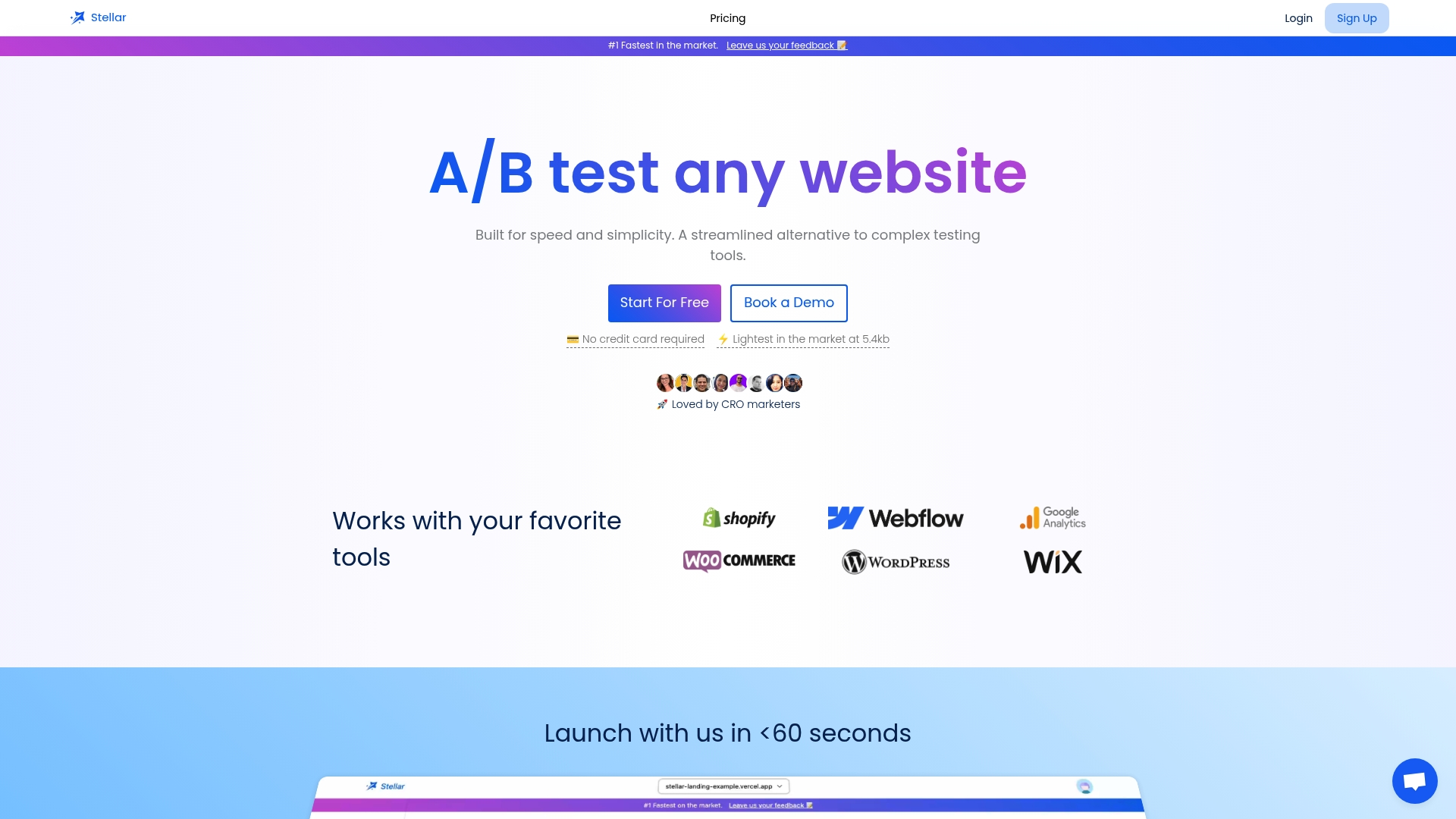
A no-code visual editor lets a marketer set up a test on a product page or checkout flow directly, no ticket to engineering required. Goal tracking connects test results to real outcomes like completed purchases, not just clicks, and the whole script runs at a small size so your page speed stays intact while the test runs. It integrates directly with popular site builders, so setup takes minutes rather than a sprint.
The decision point is simple: if your current platform's built-in testing features feel limited, clunky, or locked behind an enterprise tier, an external tool can fill that gap without a contract that outlasts your patience. Businesses with relatively low monthly user counts can start on a free plan and see results before committing to anything. For a deeper look at wiring experimentation into your specific setup, the ecommerce optimization guide walks through goal tracking in more detail, and Shopify merchants specifically can check the Shopify-focused testing guide for platform-specific setup notes.
Start a free trial at Gostellar and run your first test this week.
Sources
A few resources are worth bookmarking if you're deep in a platform evaluation right now. Coursera's ecommerce platform overview covers the baseline feature definitions referenced throughout this guide. TechTarget's ecommerce definition breaks down deployment model categories in more technical depth. Salesforce's platform guide is useful for evaluation criteria around scalability and integrations. For composable architecture specifically, commercetools' enterprise commerce page and third-party analysis of commercetools integrations both offer a closer look at how API-first platforms structure their capabilities. For broader optimization strategy once your platform is live, the ultimate ecommerce optimization guide rounds out the picture.
- Ecommerce platforms: definition and features (Coursera article)
- What is e-commerce? (TechTarget)
- What is an Ecommerce Platform? (Salesforce)
Recommended
Published: 9/4/2026