
The E-Commerce Checklist That Actually Converts in 2026
TL;DR:
- Most online stores fail because they overlook critical revenue-impacting details, especially during checkout and on product pages. Focusing on early display of shipping costs, simplifying the checkout process, and ensuring compliance with PCI DSS and sales tax rules can significantly reduce cart abandonment and boost sales. Regularly revisiting and testing these strategies across all channels, including mobile and marketplaces, sustains growth and maximizes conversion rates.
Most online stores don't fail because of bad products. They fail because the e commerce checklist their team followed at launch skipped the details that actually move revenue. Missing a clear shipping cost display costs you nearly half your potential sales. A checkout with too many steps sends buyers straight to a competitor. This guide cuts through the noise and walks you through every critical category in order of revenue impact, so you fix the leaks that matter before touching anything else.
Table of Contents
- Key takeaways
- 1. Your e-commerce checklist starts with product pages
- 2. Checkout process: where most money is lost
- 3. Shipping and returns: building buyer confidence before purchase
- 4. Sales tax compliance checklist for US-based stores
- 5. Mobile UX and conversion tracking essentials
- 6. Multi-channel selling and marketplace optimization
- My honest take on how to use this checklist
- How Gostellar fits into your conversion optimization workflow
- FAQ
Key takeaways
| Point | Details |
|---|---|
| Start with checkout and product pages | These two areas cause the most conversion loss and should be audited before anything else. |
| Show shipping costs early | Unexpected shipping fees trigger 48% of cart abandonment, so surface this information before checkout begins. |
| PCI DSS compliance is non-negotiable | Script monitoring on payment pages is now mandatory under PCI DSS v4.0 requirements 6.4.3 and 11.6.1. |
| Treat mobile as your primary storefront | Over 70% of e-commerce visits come from mobile devices, making responsive design and fast load times critical. |
| Revisit your checklist regularly | A good online store setup checklist is a living document, not a one-time pre-launch task. |
1. Your e-commerce checklist starts with product pages
Product pages are where buying decisions happen. Get these wrong and no amount of ad spend will save your conversion rate. Every product listing needs high-resolution images from multiple angles, ideally supplemented by a short demo or lifestyle video. Shoppers who cannot physically touch a product rely entirely on your visual presentation to build confidence.
Your product titles should be clear, specific, and include the terms your customers actually search for. Descriptions need to answer objections, not just list features. Think about what hesitation a buyer has before clicking "Add to Cart" and address it directly in the copy.
- Display real customer reviews and ratings prominently
- Show stock levels to create urgency when inventory is low
- Include clear pricing with any discounts or savings highlighted
- Add product schema markup for richer Google search results
- Link to sizing guides, compatibility charts, or FAQ sections where relevant
Pro Tip: Run A/B tests on your product page headlines and main image before assuming your first version is optimal. Small changes to these two elements consistently produce outsized results. Gostellar's product page testing guide walks through exactly how to structure these experiments.
For a deeper look at what actually moves the needle on product pages, the guide to optimizing product pages for sales covers both SEO and conversion angles worth reviewing.
2. Checkout process: where most money is lost
If your checkout has more than three steps, you are leaving money on the table. The data on this is clear, and the fix is not complicated. Reduce friction at every point in the flow.

Guest checkout is not optional anymore. Requiring account creation before purchase is one of the most common and avoidable conversion killers in e-commerce. Let shoppers buy first, then invite them to create an account on the confirmation page.
Here is what a high-converting checkout flow looks like:
- One to three steps maximum from cart to confirmation
- Guest checkout available with no barriers
- Shipping costs and estimated delivery displayed before payment
- Multiple payment options including cards, PayPal, buy-now-pay-later, and digital wallets
- Trust badges and security seals visible near the payment fields
- Clear error messages that help users fix mistakes without starting over
On the security side, PCI DSS v4.0 requirements 6.4.3 and 11.6.1 now mandate that merchants maintain a complete inventory of all scripts on payment pages and monitor them continuously for unauthorized changes. Third-party scripts are the most common compliance failure and the most common vector for Magecart-style data theft.
Choosing a hosted checkout solution is one of the smartest moves a small to medium e-commerce business can make. It reduces your PCI compliance scope significantly because cardholder data never touches your servers directly. Less scope means less cost, less risk, and faster compliance. Source: PCI DSS Compliance for E-commerce 2026
Many merchants incorrectly assume they qualify for the simpler SAQ A self-assessment form when they have third-party scripts running anywhere near their payment pages. Hosted checkout methods are the cleanest way to sidestep that complexity entirely.
3. Shipping and returns: building buyer confidence before purchase
Shoppers decide whether to trust you before they ever reach checkout. Your shipping and returns policy is a major part of that trust signal. Unexpected shipping costs are the single largest driver of cart abandonment at 48%, which means showing your shipping options early is not a nicety. It is a revenue strategy.
Here is what your shipping and returns checklist should include:
- Display available shipping options and costs on product pages or in a persistent header banner
- Show estimated delivery windows alongside price, not just at checkout
- Offer at least one free shipping option, even if threshold-based, since this alone improves conversion measurably
- Make your returns policy visible on product pages, not buried in the footer
- State return windows clearly: 30 days, 60 days, no questions asked
- Specify who pays return shipping and whether refunds are full or store credit
A free shipping threshold, such as "free shipping on orders over $50," also functions as a natural average order value driver. Shoppers add items to reach the threshold without you needing to discount anything. Display this threshold in your cart as a progress indicator to maximize its effect.
4. Sales tax compliance checklist for US-based stores
Sales tax compliance is the area where e-commerce owners most often underestimate their exposure. The rules changed significantly after the 2018 South Dakota v. Wayfair Supreme Court decision, and they continue to evolve. Here is your core compliance checklist for 2026.
- Determine your nexus. Physical presence (office, warehouse, employees) creates nexus automatically. Economic nexus is triggered by sales volume or transaction counts in a state, typically $100,000 in sales or 200 transactions per year.
- Register for a sales tax permit in every state where you have nexus. Permit application costs range from free to $100 depending on the state.
- Configure your store to collect the correct tax rate at the product and jurisdiction level. Some products are exempt in certain states.
- Manage exemption certificates for any wholesale or tax-exempt buyers you serve.
- File and remit on time. Filing frequency (monthly, quarterly, annually) varies by state and your sales volume.
- Review marketplace facilitator rules. As of 2025, most states require marketplace platforms like Amazon and Etsy to collect and remit sales tax on behalf of third-party sellers. If you sell only through these platforms in a state, you may have no filing obligation there, but you must verify this state by state.
Automation tools help with rate calculation and filing, but sales tax compliance still requires you to make the judgment calls on nexus and exemptions. Software does not replace due diligence.
5. Mobile UX and conversion tracking essentials
Mobile traffic exceeds 70% of all e-commerce visits, which means your desktop experience is secondary. Your mobile checkout flow, page speed, and button sizing all directly affect whether you make the sale.
Here is what to check and track:
- Test your entire checkout flow on at least three different mobile screen sizes
- Target a page load time under three seconds for all key landing and product pages
- Use large tap targets for buttons (minimum 44x44 pixels per Apple and Google guidelines)
- Minimize form fields on mobile: use autofill-friendly field names and address autocomplete
- Implement Google Analytics 4 with e-commerce tracking events for add-to-cart, begin-checkout, and purchase
Pro Tip: Set up conversion funnels in your analytics tool so you can see exactly where users drop off at each stage. You cannot fix a leak you have not located. Gostellar's resource on tracking e-commerce conversions covers the specific events and setup steps worth bookmarking.
| KPI | What it tells you |
|---|---|
| Mobile conversion rate | How well your mobile experience converts versus desktop |
| Checkout abandonment rate | Where buyers are dropping out of the funnel |
| Add-to-cart rate | Whether product pages are compelling enough to start the purchase intent |
| Page load time | Site speed impact on bounce rate and conversions |
| Revenue per session | Overall health of traffic quality and store experience |
Once you have baseline data, iterative A/B testing is how you compound gains. Even a single winning test on your checkout button color or product page layout can increase conversion rates meaningfully over time.
6. Multi-channel selling and marketplace optimization
Your own website is one channel. But if you sell on Amazon, Etsy, Walmart Marketplace, or similar platforms, each of those is its own conversion environment with distinct rules and optimization levers. Each marketplace has unique ranking algorithms, image requirements, keyword strategies, and trust metrics.
Treat each marketplace like a separate workstream:
- Audit your product listings on each platform separately: titles, images, bullet points, and back-end keywords differ by platform
- Track your conversion rate, return rate, and review score per channel independently
- Monitor seller metrics like late shipment rate and response time, since these affect your ranking and eligibility for promotional placements
- Use channel-specific repricing strategies rather than applying a single price everywhere
| Platform | Key optimization focus | Primary trust metric |
|---|---|---|
| Amazon | Keywords, Buy Box eligibility, reviews | Seller rating and fulfillment speed |
| Etsy | Tags, photos, shop story, recency | Star seller badge, response rate |
| Walmart Marketplace | Competitive pricing, Pro Seller status | On-time delivery, review count |
A solid multichannel SEO strategy for 2026 goes beyond listing management and incorporates how each platform's search algorithm rewards content quality and customer satisfaction signals differently.
My honest take on how to use this checklist
I've worked through enough store audits to know that the biggest mistake people make with any website launch checklist is treating it as a single event. You run through it before launch, check everything off, and assume you're done. That's not how conversion optimization actually works.
In my experience, the right approach is to order your fixes by revenue impact. Start with checkout and product pages every time. These two areas produce the fastest return on attention. Mobile UX is a close third, especially now that mobile accounts for the majority of traffic.
What I've seen consistently underestimated is compliance. Sales tax and PCI DSS aren't exciting checklist items, but a single compliance failure can cost more than months of conversion improvements. I'd rather spend three hours getting PCI scope right than deal with the fallout from a Magecart incident or a state tax audit.
The stores that grow most consistently are the ones that revisit their checklist quarterly. They test, learn, and update based on what the data actually shows, not assumptions made at launch. Keep this as a living document and schedule a review every 90 days minimum.
— Juan
How Gostellar fits into your conversion optimization workflow
Running through this checklist gives you a clear picture of what to fix. What it does not give you automatically is a way to know whether your fixes are actually working better than what you had before.
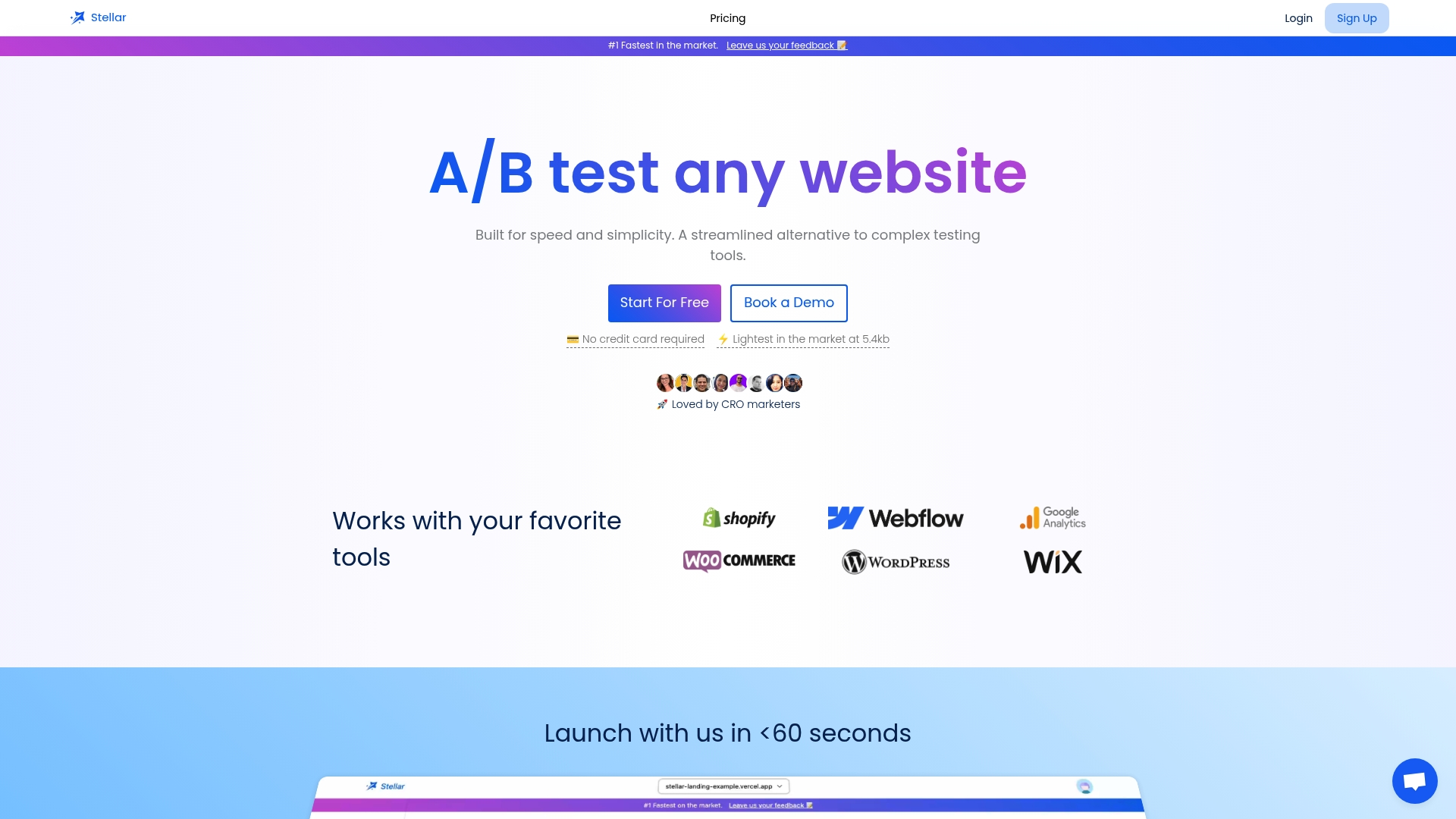
That's where Gostellar comes in. Gostellar is built specifically for e-commerce marketers who need to test changes quickly without waiting on a developer. With a 5.4KB script that won't slow down your store and a no-code visual editor, you can set up A/B tests on product pages, checkout layouts, and landing pages in minutes. Real-time analytics show you exactly which version wins before you commit to any permanent change. If you're working through your e-commerce optimization checklist and want data behind every decision, Gostellar offers a free plan for stores under 25,000 monthly tracked users.
FAQ
What should come first on an e-commerce checklist?
Start with checkout and product pages. These areas have the highest direct impact on conversion rates and fixing them first addresses the most significant revenue leaks before anything else.
How do I know if I need to collect sales tax in a new state?
You need to collect sales tax once you establish nexus in a state, either through physical presence or by crossing economic thresholds, typically $100,000 in sales or 200 transactions per year in that state.
What is PCI DSS and why does it matter for my online store?
PCI DSS is the Payment Card Industry Data Security Standard that governs how businesses handle cardholder data. Non-compliance exposes you to data breach liability and can result in fines or loss of payment processing rights.
How do I reduce cart abandonment at checkout?
Enable guest checkout, display shipping costs and delivery times before the payment step, reduce the number of form fields, and add trust badges near payment fields. These changes address the most common reasons shoppers abandon a cart.
Do I need a separate optimization strategy for each marketplace?
Yes. Amazon, Etsy, and Walmart each use different ranking algorithms and trust signals, so a listing optimized for one platform will not perform the same on another. Track metrics and optimize each channel independently.
Recommended
Published: 5/27/2026