
Top A/B Testing Software 2025 – Expert Comparison
Choosing the right experiment platform can make all the difference when every second counts and every click matters. Each tool out there brings its own blend of speed, analytics, privacy, and smart features. Some promise powerful insights in a few simple steps while others open the door to deep customization and advanced personalization. The best match can depend on how quickly you want results, how much control you need, and how simple you want your day to be. See how different platforms stack up and decide which approach fits your goals and your team.
Table of Contents
Stellar
At a Glance
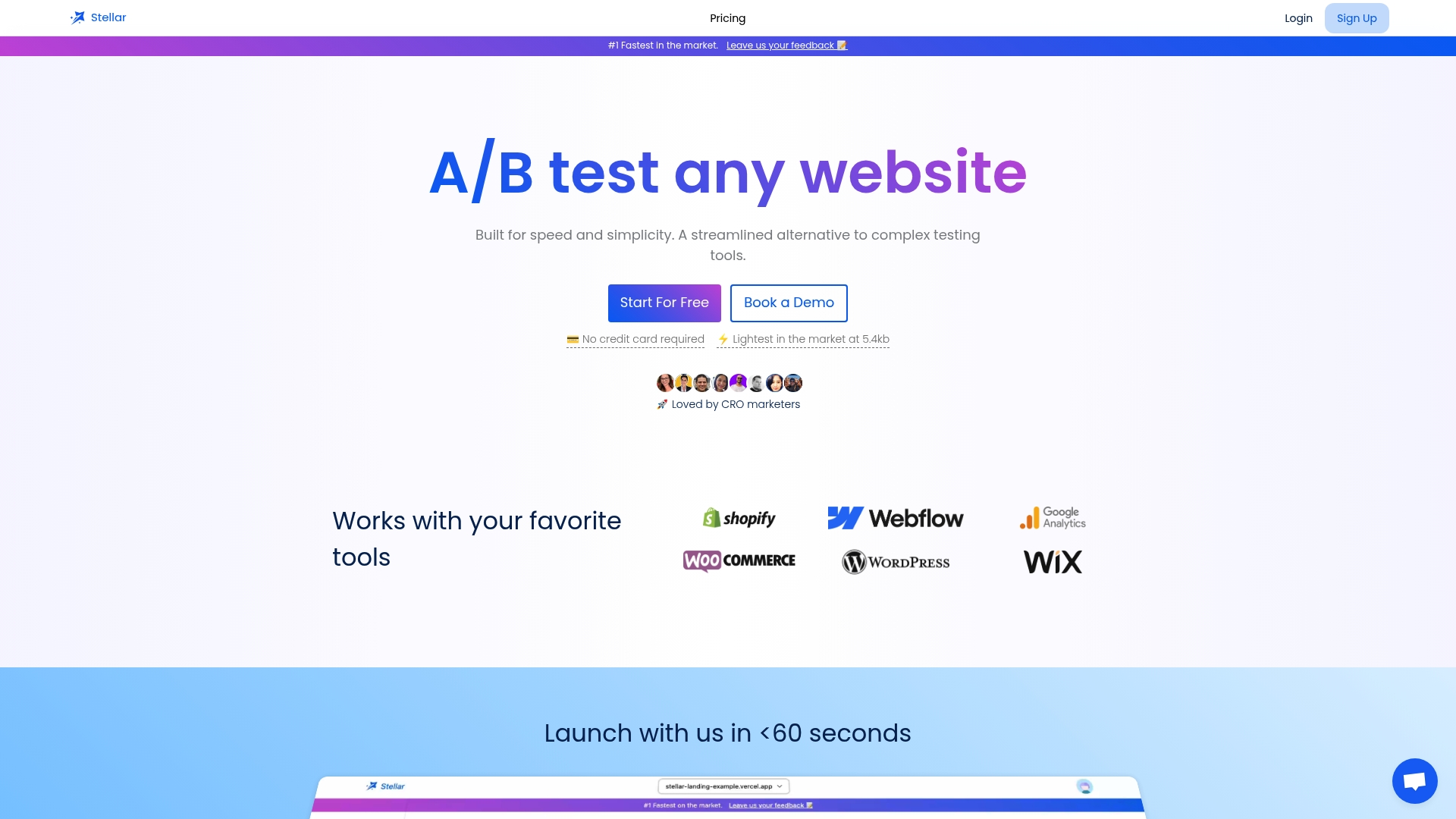
Stellar is a fast, no-nonsense A/B testing platform built for speed and simplicity — ideal when you need reliable experiments without a performance trade-off. Its 5.4KB script ensures tests load quickly, and the no-code visual editor gets non-developers running experiments in minutes. Real-time analytics and AI-powered recommendations make it easy to act on results quickly. Bottom line: Stellar is engineered for teams that prioritize site speed and rapid iteration.
Core Features
Stellar combines a no-code visual editor for creating variants with dynamic keyword insertion to personalize landing pages at scale. You can add custom JavaScript and CSS for granular control when you need it, while real-time performance analytics deliver device and behavior breakdowns as tests run. AI-powered conversion insights highlight which changes matter, and easy goal setup supports multiple event tracking. Integrations with analytics platforms such as GA4 keep data unified, and the entire tool is deliberately lightweight (5.4KB) to minimize impact on user experience.
Pros
- Extremely lightweight: The 5.4KB script minimizes impact on site speed, preserving user experience and SEO performance.
- No-code visual editor: Non-developers can create and launch experiments quickly without writing code.
- Powerful analytics and AI: Real-time analytics plus AI recommendations shorten the path from data to decision.
- Flexible pricing: A free tier for up to 25,000 monthly tracked users and an affordable Pro plan at $99 per month provide clear, scalable options.
- Simple installation and broad compatibility: Stellar works with any website and integrates with common analytics tools, making setup painless.
Who It's For
Stellar is built for marketers, CRO specialists, growth hackers, product managers, and digital agencies at small to medium-sized businesses that need fast, pragmatic experimentation. If you have limited engineering resources, care deeply about site performance, and want quick, actionable results, Stellar is designed around your workflow. It’s less about enterprise complexity and more about fast wins and steady optimization.
Unique Value Proposition
Stellar’s unique value lies in its combination of extreme performance optimization and practical experimentation tools. At 5.4KB, the script is a deliberate design choice that prioritizes minimal latency — not an accidental benefit. Pair that with a no-code visual editor and AI-driven insights, and you get a platform that accelerates hypothesis-to-decision cycles without burdening engineering teams. Pricing is transparent and accommodating (free up to 25k MTU, Pro at $99 per month, enterprise options for scale), which makes Stellar especially compelling for budget-conscious teams that still demand enterprise-grade analytics. In short: Stellar trades unnecessary complexity for speed, clarity, and actionable intelligence — a superior approach for teams focused on conversion impact rather than platform overhead.
Real World Use Case
A small e-commerce merchant uses Stellar to run concurrent A/B tests on product pages, swapping imagery, button copy, and headline variations via the visual editor. With real-time analytics and AI suggestions, the team identifies a winning layout in days instead of weeks, pushing the variant live and tracking conversion lift across devices. Results roll into GA4 for consolidated reporting and follow-up personalization via dynamic keyword insertion.
Pricing
Stellar offers a Free plan at $0 per month for up to 25,000 monthly tracked users (MTU). The Pro plan is $99 per month and adds higher capacity and advanced capabilities. Enterprise plans are available with custom solutions and pricing for very high-volume needs.
Website: https://gostellar.app
Optimizely
At a Glance
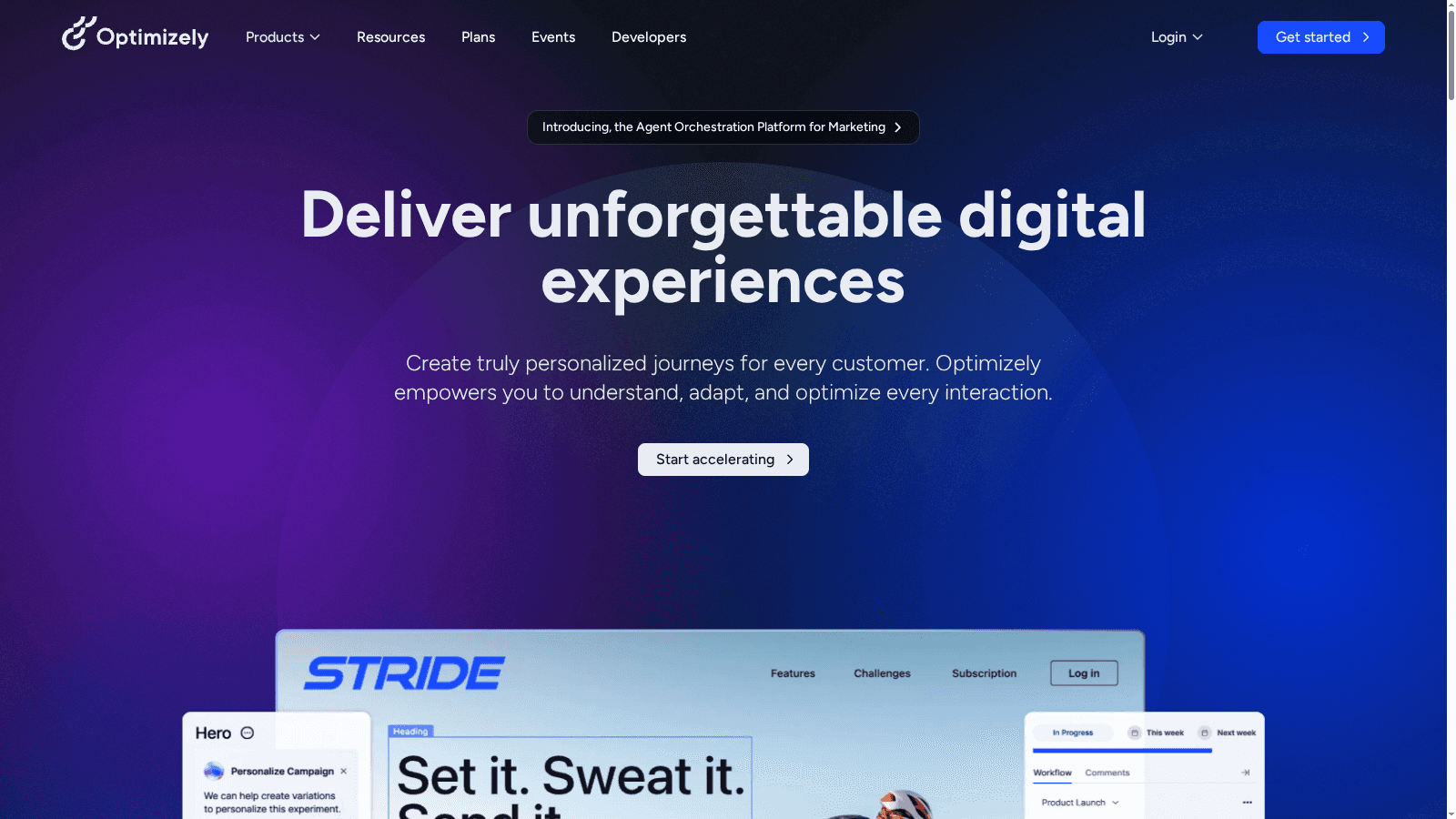
Optimizely is an AI-powered digital experience platform that bundles experimentation, personalization, and content management into a single suite. It’s built for teams that need an enterprise-grade toolset for testing, personalization, and analytics rather than a lightweight, entry-level solution. If you need an all-in-one platform to run experiments, manage content, and activate customer data, Optimizely delivers breadth and depth—at a scale that typically suits medium to large organizations.
Core Features
Optimizely combines web experimentation and testing with personalization and targeting, backed by an analytics and insights suite with dashboards and reports. The platform also includes content creation and management, commerce tools for online stores, a data platform for customer segmentation and activation, a content management system with APIs and workflows, feature experimentation and release management, and digital asset management. These capabilities are framed by AI and automation features intended to speed decision-making and reduce manual setup.
Pros
- Comprehensive feature set: Optimizely provides a wide range of tools from experimentation to content and commerce, allowing teams to centralize digital experience efforts in one platform.
- AI and automation strengths: The platform’s AI-powered capabilities aim to accelerate experimentation and personalization workflows, reducing repetitive manual tasks.
- Strong integration potential: Optimizely integrates with numerous applications, enabling data flow between marketing, analytics, and product systems.
- Personalization and targeting: The product supports targeted content delivery, which helps tailor journeys for different customer segments.
- Analytics for measurable results: Built-in dashboards and reporting give teams measurable insights to evaluate experiments and campaign performance.
Cons
- Higher cost for smaller teams: Pricing is not transparent and typically requires contacting the vendor, which suggests it may be expensive or tailored to larger customers.
- Complex setup and onboarding: New users may face a steep learning curve during initial implementation and configuration.
- Technical expertise often required: Several capabilities—especially advanced experimentation and data activation—may need technical resources to fully leverage.
Who It's For
Optimizely is best suited for medium to large enterprises that require an integrated digital experience platform with AI capabilities. If your organization runs frequent experiments, needs integrated content and commerce workflows, and has teams or vendors to manage implementation, Optimizely is a logical choice. If you’re a solo marketer or a small business seeking a lightweight, low-cost tool, this platform may overshoot your needs.
Unique Value Proposition
Optimizely’s unique value is its breadth: it combines experimentation, content management, personalization, commerce, and data activation under an AI-driven umbrella. That consolidation reduces tool sprawl and allows teams to run coordinated experiments and personalized experiences while measuring impact with unified analytics.
Real World Use Case
A retail company uses Optimizely to run A/B tests on product pages, personalize promotions for segmented audiences, manage campaign content in the CMS, and analyze engagement data in unified dashboards to improve conversion rates and customer experience.
Pricing
Optimizely requires prospective customers to request pricing via a contact form on the website, indicating custom or tiered enterprise pricing rather than transparent per-month plans.
Website: https://optimizely.com
VWO (Visual Website Optimizer)
At a Glance
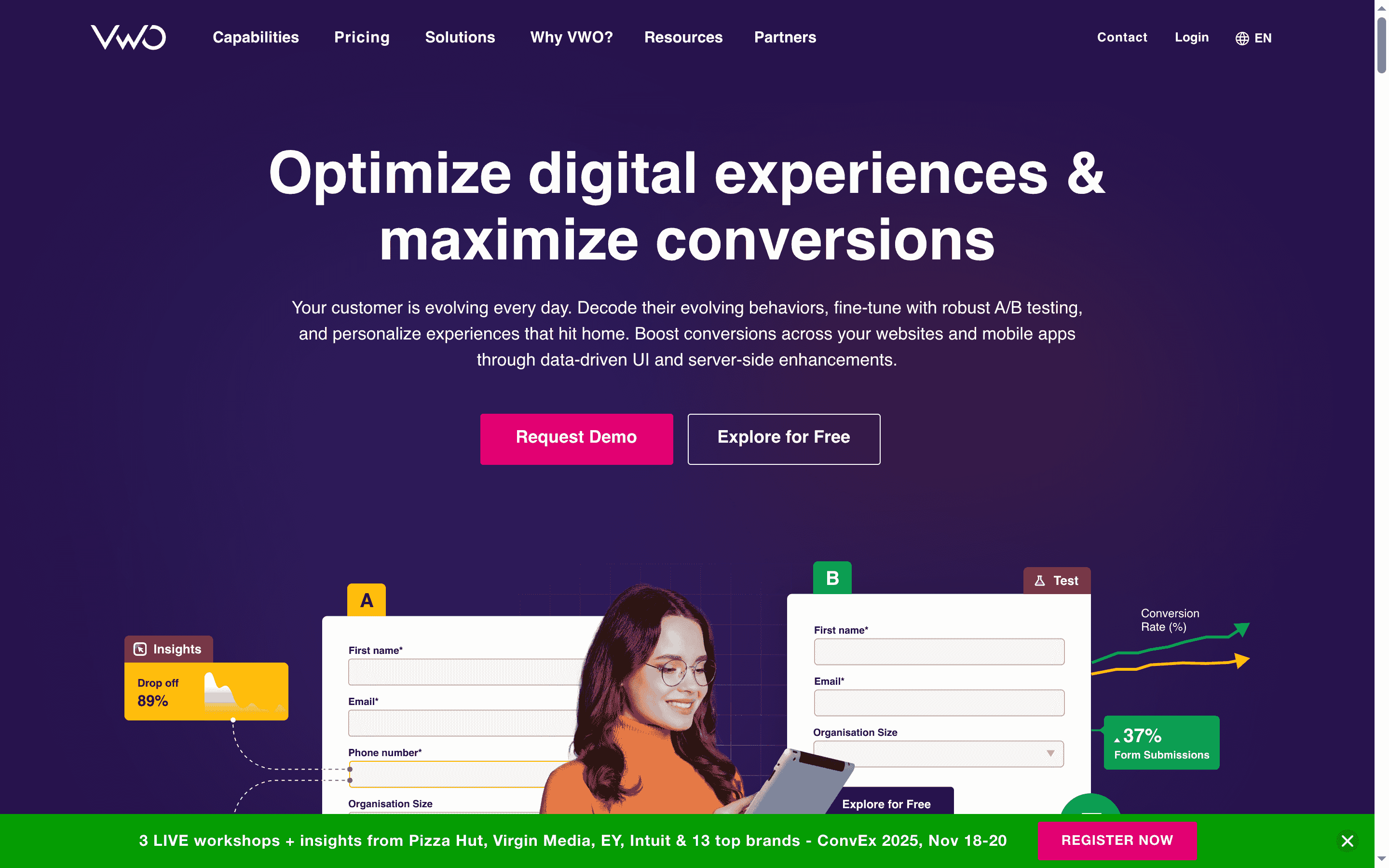
VWO is an enterprise-ready digital experience optimization platform that combines experimentation, personalization, and qualitative insights in a single suite. It’s designed to help teams run A/B and multivariate tests, personalize experiences, and diagnose user behavior with heatmaps and session recordings. If you need a scalable solution with strong security and AI-assisted workflows, VWO delivers—but expect a layered pricing model and a learning curve for advanced targeting.
Core Features
VWO brings A/B testing and multivariate testing together with heatmaps, session recordings, personalization, surveys, form and funnel analytics, and robust segment creation. The platform supports targeted campaigns across web and mobile, offers advanced targeting options, and includes AI-powered tools such as VWO Copilot to automate insights and speed up hypothesis generation. Enterprise security and scalability are built in to support large sites and complex digital properties.
Pros
- All-in-one optimization suite: VWO consolidates testing, personalization, and qualitative tools so teams don’t need multiple vendors to run experiments and gather insights.
- User-friendly visual editor: The visual editing interface reduces reliance on developers for many experiments and makes setup faster for marketers and product managers.
- Strong integrations and security: Enterprise-grade security features and solid integration options make VWO fit for regulated or large organizations that require compliance and data controls.
- AI-powered assistance: VWO Copilot helps automate analysis and suggests experiment ideas, accelerating the experimentation cycle and reducing manual interpretation time.
- Scalable for large sites and apps: The platform is architected to handle high-traffic properties and complex experiment portfolios without sacrificing performance.
Cons
- Complex pricing structure: Multiple plans and add-ons make pricing harder to compare, and the true cost can increase as you add features or scale traffic.
- Steep learning curve for advanced features: Advanced targeting, segmentation, and some analytics capabilities require time and practice to use effectively.
- Technical requirements for some features: A few capabilities still depend on technical expertise or support during setup, which can slow initial implementation.
Who It's For
VWO is best suited for mid-sized to large enterprises, ecommerce businesses, and organizations with complex digital properties that require advanced experimentation, personalization, and enterprise-level controls. Product teams, CRO specialists, and growth marketers who prioritize an integrated testing and insights platform will gain the most from VWO’s breadth of tools.
Unique Value Proposition
VWO differentiates itself by packaging experimentation, qualitative insights, and personalization into one enterprise-ready system with built-in AI assistance. That combination lets teams design, test, and act on hypotheses faster while keeping governance and scalability central to the platform.
Real World Use Case
A retail site uses VWO to test homepage layouts and promotional banners via A/B and multivariate tests, personalize product recommendations for distinct customer segments, and analyze friction points with heatmaps and session recordings to lift conversion rates and customer satisfaction.
Pricing
VWO offers several tiers—Starter (pay-as-you-go with MTU limits), Growth, Pro, and Enterprise—with higher plans unlocking unlimited experiments, advanced features, and dedicated support; custom enterprise pricing is available.
Website: https://vwo.com
Optimizely
At a Glance
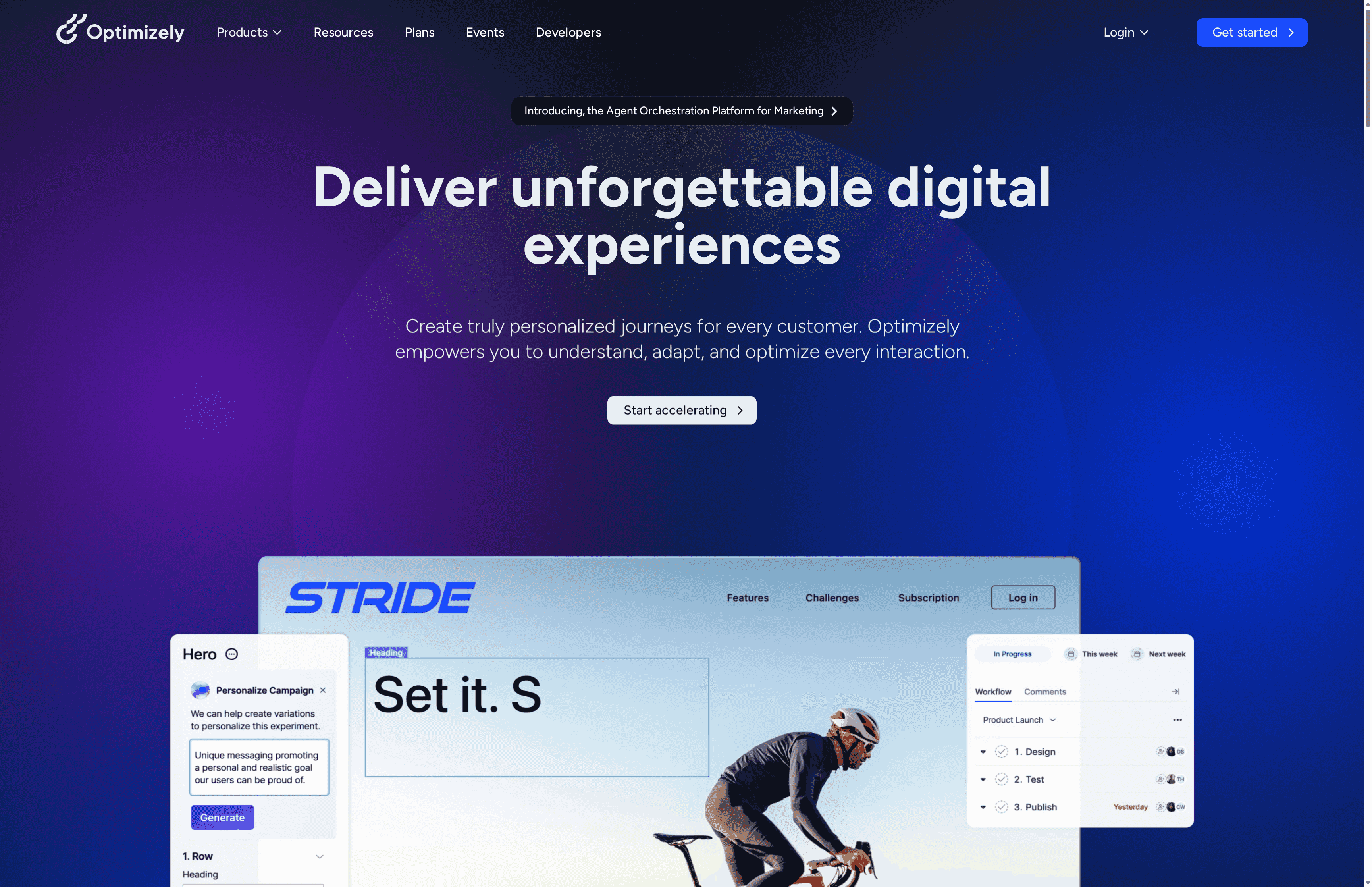
Optimizely is an enterprise-grade digital experience platform centered on AI-powered experimentation, personalization, content management, and e-commerce tooling. It’s designed to help teams test, target, automate, and analyze customer interactions across channels to boost engagement and conversions. If you need a single platform that blends testing, content workflows, and analytics with AI enhancements, Optimizely delivers broad capability—though that breadth brings complexity and a tailored pricing model.
Core Features
Optimizely combines an AI-driven experimentation and testing engine with personalization and targeting that adapts content to audiences in real time. It includes a content management system for dynamic websites and a digital asset management layer for marketing resources. Developer-focused feature experimentation and deployment tools are available alongside analytics and real-time audience insights, enabling cross-channel optimization from testing to delivery.
Pros
- Comprehensive toolset: Optimizely offers experimentation, personalization, content management, and analytics in one platform, reducing the need to stitch multiple vendors together.
- Strong integration potential: The platform is built to integrate with a variety of apps and tools, which helps centralize workflows across marketing and product teams.
- AI-enhanced productivity: AI-powered features aim to accelerate targeting and experimentation setup, improving marketing efficiency and test relevancy.
- Multi-channel support: Optimizely supports experiences across devices and channels, letting you maintain consistent testing and personalization strategies.
- Data-driven focus: The platform emphasizes analytics and audience insights, helping teams make decisions based on measurable outcomes rather than intuition alone.
Cons
- Steep learning curve: The platform’s broad feature set creates complexity that can overwhelm new users and small teams without dedicated resources.
- Opaque pricing: Pricing is tailored and not publicly listed, which makes budgeting and vendor comparisons more difficult without a sales consultation.
- Technical implementation needs: Advanced use cases often require technical knowledge, meaning product and engineering involvement for full value realization.
Who It's For
Optimizely is best suited for marketing teams, product managers, developers, and e-commerce businesses that want to leverage AI and structured experimentation to raise conversion rates and personalize customer journeys. If your organization values consolidated tooling over a patchwork of point solutions and can support a platform with technical and onboarding requirements, Optimizely fits well.
Unique Value Proposition
Optimizely’s unique value is its combination of AI-driven experimentation and personalization within a unified platform that also handles content and digital assets. That consolidation shortens the path from hypothesis to implementation and analysis, enabling teams to iterate faster on customer experiences while keeping data and assets in a single environment.
Real World Use Case
A company uses Optimizely to run A/B tests on landing pages to identify the most effective layouts, personalize content for returning visitors through AI-driven targeting, and analyze visitor behavior to refine marketing campaigns. The result is a tighter feedback loop between experiments, content changes, and performance metrics.
Pricing
Pricing is tailored to the selected products and services and is available upon request, which means you’ll need to contact Optimizely for a custom quote based on your stack and traffic volumes.
Website: https://optimizely.com
VWO (Visual Website Optimizer)
At a Glance
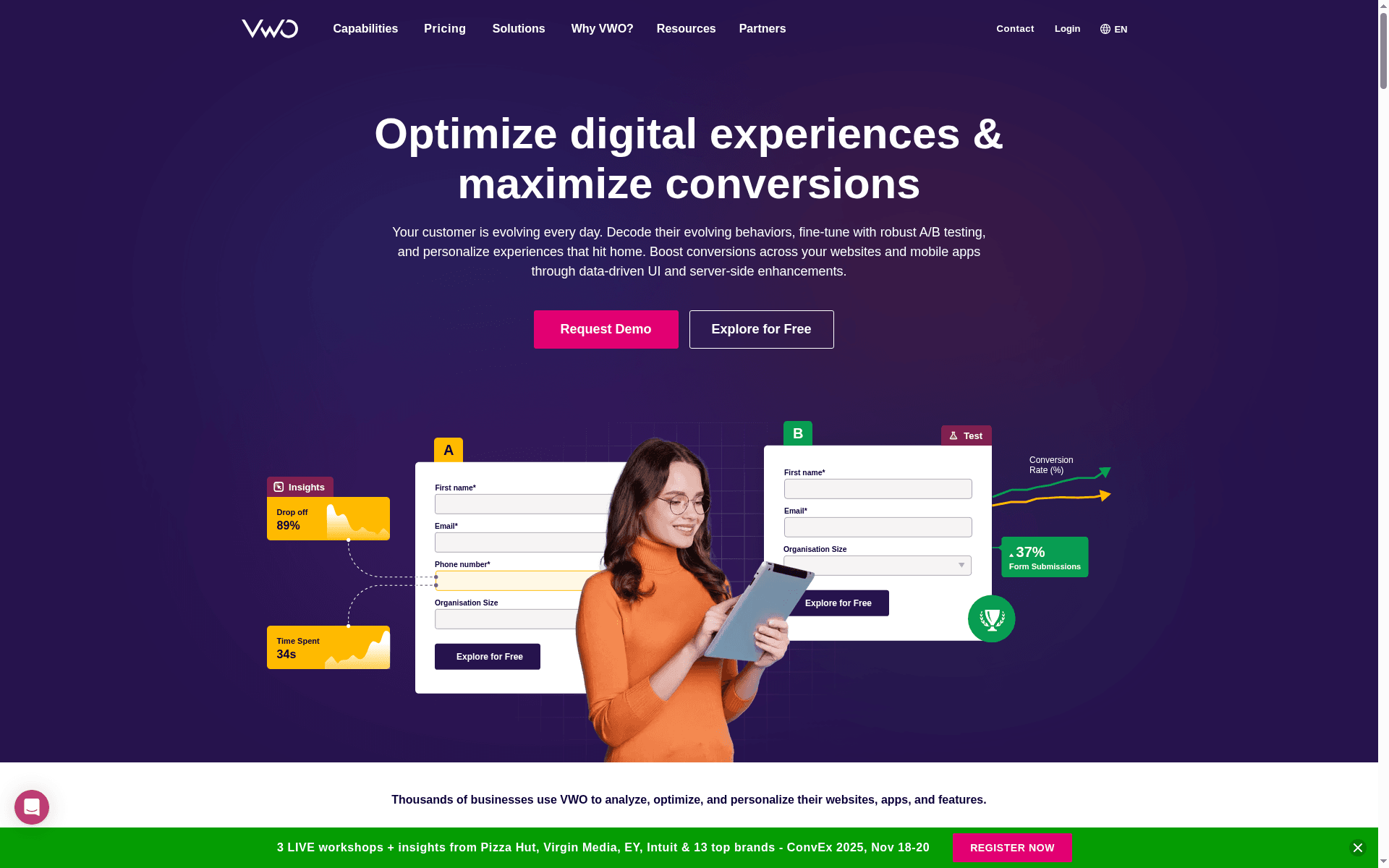
VWO is a full-featured digital experience optimization platform built for teams that need experimentation, personalization, and behavioral insight in one place. It combines A/B and multivariate testing with heatmaps, session recordings, and funnel analytics to drive conversion improvements. The platform emphasizes enterprise-grade security and scalable infrastructure, which makes it a strong choice for medium to large organizations that require compliance and integrations across complex stacks.
Core Features
VWO offers A/B testing and multivariate testing alongside personalization and targeted campaigns, enabling you to run both simple split tests and complex experiments. Behavioral tooling includes heatmaps and session recordings plus funnel and form analytics to diagnose friction points. The platform also supports rollouts and feature flags for staged releases, with luminosity-based targeting and segmentation to reach precise user cohorts. Integrations with data sources and support for multiple tech stacks round out an end-to-end optimization workflow.
Pros
- Comprehensive experimentation suite: VWO combines testing, personalization, heatmaps, recordings, and analytics so you can run end-to-end optimization without stitching disparate tools together.
- User-friendly visual editors and no-code options: Visual editors make it possible for marketers and product managers to create variations and campaigns without deep engineering support.
- Extensive integrations: The platform integrates with multiple data sources and tech stacks, allowing teams to incorporate experiments into existing analytics and deployment workflows.
- Strong security and compliance posture: Enterprise-grade security and privacy features are part of the product offering, which is critical for regulated industries and large enterprises.
- Scalable and customizable plans: VWO provides configurable plans that can scale from starter setups to enterprise-level deployments, fitting a range of organizational needs.
Cons
- Pricing geared toward larger organizations: The customized pricing model and enterprise focus may make VWO comparatively expensive for startups or very small businesses.
- Feature complexity can slow ramp-up: The breadth of capabilities means teams may need formal training or onboarding to use advanced features effectively.
- Opaque pricing details on the website: Detailed pricing information is limited without requesting a quote, which can slow evaluation cycles for buyers looking for clear cost comparisons.
Who It's For
VWO is best suited for medium to large businesses, agencies, or enterprises that run multiple sites or complex user journeys and need a secure, scalable experimentation platform. If your team requires integrated behavioral analytics and the ability to personalize experiences at scale, VWO fits that profile.
Unique Value Proposition
VWO’s strength is its all-in-one approach: experimentation, personalization, and behavioral insight live together, reducing tool sprawl and simplifying data flow. For teams that prioritize security, compliance, and integration with existing stacks, VWO presents a defensible, enterprise-ready option.
Real World Use Case
A retail organization can use VWO to A/B test product page layouts, deploy feature flags for progressive rollouts, personalize content for customer segments, and analyze heatmaps and session recordings to remove friction—ultimately increasing conversions and improving user engagement.
Pricing
Pricing is customized based on business needs, with plans ranging from Starter to Enterprise and additional add-ons available upon request. Detailed costs typically require a sales consultation.
Website: https://vwo.com
AB Tasty
At a Glance
AB Tasty is a full-featured digital experience optimization platform that blends experimentation, personalization, recommendations, and AI to help brands boost engagement and conversions. It supports web and app A/B testing, multi-channel experiments, controlled rollouts, and AI-driven targeting. If you need a scalable solution that combines testing and personalization with advanced AI capabilities, AB Tasty is a strong candidate—though it can feel overwhelming without technical resources.
Core Features
AB Tasty provides web experimentation with advanced testing tools and a focus on simple experience building, plus personalization powered by robust segmentation and targeted experiences. The platform includes product and content recommendations for discovery and cross-sell, rollout management with safety measures and automatic KPIs-triggered rollbacks, and AI-enhanced features such as emotionsAI and EVI (the evidence-based marketing agent) for AI-based targeting and productivity gains. Extensive integrations and multi-channel support make it suitable for complex digital stacks.
Pros
- Comprehensive experimentation and personalization: AB Tasty combines A/B testing, multi-channel experiments, personalization at scale, and recommendations in one platform, reducing the need for multiple point tools.
- Advanced AI capabilities: Built-in AI tools like emotionsAI and EVI deliver data-driven targeting and insights that accelerate decision-making and surface relevant experiences.
- Robust rollout safety: Rollouts include safety controls and automatic KPI-triggered rollbacks, which help you protect revenue and user experience during feature releases.
- Wide integration and multi-channel support: The platform supports web, mobile, and app experimentation and integrates with common analytics and marketing stacks to meet diverse use cases.
- Collaborative approach and support: AB Tasty emphasizes collaboration and offers strong customer support, making it easier for teams to align experiments with business goals.
Cons
- Steep learning curve for newcomers: The platform's breadth of features can be complex for new users, requiring time and training to use effectively.
- Pricing is opaque: Pricing details aren’t specified publicly and require direct contact, which can slow procurement and make budgeting harder for buyers.
- Implementation may require technical expertise: Advanced experiments, personalization at scale, and AI-driven setups can need developer resources or technical know-how to implement correctly.
Who It's For
AB Tasty targets medium to large enterprises that need a scalable, end-to-end digital experience optimization platform. It suits product, growth, and marketing teams that have access to technical resources or are prepared to work with implementation partners to unlock advanced experimentation, personalization, and AI capabilities.
Unique Value Proposition
AB Tasty’s unique value is its combination of experimentation, personalization, recommendations, rollout safety, and AI in a single platform—plus the marketing-focused AI agents (EVI) and emotional analytics that help teams craft evidence-based, emotionally resonant experiences at scale.
Real World Use Case
A global e-commerce company leveraged AB Tasty to run multi-channel A/B tests, personalize customer journeys by segment, and deploy AI-driven product recommendations—streamlining experimentation and improving engagement across web and mobile channels.
Pricing
Pricing is not specified on AB Tasty’s website; interested teams must contact AB Tasty for a tailored quote.
Website: https://abtasty.com
Google Marketing Platform
At a Glance
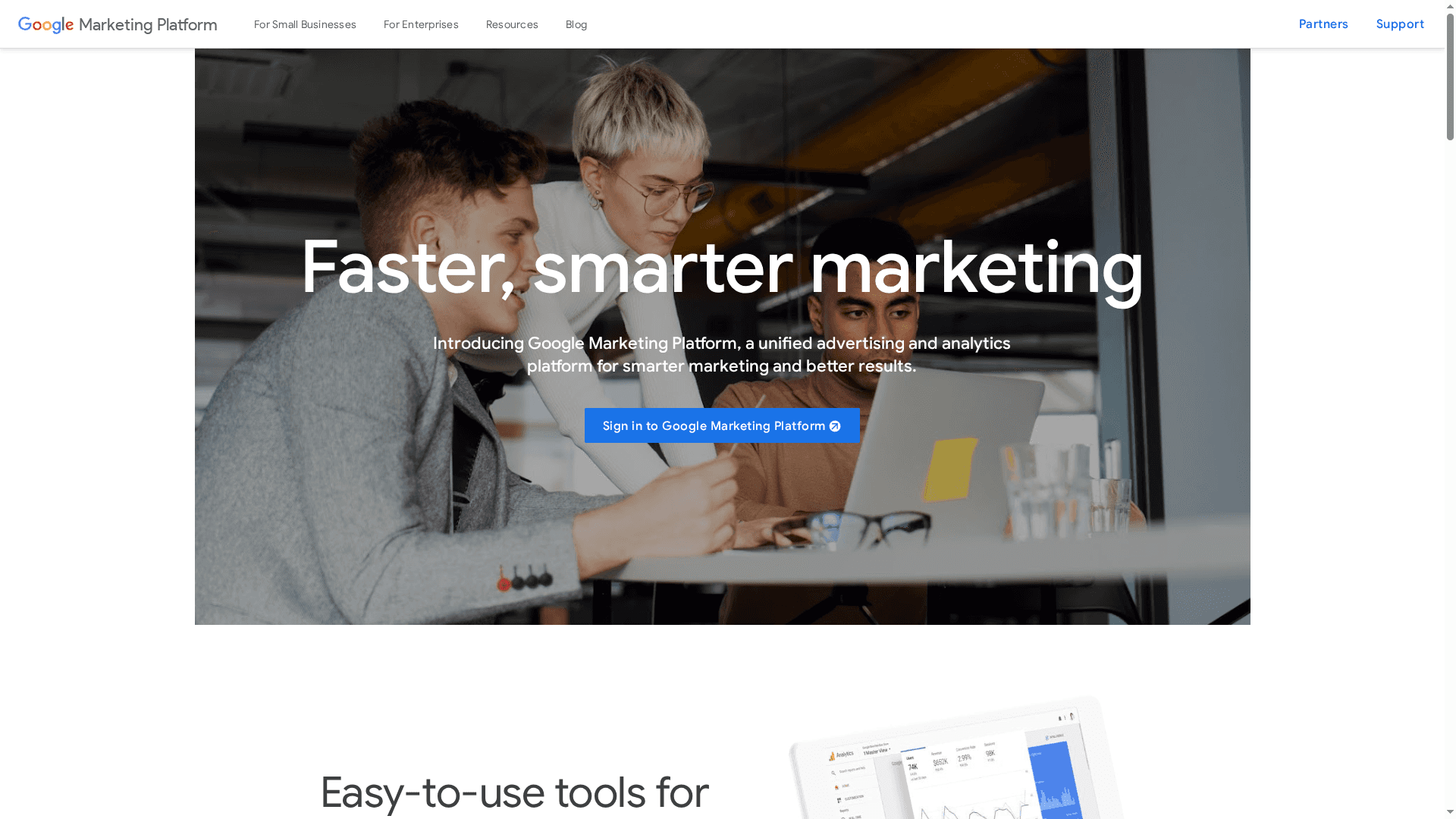
Google Marketing Platform is a unified advertising and analytics suite built to connect creative, measurement, and campaign execution in one place. It serves both small businesses with site and app analytics and large enterprises that need real-time audience insights and programmatic campaign control. The platform bundles tag management, campaign management, and creative optimization into a single ecosystem—powerful, but not always simple. Bottom line: it’s ideal when you want one integrated marketing stack and have the resources to manage its complexity.
Core Features
Google Marketing Platform combines analytics, tag management, and campaign execution tools into a single workflow. Key capabilities include unified advertising and analytics, Tag Manager for managing tags without code edits, and products such as Campaign Manager 360, Display & Video 360, and Search Ads 360 for cross-channel media planning and delivery. The platform supports small-business testing and site/app analytics while scaling to enterprise needs with real-time audience insights and on-the-fly marketing adjustments.
Pros
- Comprehensive toolset in one place: The platform consolidates analytics, advertising, and campaign management so teams can plan, execute, and measure without moving data between silos.
- Scales from small to enterprise: There are features for small-business analytics and enterprise-grade solutions, making the platform adaptable as your marketing maturity grows.
- Real-time data and insights: Real-time reporting enables faster decision-making and quicker adjustments to campaigns.
- Strong partner and support network: An established ecosystem of partners and support reduces implementation risk and helps teams accelerate onboarding.
- Tag management without code changes: Tag Manager lowers developer dependency by letting marketers deploy tracking and tags without editing site code.
Cons
- Complexity can overwhelm smaller teams: The breadth of features and integrated products creates a steep learning curve for teams without dedicated analytics or media specialists.
- Pricing is not transparent on the website: Because costs are not specified publicly, budgeting requires direct vendor conversations and may complicate procurement for smaller businesses.
- Time investment to master features: Fully leveraging Campaign Manager 360, Display & Video 360, and Search Ads 360 requires training and operational changes, which slows time-to-value.
Who It's For
Google Marketing Platform is best for marketing teams and organizations that need an end-to-end stack for advertising, analytics, and campaign orchestration. It fits businesses that plan to invest in analytics and media operations—particularly brands that run cross-channel campaigns and require tight integration between measurement and execution.
Unique Value Proposition
The platform’s unique value is the tight integration between measurement and media: analytics feeds into campaign tools, tag management streamlines deployment, and enterprise modules enable real-time audience activation. That integration reduces data friction and shortens the path from insight to action.
Real World Use Case
A retail brand could use Google Marketing Platform to centralize tag management, analyze on-site behavior, and run synchronized display, video, and search campaigns. For example, Decker's Brands combines the platform with cloud infrastructure to unify marketing and analytics, enabling coordinated, data-driven media decisions.
Pricing
Pricing is not specified on the website and likely varies by usage and services selected, so expect to request a custom quote and plan for implementation costs.
Website: https://marketingplatform.google.com
Convert.com
At a Glance
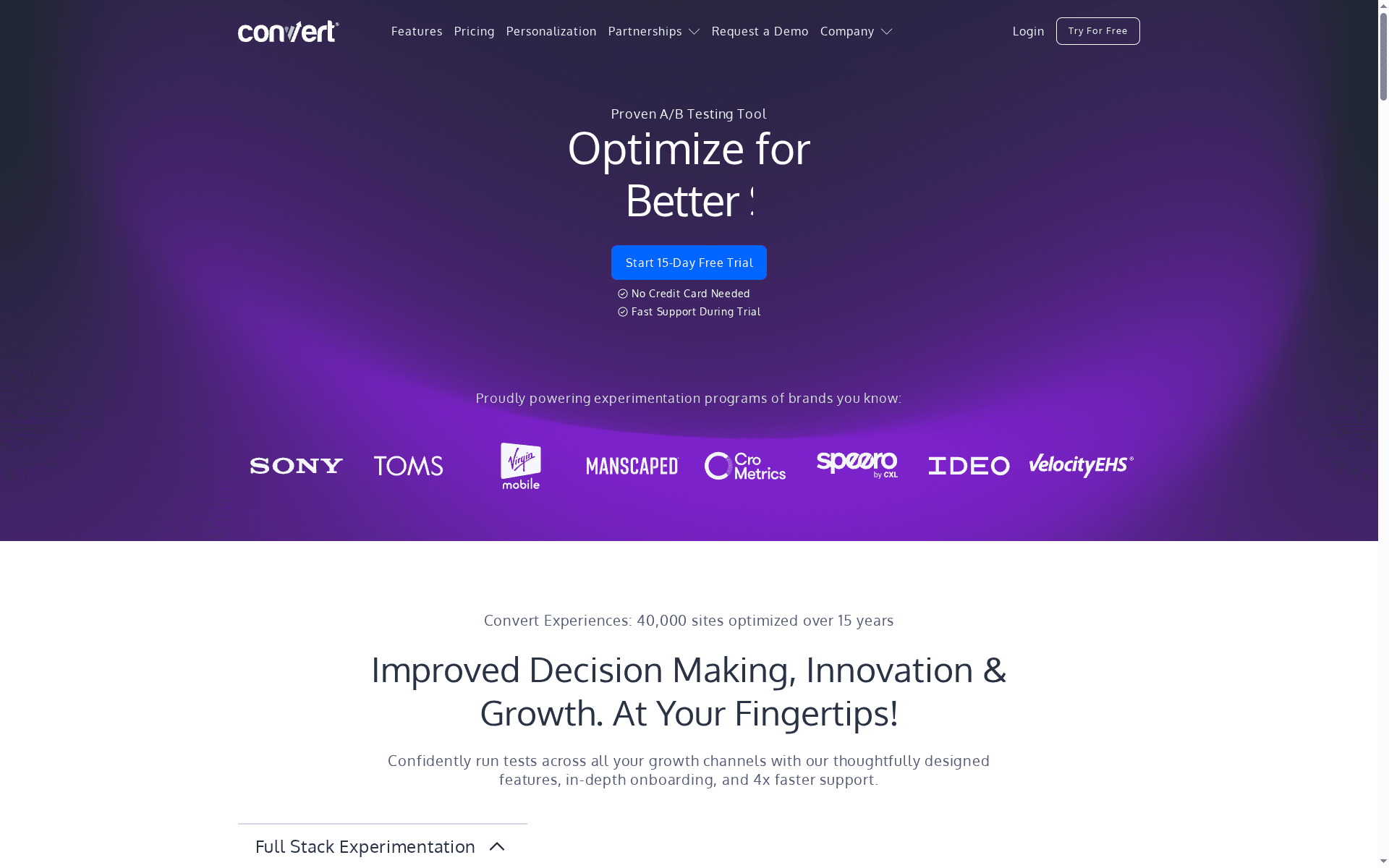
Convert.com is a privacy-focused A/B testing platform built for teams that need dependable, flicker-free experiments without compromising on compliance. It combines full-stack experimentation, feature flags, and flexible statistics engines to support both front-end and server-side programs. Onboarding is fast and support is responsive, with a reported first-response time of around seven minutes. If you prioritize reliability, performance, and GDPR-aligned hosting, Convert.com is worth evaluating.
Core Features
Convert.com centers on flicker-free A/B testing via SmartInsert™, plus full-stack experimentation capabilities that include feature flags and rollouts. It supports advanced targeting and goal configuration through filters and APIs, and offers customizable statistics engines (Frequentist and Bayesian) so you can match analysis to your experimentation philosophy. Integrations are broad—90+ available, including common commerce and CMS platforms—while data flows can be extended through APIs for deeper analytics or orchestration.
Pros
- Reliable flicker-free technology ensures experiments run without visible page flashes, which protects user experience and test validity.
- Affordable plans start at a clear entry point, making the platform accessible to small and medium teams without enterprise budgets.
- Fast support with a first-response time around seven minutes helps teams unblock experiments quickly and keep iteration cycles tight.
- Strong privacy and security measures, including GDPR and ePrivacy compliance, provide peace of mind for teams handling sensitive user data.
- A user-friendly interface and continuous updates make it easier for product and marketing teams to build and scale experimentation programs.
Cons
- Pricing for enterprise-scale deployments often requires contacting sales, which slows procurement for some organizations.
- Some advanced capabilities, such as multivariate testing, are either add-ons or reserved for higher pricing tiers, increasing total cost for complex programs.
- Details on pricing for larger enterprise plans are limited without direct contact, which reduces transparency when budgeting at scale.
Who It's For
Convert.com is ideal for marketing, product, and growth teams that need a dependable testing platform with strong privacy controls. It suits organizations that run both client-side and server-side experiments and that value quick support and predictable performance. If you operate in a regulated environment or want carbon-neutral hosting assurances, this tool aligns with those operational priorities.
Unique Value Proposition
Convert.com’s standout promise is consistent, flicker-free experimentation combined with flexible statistical choices and wide integrations, all delivered under strict privacy compliance and carbon-neutral hosting. In short: reliable experiments, configurable analysis, and enterprise-grade privacy baked into the stack.
Real World Use Case
Hivelocity uses Convert.com to analyze high-traffic website behavior, run targeted experiments, and iterate rapidly. Their program reportedly produced 30%+ lifts in conversion rates, demonstrating how reliable delivery and strong analytics can scale CRO results on sites with frequent traffic.
Pricing
Most plans start at $399/month, with tiered options up to enterprise solutions; a 15-day free trial is available without a credit card. Enterprise pricing and some advanced features may require direct engagement with sales for exact quotes.
Website: https://convert.com
Digital Experience Optimization Tools Comparison
This table provides a comprehensive comparison of several digital experience optimization tools, summarizing their core features, pros, cons, and pricing to help you make an informed decision.
| Product | Core Features | Pros | Cons | Pricing |
|---|---|---|---|---|
| Stellar | No-code editor, AI insights, real-time analytics, integrations with GA4, 5.4KB script | Lightweight, no-code setup, powerful analytics, flexible pricing, easy installation | Limited enterprise features | Free for 25k MTU, Pro at $99/month |
| Optimizely | AI-powered experimentation, personalization, content management, comprehensive feature set | All-in-one toolset, AI strengths, strong integration, personalization, analytics | High cost, complex setup, requires technical expertise | Custom pricing upon request |
| VWO | A/B and multivariate testing, heatmaps, session recordings, AI assistance, strong security | All-in-one suite, user-friendly editor, solid integrations, scalable for large sites | Complex pricing, steep learning curve for advanced features | Custom pricing based on needs |
| AB Tasty | Testing, personalization, recommendations, AI features, rollout safety | Comprehensive features, AI capabilities, robust rollout tools, wide integration support | Learning curve, opaque pricing, may need technical expertise | Contact for pricing |
| Convert.com | Flicker-free tech, feature flags, customizable stats engines, GDPR compliance | Reliable tests, affordable entry plans, fast support, strong privacy measures | Pricing for enterprise may require contact, some features are add-ons | Starts at $399/month, contact for enterprise plans |
Website: https://convert.com
Accelerate Your A/B Testing Success with Stellar
Navigating the complexities of A/B testing software can feel overwhelming, especially when site speed and ease of use are crucial. The article highlights how many platforms burden marketers with heavy scripts and steep learning curves while promising enterprise-grade capabilities. The common challenges involve balancing performance impact, managing technical resources, and deriving actionable insights quickly. If you want to avoid sacrificing user experience for experimentation power, Stellar offers a solution designed precisely to meet those needs.
With its 5.4KB lightweight script and intuitive no-code visual editor, Stellar allows marketers and growth hackers to launch and optimize experiments rapidly without developer reliance. Real-time analytics combined with advanced goal tracking make interpreting results straightforward and instant, so your team can move faster from hypothesis to impact. Tailored for small to medium-sized businesses, Stellar also provides dynamic keyword insertion to personalize landing pages at scale—solving the challenge of delivering relevant content without complexity.
Ready to see how Stellar simplifies experimentation while preserving site speed and delivering clear results? Discover the power of streamlined A/B testing on Stellar’s homepage.
Take control of your experimentation programs with the fastest and easiest A/B testing platform. Visit our landing page to start your free plan now or explore how our no-code visual editor can help you run tests that improve conversions without technical hurdles. Act today to optimize your site performance and boost your growth with actionable insights from Stellar.
Frequently Asked Questions
What should I consider when choosing A/B testing software for my team in 2025?
When selecting A/B testing software, consider key features such as ease of use, integration capabilities, and real-time analytics. Prioritize platforms that offer no-code editors and AI-driven insights to streamline your experimentation process.
How can A/B testing software improve my website's conversion rates?
A/B testing software allows you to compare different versions of your web pages to determine which performs better. By running structured tests, you can identify effective design elements or content changes that could increase conversions by up to 30% within a few weeks.
What are the essential features to look for in the best A/B testing tools?
Look for features such as a user-friendly visual editor, robust analytics, dynamic personalization, and compatibility with existing marketing tools. These capabilities enable faster experimentation and better decision-making based on data-driven insights.
How long does it typically take to see results from A/B testing?
Most A/B tests can yield actionable insights within 30 to 60 days, depending on traffic volume and the significance of the changes being tested. Begin by running parallel tests and analyzing performance data to quickly identify winning variations.
Can I run A/B tests without a technical background?
Yes, many modern A/B testing tools provide no-code solutions that enable marketers and non-developers to create and manage tests easily. Look for software that features a visual editor to simplify the process without requiring programming skills.
How do I evaluate the success of A/B tests using analytics?
Evaluate A/B test success by analyzing key metrics such as conversion rates, engagement levels, and user behavior changes. Set clear goals before starting tests, and use built-in dashboards to track performance against those goals continually.
Recommended
- 7 Essential AB Testing Platforms Every Marketer Should Know
- AB Testing App Strategies for Marketers and Growth Teams 2025
- A/B-Test erklärt: Methoden, Tools und Best Practices
- A/B-Testing-Strategien für App-Marketing & Wachstumsteams 2025
- Comparativa de rendimiento de páginas de aterrizaje: ¿Cómo te posicionas frente a la competencia?
- Landing Page Testing Strategies for US Businesses 2025 - seo analytic
Published: 11/25/2025